












Industrial maintenance

Industrial maintenance CMMS & preventive maintenance software

Track tooling, mobile plant and equipment across shutdowns, turnarounds and workshops. Pre-starts, compliance registers and maintenance in one platform, so your shutdown team knows who has what, what's due and what's job-ready.

From $1 a tool and $12 a machine a month, AUD ex GST. Unlimited users.

600,000+ assets tracked since 2012 · Unlimited users, per-asset pricing · Offline-ready, works on shutdown sites

A 5 t crane hook block hanging in a factory bay, ringed, with its QR label marked and the MapTrack inspection schedules laid beside it.
Inspections
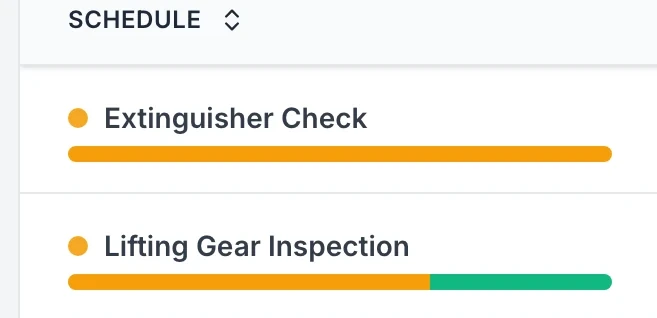
MapTrack maintenance schedules: Extinguisher Check and Lifting Gear Inspection, each with its status bar.
QR labelExample: inspection due on the record
Inspections
MapTrack maintenance schedules: Extinguisher Check and Lifting Gear Inspection, each with its status bar.
QR labelExample: inspection due on the record
Inspections
MapTrack maintenance schedules: Extinguisher Check and Lifting Gear Inspection, each with its status bar.
QR labelExample: inspection due on the record

Published customer results

Days to hours

End-of-shutdown reconciliation reduced from days to hours

Mineral Resources, Mining
Read the Mineral Resources story

Estimated 70–80%

Automated scheduling and alerts for safety inspections, certifications and regulatory requirements reduced overdue compliance items by an estimated 70–80% within the first year.

Mineral Resources, Mining & Resources
Read the Mineral Resources story

Roughly 80%

Overdue service items dropped by roughly 80% within the first six months as automated scheduling and alerts replaced manual spreadsheet tracking.

RIX Specialist Contracting, Construction
Read the RIX Specialist Contracting story

Asset tracking software for industrial maintenance helps plant and reliability teams run a single asset register with QR codes, scheduled preventive maintenance and work orders. MapTrack combines QR scanning and OEM telematics with offline mobile access for plant-floor and shutdown work, engine-hour service triggers and lifting and safety inspection records. Maintenance teams use it to move work from reactive to planned, cut unplanned downtime, and keep AS/NZS 4801, ISO 45001 and AS 2550 evidence against each asset rather than the plant as a whole. The US Department of Energy’s O&M Best Practices Guide reports that more than 55% of an average facility’s maintenance is still reactive, and CMMS users in an A.T. Kearney and IndustryWeek survey of 558 companies (1994) reported 20.1% less equipment downtime.

Key takeaways

  • The US Department of Energy’s O&M Best Practices Guide puts the savings opportunity of a functioning predictive maintenance programme at 30% to 40% against a reactive-heavy operation.
  • The US Department of Energy’s O&M Best Practices Guide reports that more than 55% of an average facility’s maintenance is still reactive; its top-performing facilities keep reactive work under 10%.
  • Asset registers with QR codes plus scheduled PMs cut unplanned downtime; in a 1994 A.T. Kearney and IndustryWeek survey of 558 CMMS users, republished by the US Department of Energy, companies reported 20.1% less equipment downtime.
  • Mobile and offline access is essential for plant-floor and remote shutdown work where cellular coverage is patchy.
  • AS/NZS 4801 and ISO 45001 cover safety inspections; AS 2550 covers crane and lifting equipment compliance.
  • OEM telematics feeds turn engine-hour readings into automated work orders, replacing calendar-based servicing guesswork.

Pricing

One price per machine, with the hardware included: software and a QR tag from $12 a machine a month, GPS tracking from $27 and AI cameras from $72. Tools and equipment start at $1/asset/month. Every plan includes unlimited users. Prices are AUD ex GST, and machine prices are for annual billing.

View pricingGet a tailored quote

Jarrod Milford

Jarrod Milford

Co-Founder & Commercial Director

Published 15 February 2026Updated 26 October 2026

Industrial maintenance software for shutdown and turnaround crews

Industrial maintenance crews need the tools, lifting gear and instruments where the work is, in date, and back at the end of the job. In MapTrack each chain hoist, torque wrench, gas detector and tooling container gets a QR label and its own record. Scan items out to the person taking them with a due-back time. Lifting gear sits on an inspection schedule and instruments on a calibration schedule, and overdue gear is flagged at sign-out. Audit the container by scan before it goes to site and again when it's back, and service plant on its run hours.

Industrial Maintenance

MapTrack at a glance

Built for
Maintenance and shutdown crews who need tools, lifting gear and instruments where the work is, and in date.
Tracks
Welders and cutting gear, chain hoists, lifting beams and rigging, torque wrenches and air tools, calibrated instruments and gas detectors, power leads, overhead and gantry cranes, forklifts, gensets, tooling containers and trailers, utes.
Tracked with
QR labels, Bluetooth tags, battery GPS trackers, hardwired GPS trackers or AI dashcams with built-in GPS.
Works offline
Pre starts, inspections and other forms save with no reception and sync when the phone is back in range. A work order already loaded on the phone can be worked through with no reception too.
Phones and computers
In the browser on a computer, and Android, iPhone and iPad access through the mobile browser or the installable web app.
Connects to
Telematics and accounting integrations, a public API, and an MCP server for AI tools such as Claude.
Sign-in
Sign in with Microsoft, or SAML 2.0 single sign-on set up by our team (Enterprise, or a Pro add-on).
Set-up and support
24/7 support. Our team sets up single sign-on and OEM telematics feeds, and helps connect trackers you already run.
Track record
600,000+ assets tracked since 2012.

How to choose industrial maintenance software

Look for:

  1. Tools scanned out to a person with a due-back time, and back in each shift
  2. Lifting gear on an inspection schedule and instruments on a calibration schedule
  3. Overdue gear flagged at sign-out
  4. Tooling containers audited by scan before they go to site and when they're back
  5. Pre starts on the phone, and plant serviced on its run hours

Where MapTrack fits

Next to an EAM or ERP

If fixed plant, work planning and finance sit in an EAM or ERP, MapTrack can run beside it for the tools, equipment and vehicles that move between sites and crews. Its public API passes records between the two.

Next to telematics

A telematics platform tracks where vehicles go. MapTrack puts each vehicle and machine on the same register as the tools, with its pre starts and services. A GPS tracker or AI dashcam puts its latest position on the record, with estimated km and hours feeding its services, and MapTrack Telematics adds GPS tracking with trips, history and geofences.

See what MapTrack costs for your industrial maintenance assets

Per-asset pricing tailored to your industrial maintenance asset mix and a rollout plan, within one business day.

Trusted by maintenance and shutdown crews, including Mineral Resources

Mineral ResourcesSaunders InternationalSupagasHacer GroupMetro TunnelUltrabuilt
G2 rating 4.9 out of 5
Capterra rating 5.0 out of 5GetApp rating 5.0 out of 5Software Advice rating 5.0 out of 5
15 reviews on G2 · the same 17 reviews on Capterra, GetApp and Software AdviceCapterra Best Value 2026 badgeCapterra Best Ease of Use 2026 badgeAll MapTrack reviews

Define the service level and the parts it needs

Workshop teams can put minor, intermediate and major services into one ordered plan, with a complete procedure and parts list for each level.

  1. 1. Prepare the whole job

    Include the full work required at each level. Higher-level services do not automatically combine the lower-level procedures and parts.

  2. 2. Reconcile the completed work

    Review planned parts, actual use and the retained service record. Return unused issued parts through the inventory workflow.

What we track

Every asset type in your maintenance operation

MapTrack is built for the full mix of assets that move across your workshops, shutdown sites, staging areas and industrial facilities, from hand tools to heavy mobile plant.

  • Tooling & specialised tools
  • Mobile plant & machinery
  • Lifting & rigging equipment
  • Welding & cutting equipment
  • Inspection & test equipment
  • Vehicles & light fleet
  • Generators & power equipment
  • Safety & compliance gear
  • Spare parts & consumables
  • Calibration equipment
  • Scaffolding & access equipment
  • Shutdown-specific equipment
  • Welding rods & other consumables
  • Workshop stands

What you run, and how MapTrack tracks it

Welders, welding helmets and cutting gear
QR label
Chain hoists, chain blocks, lifting beams and rigging
QR label
Torque wrenches, impact wrenches, air tools and hydraulic tooling
QR label
Calibrated instruments and gas detectors
QR label and Bluetooth tag
Power tools and hand tool kits
QR label
Power leads and distribution boxes
QR label
Overhead and gantry cranes
QR label
Forklifts
QR label and hardwired GPS tracker
Gensets, tooling containers and trailers
QR label and battery GPS tracker
Light vehicles and utes
Hardwired GPS tracker or AI dashcam
Welding rods and other consumables
QR label
Workshop stands
QR label

Running a mix like this? See how MapTrack handles it in a demo built around industrial maintenance teams.

Book a demo

30 minutes on Microsoft Teams

The challenge

The costs of poorly managed industrial maintenance assets

Industrial maintenance assets don't sit still. They move between workshops, shutdown sites and staging areas, wear out based on hours not dates, require documented compliance registers for lifting and rigging gear, and their absence can blow out an entire shutdown schedule.

Tooling disappears between shutdowns and workshops

Specialty tooling gets mobilised to a shutdown, borrowed by another crew or left in a laydown area. Without a clear chain of custody you write off the loss and re-purchase. Every shutdown cycle.

Compliance registers for lifting and rigging gear

Slings, shackles, chain blocks and cranes need current inspection certificates, load test records and SWL ratings attached and producible on demand. Paper registers get lost; spreadsheets don't attach evidence or alert on expiry.

Maintenance driven by usage. Not the calendar

Generators, EWPs, compressors and mobile plant need servicing based on engine hours and runtime. Not arbitrary monthly reminders. Missing service intervals leads to breakdowns mid-shutdown that blow out the schedule.

Multi-site shutdown operations need real-time visibility

Assets spread across multiple shutdown sites, workshops and staging areas with no single view. Each project runs its own spreadsheet. Planners can't see what's available, what's committed and what's overdue without manual consolidation.

Disconnected CMMS doesn't track asset location

Your existing CMMS handles work orders but doesn't tell you where an asset physically is, who has it or whether it's been checked out to a specific shutdown. You end up running a parallel spreadsheet just for accountability.

From MapTrack's own data

What we see across MapTrack customer accounts

These figures come from MapTrack's own product data, de-identified and aggregated. Accounts aren't grouped by industry, so each figure covers every qualifying customer account, not one industry alone. Every figure counts at least 20 accounts, and each one says how it was measured.

15%

Scheduled services past their due date

Across 32 MapTrack customer accounts with service schedules, 15% of scheduled services were past their due date on 26 October 2026. More than three quarters of those (78%) were over 30 days past due.

Method: MapTrack's own product data: 32 customer accounts with service schedules, 5,855 scheduled services (884 past due), snapshot at 26 October 2026. Demo, test and trial-build accounts are left out. Includes schedules MapTrack set up during onboarding; the servicing itself is the customer's. One account holds 53% of the past-due services; without it the share is 16%. Some past-due items may be assets no longer in use that were never archived.
More than 80 days

How late a missed service runs

Across 32 MapTrack customer accounts, a service that was past due on 26 October 2026 was typically more than 80 days overdue.

Method: MapTrack's own product data: 32 customer accounts, 884 past-due services, snapshot at 26 October 2026. Demo, test and trial-build accounts are left out. Includes schedules MapTrack set up during onboarding; the servicing itself is the customer's. Typical means the median: 105 days across all past-due services and 82 days with the largest account left out, so the lower figure is used.

51%

Services driven by hours and kilometres

Across 39 MapTrack customer accounts with service schedules, half of all service triggers (51%) run off engine hours or kilometres rather than the calendar.

Method: MapTrack's own product data: 39 customer accounts with service schedules, 289 service triggers (148 meter based: 118 hours, 30 km), schedules live on 26 October 2026. Demo, test and trial-build accounts and anything MapTrack staff created are left out. Counts trigger rules on live schedules, not services carried out, so the record count is small.

99%

Meter readings typed in by hand

Across 25 MapTrack customer accounts that log hour or kilometre readings, 99% of meter readings in MapTrack were entered by hand, and nearly half of meters (47%) had gone more than 30 days without a new reading on 26 October 2026.

Method: MapTrack's own product data: 25 customer accounts, 43 meters, 24,491 readings, all readings to 26 October 2026. Demo, test and trial-build accounts and anything MapTrack staff created are left out. Counts the readings stored in the MapTrack app only; trips and run hours shown through MapTrack Telematics may not appear here. Only 43 meters, so the 47% is thin, and a quiet meter can be a parked machine.

Want to know what these costs look like on your own sites? Talk it through with us.

Book a demo

30 minutes on Microsoft Teams

Use cases

How maintenance teams use MapTrack

Scan tools out and back in each shift

Scan each tool, chain hoist and torque wrench out to the person taking it, with when it's due back. Anything not back on time is flagged overdue against their name.

Tool tracking
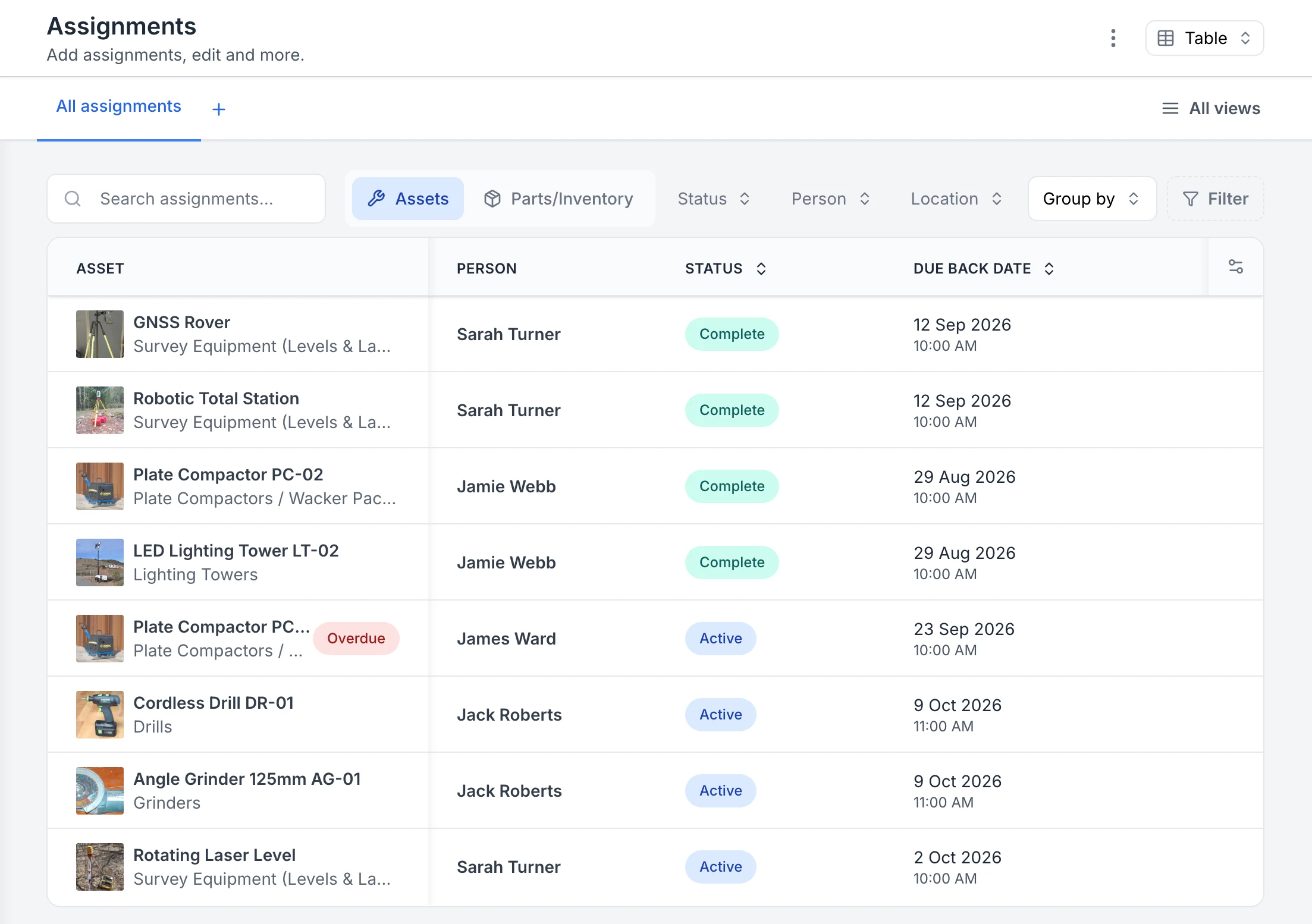
MapTrack Assignments table listing eight tool and equipment assignments, a GNSS rover, robotic total station, two plate compactors, a lighting tower, a cordless drill, an angle grinder and a rotating laser level, each with its photo, the person it went to, a Complete or Active status and a due-back date. One plate compactor is flagged Overdue.

See who has each tool and when it is due back

Every sign-out in one list. Four assignments are back and marked Complete; four are still out as Active, each with the person and the due-back date. The plate compactor with James Ward was due back on 23 September, so it is flagged Overdue.

MapTrack app · Demonstration data · Captured

About this screenshot

Captured in a demonstration workspace on the All assignments view with the Person, Status and Due Back Date columns. The app shortens long asset and category names.

Lifting gear in date, instruments in cal

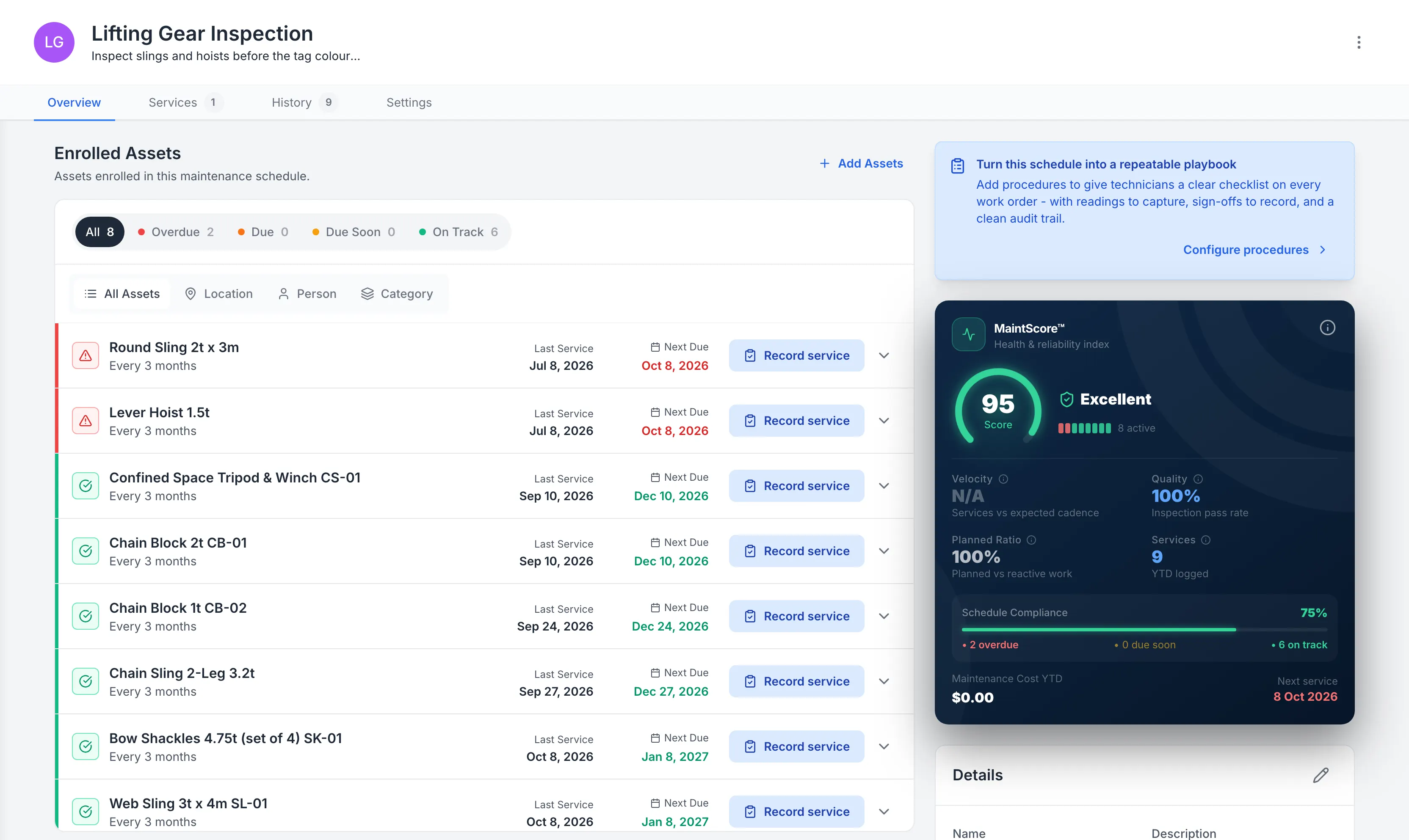
Chain hoists and other lifting gear sit on an inspection schedule, and instruments and gas detectors on a calibration schedule, each with its compliance rate. Anything overdue is flagged when someone goes to sign it out.

Compliance
The Lifting Gear Inspection schedule, every 3 months, with 8 enrolled assets: Round Sling and Lever Hoist overdue since 8 Oct 2026, and the confined space tripod, two chain blocks, a chain sling, bow shackles and a web sling on track with next due dates from Dec 2026 to Jan 2027, beside a MaintScore of 95.

Lifting gear on one inspection schedule

Every hoist, sling and shackle on one inspection schedule, with the overdue ones at the top.

MapTrack app · Demonstration data · Captured

About this screenshot

Demonstration schedule with backdated inspection history.

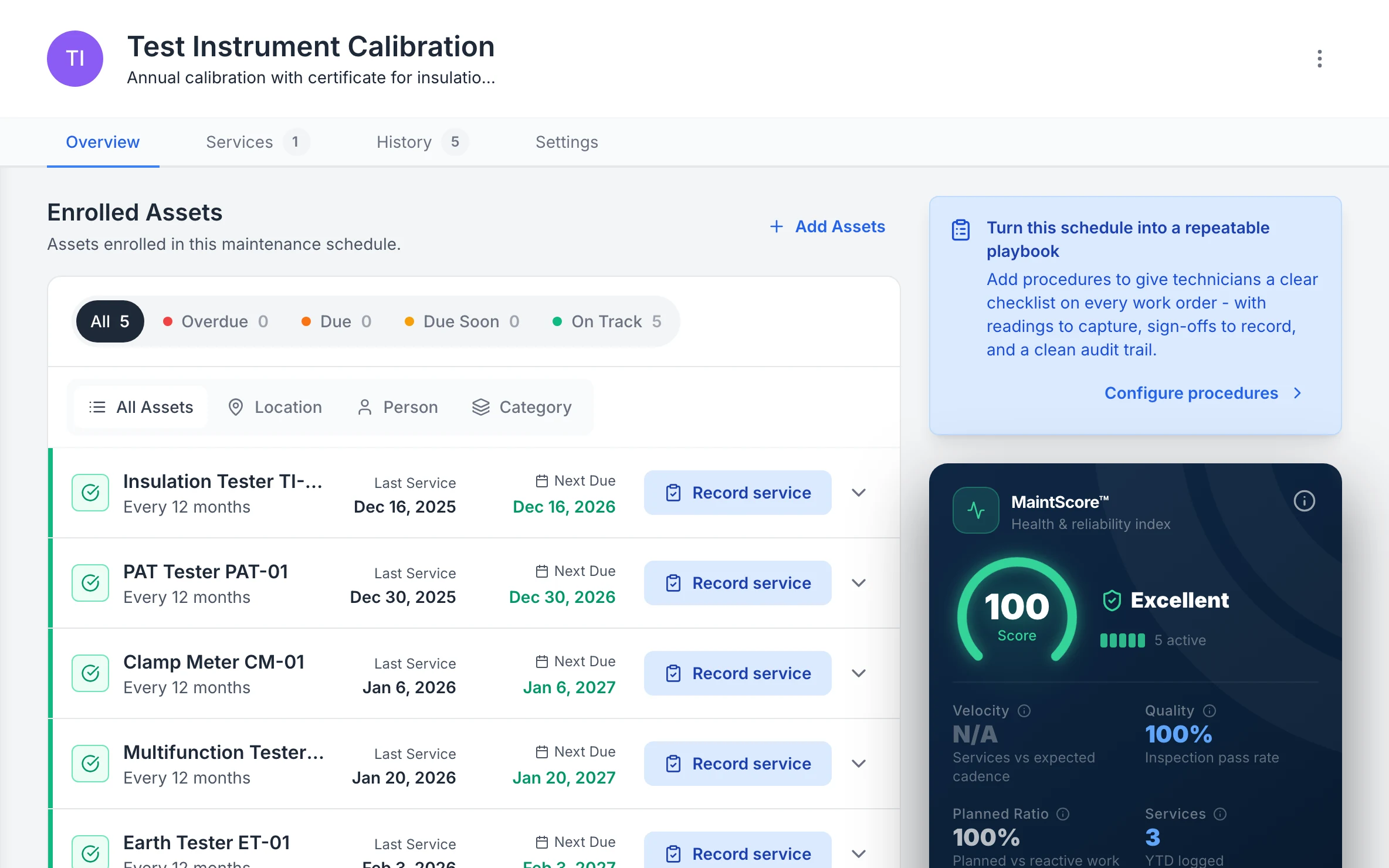
MapTrack Test Instrument Calibration schedule, annual calibration with a certificate: five enrolled testers, all on track, among them PAT tester PAT-01, clamp meter CM-01 and earth tester ET-01, each with its last calibration and next due date, beside a MaintScore of 100, Excellent.

Every tester’s next calibration

Each test instrument with its last calibration and when the next is due, on a yearly calibration schedule.

MapTrack app · Demonstration data · Captured

About this screenshot

Demonstration workspace at a 1440 x 900 desktop viewport, cropped right of the navigation sidebar to a 16:10 frame.

Not sure which of these to start with? We'll walk you through it in a demo.

Book a demo

30 minutes on Microsoft Teams

Check the tooling container out and back

Scan what's in the container against what should be there before it goes to the shutdown, and again when it's back. You see what turned up extra and what's still to find, then choose whether the rest is marked missing.

Audits
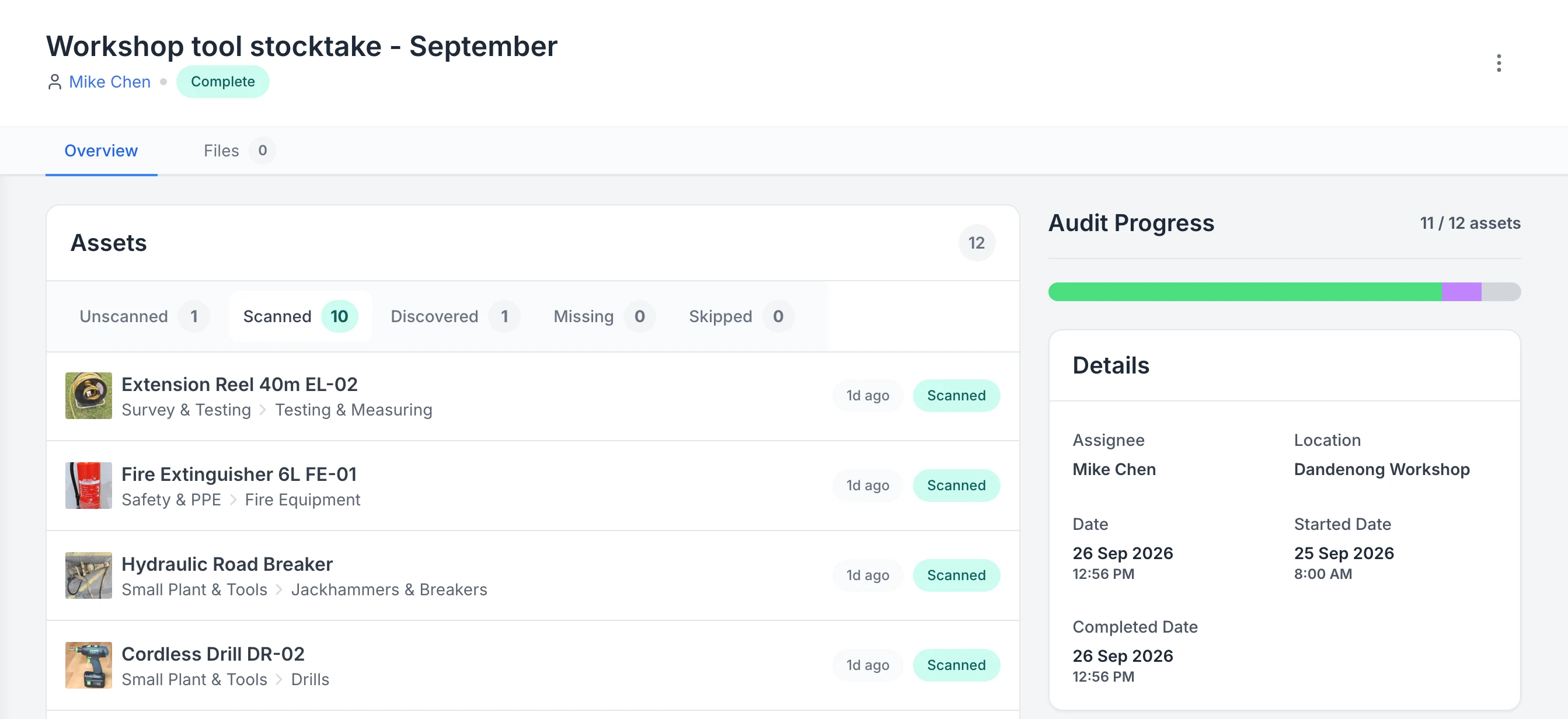
MapTrack audit Workshop tool stocktake - September, assigned to Mike Chen and marked Complete. Tabs show 1 unscanned, 10 scanned, 1 discovered, 0 missing and 0 skipped; the scanned list starts with an extension reel, a fire extinguisher, a hydraulic road breaker and a cordless drill; the progress bar reads 11 of 12 assets.

See what a stocktake scanned, discovered and missed

A completed workshop stocktake. Ten listed assets were scanned and one asset that was not on the list was discovered, so progress reads 11 of 12. One asset is still unscanned and none are marked missing.

MapTrack app · Demonstration data · Captured

About this screenshot

Captured in a demonstration workspace on the audit’s Overview tab with the Scanned tab open; its activity log continues below the crop.

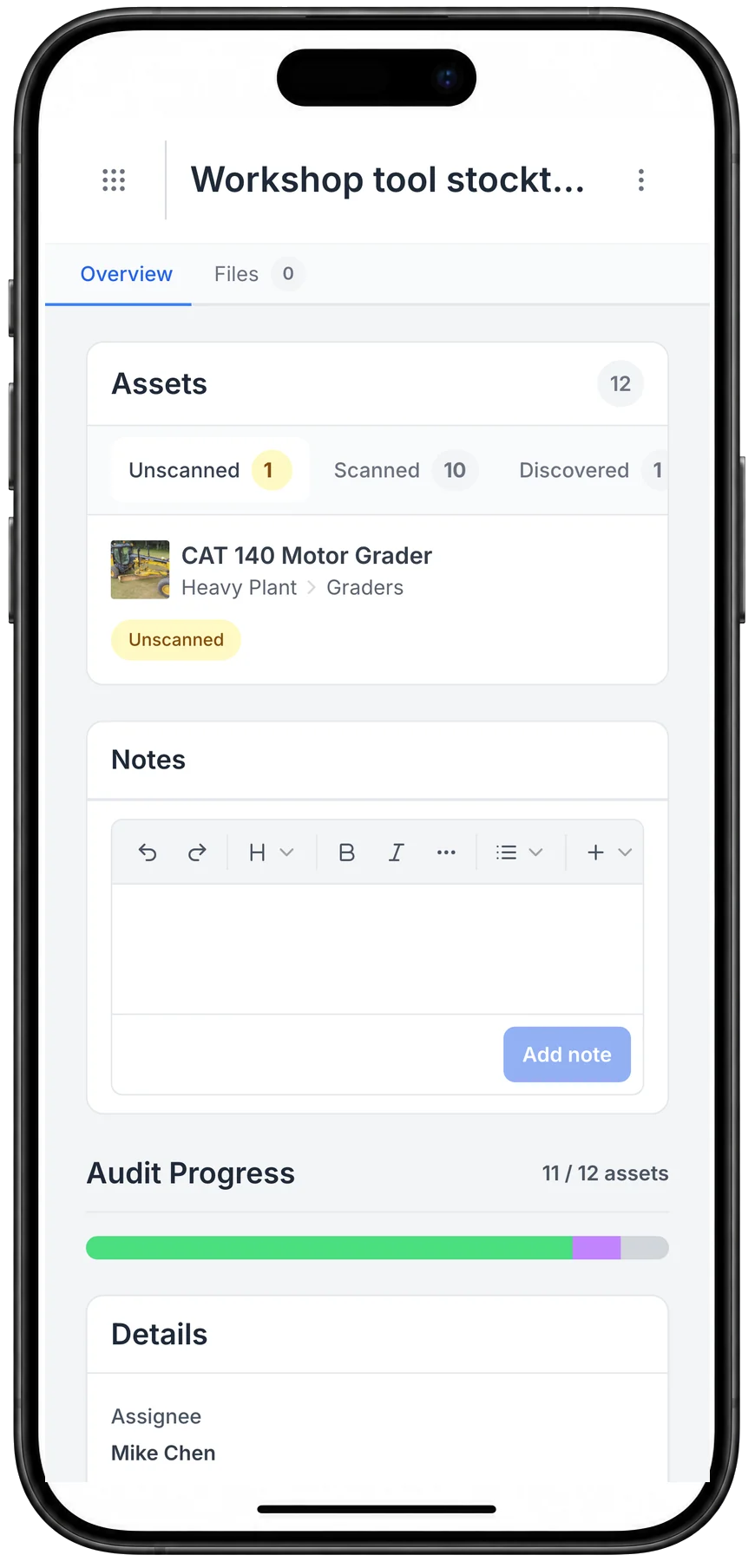
A MapTrack workshop tool stocktake on a phone: 12 assets, with 10 scanned, 1 discovered and 1 still unscanned, a CAT 140 motor grader, and audit progress at 11 of 12 assets, assigned to Mike Chen.

A stocktake on the phone

A stocktake on the phone: what has been scanned, what turned up that was not on the list, and what is still to find.

MapTrack app · Demonstration data · Captured

About this screenshot

Captured at a 430 x 932 phone viewport in a demonstration workspace and shown in a phone frame.

Pre-starts on the phone, not copies of copies

Operators scan the crane, forklift or genset and do the pre-start on their phone, even with no signal. A fail opens the fault note and photo, and a form rule can send the repair job to the workshop.

Pre-start inspections
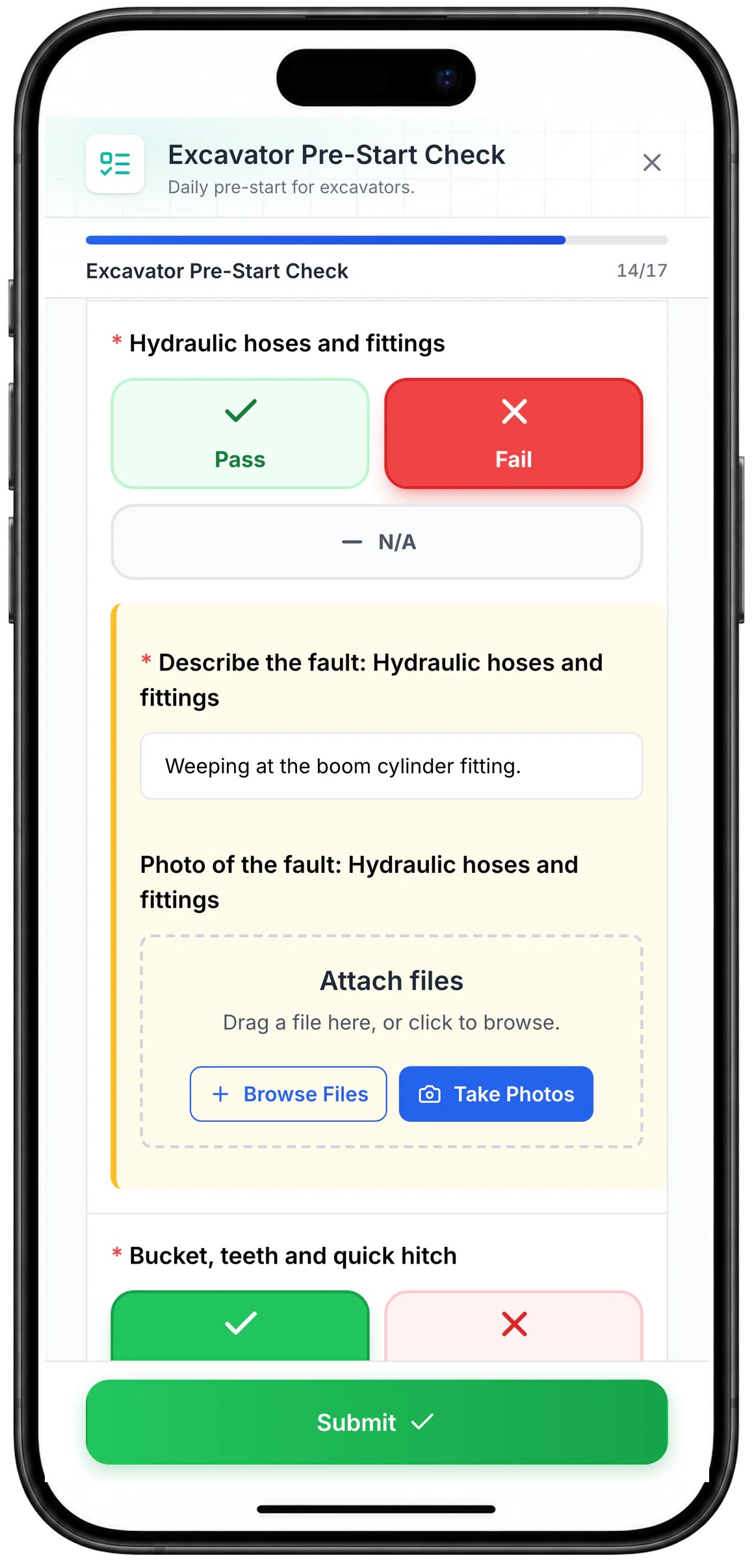
MapTrack Excavator Pre-Start Check on a phone: Fail selected for hydraulic hoses and fittings, the fault description and photo fields open below it, Pass selected on the next check, and the Submit button.

Tap Pass, Fail or N/A on a phone

A Pass, Fail or N/A question shows as large coloured buttons. Choosing Fail on the hydraulic hoses opens the fault description and photo fields.

MapTrack app · Demonstration data · Captured

About this screenshot

Captured at a 430 x 932 phone viewport in a demonstration workspace and shown in a phone frame. Questions render as buttons when their choices are a Pass/Fail-style set.

Seen one that fits how your team works? We'll show it to you in a demo.

Book a demo

30 minutes on Microsoft Teams

Customer proof

What customers say

We haven't published an industrial maintenance customer story. These are customers doing the same work in other industries, each labelled with their own industry.

Mine shutdown crew

“MapTrack streamlines tracking and asset servicing across mine shutdowns - simple, reliable, and effective.”

Gordon Stennings, Maintenance Storeman, Mineral Resources
  • From the published story: The end-of-shutdown reconciliation - previously a multi-day exercise - is now completed in hours.
Read the Mineral Resources story

“Very easy to learn and use across the team. Scanning and assigning assets takes seconds, and the custom forms help us make it fit our process.”

Shannon, General Manager, Machinery, 51-200 employeesVerified review on Capterra, August 2025

“For tooling, it's made a big difference in reducing loss and improving accountability, and it was straightforward to implement without needing much setup. ... Helps us stay in control of our tools and supports the compliance side by sending reminders and email alerts, making it easy to stay on top of inspections and servicing.”

Tony, Maintenance Planner, Mining & Metals, Mid-Market (51-1000 emp.)Verified review on G2, July 2025

Want to hear how other industrial maintenance teams set MapTrack up? Ask us in a demo.

Book a demo

30 minutes on Microsoft Teams

By the numbers

The real cost of unplanned downtime in industrial operations

Unplanned downtime, reactive maintenance and missed preventive schedules are among the biggest cost drivers in industrial operations. The numbers make a clear case for digital asset tracking and CMMS adoption.

30 to 40%

savings a functioning predictive maintenance program can open up against a reactive-heavy operation, which the guide says may be exceeded

US Department of Energy, O&M Best Practices Guide, Release 3.0 (2010), p. 5.4

35% → 55%

wrench time before and after proper planning and scheduling; the rest of the day is spent waiting, travelling and looking for parts

Doc Palmer, Plant Services, 4 March 2019

12 to 18%

lower maintenance costs from a preventive program than from running equipment to failure

US Department of Energy, O&M Best Practices Guide, Release 3.0 (2010), p. 5.3

Want to see how these fit together on your own sites? We'll show you in a demo.

Book a demo

30 minutes on Microsoft Teams

Compliance

Pre-starts and lifting gear registers, field-ready on mobile

Build and run pre-start forms for any plant or equipment directly on mobile. Riggers and fitters scan a QR code, complete the inspection in the field or workshop with photos , and results attach to the asset record with a timestamp. Lifting and rigging gear registers stay current with certificates and expiry dates attached.

  • Works offline and syncs when back on signal
  • Failed items automatically trigger work orders
  • Lifting gear certificates and SWL ratings attached
  • Full compliance history on each asset for audits
  • Build forms with AI or upload your existing forms

Accountability

Scan, assign and track from the shutdown site

QR code any tool, attach a GPS device to mobile plant, or pull in OEM telematics data. Assign assets to crews (through a crew member or crew vehicle), shutdowns (as shutdown laydown areas), workshops or staging areas. Know who has what, where it is and when it's due back with a clear chain of custody through every phase of the shutdown.

  • Check-in and check-out on mobile or tablet
  • Bulk scanning for shutdown audits and stocktakes
  • Assign to crews (through a crew member) or contractors with scoped access
  • GPS location for plant and fleet where fitted
  • Geofence alerts when assets leave a site boundary
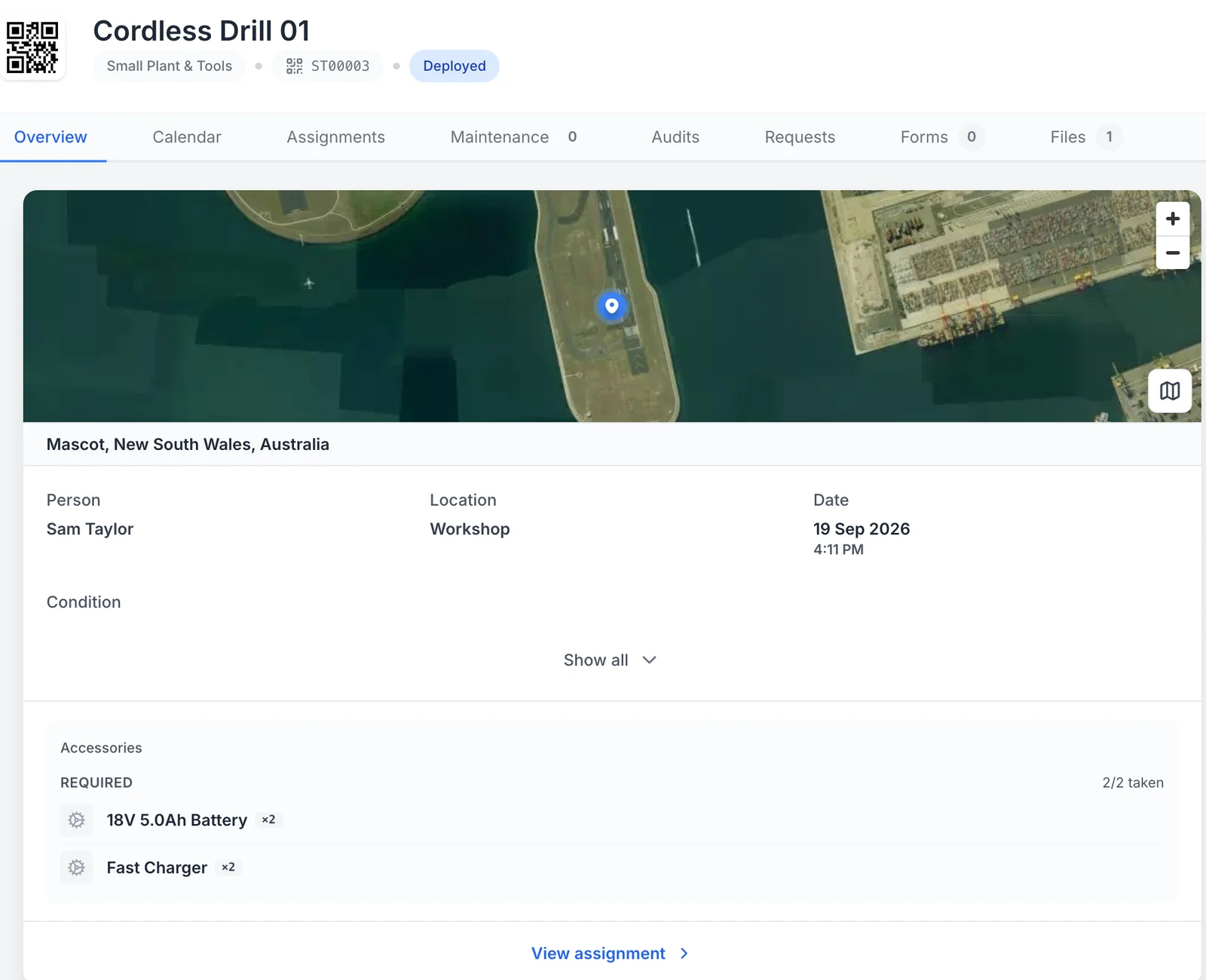
MapTrack record for Cordless Drill 01, tag ST00003, Deployed: a satellite map pinned at Mascot, New South Wales, the person Sam Taylor, the location Workshop, the date 19 Sep 2026 at 4:11 PM, and its required accessories, two 18V 5.0Ah batteries and two fast chargers, 2 of 2 taken.

Who has it, and where it was checked out

While the drill is out, its record shows who has it, where it was checked out on the map and the accessories that went with it.

MapTrack app · Demonstration data · Captured

About this screenshot

Demonstration workspace at a desktop viewport, on the asset’s Overview tab, cropped to its header, map, assignment and accessories.

See these on a phone and a desktop in a live demo.

Book a demo

30 minutes on Microsoft Teams

Maintenance

Service plant when the hours say so. Not the calendar

Trigger work orders from engine hours, runtime or odometer - not arbitrary calendar reminders. OEM and telematics data feeds in automatically where integrated. Every service record lives alongside the asset's tracking and compliance history so your workshop and shutdown teams have the full picture.

  • Meter-based triggers: hours, ODO, runtime
  • OEM telematics data feeds in automatically
  • Work orders assigned to fitters on mobile
  • Complete parts history and cost tracking
  • Overdue alerts to keep maintenance current

Integrations

Plant data straight from the machine

MapTrack integrates with OEM telematics platforms across major equipment brands, so engine hours, odometer and GPS location drive maintenance and utilisation automatically for your mobile plant, generators and EWPs, without manual data entry.

Caterpillar
Komatsu
Hitachi
Teletrac Navman
Geotab
HCSS
  • Engine hour and ODO tracking for timely preventive maintenance
  • Live GPS location and geofence alerts for plant across your sites
  • Fault and diagnostic data where supported by your integration
  • Geofence-based utilisation and time-on-site for shutdown job costing

See all integrations

What we track

Built for shutdown sites, mobile and offline

MapTrack is built for the full mix of assets that move across your workshops, shutdown sites, staging areas and industrial facilities, from hand tools to heavy mobile plant.

Build and run pre-start forms for any plant or equipment directly on mobile. Riggers and fitters scan a QR code, complete the inspection in the field or workshop with photos , and results attach to the asset record with a timestamp. Lifting and rigging gear registers stay current with certificates and expiry dates attached.

iOS & Android

No specialist hardware required

Offline sync

Works inside plants

QR scan

Any standard phone camera

Unlimited users

No per-seat charges

Full asset control across shutdowns and turnarounds

Track tooling, plant and lifting gear from mobilisation to demob. Pre-starts, compliance registers and maintenance scheduling built in.

  • Used across Australia & New Zealand
  • Per-asset pricing
  • Unlimited users

Get started

How industrial maintenance teams get started

Most industrial maintenance teams are up and running within days. Import your equipment register, tag assets, and connect maintenance schedules from day one.

Step 1

Import your equipment and tooling register

Upload your existing CMMS data or start fresh. Add CNC machines, conveyors, hydraulic presses, calibrated tooling, and safety equipment.

Step 2

Tag assets and link to maintenance schedules

Print industrial-grade QR labels and attach to equipment. Connect each asset to its service history and preventive maintenance triggers.

Step 3

Manage work orders and track downtime events

Log breakdowns, schedule PMs, assign technicians to jobs, and generate reliability reports for production management.

The maintenance and inspection records plant rules ask for

Maintenance teams in Australia, the United States and the United Kingdom answer to different rules, but the records they ask for look alike: what was checked, when, by whom, and what's due next. Open a market to see its rules, the words buyers there search for, and how pricing is quoted.

Australia

WHS Regulation s 213

Prices on our pricing page are in Australian dollars, ex GST.

  • Australia, in Queensland's text of the model WHS Regulations (each state and territory enacts its own version)

    Work Health and Safety Regulation 2011, section 213, maintenance and inspection of plant

    What it asks for

    The person with management or control of plant at a workplace makes sure its maintenance, inspection and, if needed, testing is done by a competent person, following the manufacturer's recommendations. Where there are none, a competent person's recommendations apply, and where neither is reasonably practicable, the plant is inspected annually.

    How MapTrack keeps the record

    Each machine's services are scheduled at the maker's interval, by date or by run hours from meter readings, and inspections are signed forms on the machine's record.

    Source: Work Health and Safety Regulation 2011 (Queensland) (Queensland Government (Queensland Legislation), checked 26 Oct 2026)

United States

OSHA 1910.147(c)(6), OSHA 1910.178(q)(7)

Pricing is quoted in your currency, US dollars.

  • United States, general industry

    OSHA 29 CFR 1910.147(c)(6), lockout/tagout periodic inspection

    What it asks for

    Each energy control procedure is inspected at least annually by an authorised employee other than the ones using it, to check the procedure is being followed and correct anything that isn't. The employer certifies each inspection, naming the machine or equipment, the date, the employees included and the person who did it.

    How MapTrack keeps the record

    The annual inspection of each procedure is a form on the machine's record, naming the employees included and signed by the inspector, with the next one showing as due soon or overdue.

    Source: 29 CFR 1910.147, The control of hazardous energy (lockout/tagout) (US Occupational Safety and Health Administration, checked 26 Oct 2026)

  • United States, forklifts and other powered industrial trucks

    OSHA 29 CFR 1910.178(q)(7) and (l), powered industrial trucks

    What it asks for

    Each truck is examined before it's placed in service, at least daily (after each shift where trucks run around the clock), and one with a condition affecting safety stays out of service. Defects are reported and corrected straight away. Each operator's performance is evaluated at least every three years, and the employer certifies training and evaluation with the operator's name and the dates.

    How MapTrack keeps the record

    The daily check is a pre start on the operator's phone, and a failed check can raise the workshop job through a rule you set. Each operator's training and evaluation is a VOC form signed off on their person record.

    Source: 29 CFR 1910.178, Powered industrial trucks (US Occupational Safety and Health Administration, checked 26 Oct 2026)

LOTO
Lockout/tagout: isolating a machine's energy sources and locking or tagging them out before servicing, under OSHA 29 CFR 1910.147, with each procedure inspected at least annually.

United Kingdom

PUWER regulation 5, PSSR regulation 9

Pricing is quoted in your currency, pounds sterling.

  • Great Britain, all work equipment

    PUWER 1998, regulation 5, maintenance

    What it asks for

    Work equipment is kept in an efficient state, in efficient working order and in good repair, and where a machine has a maintenance log, the log is kept up to date.

    How MapTrack keeps the record

    Each machine's services and repairs sit on its record as work orders, with labour, parts and external costs, so its maintenance log is up to date.

    Source: Provision and Use of Work Equipment Regulations 1998 (PUWER), regulation 5 (legislation.gov.uk (The National Archives), checked 26 Oct 2026)

  • Great Britain, installed and mobile pressure systems

    Pressure Systems Safety Regulations 2000, regulation 9, examination under the written scheme

    What it asks for

    The parts in the written scheme are examined by a competent person within its intervals. The examiner's signed, dated report says what was examined, its condition, any repairs needed and by when, and the date after which the system may not be operated without another examination, and the system isn't run past that date until it has been examined again.

    How MapTrack keeps the record

    Each receiver, vessel and relief valve in the scheme is its own record. The examination is a service with the report attached, and the next examination date shows as due soon or overdue.

    Source: Pressure Systems Safety Regulations 2000 (PSSR), regulation 9 (legislation.gov.uk (The National Archives), checked 26 Oct 2026)

Written scheme of examination
The document PSSR asks for before a pressure system runs, drawn up or certified by a competent person, naming the parts to examine and how often.

MapTrack keeps the records these rules ask you to keep. It does not do the inspection or testing, certify your work or make you compliant, and the current text of each instrument is the authority.

Want to see how these records would look for your own gear? We'll show you in a demo.

Book a demo

30 minutes on Microsoft Teams

Stop the loss

Equipment loss and compliance gaps are the two biggest controllable risks in industrial maintenance

MapTrack gives your shutdown and workshop teams the visibility, accountability and compliance registers to close both without adding headcount or replacing your existing systems.

Frequently asked questions

Common questions from industrial maintenance teams.

Industrial maintenance asset management software is a platform that helps maintenance contractors, shutdown teams and turnaround planners track, manage and maintain tooling, mobile plant, lifting gear and equipment across workshops, shutdown sites and industrial facilities. It replaces spreadsheets, paper compliance registers and disconnected CMMS tools with a single source of truth for where assets are, who has them, what their compliance status is and when they're due for service. MapTrack combines asset tracking (QR codes, barcodes, GPS and OEM telematics), pre-start and inspection forms, maintenance scheduling and work orders, and reporting, all on mobile in the field.

MapTrack supports the full shutdown lifecycle, from mobilisation through execution to demobilisation. Allocate tooling, lifting gear, welding equipment and mobile plant to a specific shutdown or turnaround project (as the shutdown site). Check assets in and out by crew, run bulk audits to verify what's on site, and track handover and acceptance at each phase. Assignments and transfers are recorded with timestamps so accountability is always clear, even when thousands of assets move between workshops and shutdown sites over a compressed timeframe.

Yes. MapTrack is built for compliance-heavy asset classes like lifting and rigging equipment. Attach inspection certificates, load test results, SWL ratings and expiry dates to each sling, shackle, chain block or crane. Set up recurring inspection schedules so you're alerted before certificates expire. Pre-use inspection forms can be completed on mobile in the field with photo evidence, and results attach directly to the asset record. Failed inspections automatically trigger work orders or quarantine the asset until rectified.

MapTrack has an open API and integrates with a wide range of existing CMMS and ERP platforms. For many industrial maintenance teams, MapTrack replaces the asset tracking and field compliance gap that traditional CMMS tools leave - particularly around mobile accountability, QR-based check-in/out, offline pre-starts and shutdown-specific workflows. You can run MapTrack alongside your existing CMMS or use it as your single platform for tracking, compliance and maintenance.

Yes. MapTrack integrates with OEM telematics platforms across major equipment brands, including Caterpillar, Komatsu, Hitachi, Teletrac Navman, Geotab and HCSS. Engine hours, odometer readings, GPS location and fault codes feed directly into MapTrack, driving maintenance triggers and utilisation visibility without manual data entry. This means your EWPs, cranes, generators and mobile plant get serviced based on real usage, not guesswork.

MapTrack is built for field use with offline support. Maintenance crews can scan assets, complete pre-start forms, update work orders and record meter readings in areas with no connectivity, such as inside processing plants, confined spaces or remote shutdown sites. Data syncs automatically when the device comes back online. This is critical for industrial maintenance where work happens in environments that cellular coverage doesn't reach.

Yes. Use bulk scanning (QR or barcode) to verify what's arrived on site during mobilisation and what's being returned during demobilisation. MapTrack records each asset scanned, when it was scanned and who scanned it. Compare scanned results to the expected shutdown asset list and immediately see what's missing, unscanned or unaccounted for. Reports by shutdown, crew or asset class give you audit-ready evidence. Stocktakes that used to take hours with clipboards now take minutes on mobile.

MapTrack uses per-asset pricing with unlimited users included. Not per-seat licensing. You can give access to every fitter, rigger, supervisor, shutdown planner, workshop tech and admin without your costs growing as the team does. This is a significant advantage in industrial maintenance where crew sizes surge during shutdowns, contractors rotate through projects, and you may need hundreds of people to complete forms or scans. Pricing scales with the number of assets you track, not the size of your team.

Most industrial maintenance teams are running on MapTrack within one to two weeks. The typical approach is to start with one asset class or one workshop: import or scan in assets, set up your first workflows (usually lifting gear registers or pre-starts), and roll out to field crews. MapTrack's onboarding team supports you through setup and training at no additional cost. For larger rollouts across multiple shutdown contracts, a phased approach works well: get adoption solid on one workflow, then expand to more asset types and sites.

Yes. Calibration and test equipment, such as torque wrenches, multimeters, pressure gauges and NDT equipment and can be tracked with calibration due dates, certificate attachments and recurring calibration schedules. MapTrack alerts you before calibration expires so equipment is never used out of certification. The full calibration history is stored against each asset for audit purposes, and expired equipment can be automatically flagged or quarantined until recalibrated.

Preventive maintenance is scheduled based on fixed intervals - calendar dates, engine hours, kilometres or runtime cycles. MapTrack triggers preventive work orders automatically when an asset hits its next interval, so 250-hour services, quarterly inspections and annual recertifications never get missed. Predictive maintenance uses real-time condition data (vibration, temperature, oil samples, telematics fault codes, inspection findings) to service equipment based on its actual condition rather than a schedule. MapTrack supports both. Most industrial maintenance teams start with preventive triggers on engine hours and odometer, then layer in predictive workflows as condition data and integrations mature. Both approaches live against the same asset record, so service history stays in one place.

ISO 55000 (and the certifiable ISO 55001 standard) requires organisations to have a documented, controlled asset management system covering asset information, lifecycle activities, risk, performance and decision-making. MapTrack provides the operational backbone for this: a single asset register with unique identifiers, criticality and class taxonomy, location and ownership data, full lifecycle events (acquisition, transfer, maintenance, disposal), condition monitoring, cost data and compliance evidence. Each asset's history is timestamped and exportable, supporting the documented information, performance evaluation and management review clauses of ISO 55001. MapTrack on its own doesn't certify you against the standard, but it removes the spreadsheet sprawl that blocks most teams from getting there.

Australian industrial maintenance teams typically need to track compliance against several overlapping frameworks: WHS Regulations 2011 plant and structure requirements (registered plant inspections, plant risk assessments, isolation procedures), AS 2550 mobile crane and lifting gear inspections, AS/NZS 3760 electrical test and tag, AS 1418 crane and hoist standards, AS/NZS 1891 height safety and harness inspections, and OEM-specified service intervals on registered plant. Site-specific principal contractor requirements (Tier 1 builders, mining and oil and gas operators) usually add their own competency and pre-start documentation rules. MapTrack lets you build the inspection, certificate and pre-start workflows that prove compliance against each of these, attached to the asset record with timestamps, photos and signatures.

Work orders in MapTrack are created against a specific asset (a generator, EWP, lifting beam, calibrated torque wrench) and carry the priority, due date, assigned crew or fitter, parts required, labour estimate and any safety or isolation requirements. They can be raised manually from the field when a defect is found, triggered automatically when a pre-start fails, or generated from preventive schedules and telematics fault codes. Fitters complete work orders on mobile - capturing parts used, labour hours, photos and a sign-off - and the cost rolls into the asset's total cost of ownership. Reporting filters work orders by status (open, in progress, complete, overdue), shutdown or workshop, priority and asset class so planners can see the backlog at a glance.

MapTrack keeps each asset's services, costs and parts on its own record, whichever site it's at, and each service closes out on a work order with labour, parts and external costs. A 0 to 100 maintenance health score, with 12 months of memory, shows which assets and schedules keep slipping, and stale meter readings are flagged so services don't slip between readings.

Both sides in one place: the tools and gear your crews take out, and the servicing of the plant they work on. That means QR check-out with due-back times, inspection and calibration schedules that flag overdue gear at sign-out, container audits by scan, service plans on run hours with tiered services, and work orders that record labour, parts and costs. MapTrack covers those with per-asset pricing and unlimited users. New to the term? See what a CMMS is.

Got a question we haven't answered here? Ask it in a demo.

Book a demo

30 minutes on Microsoft Teams

Get MapTrack pricing for Industrial Maintenance teams

Tell us about your operations. Our team will share per-asset pricing tailored to your industrial maintenance asset mix and a rollout plan - within one business day.

Per-asset pricing. Unlimited users. Primary database hosted in Sydney.

Industrial maintenance teams start tracking today

Join industrial maintenance teams across Australia using MapTrack to track assets, run digital pre-starts and keep equipment maintained, all in one platform.

Pre · Maintenance · Asset tracking · Mining · Compare

Tools from $1 · Machines from $12View pricing