












Manufacturing

Manufacturing asset management software

Track tools, jigs, calibrated equipment and mobile assets across manufacturing plants, production lines and sites. Accountability, calibration compliance and maintenance in one platform, so you know who has what, what's due and what's production-ready.

From $1 a tool and $12 a machine a month, AUD ex GST. Unlimited users.

600,000+ assets tracked since 2012 · Unlimited users, per-asset pricing · Offline-ready, works on the floor

A machine shop floor with CNC tool grinders and a tool cart, with one grinder ringed, its QR label marked and a MapTrack maintenance health panel laid beside it.
Maintenance health
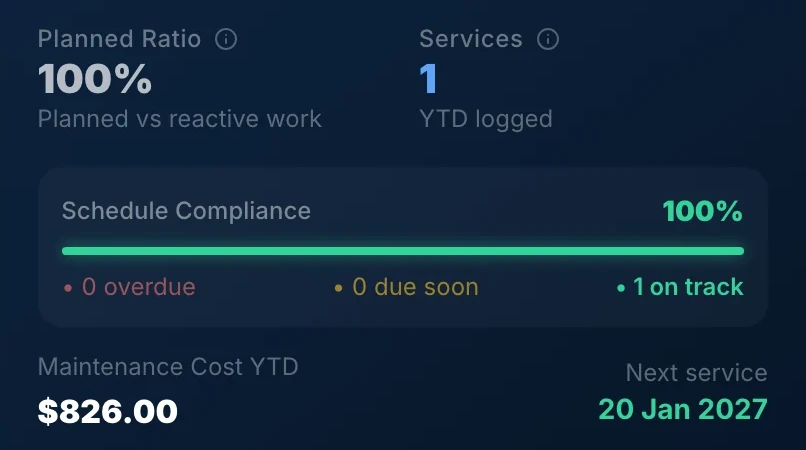
MapTrack maintenance health: planned versus reactive work, services logged this year, schedule compliance, maintenance cost this year and the next service.
QR labelExample: scan for its service history
Maintenance health
MapTrack maintenance health: planned versus reactive work, services logged this year, schedule compliance, maintenance cost this year and the next service.
QR labelExample: scan for its service history

Published customer results

Roughly 80%

Overdue service items dropped by roughly 80% within the first six months as automated scheduling and alerts replaced manual spreadsheet tracking.

RIX Specialist Contracting, Construction
Read the RIX Specialist Contracting story

Instantly

Safety audit documentation that previously took 2–3 days to compile can now be retrieved instantly from the platform on any device.

RIX Specialist Contracting, Construction
Read the RIX Specialist Contracting story

Estimated 70–80%

Automated scheduling and alerts for safety inspections, certifications and regulatory requirements reduced overdue compliance items by an estimated 70–80% within the first year.

Mineral Resources, Mining & Resources
Read the Mineral Resources story

Asset tracking software for manufacturing helps plant and maintenance teams run a single asset register with calibrated instruments, machine safety records and work orders. MapTrack combines QR scanning and OEM telematics with digital tool crib check-in and check-out, calibration intervals for gauges and torque wrenches, lockout/tagout and pre-start records, and meter-based servicing. Manufacturers use it to protect ISO 9001 and ISO 55001 evidence on each asset, cut into unplanned production downtime, and recover the time maintenance coordinators lose to manual tracking. ABB’s 2023 Value of Reliability survey puts unplanned downtime at close to A$349,000 an hour for the typical Australian industrial business, and CMMS users in an A.T. Kearney and IndustryWeek survey of 558 companies (1994) reported 28.3% higher maintenance productivity.

Key takeaways

  • ABB’s 2023 Value of Reliability survey puts unplanned downtime at close to A$349,000 an hour for the typical Australian industrial business, against A$194,000 globally. 24% of Australian businesses surveyed still rely on run-to-fail maintenance.
  • ISO 55001 asset management requires documented information, lifecycle events and performance evaluation tied to each asset, not the plant as a whole.
  • Calibrated instruments (gauges, torque wrenches, multimeters) sit under AS ISO/IEC 17025 intervals; missed calibrations void ISO 9001 quality evidence.
  • Lockout/tagout (AS/NZS 4024 machine safety) and pre-start records must be attached to the specific asset to survive a customer or accreditation audit.
  • Unplanned downtime costs the typical Australian business around $349,000 per hour (ABB, 2023); OEE improvement starts with a single maintenance source of truth.
  • Digital tool crib check-in/check-out replaces honour systems and the manual logs maintenance coordinators keep by hand each week.

Pricing

One price per machine, with the hardware included: software and a QR tag from $12 a machine a month, GPS tracking from $27 and AI cameras from $72. Tools and equipment start at $1/asset/month. Every plan includes unlimited users. Prices are AUD ex GST, and machine prices are for annual billing.

View pricingGet a tailored quote

Jarrod Milford

Jarrod Milford

Co-Founder & Commercial Director

Published 15 February 2026Updated 26 October 2026

Manufacturing asset tracking for tools, gauges and plant

Manufacturing asset tracking covers the tool store, the calibrated gauges and the machines on the floor. In MapTrack each welder, grinder, torque wrench, gauge and forklift gets a QR label and its own record. Scan tools out to the person taking them and back in. Gauges and torque wrenches carry their last and next calibration with the cert attached, due every 12 months or on a cycle count you log. Forklift and machine pre starts run on the phone, and a failed check can raise the repair job through a rule you set.

Manufacturing

MapTrack at a glance

Built for
Manufacturers looking after the tool store, calibrated gauges, forklifts and the machines on the floor.
Tracks
Power, corded and pneumatic tools, welding equipment, gauges, testing gear and torque wrenches, forklifts, small plant, fasteners and consumables, CNC machines and other factory machinery, cranes and hoists.
Tracked with
QR labels, Bluetooth tags, battery GPS trackers or hardwired GPS trackers.
Works offline
Pre starts, inspections and other forms save with no reception and sync when the phone is back in range. A work order already loaded on the phone can be worked through with no reception too.
Phones and computers
In the browser on a computer, and Android, iPhone and iPad access through the mobile browser or the installable web app.
Connects to
Telematics and accounting integrations, a public API, and an MCP server for AI tools such as Claude.
Sign-in
Sign in with Microsoft, or SAML 2.0 single sign-on set up by our team (Enterprise, or a Pro add-on).
Set-up and support
24/7 support. Our team sets up single sign-on and OEM telematics feeds, and helps connect trackers you already run.
Track record
600,000+ assets tracked since 2012.

How to choose manufacturing asset tracking software

Look for:

  1. Tools scanned out to the person taking them and back in
  2. Gauges and torque wrenches calibrated every 12 months or on a cycle count you log
  3. Test and tag, and machine checks, run as one job
  4. Forklift pre starts on the phone before every shift
  5. A failed check that can raise the repair job through a rule you set

Where MapTrack fits

Next to an EAM or ERP

If fixed plant, work planning and finance sit in an EAM or ERP, MapTrack can run beside it for the tools, equipment and vehicles that move between sites and crews. Its public API passes records between the two.

See what MapTrack costs for your manufacturing assets

Per-asset pricing tailored to your manufacturing asset mix and a rollout plan, within one business day.

Trusted by manufacturers and maintenance teams, including Concept Tanks

Concept TanksSaunders InternationalMineral ResourcesSupagasHacer GroupMetro Tunnel
G2 rating 4.9 out of 5
Capterra rating 5.0 out of 5GetApp rating 5.0 out of 5Software Advice rating 5.0 out of 5
15 reviews on G2 · the same 17 reviews on Capterra, GetApp and Software AdviceCapterra Best Value 2026 badgeCapterra Best Ease of Use 2026 badgeAll MapTrack reviews

What we track

Every asset type in your manufacturing operation

MapTrack is built for the full mix of assets that move across your production floors, tool cribs, warehouses and multiple plants, from hand tools to forklifts.

  • Tools & jigs
  • Calibrated equipment
  • Mobile machinery & trolleys
  • Forklifts & MHE
  • Inspection & test equipment
  • Consumables & tool crib
  • Spare parts & dies
  • PPE & safety equipment
  • Hand tools & power tools
  • Fixtures & gauges
  • Vehicles & plant (internal)
  • IT & production devices
  • CNC machines
  • Cranes & hoists on the floor

What you run, and how MapTrack tracks it

Power, corded and pneumatic tools
QR label
Welding equipment
QR label and Bluetooth tag
Gauges, testing gear and torque wrenches
QR label
Forklifts
QR label and hardwired GPS tracker
Small plant
QR label and battery GPS tracker
Fasteners and consumables
QR label
Factory machinery that needs inspections
QR label
CNC machines
QR label
Cranes and hoists on the floor
QR label

Running a mix like this? See how MapTrack handles it in a demo built around manufacturing teams.

Book a demo

30 minutes on Microsoft Teams

The challenge

The costs of poorly managed manufacturing assets

Manufacturing assets don't sit still. They move between production lines, tool cribs and plants, need calibration on schedule, require documented compliance evidence, and their absence can halt entire production runs.

Tools and jigs move between lines with no tracking

Specialty tooling, jigs and fixtures get borrowed between production lines, shifts and departments. Without a clear chain of custody you lose time searching, re-purchase prematurely and production stalls while teams hunt for critical tooling.

Calibration due dates missed across the fleet

Gauges, test instruments and measurement equipment need calibration on schedule. When certificates live in filing cabinets or scattered spreadsheets, overdue calibrations get missed - putting product quality, ISO compliance and customer audits at risk.

Tool crib has no digital check-in/check-out

Paper sign-out sheets and honour systems mean you never really know who has what. Tools go missing between shifts, duplicates get purchased because nobody can confirm what's already available, and crib managers spend hours chasing returns.

Production stalls when critical tooling can't be found

When a die, fixture or specialty tool can't be located, a production line can grind to a halt. Every minute of unplanned downtime costs output, delays orders and cascades across the schedule. You need instant visibility of where every critical asset is.

Multi-plant visibility is fragmented

Assets spread across multiple plants, warehouses and workshops with no single view. Each site runs its own spreadsheet or system. Leadership can't see the full picture without manual consolidation, making capital planning and reallocation reactive.

From MapTrack's own data

What we see across MapTrack customer accounts

These figures come from MapTrack's own product data, de-identified and aggregated. Accounts aren't grouped by industry, so each figure covers every qualifying customer account, not one industry alone. Every figure counts at least 20 accounts, and each one says how it was measured.

15%

Scheduled services past their due date

Across 32 MapTrack customer accounts with service schedules, 15% of scheduled services were past their due date on 26 October 2026. More than three quarters of those (78%) were over 30 days past due.

Method: MapTrack's own product data: 32 customer accounts with service schedules, 5,855 scheduled services (884 past due), snapshot at 26 October 2026. Demo, test and trial-build accounts are left out. Includes schedules MapTrack set up during onboarding; the servicing itself is the customer's. One account holds 53% of the past-due services; without it the share is 16%. Some past-due items may be assets no longer in use that were never archived.

More than 80 days

How late a missed service runs

Across 32 MapTrack customer accounts, a service that was past due on 26 October 2026 was typically more than 80 days overdue.

Method: MapTrack's own product data: 32 customer accounts, 884 past-due services, snapshot at 26 October 2026. Demo, test and trial-build accounts are left out. Includes schedules MapTrack set up during onboarding; the servicing itself is the customer's. Typical means the median: 105 days across all past-due services and 82 days with the largest account left out, so the lower figure is used.

About 160

Size of a typical register

The typical MapTrack customer account tracks about 160 assets, and a quarter track more than 425 (62 accounts, 26 October 2026).

Method: MapTrack's own product data: 62 customer accounts, 24,507 assets, snapshot at 26 October 2026. Demo, test and trial-build accounts and anything MapTrack staff created are left out. Median 157, middle half 40 to 428. Counts only assets customers added themselves, so registers MapTrack staff imported read low.

Want to know what these costs look like on your own sites? Talk it through with us.

Book a demo

30 minutes on Microsoft Teams

Use cases

How manufacturers use MapTrack

Get the store organised, high-value items first

Start with the welders, grinders and drills: each gets a QR label and its own line in the register. You can see what's in the store, and what's out with your crew.

Tool tracking
MapTrack Assets table filtered to Small Plant & Tools, showing 9 tools, angle grinders, a hydraulic road breaker, cordless drills, a concrete cut-off saw, an inverter welder and plate compactors, each with its category, a Deployed or Available status, the person or site it is with, its QR tag ID and its make.

Keep small tools in the same register as plant

The same register filtered to small plant and tools. Each tool carries its own QR tag and shows whether it is out with someone or sitting at the workshop or on site.

MapTrack app · Demonstration data · Captured

About this screenshot

Captured in a demonstration workspace. The All assets view is filtered to the Small Plant & Tools category and shows the Status, Person, Location, Tag and Make columns.

Calibration every 12 months, or by cycles

Gauges, torque wrenches and test gear each carry their last and next calibration, with the cal cert on the record. Set it to fall due every 12 months or on a cycle count you log against the tool, whichever comes first.

Compliance
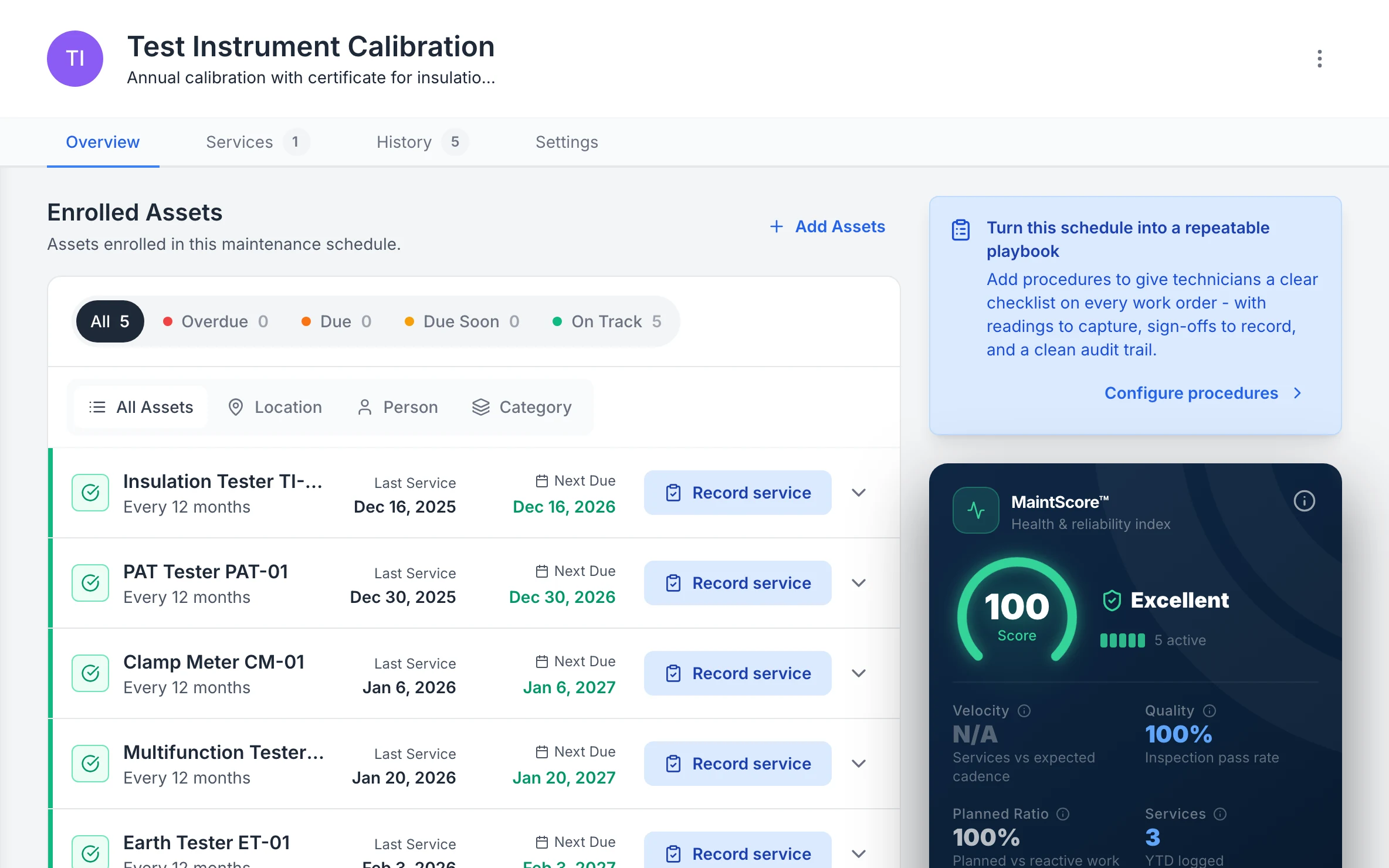
MapTrack Test Instrument Calibration schedule, annual calibration with a certificate: five enrolled testers, all on track, among them PAT tester PAT-01, clamp meter CM-01 and earth tester ET-01, each with its last calibration and next due date, beside a MaintScore of 100, Excellent.

Every tester’s next calibration

Each test instrument with its last calibration and when the next is due, on a yearly calibration schedule.

MapTrack app · Demonstration data · Captured

About this screenshot

Demonstration workspace at a 1440 x 900 desktop viewport, cropped right of the navigation sidebar to a 16:10 frame.

Not sure which of these to start with? We'll walk you through it in a demo.

Book a demo

30 minutes on Microsoft Teams

Test and tag, and machine checks, in one job

Do the test and tag round on corded gear, or the checks on the workshop machines, as one job with a pass or fail on each item. Whatever fails is plain to see on the job.

Compliance
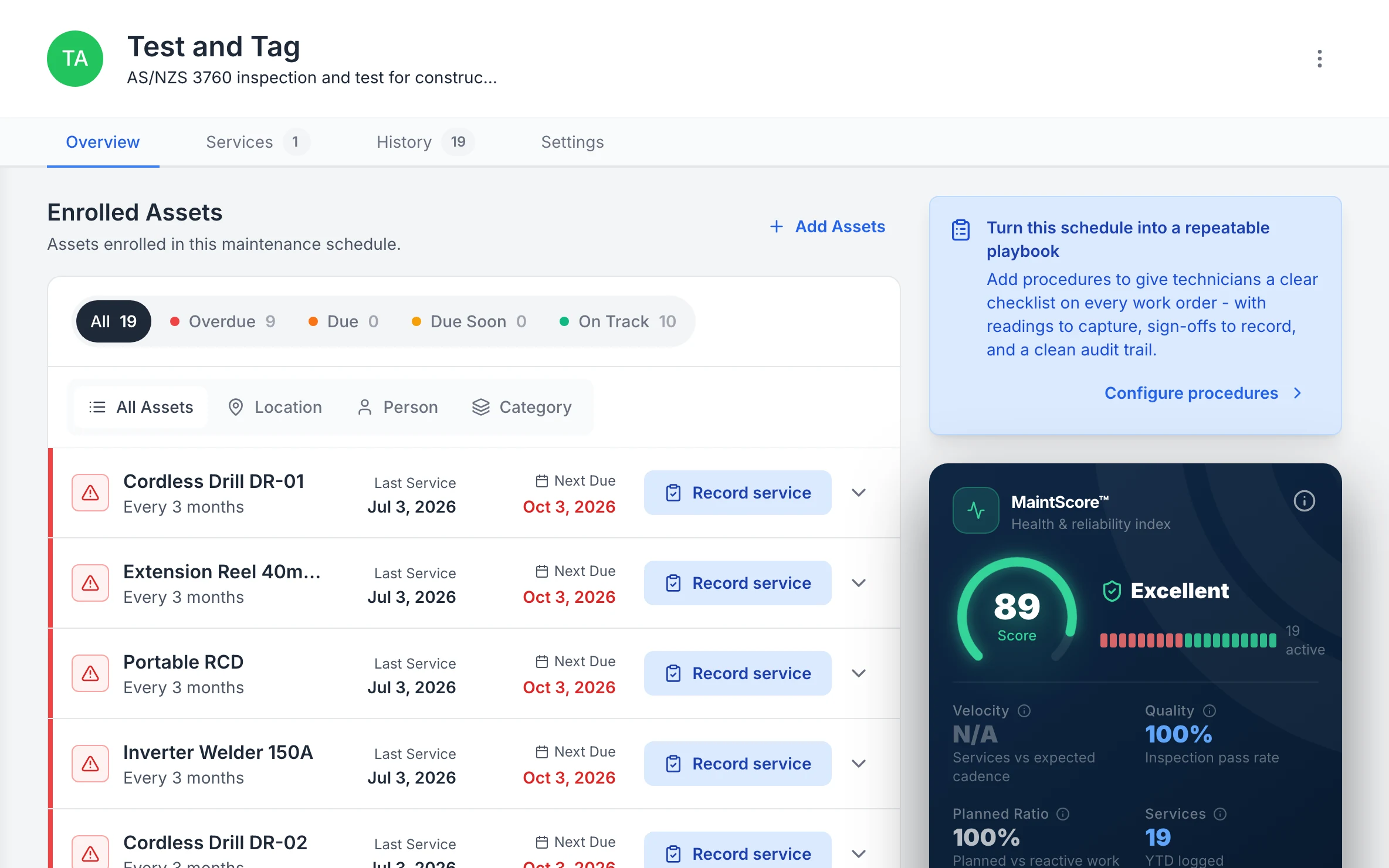
MapTrack Test and Tag schedule for AS/NZS 3760 inspection and test: 19 enrolled assets, 9 overdue and 10 on track; cordless drills, a 40m extension reel, a portable RCD and an inverter welder, each tested every 3 months with its last service and next due date, beside a MaintScore of 89, Excellent.

Test and tag, lead by lead

Every enrolled lead and tool with when it was last tested and when it’s next due, the overdue ones first.

MapTrack app · Demonstration data · Captured

About this screenshot

Demonstration workspace at a 1440 x 900 desktop viewport, cropped right of the navigation sidebar to a 16:10 frame.

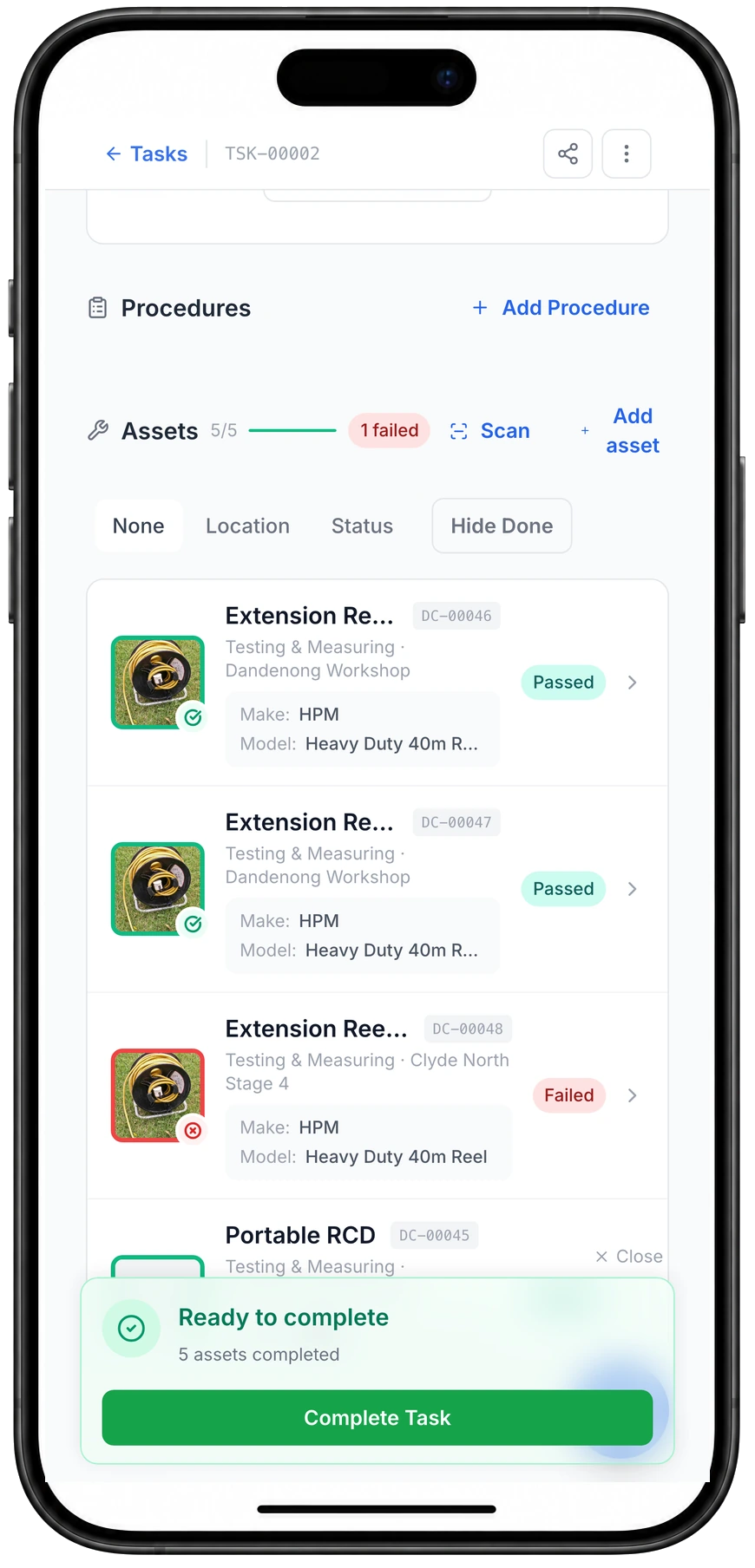
A task on a phone with Assets 5 of 5 and a red "1 failed" badge. Two Extension Reel 40m rows at Dandenong Workshop show Passed, and a third at Clyde North Stage 4 shows Failed with a red outline. A Ready to complete panel reads 5 assets completed.

A test and tag round as one job, pass or fail each

Work through every lead and RCD on one job, and the one that fails stands out straight away.

MapTrack app · Demonstration data · Captured

About this screenshot

Demonstration task with five items overdue for test and tag (three 40 m reels, a portable RCD and a welder), four completed as Passed and one as Failed on a phone on 23 Oct 2026. No test readings, tags, time or notes recorded.

Forklift pre-starts before every shift

Drivers scan the forklift's QR label and do the pre-start on their phone. A failed check stays on the record beside the repair and the recheck, and a form rule can raise the repair job.

Pre-start inspections
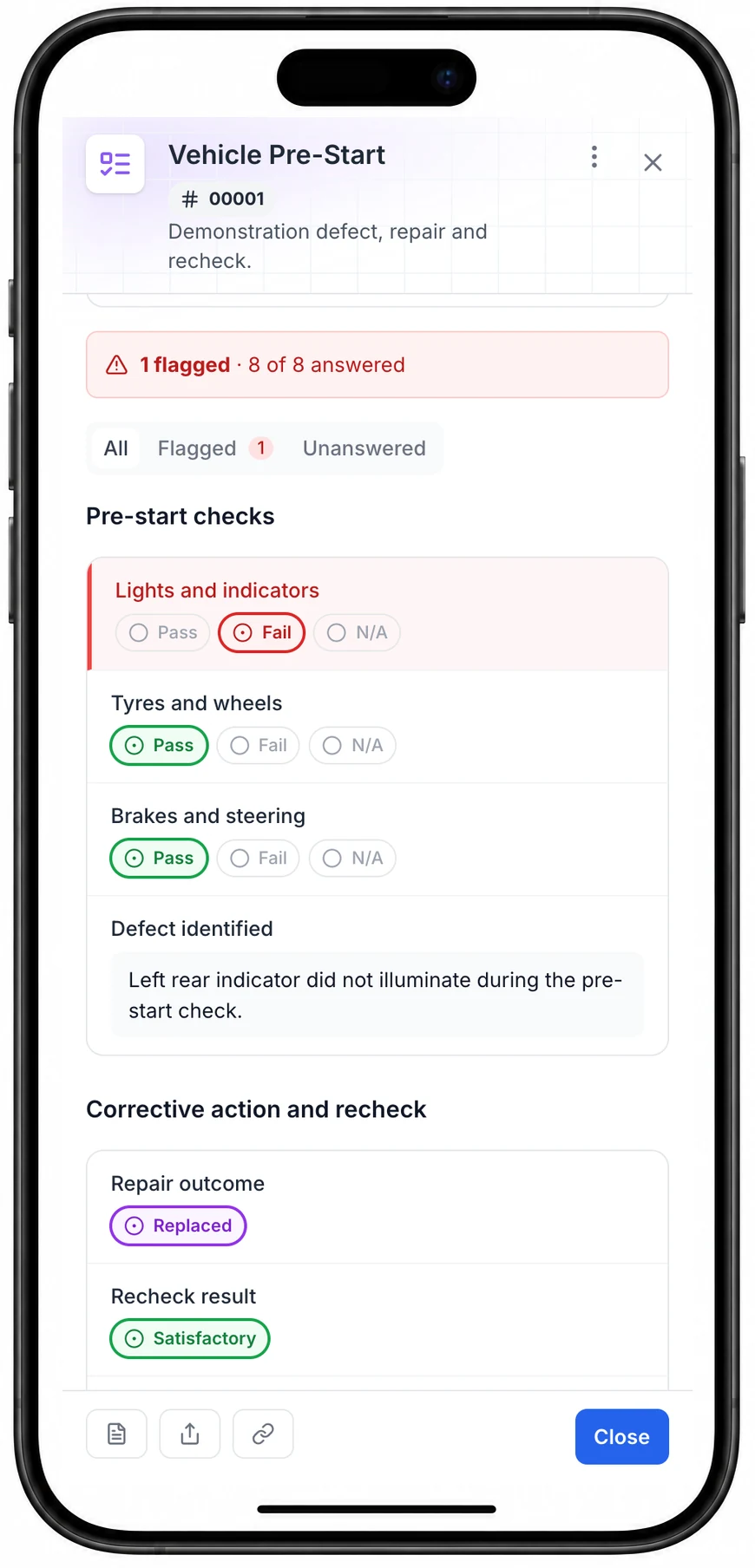
Saved vehicle pre-start on a phone showing eight of eight answered, one flagged check, the red failed indicator check, two green Pass answers, a purple Replaced outcome and a green Satisfactory recheck.

See the completed pre-start on a phone

All eight answers are saved. This phone view shows the original failed check and the replacement and recheck outcomes. The desktop result also shows the action taken and recheck notes.

MapTrack app · Demonstration data · Captured

About this screenshot

Saved demonstration pre-start, reopened in an online phone browser.

Seen one that fits how your team works? We'll show it to you in a demo.

Book a demo

30 minutes on Microsoft Teams

Customer proof

What customers say

“I looked at many other systems.. and MapTrack beat them all in every aspect. Can't fault them.”

Vincent Stone, HSEQ Advisor, Concept TanksReview on G2
Read the reviews on G2

“We used to spend hours trying to track down tools and equipment, and things would regularly go missing. That cost us both time and money. MapTrack has solved that by giving us clear visibility of where everything is and who has it. It's reduced asset losses, improved accountability across the team, and saved us a lot of admin time.”

Verified User, Manufacturing, Mid-Market (51-1000 emp.)Verified review on G2, August 2025

“Very easy to learn and use across the team. Scanning and assigning assets takes seconds, and the custom forms help us make it fit our process.”

Shannon, General Manager, Machinery, 51-200 employeesVerified review on Capterra, August 2025

Want to hear how other manufacturing teams set MapTrack up? Ask us in a demo.

Book a demo

30 minutes on Microsoft Teams

By the numbers

The real cost of poor maintenance tracking in manufacturing

Unplanned downtime and reactive maintenance are among the biggest cost drivers in Australian manufacturing. The numbers make a clear case for digital asset lifecycle tracking.

$349,000

cost per hour of unplanned downtime for the typical Australian industrial business, against $194,000 globally

ABB Value of Reliability survey, 2023

24%

of Australian businesses still rely on run-to-fail (reactive) maintenance

ABB Value of Reliability survey, 2023

10-20%

more equipment uptime from predictive, condition-based maintenance

Deloitte Analytics Institute, Predictive Maintenance (2017)

30–40%

savings opportunity that a functioning predictive maintenance programme opens up against a reactive-heavy operation

US Department of Energy, O&M Best Practices Guide, Release 3.0 (2010), p. 5.4

Want to see how these fit together on your own sites? We'll show you in a demo.

Book a demo

30 minutes on Microsoft Teams

Compliance

Calibration certificates and compliance. Always audit-ready

Store calibration certificates, due dates and inspection evidence directly on each asset record. Automated alerts notify your team before anything falls overdue, so you pass ISO audits, customer audits and internal quality reviews without scrambling.

  • Calibration due dates and certificates on each asset
  • Automated alerts before instruments fall overdue
  • Full compliance history attached to every asset
  • Pre-start forms for forklifts and production equipment
  • Failed inspections automatically trigger work orders
Compliance & certificates
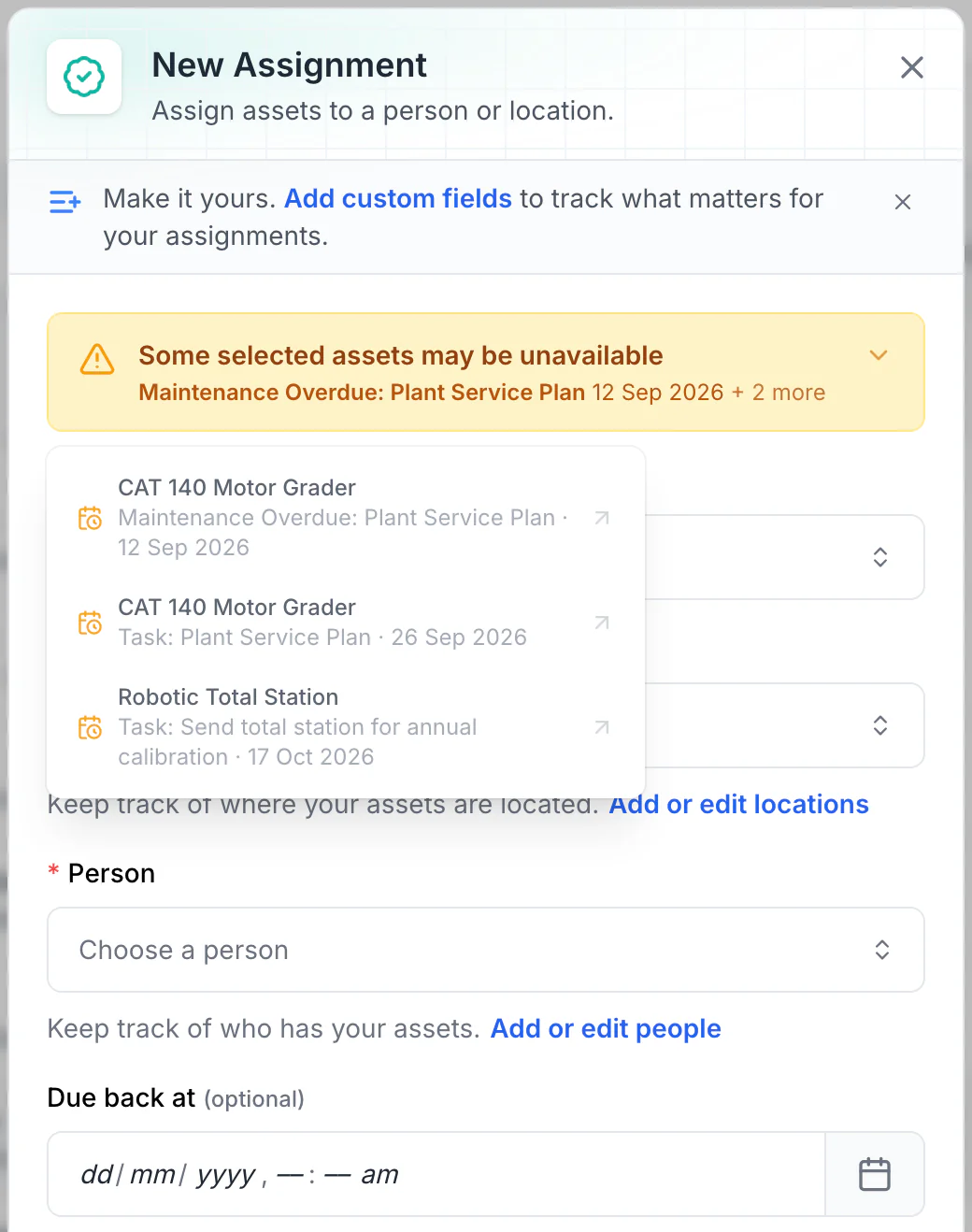
MapTrack New Assignment form with an amber notice that some selected assets may be unavailable, and its detail open: the CAT 140 Motor Grader with Plant Service Plan maintenance overdue since 12 September 2026 and a Plant Service Plan task on 26 September 2026, and the Robotic Total Station with a task to send it for annual calibration on 17 October 2026, each with a link.

Read the warnings before issuing equipment

Overdue maintenance and scheduled tasks show as amber warnings. No due-back date is set here, so every upcoming conflict is listed. With a due-back date, only tasks before it are listed: a 15 October due-back leaves out the total station’s 17 October calibration.

MapTrack app · Demonstration data · Captured

About this screenshot

Demonstration workspace. Two assets selected and Assign opened; the form was not saved.

Accountability

Digitise the tool crib - scan, assign and track

QR code every tool in the crib. Operators scan to check out; the system records who has what, when it was taken and when it's due back. Tool crib managers get real-time visibility instead of paper sign-out sheets, and production teams stop wasting time hunting for tooling.

  • Digital check-in and check-out on mobile or tablet
  • Bulk scanning for plant audits and stocktakes
  • Assign to operators, lines or departments (through a store or area for each department)
  • Overdue return alerts so nothing goes missing
  • Full chain of custody - who had it, when, where
Asset tracking
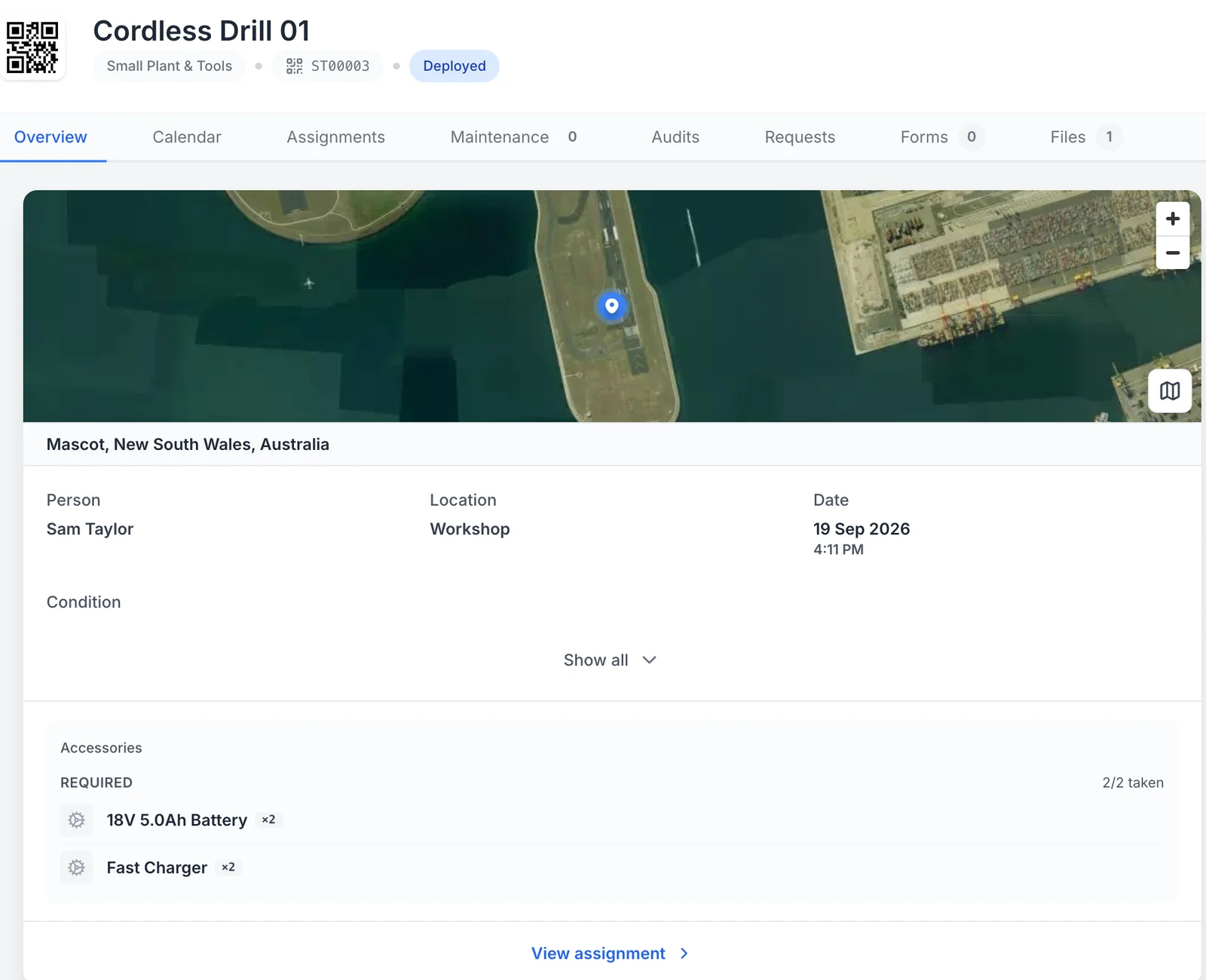
MapTrack record for Cordless Drill 01, tag ST00003, Deployed: a satellite map pinned at Mascot, New South Wales, the person Sam Taylor, the location Workshop, the date 19 Sep 2026 at 4:11 PM, and its required accessories, two 18V 5.0Ah batteries and two fast chargers, 2 of 2 taken.

Who has it, and where it was checked out

While the drill is out, its record shows who has it, where it was checked out on the map and the accessories that went with it.

MapTrack app · Demonstration data · Captured

About this screenshot

Demonstration workspace at a desktop viewport, on the asset’s Overview tab, cropped to its header, map, assignment and accessories.

See these on a phone and a desktop in a live demo.

Book a demo

30 minutes on Microsoft Teams

Maintenance

Preventive maintenance that keeps production running

Schedule preventive maintenance by calendar, meter readings or inspection results. Not arbitrary reminders. Work orders are assigned to maintenance techs on mobile. Every service record lives alongside the asset's tracking and compliance history so nothing falls through the cracks.

  • Calendar-based and meter-based maintenance triggers
  • Failed pre-starts automatically create work orders
  • Work orders assigned to maintenance techs on mobile
  • Complete parts history and cost tracking per asset
  • Overdue alerts to keep maintenance schedules current
Maintenance & work orders
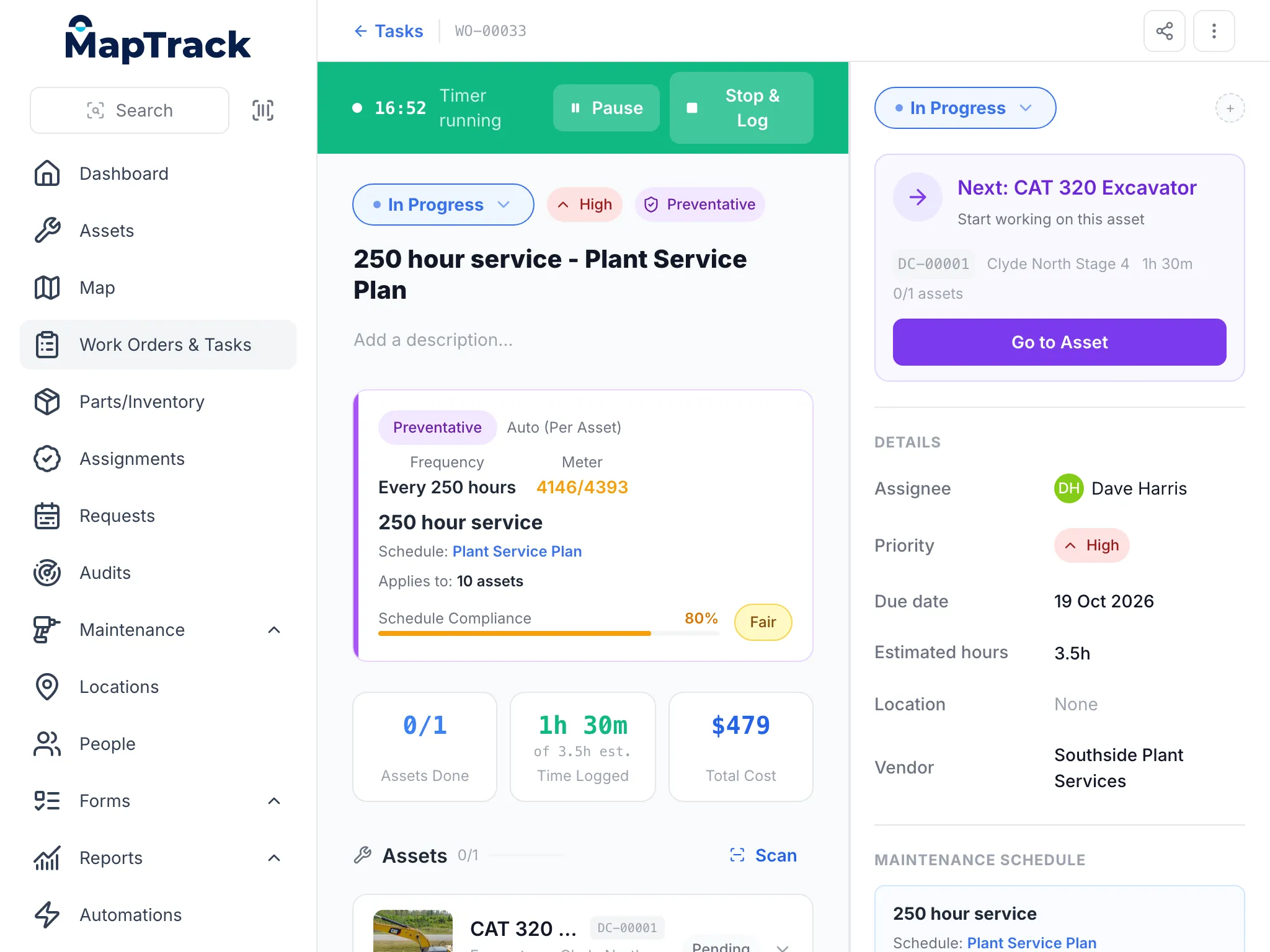
MapTrack on a tablet: a 250 hour service work order for a CAT 320 excavator, in progress with its timer running at 16:52, high priority and preventative, every 250 hours on a meter reading 4146 of 4393, with 1 hour 30 minutes logged, a total cost of $479, Dave Harris assigned and Southside Plant Services as the vendor.

A service job on a tablet

The same work order a mechanic runs on a phone or a desk, here on a tablet: the timer, the schedule that raised it, the time logged and the costs.

MapTrack app · Demonstration data · Captured

About this screenshot

Captured at a 1024 x 768 tablet viewport (the app at a 1024 px wide window) in a demonstration workspace; nothing pressed.

Integrations

Fleet and forklift data straight from the machine

MapTrack integrates with telematics platforms for your internal fleet and material handling equipment, so engine hours, odometer and GPS location drive maintenance and utilisation automatically, without manual data entry.

Teletrac Navman
Geotab
  • Engine hour and ODO tracking for timely forklift and vehicle maintenance
  • GPS location for internal fleet, yard vehicles and mobile plant
  • Usage data drives preventive maintenance triggers automatically
  • Utilisation reports to right-size your internal fleet

See all integrations

Field-ready

Built for the factory floor, mobile and offline

Manufacturing happens on the floor, not in the office. MapTrack runs on any phone or tablet. No specialist hardware required. Scan assets, complete pre-starts, check tools in and out, update work orders and run stocktakes directly from the production floor.

Offline mode means teams can keep working in areas with poor signal coverage - warehouses, basements and shielded environments. Data syncs automatically when back online. Unlimited users means everyone on the floor has access - operators, tool crib managers, maintenance techs and supervisors.

iOS & Android

No specialist hardware required

Offline sync

Works in shielded areas

QR scan

Any standard phone camera

Unlimited users

No per-seat charges

Control tools and calibrated assets on the factory floor

Track jigs, tooling and calibrated equipment across production lines. Compliance registers and maintenance scheduling in one platform.

  • Used across Australia & New Zealand
  • Per-asset pricing
  • Unlimited users

Get started

How manufacturing teams get started

Most manufacturing teams have their equipment register imported and tagged within days. Start on one production line and expand across the plant.

Step 1

Register your equipment, tooling, and fixtures

Import your existing asset register or start from scratch. Add machines, jigs, calibrated tooling, safety equipment, and material handling gear.

Step 2

Tag assets and link to maintenance schedules

Print durable QR labels and attach to equipment. Configure preventive maintenance triggers based on run hours, cycles, or calendar intervals.

Step 3

Manage work orders and track OEE impact

Log breakdowns, schedule and assign maintenance jobs, track spare parts, and produce downtime analysis reports for operations management.

The machine, forklift and crane records manufacturing rules ask for

Manufacturers in Australia, the United States and the United Kingdom answer to different rules, but the records they ask for look alike: what was checked, when, by whom, and what's due next. Open a market to see its rules, the words buyers there search for, and how pricing is quoted.

Australia

WHS Regulation s 213, WHS Regulation s 237

Prices on our pricing page are in Australian dollars, ex GST.

  • Australia, in Queensland's text of the model WHS Regulations (each state and territory enacts its own version)

    Work Health and Safety Regulation 2011, section 213, maintenance and inspection of plant

    What it asks for

    The person with management or control of plant at a workplace makes sure its maintenance, inspection and, if needed, testing is done by a competent person, following the manufacturer's recommendations. Where there are none, a competent person's recommendations apply, and where neither is reasonably practicable, the plant is inspected annually.

    How MapTrack keeps the record

    Each machine's services are scheduled at the maker's interval, by date or by run hours from meter readings, and inspections are signed forms on the machine's record.

    Source: Work Health and Safety Regulation 2011 (Queensland) (Queensland Government (Queensland Legislation), checked 26 Oct 2026)

  • Australia, in Queensland's text of the model WHS Regulations (each state and territory enacts its own version)

    Work Health and Safety Regulation 2011, section 237, records of registered plant

    What it asks for

    For plant that has to be registered, which includes boilers and pressure vessels of hazard level A, B or C, tower cranes and mobile cranes rated over 10 tonnes, the person with management or control keeps a record of all tests, inspections, maintenance, commissioning, decommissioning, dismantling and alterations. The record is kept for as long as the plant is used or until they give up control of it, kept available for inspection, and handed to whoever takes the plant over.

    How MapTrack keeps the record

    Each registered crane and pressure vessel's tests, inspections, services and repairs sit on its own record as work orders and signed forms with their PDFs.

    Source: Work Health and Safety Regulation 2011 (Queensland) (Queensland Government (Queensland Legislation), checked 26 Oct 2026)

United States

OSHA 1910.147(c)(6), OSHA 1910.178(q)(7), OSHA 1910.179(j)(2)

Pricing is quoted in your currency, US dollars.

  • United States, general industry

    OSHA 29 CFR 1910.147(c)(6), lockout/tagout periodic inspection

    What it asks for

    Each energy control procedure is inspected at least annually by an authorised employee other than the ones using it, to check the procedure is being followed and correct anything that isn't. The employer certifies each inspection, naming the machine or equipment, the date, the employees included and the person who did it.

    How MapTrack keeps the record

    The annual inspection of each procedure is a form on the machine's record, naming the employees included and signed by the inspector, with the next one showing as due soon or overdue.

    Source: 29 CFR 1910.147, The control of hazardous energy (lockout/tagout) (US Occupational Safety and Health Administration, checked 26 Oct 2026)

  • United States, forklifts and other powered industrial trucks

    OSHA 29 CFR 1910.178(q)(7) and (l), powered industrial trucks

    What it asks for

    Each truck is examined before it's placed in service, at least daily (after each shift where trucks run around the clock), and one with a condition affecting safety stays out of service. Defects are reported and corrected straight away. Each operator's performance is evaluated at least every three years, and the employer certifies training and evaluation with the operator's name and the dates.

    How MapTrack keeps the record

    The daily forklift check is a pre start on the operator's phone, and a failed check can raise the workshop job through a rule you set. Each operator's training and evaluation is a VOC form on their person record.

    Source: 29 CFR 1910.178, Powered industrial trucks (US Occupational Safety and Health Administration, checked 26 Oct 2026)

  • United States, overhead and gantry cranes

    OSHA 29 CFR 1910.179(j)(2), overhead and gantry crane inspections

    What it asks for

    Hooks and hoist chains get a visual inspection daily and a monthly inspection with a certification record: the date, the signature of the person who did it and the serial number or other identifier of the hook or chain. Air and hydraulic systems and operating mechanisms are also checked daily.

    How MapTrack keeps the record

    Each hook and chain has its own record with its serial number, and the monthly inspection is a signed form on that record with its date.

    Source: 29 CFR 1910.179, Overhead and gantry cranes (US Occupational Safety and Health Administration, checked 26 Oct 2026)

LOTO
Lockout/tagout: isolating a machine's energy sources and locking or tagging them out before servicing, under OSHA 29 CFR 1910.147, with each procedure inspected at least annually.
Forklift daily inspection
The pre-use examination OSHA 29 CFR 1910.178(q)(7) asks for at least daily, or after each shift where trucks run around the clock.

United Kingdom

PUWER regulation 6, LOLER regulation 9, PSSR regulation 8

Pricing is quoted in your currency, pounds sterling.

  • Great Britain, work equipment exposed to conditions that cause deterioration

    PUWER 1998, regulation 6, inspection

    What it asks for

    Equipment whose safety depends on how it's installed is inspected after installation and after assembly at a new site. Equipment exposed to conditions that cause deterioration is inspected at suitable intervals and after anything exceptional that could affect its safety. Each result is recorded and kept until the next one, and equipment going to another business carries evidence of its last inspection. Lifting equipment falls under LOLER instead.

    How MapTrack keeps the record

    Each machine has its own record, and inspection forms are signed and kept on it, with the next one showing as due soon or overdue.

    Source: Provision and Use of Work Equipment Regulations 1998 (PUWER), regulation 6 (legislation.gov.uk (The National Archives), checked 26 Oct 2026)

  • United Kingdom, lifting equipment and lifting accessories

    LOLER 1998, regulation 9, thorough examination and inspection

    What it asks for

    Lifting equipment exposed to conditions that cause deterioration is thoroughly examined at least every 6 months if it lifts people or is a lifting accessory, and at least every 12 months otherwise, or to an examination scheme, plus after anything exceptional. A competent person inspects it between examinations where that suits, and equipment going to another business carries evidence of its last thorough examination.

    How MapTrack keeps the record

    Overhead cranes, hoists, forklifts and lifting accessories carry their thorough examination dates and reports on their records, on a 6 or 12 month schedule.

    Source: Lifting Operations and Lifting Equipment Regulations 1998 (LOLER), regulation 9 (legislation.gov.uk (The National Archives), checked 26 Oct 2026)

  • Great Britain, installed and mobile pressure systems

    Pressure Systems Safety Regulations 2000, regulation 8, written scheme of examination

    What it asks for

    A pressure system isn't operated without a written scheme, drawn up or certified by a competent person, for the periodic examination of its protective devices and of the pressure vessels, pipelines and pipework where a defect could cause danger. The scheme names those parts and sets the nature and frequency of each examination, and is reviewed at appropriate intervals.

    How MapTrack keeps the record

    Each receiver, vessel and relief valve named in the scheme is its own record, with the scheme and examination reports attached and the next examination showing as due soon or overdue.

    Source: Pressure Systems Safety Regulations 2000 (PSSR), regulation 8 (legislation.gov.uk (The National Archives), checked 26 Oct 2026)

Written scheme of examination
The document PSSR asks for before a pressure system runs, drawn up or certified by a competent person, naming the parts to examine and how often.

MapTrack keeps the records these rules ask you to keep. It does not do the inspection or testing, certify your work or make you compliant, and the current text of each instrument is the authority.

Want to see how these records would look for your own gear? We'll show you in a demo.

Book a demo

30 minutes on Microsoft Teams

Stop the loss

Tool loss and missed calibrations are the two biggest controllable costs in manufacturing asset management

MapTrack gives your team the visibility, accountability and compliance triggers to cut both without adding headcount or replacing your existing systems.

Frequently asked questions

Common questions from manufacturing teams.

Manufacturing asset management software is a platform that helps manufacturing operations track, manage and maintain their tools, jigs, calibrated equipment, mobile assets and production devices across plants, lines and sites. It replaces spreadsheets, paper tool crib logs and disconnected point solutions with a single source of truth for where assets are, who has them, what their calibration status is and when they're due for service. MapTrack combines asset tracking (QR codes, barcodes, GPS), calibration and compliance registers, maintenance scheduling and work orders, and reporting, all on mobile on the factory floor.

Yes. MapTrack stores calibration due dates, certificates and evidence directly on each asset record. You can set alerts for upcoming and overdue calibration, so nothing slips through. When an instrument or gauge is due for calibration, the system notifies the responsible team. All calibration history is searchable and exportable for ISO audits, customer audits and internal quality reviews.

MapTrack replaces paper sign-out sheets and honour systems with a digital check-in/check-out workflow. Operators scan a QR code or barcode on the tool, select their name or badge, and the system records who has what, when it was taken and when it's due back. Tool crib managers get real-time visibility of what's out, what's overdue and who had it last. This eliminates the guesswork and reduces tool loss significantly.

MapTrack has an open API for integration with manufacturing execution systems (MES), enterprise resource planning (ERP) platforms and other operational systems. Common integrations include syncing asset registers, pushing maintenance completion data back to your ERP, and pulling work order triggers from production systems. We can discuss your specific MES, ERP or SCADA environment and how MapTrack fits alongside it.

Yes. MapTrack is built for assets that move. Track forklifts, trolleys, pallet jacks and mobile equipment with QR or barcode labels. For assets with GPS or telematics devices fitted, such as forklifts or yard vehicles - location and usage data can feed into MapTrack automatically. Assignments show which line, cell or operator has which asset at any time.

MapTrack supports multi-plant and multi-site rollouts with role-based access control (RBAC) and SSO. Each plant or department sees their own assets, while operations and leadership get a consolidated view across all sites. You can run reports, audits and compliance reviews by plant, line, asset class or any combination. Assets transferring between plants are tracked with timestamps and approval workflows.

Yes. Forklifts, reach trucks, pallet jacks and other material handling equipment (MHE) are common asset types in MapTrack. You can run daily pre-start inspections on mobile, track service history, schedule maintenance based on hours or calendar, and record compliance certificates, all attached to each unit. Where telematics devices are fitted (Teletrac Navman, Geotab or similar), usage and location data feeds in automatically.

Use bulk scanning (QR or barcode) to verify what's on a specific plant floor, in a tool crib or assigned to a production line. MapTrack records each asset scanned, when it was scanned and who scanned it. Compare scanned results to expected asset lists and immediately see what's missing, unscanned or unaccounted for. Reports by plant, line or asset class give you audit-ready evidence. Stocktakes that used to take a full shift with clipboards now take a fraction of the time on mobile.

MapTrack uses per-asset pricing with unlimited users included. Not per-seat licensing. You can give access to every operator, tool crib manager, maintenance technician, quality engineer and supervisor without your costs growing as the team does. This is a significant advantage in manufacturing where shift sizes vary, contractors rotate through and you may need dozens or hundreds of people to be able to scan, check out tools or complete forms. Pricing scales with the number of assets you track, not the size of your team.

Most manufacturing teams are running on MapTrack within one to two weeks. The typical approach is to start with one plant or one asset class, such as calibrated equipment or the tool crib: import or scan in assets, set up your first workflows (usually calibration tracking or check-in/check-out), and roll out to floor teams. MapTrack's onboarding team supports you through setup and training at no additional cost. For larger multi-plant rollouts, a phased approach works well: get adoption solid on one workflow, then expand to more asset types and sites.

One that handles tools, calibrated instruments and machines together, so maintenance and quality records sit on the same register. Look for QR check-out with due-back times, calibration schedules that flag overdue gauges at check-out, pre starts and inspections on the phone, and servicing on run hours. MapTrack does all of that, with per-asset pricing and unlimited users across every plant.

Set each plant up as a location, with zones for the store, the workshop and each line, and put every machine and tool on one register. Machine services close out on work orders with labour, parts and costs, and tools are scanned out and back with a due-back time. Each plant's store can be audited by scan, and every plant's records sit in the same account.

Got a question we haven't answered here? Ask it in a demo.

Book a demo

30 minutes on Microsoft Teams

Get MapTrack pricing for Manufacturing teams

Tell us about your operations. Our team will share per-asset pricing tailored to your manufacturing asset mix and a rollout plan - within one business day.

Per-asset pricing. Unlimited users. Primary database hosted in Sydney.

Factory floor to field, one system

Join manufacturing teams across Australia using MapTrack to track tools, manage calibration compliance and keep equipment maintained, all in one platform.

Pre-start inspections · Maintenance · Asset tracking · Industrial maintenance · Compare

Tools from $1 · Machines from $12View pricing