
Free template · PDF
Free plant risk assessment
Free plant risk assessment template (PDF-ready). Identify hazards, rate risk and apply the control hierarchy for each item of plant.
Loading PDF page...
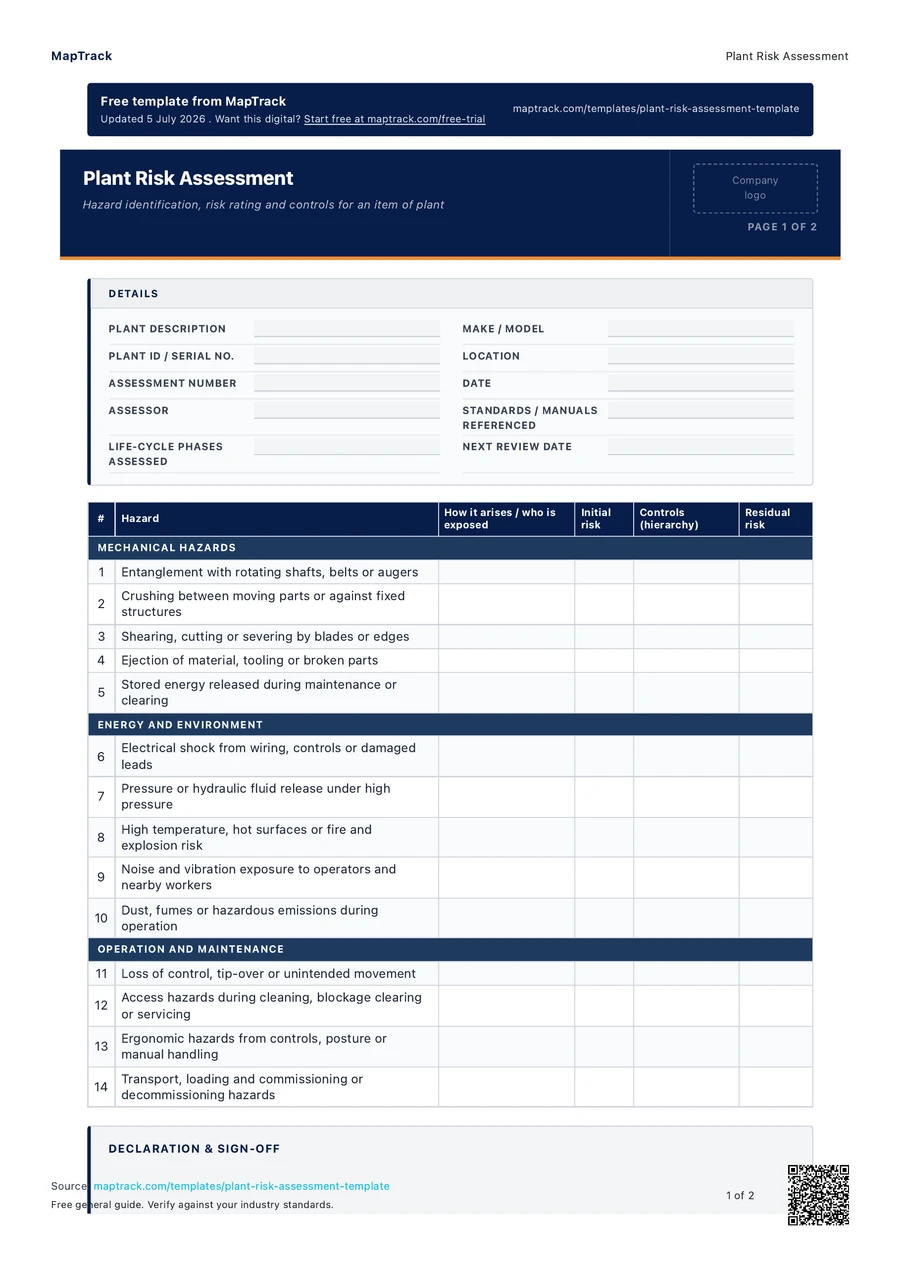

Read the form fields
14 checks · 3 sections · Sign-off
14 checks
The fields in the printable form, in a view that fits your screen.
- Plant description
- Make / model
- Plant ID / serial no.
- Location
- Assessment number
- Date
- Assessor
- Standards / manuals referenced
- Life-cycle phases assessed
- Next review date
MECHANICAL HAZARDS
ENERGY AND ENVIRONMENT
OPERATION AND MAINTENANCE
Declaration & Sign-Off
I confirm that all items have been inspected/completed as indicated above. Any defects or concerns have been noted and reported.
Completed By
Printed name · Signature · Date
Reviewed / Approved By
Printed name · Signature · Date
The MapTrack plant risk assessment contains 14 checks across 3 sections.

Co-Founder & Commercial Director
Make this form your own
Add your fields and logo. Give your team a form they can use on site.
Free 30-day trial. No credit card. Work email needed.
Upload & use this form now for free



“MapTrack beat them all in every aspect.”
 Vincent Stone · HSEQ Advisor, Concept Tanks
After signup: upload this PDF, check the form MapTrack drafts, then save and publish it for your team.
General guidance only. Check the form against your equipment manual, site procedures and local requirements before using it.
Key takeaways
- The MapTrack plant risk assessment contains 14 checks across 3 sections. Sections covered: MECHANICAL HAZARDS, ENERGY AND ENVIRONMENT, OPERATION AND MAINTENANCE.
- Plant description, make, model and identifier or serial number, and its location
- Assessment number, date and the assessor, plus the standards and manuals referenced
- Life-cycle phases assessed: operation, maintenance, cleaning, transport, commissioning, decommissioning
What is a plant risk assessment?
A plant risk assessment is a structured assessment of a single item of plant or machinery that identifies its hazards, rates the risk of each, and records the controls applied working down the hierarchy of controls. It captures the plant details and identifier, the location, the assessor and the standards referenced, then works through a row for each hazard covering the hazard and how it arises, the initial risk rating, the controls, and the residual risk once those controls are in place. It considers the plant across its whole life: operation, maintenance, cleaning, transport, commissioning and decommissioning, not just normal running.
A plant risk assessment matters because plant causes a large share of serious workplace injuries through crushing, entanglement, contact with moving parts, stored energy and mechanical failure. The model WHS Regulations place specific duties on those who design, manufacture, supply, install and use plant to manage its risks (in Victoria, the Occupational Health and Safety Regulations 2017), and the AS/NZS 4024 Safety of machinery series sets out how to assess and control plant hazards. Completing an assessment for each item of plant gives you a documented basis for guarding, isolation, safe operating procedures and maintenance controls, ties those controls to the specific asset in your register, and provides the dated evidence a regulator or auditor will expect after an incident or during a review.
Learn more about compliance and inspections in MapTrack.
Choose the format that fits your team
Download the PDF
Use the original printable form for a paper workflow. Check it against your equipment and site procedure before the job.
Keep completed copies in your own record system and arrange any follow-up through your normal process.
Download free PDFCustomise a form in MapTrack
Start a free trial, upload this PDF and MapTrack drafts the form. Adjust it to your workflow, then save and publish it for your team to use.
Sample answers on this page and completed PDF records aren't imported automatically.
Upload & use this form now for freeFree 30-day trial. No credit card. Work email needed.
Benefits of using this plant risk assessment
- Whole-of-life view: assessing operation, maintenance, cleaning and transport catches the hazards that only appear off the normal running cycle.
- Hierarchy of controls: each hazard is matched to a control and re-rated, so you can see whether guarding or isolation has actually cut the risk enough.
- Guarding decisions: identifying moving-part and entanglement hazards drives the guarding and interlock decisions rather than leaving them to chance.
- Asset-linked: tying the assessment to the plant's identifier means the controls, SWP and maintenance sit against the same asset in your register.
- SWP foundation: the assessed hazards and controls become the basis for the safe operating procedure the operators are trained on.
- Regulatory fit: the model WHS Regulations place plant-specific duties on operators, and a documented assessment is objective evidence those duties are met.
- Change trigger: reassessing after a modification or repair keeps the controls matched to the plant as it actually is, not as it left the factory.
What to include in a plant risk assessment
- Plant description, make, model and identifier or serial number, and its location
- Assessment number, date and the assessor, plus the standards and manuals referenced
- Life-cycle phases assessed: operation, maintenance, cleaning, transport, commissioning, decommissioning
- Hazard rows: mechanical, entanglement, crushing, electrical, pressure, noise, dust and ergonomic
- How each hazard arises and who is exposed, including operators, maintainers and bystanders
- Initial risk rating using a likelihood and consequence matrix
- Control measures for each hazard, applied down the hierarchy from elimination to PPE
- Residual risk rating after controls, and whether it is low enough to operate
- Guarding, isolation, emergency stops and safe operating procedure requirements
- Actions outstanding, responsible person, due date and assessor sign-off
How to use this plant risk assessment
Record the plant and gather its documentation
Capture the plant make, model and identifier, its location, and pull together the operator manual, the manufacturer's information and any prior assessments. Working from the manufacturer's data means you assess the plant against how it was designed to be guarded, isolated and maintained rather than guessing at the hazards from the outside.
Identify hazards across the whole life cycle
Walk the plant and list its hazards not just in normal operation but during maintenance, cleaning, clearing blockages, transport, commissioning and decommissioning. Many plant injuries happen when a guard is off for cleaning or a machine is being cleared, so a running-only assessment misses the phases where workers are most exposed.
Rate each hazard for risk
Score each hazard using a likelihood and consequence matrix to set an initial risk rating, and note who is exposed, including operators, maintainers and people nearby. A consistent matrix lets you prioritise the guarding and isolation work by which hazards carry the highest risk rather than treating every hazard as equal.
Apply controls down the hierarchy
For each hazard, choose controls working down the hierarchy: eliminate the hazard, substitute, engineer it out with guarding and interlocks, use administrative controls such as a safe operating procedure, then PPE. Record the control and re-rate the residual risk, and raise an action with an owner and due date for any control not yet in place.
Set the SWP and review the assessment
Turn the assessed hazards and controls into the safe operating procedure operators are trained on, and have the assessor sign off. Reassess the plant after any modification, major repair, incident or change in use, and on a set review cycle, so the controls stay matched to the plant as it actually is.
How often should you complete this form?
Complete a plant risk assessment before an item of plant is first used, whether it is new, hired or newly modified, and reassess it after any modification, major repair, incident, near miss or change in the way the plant is used. A change that seems minor, such as a new attachment or a bypassed guard, can introduce a hazard the original assessment never covered.
Set a periodic review cycle for each item of plant so assessments do not go stale, commonly annually or aligned to the plant's service schedule. Review sooner if a relevant standard changes or if operators report a hazard, and keep the assessment against the asset so the next reviewer starts from the current controls.
Make this form your own
From your template to your team.
Upload this PDF and MapTrack drafts the form. Adjust it for your equipment and site, then save and publish the digital form for your team.
- 01
Start your free trial
Use your work email to create your MapTrack account.
- 02
Customise, save and publish
Adjust the template fields and branding for your site.
- 03
Complete it on the job
Record checks, add photos and export a branded PDF.
Keep working offline
Load the form before you lose reception. Complete it offline and sync when you're back online.
Scan the asset. Open its form.
Use an asset's QR code to find and complete the forms that belong to it.
Show what you found
Capture photos and attach files so the next person has the details they need.
Take a branded PDF with you
Download completed forms as PDF reports with your company logo.
Completed paper records aren't imported automatically.
Frequently asked questions
Practical answers about the form, record keeping and using MapTrack.
The model WHS Regulations place duties on persons conducting a business or undertaking to manage the risks associated with plant, and on designers, manufacturers, importers, suppliers and installers of plant (in Victoria, the Occupational Health and Safety Regulations 2017). Managing those risks requires identifying the hazards and controlling them using the hierarchy of controls, which is exactly what a plant risk assessment documents. While the regulation does not mandate a specific form, a documented plant risk assessment is the standard way to demonstrate the plant duties have been met, and the AS/NZS 4024 Safety of machinery series guides the method.
Link to this answerCover the full range of plant hazards: mechanical hazards such as moving parts, entanglement, crushing, shearing and cutting; stored and released energy; electrical hazards; pressure and hydraulics; high temperature or fire; noise and vibration; dust and fumes; and ergonomic hazards from operation and maintenance. Assess each across the whole life cycle, including maintenance, cleaning and clearing blockages, because that is when guards are often removed and exposure is highest.
Link to this answerA plant risk assessment focuses on a single item of plant and its inherent hazards and controls across its life cycle, and it underpins the guarding, isolation and safe operating procedure for that machine. A SWMS is a task and site document for high-risk construction work that sets out how a specific job will be done safely. The plant risk assessment feeds the SWMS: the controls it identifies for a machine become inputs to the SWMS for any job that uses that machine.
Link to this answerWork down the hierarchy from most to least effective. Eliminate the hazard where you can, for example by removing the need for a person to reach into a danger zone. Then substitute, then engineer the risk out with fixed guards, interlocks and emergency stops, which are the most reliable controls for plant. Administrative controls such as safe operating procedures and training come next, and PPE is the last line. Fixing guarding at the engineering level beats relying on a worker following a procedure every time.
Link to this answerAssess plant before first use and after any modification, major repair, incident, near miss or change in use, because these can introduce new hazards. Beyond that, set a periodic review cycle for each item, commonly annually or aligned to its service schedule, and review sooner if a standard changes or an operator reports a hazard. Keeping the assessment current against the asset means controls match the plant as it is now, not as it was first commissioned.
Link to this answerYes, it is completely free. It downloads as a ready-to-print PDF. You do not need a MapTrack account. If you want to move beyond paper, MapTrack keeps your plant and equipment register, inspection and maintenance history, and the controls and documents against each asset in one place. Start a free trial or book a demo to see how.
Link to this answerApplicable regulatory standards
This form is a starting point. Check the current requirements that apply to your equipment, work and location. The form alone does not establish compliance.
- Model Work Health and Safety Act (enacted in each state and territory; in Victoria, the Occupational Health and Safety Act 2004)
- Model Work Health and Safety Regulations, Chapter 5 Plant and structures (Part 5.1), with general risk management under Part 3.1 (in Victoria, the Occupational Health and Safety Regulations 2017)
- Safe Work Australia Model Code of Practice: Managing the risks of plant in the workplace
- AS/NZS 4024 Safety of machinery series (multi-part), e.g. AS/NZS 4024.1601:2014 (guards)
- Model Code of Practice: Managing risks of plant in the workplace (Safe Work Australia)
- Model WHS Regulations (Safe Work Australia)
- Model Work Health and Safety Act (Safe Work Australia)
- AS 4024 series, Safety of machinery (Standards Australia listing)
MapTrack publishes this template. The linked authorities publish their own guidance; they haven't endorsed this form.
The numbers behind this plant risk assessment
Every figure below is sourced and dated, so you can quote it in a toolbox talk, a budget case or a board paper without having to chase the original report.
Cite this template
Writing about this topic? You’re welcome to quote this checklist. Here’s the wording to use so your readers can find the original.
The MapTrack plant risk assessment contains 14 checks across 3 sections.
- Short attribution
- MapTrack Plant Risk Assessment, https://www.maptrack.com/templates/plant-risk-assessment-template
- Reference list
- MapTrack. (2026). Plant Risk Assessment [Checklist template]. Retrieved from https://www.maptrack.com/templates/plant-risk-assessment-template
Free to reuse with credit under a Creative Commons Attribution 4.0 licence. If you’d rather link straight to it, the page is https://www.maptrack.com/templates/plant-risk-assessment-template.
Embed this free template on your website
Run an industry blog, trade association site, or training resource? Drop a preview of this free plant risk assessment straight into your page. The snippet is self-contained, needs no scripts, and links readers back to the full free template.
<div style="max-width:480px;font-family:system-ui,-apple-system,'Segoe UI',Roboto,sans-serif;border:1px solid #E5E7EB;border-radius:12px;padding:20px;background:#ffffff;">
  <p style="font-size:12px;font-weight:700;letter-spacing:0.05em;text-transform:uppercase;color:#071D49;margin:0;">Free template</p>
  <p style="font-size:18px;font-weight:700;color:#071D49;margin:6px 0 0;">Plant Risk Assessment</p>
  <ul style="margin:12px 0 0;padding-left:18px;color:#374151;font-size:14px;line-height:1.6;">
    <li style="margin:4px 0;">Plant description, make, model and identifier or serial number, and its location</li>
    <li style="margin:4px 0;">Assessment number, date and the assessor, plus the standards and manuals referenced</li>
    <li style="margin:4px 0;">Life-cycle phases assessed: operation, maintenance, cleaning, transport, commissioning, decommissioning</li>
    <li style="margin:4px 0;">Hazard rows: mechanical, entanglement, crushing, electrical, pressure, noise, dust and ergonomic</li>
    <li style="margin:4px 0;">How each hazard arises and who is exposed, including operators, maintainers and bystanders</li>
    <li style="margin:4px 0;">Initial risk rating using a likelihood and consequence matrix</li>
  </ul>
  <p style="font-size:13px;color:#6B7280;margin:14px 0 0;padding-top:12px;border-top:1px solid #E5E7EB;">Free <a href="https://www.maptrack.com/templates/plant-risk-assessment-template" style="color:#071D49;font-weight:600;text-decoration:none;">Plant Risk Assessment</a> by MapTrack</p>
</div>Free to reuse, including commercially. This template is published under a Creative Commons Attribution 4.0 licence. Copy it, adapt it, put it on your own site or in your own docs. All we ask is that you credit MapTrack with a link back to this page. The snippet above already includes that credit, so if you use it as-is you’re covered.
About the author

Co-Founder & Commercial Director
Jarrod has spent over a decade in technology consulting and asset management, including roles at Accenture (mining and heavy industry) and CGI as an Asset Management Consultant. He co-founded MapTrack and built and scaled its original platform, then rebuilt it with Lachlan and Alex from thousands of customer conversations and 300+ user research sessions with field teams. His consulting background gives him deep insight into the operational and compliance challenges facing asset-intensive Australian businesses.
View LinkedIn profile →Ready for your next job?
Keep the PDF handy, or upload it to MapTrack and turn it into a digital form for your team.