
Free concreting SWMS template
Free concreting SWMS template (PDF-ready). Covers concrete pumping, formwork, precast, cement burns and silica controls.
Updated 10 Aug 2026
Concreting Safe Work Method Statement (SWMS)
High-risk construction work: concrete pumping, formwork and precast
Checklist
Prepared by
Signature
Print name
Position
Date
Approved by
Signature
Print name
Position
Date
How to use: download the PDF, print or complete digitally on any device.
- PDF format, ready to print or fill on screen
- Use as-is or customise to suit your operation
- Go digital in MapTrack for photos, reminders and audit trails
Two ways to use it
Use in MapTrack →Use it digitally instead
Unlimited usersUpload this PDF and MapTrack drafts the form for you.




- Scan the asset’s QR tag with any phone
- Submitted forms can trigger alerts
- Photos on fails, audit-ready records
- Export responses, PDF reports with your logo
Free trial. No credit card needed.
Trusted by teams across Australia and New Zealand
We respect your privacy. Unsubscribe anytime.
These templates are free general guides provided as-is. They do not constitute legal, safety or compliance advice. You are responsible for ensuring any form meets your specific workplace obligations, industry standards and applicable regulations.
Don't just download it - use it live. Start a free workspace, upload this concreting SWMS template and MapTrack drafts it as a form your crew can run from a phone.

Co-Founder & Commercial Director
Key takeaways
- The MapTrack concreting SWMS template contains 4 checks.
- Concreting needs a SWMS when it involves a concrete pump or other mobile plant, tilt-up or precast elements, or structural formwork.
- Pump line blockage and hose whip are top hazards: set firm exclusion zones, use a trained operator and spotter, and clear blockages with water.
- Formwork and falsework should be designed and inspected to AS 3610 and signed off before the pour to prevent collapse under load.
- Wet concrete is a corrosive alkaline slurry: provide gloves, eye protection and wash water, and suppress silica dust when cutting set concrete.
- Prepare the SWMS before work starts, sign on the whole crew, and review it whenever the method, plant, weather or crew changes.
Enter your email below to download this concreting SWMS template as a ready-to-use PDF.
Used by construction, mining and field service teams









What is a concreting SWMS template?
A concreting Safe Work Method Statement (SWMS) sets out the high-risk construction work involved in a concrete pour, the hazards that arise at each stage, and the control measures that manage them. Concreting becomes high-risk construction work under the WHS Regulations 2011 when it involves powered mobile plant such as a concrete pump, agitator or boom, the erection of tilt-up or precast concrete elements, or structural formwork, or where it is carried out near other high-risk work. When any of those elements apply, a SWMS must be prepared before the work starts, kept on site, and reviewed with every worker on the task.
Concrete work concentrates several severe hazards into a short, fast-moving window. A blocked pump line can release stored pressure and cause the delivery hose to whip, formwork or falsework can fail under the load of wet concrete, and wet concrete itself is a corrosive alkaline slurry that burns skin and eyes. This template documents the work steps, hazards, risk ratings and controls in the formal SWMS structure so the crew can plan the pour, agree the exclusion zones and placement method, and sign on before any concrete is delivered.
Learn more about compliance and inspections in MapTrack.
Benefits of using this concreting SWMS template
- High-risk work coverage: addresses the concreting activities that trigger a SWMS under the WHS Regulations, including concrete pumping, precast and structural formwork.
- Pump and plant safety: documents exclusion zones, spotter duties and operator competency so hose whip and plant interaction are controlled before delivery starts.
- Formwork assurance: prompts a check that formwork and falsework are designed and inspected to AS 3610 before the pour, reducing collapse risk under load.
- Health hazard control: captures cement burn, dermatitis and respirable silica controls so contact and dust exposure are managed, not left to chance.
- Worker engagement: requires the crew to review and sign the SWMS, confirming they understand the placement method, hazards and their duties before work begins.
- Audit readiness: a completed concreting SWMS gives documented evidence for principal contractor reviews, client inspections and regulator visits.
Benefits of digitising forms in MapTrack
When you move your procedures from paper to MapTrack, you get:
- Field users can easily scan a QR code to complete a form on mobile. Unlimited users.
- Email the right people when a form is submitted, with an automation you set up.
- File every completed form against the asset, location or person it covers.
- Download any completed form as a PDF, with failed answers listed at the top.
- Fill in forms offline; they upload when the device is back online.
- Build conditional logic (show or hide questions based on answers).
- Take pictures or attach photos. Not possible with a paper-based form.
- Electronic signatures.
- Edit forms later without reprinting.
- Set who can view, fill in or edit forms with user roles.
- Upload a paper form (PDF, Word, Excel or a photo) and MapTrack's AI builds a digital version for you to check.
- Email safety managers when a hazard report is submitted, with an automation you set up.
- Keep every hazard and incident report against the site it came from, with photos.
- Turn a hazard report into a corrective-action work order with its own review step.
Book a demo to see how MapTrack handles procedures.
Try MapTrack free for 30 days
Full access to every feature. No credit card required. Per-asset pricing so you scale as your fleet grows.
- No credit card required
- 30 days free trial
- Cancel anytime
1-2 days/week saved
“Bloody amazing! We used to spend 1-2 days a week tracking and managing our generators alone.”

Steve McAllister
Asset Coordinator, Saunders International
What to include in a concreting SWMS template
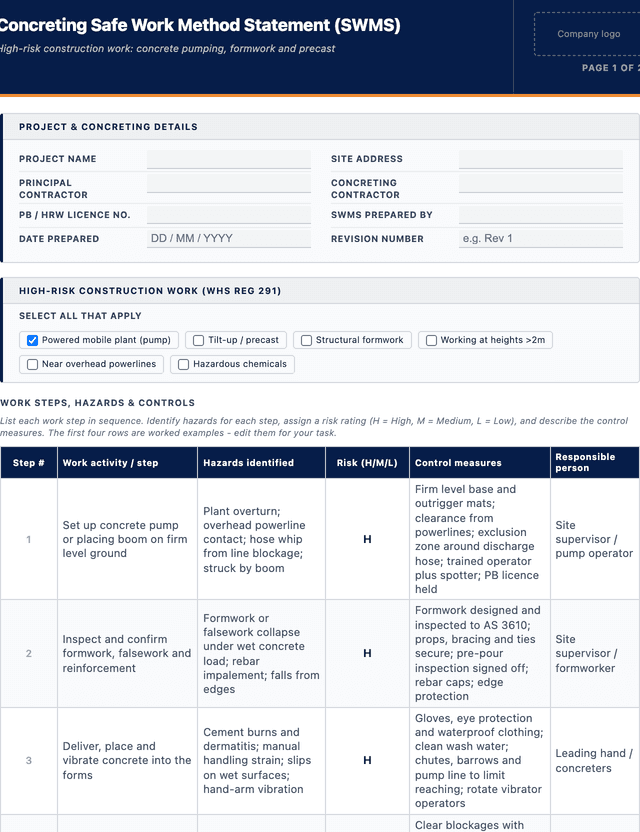
This concreting SWMS template covers 9 key areas:
- Task and scope: the specific concreting activity and which high-risk construction work categories apply (pump, precast, tilt-up, formwork, work near other plant).
- Work steps: sequential breakdown from set-up and formwork check through delivery, placement, vibration, finishing and clean-down.
- Hazards: pump line blockage and hose whip, formwork or falsework collapse, cement burns and dermatitis, silica dust, rebar impalement, manual handling, slips and plant interaction.
- Risk rating: likelihood and consequence for each hazard, rated before and after controls.
- Control measures: controls in hierarchy order, including pump exclusion zone, formwork inspection, rebar caps, dust suppression, washing facilities and manual-handling aids.
- Plant and operator details: concrete pump or placing boom, the PB high risk work licence where required, and the operator and spotter assigned.
- Responsible persons: who implements and monitors each control during the pour.
- PPE and welfare: gloves, eye protection, waterproof clothing, respiratory protection for cutting, and access to clean water for cement contact.
- Review and sign-on: names and signatures of all workers, the reviewer, and the next review trigger or date.
How to use this concreting SWMS template
- Confirm the work is high-risk and break the pour into steps.: Identify which elements make the concreting high-risk construction work, such as the concrete pump, precast or tilt-up panels, or structural formwork. List each work step in order, from ground set-up and formwork inspection through delivery, placement, vibration, finishing and line clean-down, so every stage is captured.
- Set up the pump or placing plant and establish exclusion zones.: Position the concrete pump or placing boom on firm, level ground clear of excavations and overhead powerlines. Establish an exclusion zone around the discharge hose, assign a trained competent operator and a dedicated spotter, and confirm a placing boom operator holds the relevant high risk work licence before any concrete moves.
- Verify formwork, falsework and reinforcement before the pour.: Check that formwork and supporting falsework have been designed and inspected in line with AS 3610 and can carry the wet concrete load. Confirm props, bracing and ties are secure, exposed reinforcement starter bars are fitted with protective caps, and access and edge protection are in place before delivery begins.
- Control cement contact, silica dust and manual handling during placement.: Brief the crew on cement being a corrosive alkaline slurry and provide gloves, eye protection and clean wash water for skin contact. Use water suppression or on-tool extraction when cutting or grinding set concrete to control respirable silica, and use barrows, chutes or pump lines to limit manual handling and reaching.
- Brief, sign on, then review the SWMS when conditions change.: Walk the crew through the SWMS at the work face, confirm each person understands the placement method, exclusion zones and their duties, and obtain sign-on before concrete is delivered. Stop and revise the SWMS if the pour method, plant, weather or crew changes, or if a blockage or near miss occurs, then re-brief and re-sign.
In MapTrack, you can digitise safety inspections and compliance forms. Each submission is stored as a timestamped PDF against the asset record.
Get the free templateEnter your email above to download the full concreting SWMS template as a PDF.Back to download formHow often should you complete this procedure?
A concreting SWMS must be prepared before the high-risk concreting work starts and kept on site and accessible to everyone doing the work for the duration of the pour. It must be reviewed whenever the placement method changes, when the plant or pump set-up changes, when site or weather conditions change, when new workers join the crew, and immediately if a line blockage, hose whip, formwork movement or any incident or near miss occurs. The principal contractor is responsible for ensuring the SWMS is prepared, reviewed with workers and signed before work commences, and that work stops and the SWMS is revised if it is not being followed.
Under the WHS Regulations 2011, concreting that involves powered mobile plant, tilt-up or precast concrete, or structural formwork is high-risk construction work that requires a SWMS, and working without a current one for these activities is a regulatory breach. Beyond the legal trigger, treat each distinct pour as a fresh review point rather than reusing a generic document, because the ground conditions, formwork loads, pump reach and exclusion zones differ every time. Keep superseded versions on file so the review history is available for audit.
Frequently asked questions
Applicable regulatory standards
This template is a starting point. Check the current requirements that apply to your equipment, work and location. The template alone does not establish compliance.
- WHS Regulations 2011 - Regulation 291 (high risk construction work, including powered mobile plant, tilt-up and precast concrete)
- WHS Regulations 2011 - Chapter 6 (construction work and SWMS duties)
- AS 3610 - Formwork for concrete
- Safe Work Australia - Concrete pumping guidance material
- WHS Act 2011 (Section 19 - Primary duty of care)
Concreting SWMS template preview
The numbers behind this concreting SWMS template
Every figure below is sourced and dated, so you can quote it in a toolbox talk, a budget case or a board paper without having to chase the original report.
Embed this free template on your website
Run an industry blog, trade association site, or training resource? Drop a preview of this free concreting SWMS template straight into your page. The snippet is self-contained, needs no scripts, and links readers back to the full free template.
<div style="max-width:480px;font-family:system-ui,-apple-system,'Segoe UI',Roboto,sans-serif;border:1px solid #E5E7EB;border-radius:12px;padding:20px;background:#ffffff;">
  <p style="font-size:12px;font-weight:700;letter-spacing:0.05em;text-transform:uppercase;color:#071D49;margin:0;">Free template</p>
  <p style="font-size:18px;font-weight:700;color:#071D49;margin:6px 0 0;">Concreting SWMS template</p>
  <ul style="margin:12px 0 0;padding-left:18px;color:#374151;font-size:14px;line-height:1.6;">
    <li style="margin:4px 0;">Task and scope: the specific concreting activity and which high-risk construction work categories apply (pump, precast, tilt-up, formwork, work near other plant).</li>
    <li style="margin:4px 0;">Work steps: sequential breakdown from set-up and formwork check through delivery, placement, vibration, finishing and clean-down.</li>
    <li style="margin:4px 0;">Hazards: pump line blockage and hose whip, formwork or falsework collapse, cement burns and dermatitis, silica dust, rebar impalement, manual handling, slips and plant interaction.</li>
    <li style="margin:4px 0;">Risk rating: likelihood and consequence for each hazard, rated before and after controls.</li>
    <li style="margin:4px 0;">Control measures: controls in hierarchy order, including pump exclusion zone, formwork inspection, rebar caps, dust suppression, washing facilities and manual-handling aids.</li>
    <li style="margin:4px 0;">Plant and operator details: concrete pump or placing boom, the PB high risk work licence where required, and the operator and spotter assigned.</li>
  </ul>
  <p style="font-size:13px;color:#6B7280;margin:14px 0 0;padding-top:12px;border-top:1px solid #E5E7EB;">Free <a href="https://www.maptrack.com/templates/concreting-swms" style="color:#071D49;font-weight:600;text-decoration:none;">Concreting SWMS template</a> by MapTrack</p>
</div>Free to reuse, including commercially. This template is published under a Creative Commons Attribution 4.0 licence. Copy it, adapt it, put it on your own site or in your own docs. All we ask is that you credit MapTrack with a link back to this page. The snippet above already includes that credit, so if you use it as-is you’re covered.
Cite this template
Writing about this topic? You’re welcome to quote this checklist. Here’s the wording to use so your readers can find the original.
The MapTrack concreting SWMS template contains 4 checks.
- Short attribution
- MapTrack Concreting SWMS template, https://www.maptrack.com/templates/concreting-swms
- Reference list
- MapTrack. (2026). Concreting SWMS template [Checklist template]. Retrieved from https://www.maptrack.com/templates/concreting-swms
Free to reuse with credit under a Creative Commons Attribution 4.0 licence. If you’d rather link straight to it, the page is https://www.maptrack.com/templates/concreting-swms.
Need to digitise safety inspections and compliance forms?
Register every asset in MapTrack, attach digital forms, and get a complete history of every inspection, service and compliance record.
Compliance and inspections · All templates · Pricing · Book a demo