
Free job safety and environmental analysis (JSEA)
Free JSEA template (PDF-ready). Break a job into steps, identify hazards and environmental aspects, and record controls before work starts.
Updated 10 Aug 2026
Job Safety and Environmental Analysis (JSEA)
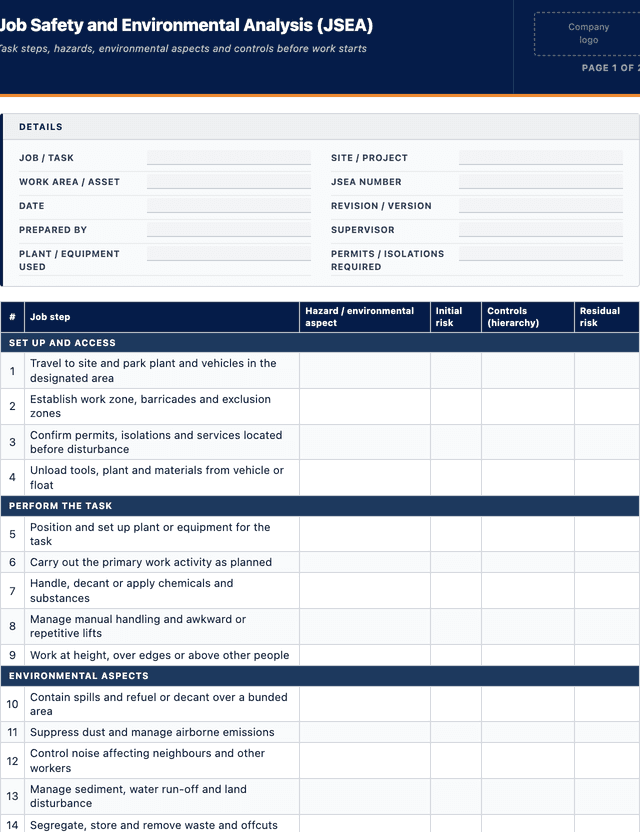
Task steps, hazards, environmental aspects and controls before work starts
SET UP AND ACCESS
PERFORM THE TASK
ENVIRONMENTAL ASPECTS
PACK DOWN AND CLOSE OUT
How to use: download the PDF, print or complete digitally on any device.
- PDF format, ready to print or fill on screen
- Use as-is or customise to suit your operation
- Go digital in MapTrack for photos, reminders and audit trails
Download free PDF template
Use in MapTrack →



Trusted by teams across Australia and New Zealand
We respect your privacy. Unsubscribe anytime.
Or set it up in MapTrack
- Fill it in on a phone, attach photos to any check
- Automatic reports and audit trails
- Upload the PDF and MapTrack drafts the form for you
Free 30-day trial. No credit card. Personal email accepted.
Don't just download it - use it live. Start a free workspace, upload this job safety and environmental analysis (JSEA) and MapTrack drafts it as a form your crew can run from a phone.

Co-Founder & Commercial Director
Key takeaways
- The MapTrack job safety and environmental analysis (JSEA) contains 18 checks across 4 sections. Sections covered: SET UP AND ACCESS, PERFORM THE TASK, ENVIRONMENTAL ASPECTS, PACK DOWN AND CLOSE OUT.
Enter your email below to download this job safety and environmental analysis (JSEA) as a ready-to-use PDF.
Used by construction, mining and field service teams










What is a job safety and environmental analysis (JSEA)?
A Job Safety and Environmental Analysis (JSEA) is a task-based risk assessment that breaks a job into its individual steps, then identifies the safety hazards and the environmental aspects of each step and records the controls that will keep the work safe and compliant. It captures the task, the site, the plant and people involved, and a row for every job step showing the hazard, the initial risk rating, the control measures applied and the residual risk once those controls are in place. The environmental column is what sets a JSEA apart from a plain JSA: it prompts the crew to consider spills, dust, noise, waste, water and land disturbance alongside the injury risks.
A JSEA matters because it is completed by the people who actually do the work, before they start, so hazards are found on paper instead of the hard way. It is a practical way to meet the risk management duties in the model Work Health and Safety (WHS) Regulations enacted in your state or territory (in Victoria, the Occupational Health and Safety Regulations 2017), which require hazards to be identified and risks controlled using the hierarchy of controls. Tying the assessment to a specific asset, plant item or work area also builds a record you can reuse next time the same job comes up, refine after an incident, and hand to a new crew so they inherit the hard-won knowledge instead of relearning it.
Learn more about compliance and inspections in MapTrack.
Benefits of using this job safety and environmental analysis (JSEA)
- Step-by-step clarity: breaking the job into ordered steps exposes the hazards hidden between tasks that a whole-of-job glance misses.
- Environmental cover: the added environmental column catches spills, dust, noise and waste that a safety-only assessment would leave unmanaged.
- Hierarchy of controls: each hazard is matched to a control and a residual rating, so the crew can see whether the risk is actually low enough to proceed.
- Worker ownership: the crew who do the work fill it in and sign on, which lifts buy-in and surfaces practical hazards a desk assessment never would.
- Reusable knowledge: a completed JSEA becomes the starting template for the next identical job, so lessons carry forward instead of being relearned.
- Audit evidence: a dated, signed JSEA against a task and asset is objective proof of a controlled risk process for WHS reviews or after an incident.
- Faster inductions: new crew members read the JSEA and understand the hazards, controls and sign-on requirements before they touch the job.
Benefits of digitising forms in MapTrack
When you move from paper or static PDFs to digital forms in MapTrack, you get:
- Field users can easily scan a QR code to complete a form on mobile. Unlimited users.
- Email the right people when a form is submitted, with an automation you set up.
- File every completed form against the asset, location or person it covers.
- Download any completed form as a PDF, with failed answers listed at the top.
- Fill in forms offline; they upload when the device is back online.
- Build conditional logic (show or hide questions based on answers).
- Take pictures or attach photos. Not possible with a paper-based form.
- Electronic signatures.
- Edit forms later without reprinting.
- Set who can view, fill in or edit forms with user roles.
- Upload a paper form (PDF, Word, Excel or a photo) and MapTrack's AI builds a digital version for you to check.
- Email safety managers when a hazard report is submitted, with an automation you set up.
- Keep every hazard and incident report against the site it came from, with photos.
- Turn a hazard report into a corrective-action work order with its own review step.
Book a demo to see how MapTrack handles forms.
Try MapTrack free for 30 days
Full access to every feature. No credit card required. Per-asset pricing so you scale as your fleet grows.
- No credit card required
- 30 days free trial
- Cancel anytime
1-2 days/week saved
“Bloody amazing! We used to spend 1-2 days a week tracking and managing our generators alone.”

Steve McAllister
Asset Coordinator, Saunders International
What to include in a job safety and environmental analysis (JSEA)
This job safety and environmental analysis (JSEA) covers 10 key areas:
- Job or task description, site or project, and the work area or asset it applies to
- Date, JSEA reference number and the revision or version
- Crew members involved, their roles, and the person supervising the work
- Plant, equipment and substances used on the task, with any tickets or licences required
- PPE required for the task and any permits, isolations or exclusion zones needed
- Job steps listed in the order they are performed, one row per step
- Hazards identified for each step, covering both safety and environmental aspects
- Initial risk rating, control measures from the hierarchy, and residual risk rating per step
- Environmental aspects: spill, dust, noise, waste, water and land disturbance controls
- Sign-on section for every worker plus supervisor authorisation before work starts
How to use this job safety and environmental analysis (JSEA)
- Define the job and gather the crew: Write down the exact job, the site and the asset or work area it covers, then bring together the people who will do the work. The crew who perform the task see hazards a supervisor at a desk will not, so their input up front makes the whole assessment more accurate and more likely to be followed.
- Break the job into ordered steps: List the task as a sequence of steps in the order they actually happen, from setting up to packing down. Keep each step to a single action rather than a broad phase, because hazards hide in the transitions between tasks and a step that is too broad will hide the very risk you are trying to catch.
- Identify safety and environmental hazards per step: For each step, name what could cause harm to people and what could harm the environment, such as spills, dust, noise, sediment run-off or waste. Consider the plant, the substances, the ground conditions and the people nearby so both the injury risk and the environmental aspect are captured in the same pass.
- Rate the risk and apply controls: Score each hazard for likelihood and consequence to set an initial rating, then choose controls working down the hierarchy from elimination through to PPE. Record the control against the hazard and re-rate the residual risk, so the crew can judge whether the remaining risk is low enough to start the work safely.
- Sign on, work to the plan and review: Every worker reads the JSEA and signs on to confirm they understand the hazards and controls, and the supervisor authorises the job. Keep the JSEA at the work front, stop and reassess if conditions or the scope change, and review it after the job or any incident so the next version is sharper.
In MapTrack, you can digitise safety inspections and compliance forms. Each submission is stored as a timestamped PDF against the asset record.
Get the free templateEnter your email above to download the full job safety and environmental analysis (JSEA) as a PDF.Back to download formHow often should you complete this form?
Complete a JSEA before the job starts and any time the task, the crew, the plant or the site conditions change enough to introduce new hazards. Unlike a quick Take 5, a JSEA suits non-routine, higher-risk or multi-step work where the hazards are not obvious at a glance.
Review the JSEA at each shift or job start even when reusing a prior version, because ground conditions, weather and the people on the job rarely stay identical. Formally revise the master JSEA after an incident, a near miss, a change in method or a change in the relevant standard, and re-issue it so every crew is working from the current controls.
Frequently asked questions
Applicable regulatory standards
This template is a starting point. Check the current requirements that apply to your equipment, work and location. The template alone does not establish compliance.
- Model Work Health and Safety Act (enacted in each state and territory; in Victoria, the Occupational Health and Safety Act 2004)
- Model Work Health and Safety Regulations, Part 3.1 Managing risks to health and safety (in Victoria, the Occupational Health and Safety Regulations 2017)
- Safe Work Australia Model Code of Practice: How to manage work health and safety risks
- ISO 45001:2018 Occupational health and safety management systems
Job Safety and Environmental Analysis (JSEA) preview
The numbers behind this job safety and environmental analysis (JSEA)
Every figure below is sourced and dated, so you can quote it in a toolbox talk, a budget case or a board paper without having to chase the original report.
Embed this free template on your website
Run an industry blog, trade association site, or training resource? Drop a preview of this free job safety and environmental analysis (JSEA) straight into your page. The snippet is self-contained, needs no scripts, and links readers back to the full free template.
<div style="max-width:480px;font-family:system-ui,-apple-system,'Segoe UI',Roboto,sans-serif;border:1px solid #E5E7EB;border-radius:12px;padding:20px;background:#ffffff;">
  <p style="font-size:12px;font-weight:700;letter-spacing:0.05em;text-transform:uppercase;color:#071D49;margin:0;">Free template</p>
  <p style="font-size:18px;font-weight:700;color:#071D49;margin:6px 0 0;">Job Safety and Environmental Analysis (JSEA)</p>
  <ul style="margin:12px 0 0;padding-left:18px;color:#374151;font-size:14px;line-height:1.6;">
    <li style="margin:4px 0;">Job or task description, site or project, and the work area or asset it applies to</li>
    <li style="margin:4px 0;">Date, JSEA reference number and the revision or version</li>
    <li style="margin:4px 0;">Crew members involved, their roles, and the person supervising the work</li>
    <li style="margin:4px 0;">Plant, equipment and substances used on the task, with any tickets or licences required</li>
    <li style="margin:4px 0;">PPE required for the task and any permits, isolations or exclusion zones needed</li>
    <li style="margin:4px 0;">Job steps listed in the order they are performed, one row per step</li>
  </ul>
  <p style="font-size:13px;color:#6B7280;margin:14px 0 0;padding-top:12px;border-top:1px solid #E5E7EB;">Free <a href="https://www.maptrack.com/templates/jsea-template" style="color:#071D49;font-weight:600;text-decoration:none;">Job Safety and Environmental Analysis (JSEA)</a> by MapTrack</p>
</div>Free to reuse, including commercially. This template is published under a Creative Commons Attribution 4.0 licence. Copy it, adapt it, put it on your own site or in your own docs. All we ask is that you credit MapTrack with a link back to this page. The snippet above already includes that credit, so if you use it as-is you’re covered.
Cite this template
Writing about this topic? You’re welcome to quote this checklist. Here’s the wording to use so your readers can find the original.
The MapTrack job safety and environmental analysis (JSEA) contains 18 checks across 4 sections.
- Short attribution
- MapTrack Job Safety and Environmental Analysis (JSEA), https://www.maptrack.com/templates/jsea-template
- Reference list
- MapTrack. (2026). Job Safety and Environmental Analysis (JSEA) [Checklist template]. Retrieved from https://www.maptrack.com/templates/jsea-template
Free to reuse with credit under a Creative Commons Attribution 4.0 licence. If you’d rather link straight to it, the page is https://www.maptrack.com/templates/jsea-template.
Need to digitise safety inspections and compliance forms?
Register every asset in MapTrack, attach digital forms, and get a complete history of every inspection, service and compliance record.
Compliance and inspections · All templates · Pricing · Book a demo