
Free template · PDF
Free verification of competency (VOC)
Free verification of competency (VOC) form and template (printable PDF). Theory questions plus practical observation sign-off. Download free.
Loading PDF page...
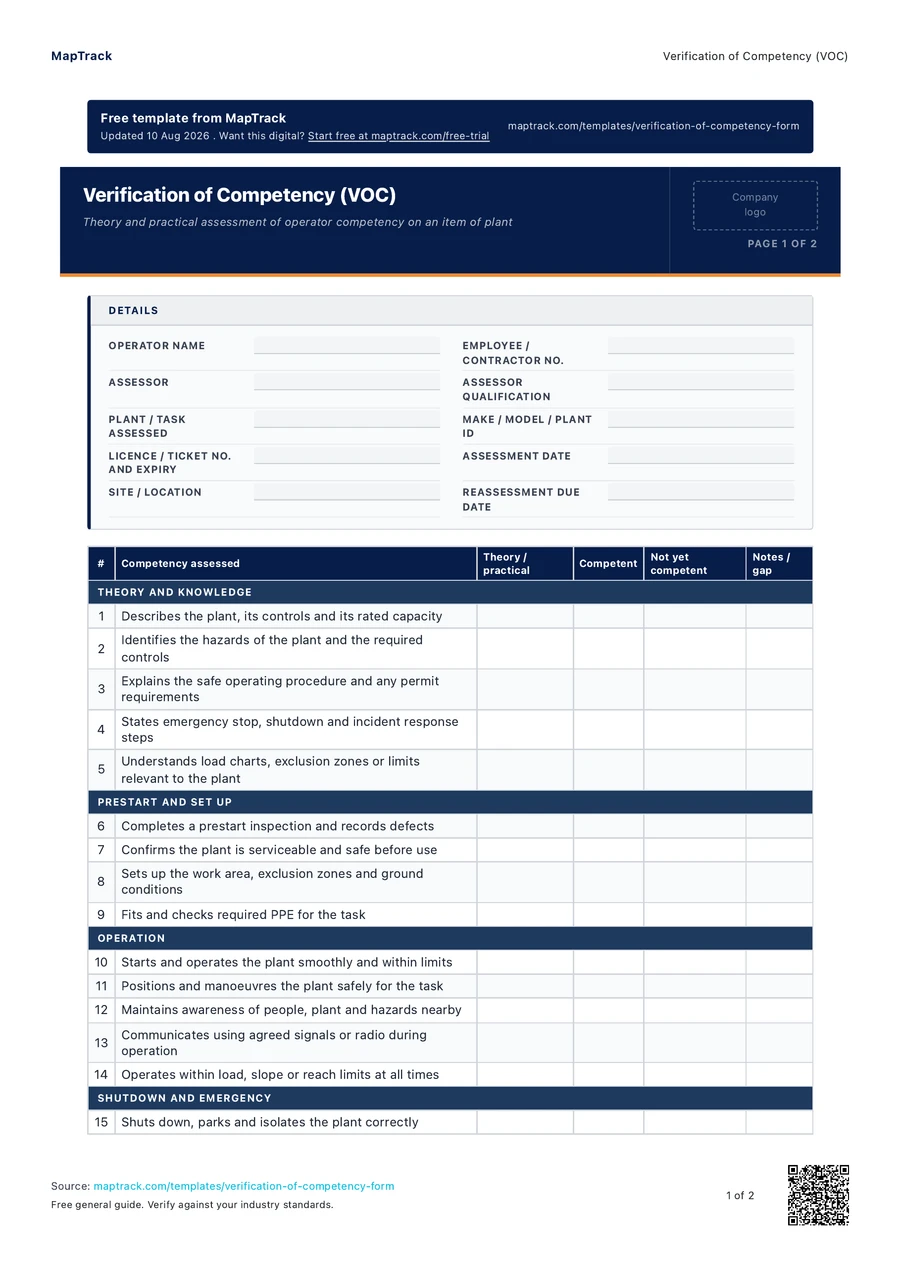

Read the form fields
18 checks · 4 sections · Sign-off
18 checks
The fields in the printable form, in a view that fits your screen.
- Operator name
- Employee / contractor no.
- Assessor
- Assessor qualification
- Plant / task assessed
- Make / model / plant ID
- Licence / ticket no. and expiry
- Assessment date
- Site / location
- Reassessment due date
THEORY AND KNOWLEDGE
PRESTART AND SET UP
OPERATION
SHUTDOWN AND EMERGENCY
Declaration & Sign-Off
I confirm that all items have been inspected/completed as indicated above. Any defects or concerns have been noted and reported.
Completed By
Printed name · Signature · Date
Reviewed / Approved By
Printed name · Signature · Date
The MapTrack verification of competency (VOC) contains 18 checks across 4 sections.

Make this form your own
Add your fields and logo. Give your team a form they can use on site.
Free 30-day trial. No credit card. Work email needed.
Upload & use this form now for free



“MapTrack beat them all in every aspect.”
 Vincent Stone · HSEQ Advisor, Concept Tanks
After signup: upload this PDF, check the form MapTrack drafts, then save and publish it for your team.
General guidance only. Check the form against your equipment manual, site procedures and local requirements before using it.
Key takeaways
- The MapTrack verification of competency (VOC) contains 18 checks across 4 sections. Sections covered: THEORY AND KNOWLEDGE, PRESTART AND SET UP, OPERATION, SHUTDOWN AND EMERGENCY.
- Operator name, employee or contractor number, and the assessment date
- Assessor name, their qualification to assess, and the assessment location or site
- Plant or task the VOC covers, with make, model and plant identifier
What is a verification of competency (VOC)?
A verification of competency (VOC) form is the document used to confirm that a worker is competent to operate a specific item of plant or carry out a specific task, by assessing them against a defined set of competencies through a mix of theory questions and practical observation. It records the operator, the assessor, the plant or task, the ticket or licence held, and a row for each competency showing what was observed, whether the operator was assessed as competent, and any gap to close before sign-off. A VOC does not replace a licence or ticket: it verifies that the person can safely apply that training on your plant, in your conditions, right now.
A VOC matters because a licence or ticket shows a worker was assessed as competent at some point in the past, often on different plant at a training provider, not that they can safely run your machine in your yard today. The model WHS Act requires a person conducting a business or undertaking to ensure workers are competent for the work (in Victoria, the Occupational Health and Safety Act 2004), and many sites and clients require a current VOC before an operator touches high-risk plant. A VOC itself is not a document prescribed by WHS law; it is a site or employer competency-assurance practice. Completing a VOC against the specific asset gives you dated evidence of competency, exposes skill gaps before they become incidents, and ties the assessment to both the operator and the plant in your records.
Learn more about compliance and inspections in MapTrack.
Signing off operators on several machines? Our guide compares plant and equipment management software in Australia.
Choose the format that fits your team
Download the PDF
Use the original printable form for a paper workflow. Check it against your equipment and site procedure before the job.
Keep completed copies in your own record system and arrange any follow-up through your normal process.
Download free PDFCustomise a form in MapTrack
Start a free trial, upload this PDF and MapTrack drafts the form. Adjust it to your workflow, then save and publish it for your team to use.
Sample answers on this page and completed PDF records aren't imported automatically.
Upload & use this form now for freeFree 30-day trial. No credit card. Work email needed.
Benefits of using this verification of competency (VOC)
- Site-specific competency: verifying the operator on your actual plant and conditions catches gaps a generic ticket from a training provider never would.
- Theory and practical: combining questions with observed operation confirms the operator both understands and can safely apply the task, not just one or the other.
- Ticket verification: recording the licence or ticket number and expiry against the VOC confirms the underlying qualification is genuine and current.
- Gap identification: marking any competency not yet met, with an action to close it, turns the VOC into a training plan rather than a pass or fail stamp.
- Client and site evidence: a dated, signed VOC is the record many principals and sites require before an operator is allowed on high-risk plant.
- Reduced incidents: confirming competency before an operator runs plant unsupervised removes a common root cause of plant incidents and near misses.
- Asset-linked record: tying the VOC to the specific plant item keeps operator competency visible against the same asset as its inspections and maintenance.
What to include in a verification of competency (VOC)
- Operator name, employee or contractor number, and the assessment date
- Assessor name, their qualification to assess, and the assessment location or site
- Plant or task the VOC covers, with make, model and plant identifier
- Licence, ticket or high-risk work licence held, with number and expiry date
- Theory questions covering the plant, hazards, controls and safe operating procedure
- Practical observation competencies: prestart, operation, shutdown and emergency response
- A competent or not-yet-competent result against each observed competency
- Any gaps identified and the action, training or reassessment needed to close them
- Overall outcome, any conditions or limits on the operator, and the reassessment due date
- Operator and assessor signatures confirming the result and any conditions
How to use this verification of competency (VOC)
Confirm the scope and check the ticket
Agree which plant or task the VOC covers, then sight and record the operator's licence or ticket and its expiry. The VOC verifies competency on top of that qualification, so confirm the underlying ticket is genuine and current first, because a VOC does not replace a required high-risk work licence.
Run the theory assessment
Ask the operator questions on the plant, its hazards, the controls, the safe operating procedure and what to do in an emergency. The theory check confirms the operator understands why the safe method matters, not just the sequence of levers, and it surfaces knowledge gaps before you put them on the machine.
Observe the practical operation
Watch the operator complete a prestart, operate the plant through the tasks it will actually do, shut it down correctly and respond to a simulated fault or emergency. Observe real operation rather than a demonstration, because a worker can describe the right method and still not apply it safely under load or time pressure.
Mark competencies and identify gaps
Mark each competency as competent or not yet competent based on what you observed, and record the specific gap for anything not met. A not-yet-competent result is not a failure, it is a defined training action with a person and a date attached, so the operator knows exactly what to close before reassessment.
Record the outcome and set review
Record the overall outcome and any conditions or limits on the operator, have both the operator and assessor sign, and set a reassessment due date. File the VOC against the operator and the plant, and reassess after the due date, an incident, a change to the plant, or a period away from operating it.
How often should you complete this form?
Complete a VOC before an operator runs an item of high-risk plant unsupervised, whenever they start on a new type of plant, and when they join a new site that requires site-specific verification. Many organisations then reverify on a set cycle, commonly every one to three years depending on the plant and the client requirement.
Reassess sooner if the operator is involved in an incident or near miss, returns after an extended period away from operating the plant, or if the plant is significantly modified. Keeping VOCs current against each operator and asset means you can show, at any point, that the people running your plant were verified competent to do so.
Make this form your own
From your template to your team.
Upload this PDF and MapTrack drafts the form. Adjust it for your equipment and site, then save and publish the digital form for your team.
- 01
Start your free trial
Use your work email to create your MapTrack account.
- 02
Customise, save and publish
Adjust the template fields and branding for your site.
- 03
Complete it on the job
Record checks, add photos and export a branded PDF.
Keep working offline
Load the form before you lose reception. Complete it offline and sync when you're back online.
Scan the asset. Open its form.
Use an asset's QR code to find and complete the forms that belong to it.
Show what you found
Capture photos and attach files so the next person has the details they need.
Take a branded PDF with you
Download completed forms as PDF reports with your company logo.
Completed paper records aren't imported automatically.
Frequently asked questions
Practical answers about the form, record keeping and using MapTrack.
A VOC is not itself a document prescribed by WHS law; there is no clause in the WHS Regulations that mandates a VOC. What the model WHS Act does require is that a person conducting a business or undertaking ensures workers are competent to do their work safely (in Victoria, the Occupational Health and Safety Act 2004), and for high-risk plant that duty is often met through a VOC on top of the required licence. A VOC does not replace a high-risk work licence or ticket where one is legally required: the licence is the legal authorisation, and the VOC verifies the person can apply it competently on your specific plant and site. Many principal contractors also require a current VOC as a condition of site access.
Link to this answerA ticket or high-risk work licence is a formal qualification issued after assessment by a registered training organisation, and for some plant it is a legal requirement to operate at all. A VOC is a workplace verification that the licensed operator can safely operate your particular plant, in your conditions, now. The licence proves training happened; the VOC confirms current, site-specific competency. You generally need both for high-risk plant.
Link to this answerA VOC should be conducted by a competent assessor: someone with the knowledge, skills and experience to judge safe operation of the plant, and often a formal assessment qualification. That may be an internal trainer, a supervisor with the right competency, or an external assessor. The key point is that the assessor must themselves be competent in the plant and the assessment method, so record the assessor's qualification on the form.
Link to this answerThere is no single legislated interval, but most organisations reverify on a set cycle, commonly every one to three years, with the exact period driven by the plant type and any client or site requirement. Reassess sooner after an incident or near miss, after an extended break from operating the plant, or after a significant modification to the plant. The aim is to be able to show current competency at any time.
Link to this answerYes, it is completely free. It downloads as a ready-to-print PDF. You do not need a MapTrack account. If you want to move beyond paper, MapTrack keeps your plant and equipment register with operator competency, licence expiry and reassessment due dates against each asset, so nothing lapses unnoticed. Start a free trial or book a demo to see how.
Link to this answerApplicable regulatory standards
This form is a starting point. Check the current requirements that apply to your equipment, work and location. The form alone does not establish compliance.
- Model Work Health and Safety Act, primary duty to ensure workers are competent, trained and supervised (in Victoria, the Occupational Health and Safety Act 2004). Note: a VOC is not itself a document prescribed by WHS law
- Model Work Health and Safety Regulations, high-risk work licensing (Chapter 4, Part 4.5; classes in Schedule 3) - the separate legal requirement a VOC does not replace
- Safe Work Australia Model Code of Practice: Managing the risks of plant in the workplace
- ISO 45001:2018 Occupational health and safety management systems
- Model Code of Practice: Managing risks of plant in the workplace (Safe Work Australia)
- Model WHS Regulations (Safe Work Australia)
- Model Work Health and Safety Act (Safe Work Australia)
- ISO 45001:2018, Occupational health and safety management systems (ISO catalogue)
MapTrack publishes this template. The linked authorities publish their own guidance; they haven't endorsed this form.
The numbers behind this verification of competency (VOC)
Every figure below is sourced and dated, so you can quote it in a toolbox talk, a budget case or a board paper without having to chase the original report.
Cite this template
Writing about this topic? You’re welcome to quote this checklist. Here’s the wording to use so your readers can find the original.
The MapTrack verification of competency (VOC) contains 18 checks across 4 sections.
- Short attribution
- MapTrack Verification of Competency (VOC), https://www.maptrack.com/templates/verification-of-competency-form
- Reference list
- MapTrack. (2026). Verification of Competency (VOC) [Checklist template]. Retrieved from https://www.maptrack.com/templates/verification-of-competency-form
Free to reuse with credit under a Creative Commons Attribution 4.0 licence. If you’d rather link straight to it, the page is https://www.maptrack.com/templates/verification-of-competency-form.
Embed this free template on your website
Run an industry blog, trade association site, or training resource? Drop a preview of this free verification of competency (VOC) straight into your page. The snippet is self-contained, needs no scripts, and links readers back to the full free template.
<div style="max-width:480px;font-family:system-ui,-apple-system,'Segoe UI',Roboto,sans-serif;border:1px solid #E5E7EB;border-radius:12px;padding:20px;background:#ffffff;">
  <p style="font-size:12px;font-weight:700;letter-spacing:0.05em;text-transform:uppercase;color:#071D49;margin:0;">Free template</p>
  <p style="font-size:18px;font-weight:700;color:#071D49;margin:6px 0 0;">Verification of Competency (VOC)</p>
  <ul style="margin:12px 0 0;padding-left:18px;color:#374151;font-size:14px;line-height:1.6;">
    <li style="margin:4px 0;">Operator name, employee or contractor number, and the assessment date</li>
    <li style="margin:4px 0;">Assessor name, their qualification to assess, and the assessment location or site</li>
    <li style="margin:4px 0;">Plant or task the VOC covers, with make, model and plant identifier</li>
    <li style="margin:4px 0;">Licence, ticket or high-risk work licence held, with number and expiry date</li>
    <li style="margin:4px 0;">Theory questions covering the plant, hazards, controls and safe operating procedure</li>
    <li style="margin:4px 0;">Practical observation competencies: prestart, operation, shutdown and emergency response</li>
  </ul>
  <p style="font-size:13px;color:#6B7280;margin:14px 0 0;padding-top:12px;border-top:1px solid #E5E7EB;">Free <a href="https://www.maptrack.com/templates/verification-of-competency-form" style="color:#071D49;font-weight:600;text-decoration:none;">Verification of Competency (VOC)</a> by MapTrack</p>
</div>Free to reuse, including commercially. This template is published under a Creative Commons Attribution 4.0 licence. Copy it, adapt it, put it on your own site or in your own docs. All we ask is that you credit MapTrack with a link back to this page. The snippet above already includes that credit, so if you use it as-is you’re covered.
About the author

Co-Founder & Commercial Director
Jarrod has spent over a decade in technology consulting and asset management, including roles at Accenture (mining and heavy industry) and CGI as an Asset Management Consultant. He co-founded MapTrack and built and scaled its original platform, then rebuilt it with Lachlan and Alex from thousands of customer conversations and 300+ user research sessions with field teams. His consulting background gives him deep insight into the operational and compliance challenges facing asset-intensive Australian businesses.
View LinkedIn profile →Ready for your next job?
Keep the PDF handy, or upload it to MapTrack and turn it into a digital form for your team.