
Free excavation and trenching SWMS
Free excavation and trenching SWMS template (PDF-ready). Shoring, BYDA, spoil, access and atmosphere controls for trenches over 1.5m.
Updated 10 Aug 2026
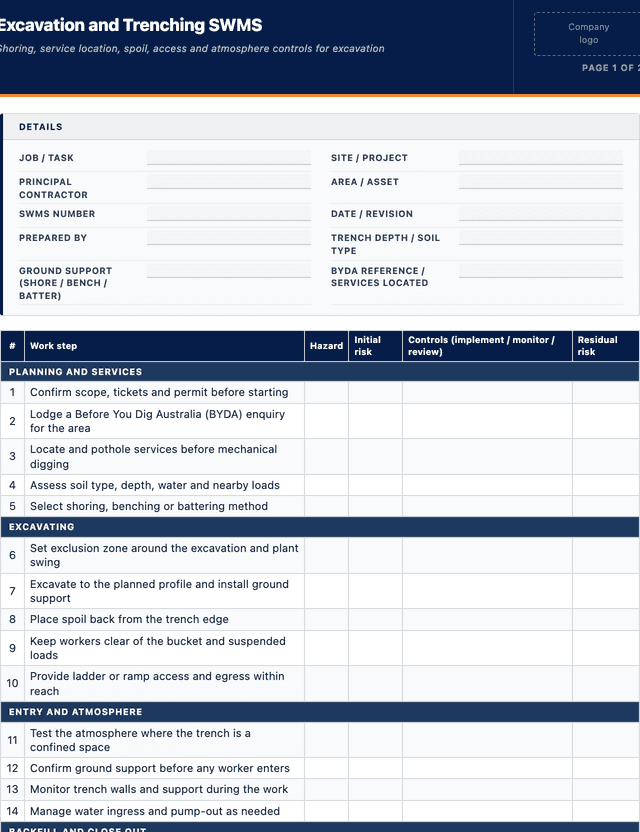
Excavation and Trenching SWMS
Shoring, service location, spoil, access and atmosphere controls for excavation
PLANNING AND SERVICES
EXCAVATING
ENTRY AND ATMOSPHERE
BACKFILL AND CLOSE OUT
How to use: download the PDF, print or complete digitally on any device.
- PDF format, ready to print or fill on screen
- Use as-is or customise to suit your operation
- Go digital in MapTrack for photos, reminders and audit trails
Download free PDF template
Use in MapTrack →



Trusted by teams across Australia and New Zealand
We respect your privacy. Unsubscribe anytime.
Or set it up in MapTrack
- Fill it in on a phone, attach photos to any check
- Automatic reports and audit trails
- Upload the PDF and MapTrack drafts the form for you
Free 30-day trial. No credit card. Personal email accepted.
Don't just download it - use it live. Start a free workspace, upload this excavation and trenching SWMS and MapTrack drafts it as a form your crew can run from a phone.

Co-Founder & Commercial Director
Key takeaways
- The MapTrack excavation and trenching SWMS contains 18 checks across 4 sections. Sections covered: PLANNING AND SERVICES, EXCAVATING, ENTRY AND ATMOSPHERE, BACKFILL AND CLOSE OUT.
Enter your email below to download this excavation and trenching SWMS as a ready-to-use PDF.
Used by construction, mining and field service teams











What is an excavation and trenching SWMS?
An excavation and trenching Safe Work Method Statement (SWMS) is the high-risk construction work document that sets out how excavation work, particularly trenches deeper than 1.5 metres, will be carried out safely. It records the job and site, the workers and their tickets, the plant used, and a row for every work step showing the hazard, the risk rating, the controls and how each control is implemented, monitored and reviewed. For excavation it focuses on preventing collapse through shoring, benching or battering, locating buried services before you dig, controlling spoil, providing safe access and egress, and testing the atmosphere where a trench can become a confined space.
An excavation and trenching SWMS matters because a trench collapse gives a worker no warning and no time to escape, and even a shallow fall of earth can bury and kill. Excavation work in or near a shaft or trench with an excavated depth greater than 1.5 metres, or a tunnel, is named in the high-risk construction work categories of the model WHS Regulations (in Victoria, the Occupational Health and Safety Regulations 2017), which require a SWMS before the work starts. This template keeps the ground-support and service-location controls explicit so a crew cannot enter an unsupported trench under time pressure, ties the controls to the specific site and asset, and gives you the dated, signed evidence a regulator or principal contractor expects.
Learn more about compliance and inspections in MapTrack.
Benefits of using this excavation and trenching SWMS
- Collapse prevention: shoring, benching and battering are written as controls per step, so the crew never enters an unsupported trench to save time.
- Services located: a required Before You Dig Australia (BYDA) enquiry and potholing stops an excavator striking gas, power, water or comms lines.
- Spoil control: keeping spoil back from the edge removes the surcharge load that causes many trench-wall collapses.
- Safe access: dedicated access and egress controls give workers a way out within reach along the trench, not a scramble at one end.
- Atmosphere aware: an atmospheric-testing step catches the point where a deep or enclosed trench becomes a confined space with its own hazards.
- Regulatory fit: a trench or shaft deeper than 1.5m is named high-risk construction work, and this template captures the hazard, control and review detail the regulation requires.
- Crew sign-on: every worker signs on, so the whole crew shares the same understanding of the ground support, services and exclusion zones.
Benefits of digitising forms in MapTrack
When you move from paper or static PDFs to digital forms in MapTrack, you get:
- Field users can easily scan a QR code to complete a form on mobile. Unlimited users.
- Email the right people when a form is submitted, with an automation you set up.
- File every completed form against the asset, location or person it covers.
- Download any completed form as a PDF, with failed answers listed at the top.
- Fill in forms offline; they upload when the device is back online.
- Build conditional logic (show or hide questions based on answers).
- Take pictures or attach photos. Not possible with a paper-based form.
- Electronic signatures.
- Edit forms later without reprinting.
- Set who can view, fill in or edit forms with user roles.
- Upload a paper form (PDF, Word, Excel or a photo) and MapTrack's AI builds a digital version for you to check.
- Email safety managers when a hazard report is submitted, with an automation you set up.
- Keep every hazard and incident report against the site it came from, with photos.
- Turn a hazard report into a corrective-action work order with its own review step.
Book a demo to see how MapTrack handles forms.
Try MapTrack free for 30 days
Full access to every feature. No credit card required. Per-asset pricing so you scale as your fleet grows.
- No credit card required
- 30 days free trial
- Cancel anytime
1-2 days/week saved
“Bloody amazing! We used to spend 1-2 days a week tracking and managing our generators alone.”

Steve McAllister
Asset Coordinator, Saunders International
What to include in an excavation and trenching SWMS
This excavation and trenching SWMS covers 10 key areas:
- Job description, site or project, principal contractor and the area or asset worked on
- SWMS number, date prepared and revision, with the person responsible for the SWMS
- Workers and roles, plus tickets for excavator, dogging or other plant used
- Plant and attachments used, and the ground-support method: shoring, benching or battering
- Before You Dig Australia (BYDA) plans, service locating results and potholing before mechanical digging
- Trench depth, soil type and water conditions, and the exclusion zone around the excavation
- Work steps in order, one row per step, covering set up, digging, entry and backfill
- Hazard, risk rating, controls and residual risk for each step
- Spoil placement, edge protection, access and egress points, and plant separation from workers
- Atmospheric testing where the trench is a confined space, emergency plan and worker sign-on
How to use this excavation and trenching SWMS
- Plan the dig and locate services first: Define the excavation, the site and the asset, lodge a Before You Dig Australia (BYDA) enquiry, and locate and pothole buried services before any mechanical digging. A trench or shaft deeper than 1.5 metres is named high-risk construction work, so the SWMS must be ready and understood before the excavator turns a bucket, not written up after the trench is open.
- Choose the ground-support method: Assess the soil type, depth, water and nearby loads, then select shoring, benching or battering to prevent collapse. Record which method applies to each part of the trench, because ground conditions change along a run, and a control that holds in stable clay may be useless in loose or saturated ground a few metres on.
- Control spoil, access and the exclusion zone: Set spoil back from the trench edge so it does not surcharge the wall, mark an exclusion zone around the excavation, and provide safe access and egress such as a ladder or ramp within reach of workers in the trench. Keep plant and its swing separated from workers, and never let anyone work beneath a suspended load or a swinging bucket.
- Rate hazards, test atmosphere and apply controls: For each work step, score the risk and apply controls, noting who implements each and how it is monitored. Where a deep or enclosed trench can become a confined space, test the atmosphere before entry, because gases can collect in a trench with no obvious warning and a worker who enters without testing may be overcome.
- Sign on, monitor and review: Every worker reads and signs on to the SWMS, and the supervisor authorises the job. Keep it at the work front, stop and revise it if the ground, the weather or the method changes, and review it after the job or any incident so the collapse-prevention controls stay current for the next crew.
In MapTrack, you can digitise safety inspections and compliance forms. Each submission is stored as a timestamped PDF against the asset record.
Get the free templateEnter your email above to download the full excavation and trenching SWMS as a PDF.Back to download formHow often should you complete this form?
Prepare an excavation and trenching SWMS before the work starts, and review it whenever the ground conditions, the depth, the weather or the crew changes. Rain can turn stable ground unstable overnight, so reassess the trench walls and support at the start of each shift and after any weather event.
Stop work and revise the SWMS if a control is not being followed or is not working, then re-communicate it and have the crew sign on again. Formally review the master SWMS after any incident or near miss, after a change to the ground-support method, or when a relevant standard or regulation changes.
Frequently asked questions
Applicable regulatory standards
This template is a starting point. Check the current requirements that apply to your equipment, work and location. The template alone does not establish compliance.
- Model Work Health and Safety Act (enacted in each state and territory; in Victoria, the Occupational Health and Safety Act 2004)
- Model Work Health and Safety Regulations, high-risk construction work and SWMS duties (regs 291 and 299; in Victoria, the Occupational Health and Safety Regulations 2017)
- Safe Work Australia Model Code of Practice: Excavation work
- Safe Work Australia Model Code of Practice: Construction work
Excavation and Trenching SWMS preview
The numbers behind this excavation and trenching SWMS
Every figure below is sourced and dated, so you can quote it in a toolbox talk, a budget case or a board paper without having to chase the original report.
Embed this free template on your website
Run an industry blog, trade association site, or training resource? Drop a preview of this free excavation and trenching SWMS straight into your page. The snippet is self-contained, needs no scripts, and links readers back to the full free template.
<div style="max-width:480px;font-family:system-ui,-apple-system,'Segoe UI',Roboto,sans-serif;border:1px solid #E5E7EB;border-radius:12px;padding:20px;background:#ffffff;">
  <p style="font-size:12px;font-weight:700;letter-spacing:0.05em;text-transform:uppercase;color:#071D49;margin:0;">Free template</p>
  <p style="font-size:18px;font-weight:700;color:#071D49;margin:6px 0 0;">Excavation and Trenching SWMS</p>
  <ul style="margin:12px 0 0;padding-left:18px;color:#374151;font-size:14px;line-height:1.6;">
    <li style="margin:4px 0;">Job description, site or project, principal contractor and the area or asset worked on</li>
    <li style="margin:4px 0;">SWMS number, date prepared and revision, with the person responsible for the SWMS</li>
    <li style="margin:4px 0;">Workers and roles, plus tickets for excavator, dogging or other plant used</li>
    <li style="margin:4px 0;">Plant and attachments used, and the ground-support method: shoring, benching or battering</li>
    <li style="margin:4px 0;">Before You Dig Australia (BYDA) plans, service locating results and potholing before mechanical digging</li>
    <li style="margin:4px 0;">Trench depth, soil type and water conditions, and the exclusion zone around the excavation</li>
  </ul>
  <p style="font-size:13px;color:#6B7280;margin:14px 0 0;padding-top:12px;border-top:1px solid #E5E7EB;">Free <a href="https://www.maptrack.com/templates/excavation-trenching-swms-template" style="color:#071D49;font-weight:600;text-decoration:none;">Excavation and Trenching SWMS</a> by MapTrack</p>
</div>Free to reuse, including commercially. This template is published under a Creative Commons Attribution 4.0 licence. Copy it, adapt it, put it on your own site or in your own docs. All we ask is that you credit MapTrack with a link back to this page. The snippet above already includes that credit, so if you use it as-is you’re covered.
Cite this template
Writing about this topic? You’re welcome to quote this checklist. Here’s the wording to use so your readers can find the original.
The MapTrack excavation and trenching SWMS contains 18 checks across 4 sections.
- Short attribution
- MapTrack Excavation and Trenching SWMS, https://www.maptrack.com/templates/excavation-trenching-swms-template
- Reference list
- MapTrack. (2026). Excavation and Trenching SWMS [Checklist template]. Retrieved from https://www.maptrack.com/templates/excavation-trenching-swms-template
Free to reuse with credit under a Creative Commons Attribution 4.0 licence. If you’d rather link straight to it, the page is https://www.maptrack.com/templates/excavation-trenching-swms-template.
Need to digitise safety inspections and compliance forms?
Register every asset in MapTrack, attach digital forms, and get a complete history of every inspection, service and compliance record.
Compliance and inspections · All templates · Pricing · Book a demo