
Free template · PDF
Free plant equipment risk assessment template
Free plant risk assessment template (PDF-ready). ISO 12100 (AS/NZS 4024.1201) machinery hazard scoring with model WHS plant-duty references.
Loading PDF page...
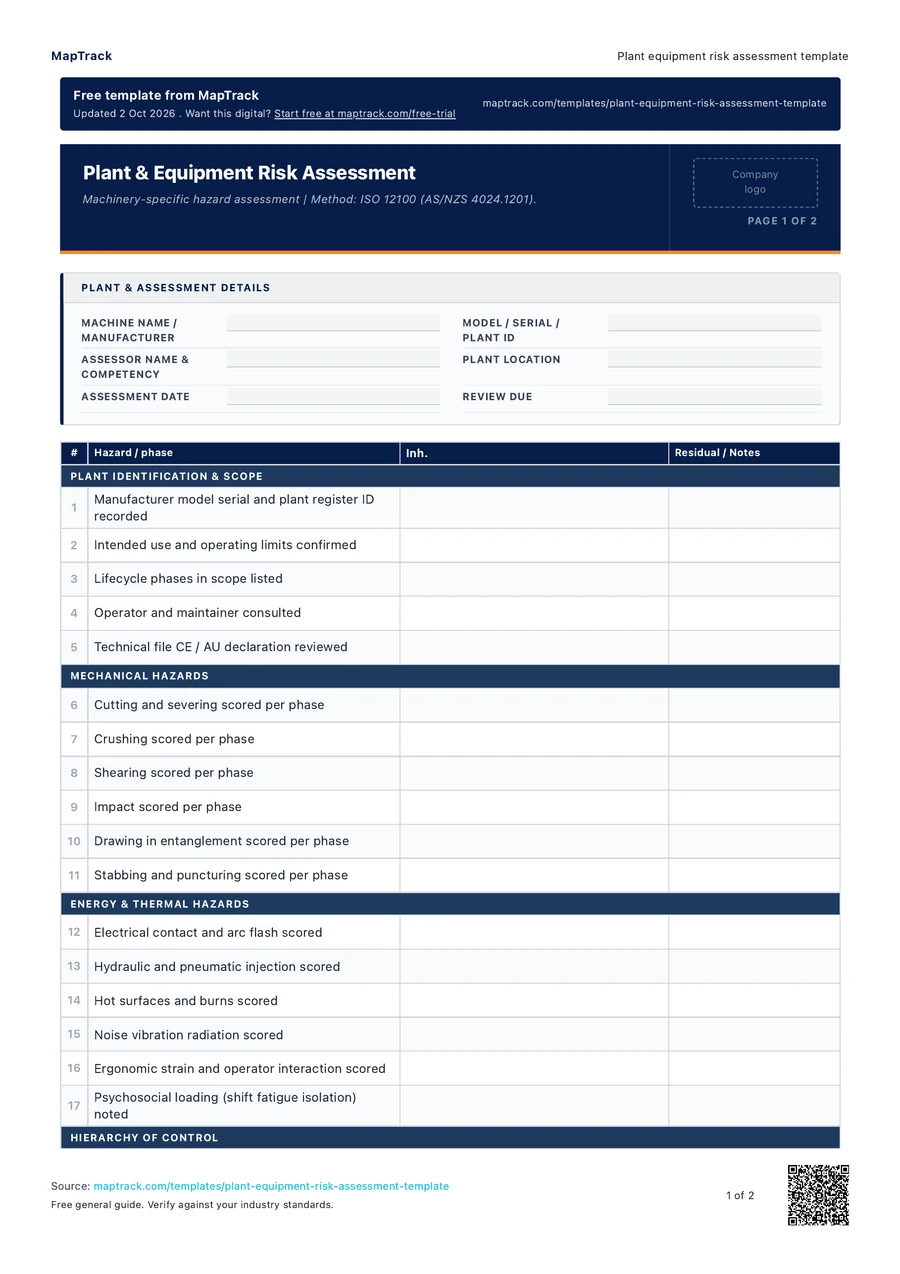

Read the form fields
23 checks · 4 sections · Sign-off
23 checks
The fields in the printable form, in a view that fits your screen.
- Machine name / manufacturer
- Model / serial / plant ID
- Assessor name & competency
- Plant location
- Assessment date
- Review due
Plant identification & scope
Mechanical hazards
Energy & thermal hazards
Hierarchy of control
Declaration & Sign-Off
I confirm that all items have been inspected/completed as indicated above. Any defects or concerns have been noted and reported.
Completed By
Printed name · Signature · Date
Reviewed / Approved By
Printed name · Signature · Date
The MapTrack plant equipment risk assessment template contains 23 checks across 4 sections.

Co-Founder & Commercial Director
Make this form your own
Add your fields and logo. Give your team a form they can use on site.
Free 30-day trial. No credit card. Work email needed.
Upload & use this form now for free



“MapTrack beat them all in every aspect.”
 Vincent Stone · HSEQ Advisor, Concept Tanks
After signup: upload this PDF, check the form MapTrack drafts, then save and publish it for your team.
General guidance only. Check the form against your equipment manual, site procedures and local requirements before using it.
Key takeaways
- The MapTrack plant equipment risk assessment template contains 23 checks across 4 sections. Sections covered: Plant identification & scope, Mechanical hazards, Energy & thermal hazards, Hierarchy of control.
- Plant identification: machine name, manufacturer, model, serial number, plant register ID, capacity, location and intended use including any limits or restrictions.
- Assessment context: trigger for the assessment (new plant, modification, relocation, post-incident, periodic review), assessor name and competency, supplier or designer details and the lifecycle phases in scope.
- Hazard categories: cutting and severing, crushing, shearing, impact, drawing in and entanglement, stabbing and puncturing, electrical contact and arc flash, hydraulic and pneumatic injection, hot surfaces and burns, slips and falls, noise, vibration, radiation, biological, ergonomic and psychosocial.
What is a plant equipment risk assessment template?
A plant and equipment risk assessment is a machinery-specific evaluation that scores the mechanical, electrical, hydraulic, pneumatic, thermal, ergonomic and noise hazards generated by a piece of plant or equipment across its design, supply, installation, operation, maintenance and decommissioning lifecycle. It is a document that designers, manufacturers, importers, suppliers, installers and people managing or controlling plant can use against a specific machine (press, conveyor, mixer, lathe, mill, packaging line, crusher, mobile plant, hoist, robot cell) rather than the broader generic workplace risk assessment that scores tasks or environments. The legal duties depend on the duty holder's role: sections 21 to 26 of the model WHS Act cover management or control of plant and the design, manufacture, import, supply, installation and commissioning of plant, while Part 5.1 of the model WHS Regulations adds role-specific plant duties. ISO 12100, adopted in Australia as AS/NZS 4024.1201, sets out the machinery risk assessment and risk reduction method, and AS 4024.1100 is the application guide to the AS 4024.1 series. OSHA 29 CFR 1910 Subpart O and EU machinery law are jurisdiction-specific references, so confirm which law and standard applies before relying on this general template.
The assessment is distinct from a generic workplace risk assessment because it works through the hazard categories that exist only at the machine boundary: cutting and severing, crushing, shearing, impact, drawing in and entanglement, stabbing and puncturing, electrical contact and arc flash, hydraulic and pneumatic injection, hot surface burns, noise, vibration, radiation, and ergonomic strain in operator interaction. For each hazard the assessment identifies the lifecycle phase (design, transport, installation, commissioning, operation, cleaning, maintenance, fault-finding, decommissioning), scores the likelihood and severity, applies the machinery-specific hierarchy of controls (inherent design measures first, safeguarding and complementary protective measures second, information for use last) and re-scores the residual risk. WHS coordinators and major-project HSE managers complete the assessment when introducing new plant, when modifying or relocating existing plant, after an incident or near-miss involving the equipment, and when periodic plant review cycles fall due. The output can inform operator instructions, guarding, isolation procedures, pre-start checks and plant records. Which documents and controls are required depends on the plant, the duty holder's role and the applicable jurisdiction.
Learn more about compliance and inspections in MapTrack.
Keeping risk assessments with each machine? Our guide compares plant and equipment management software in Australia, including how each handles plant risk.
Choose the format that fits your team
Download the PDF
Use the original printable form for a paper workflow. Check it against your equipment and site procedure before the job.
Keep completed copies in your own record system and arrange any follow-up through your normal process.
Download free PDFCustomise a form in MapTrack
Start a free trial, upload this PDF and MapTrack drafts the form. Adjust it to your workflow, then save and publish it for your team to use.
Sample answers on this page and completed PDF records aren't imported automatically.
Upload & use this form now for freeFree 30-day trial. No credit card. Work email needed.
Benefits of using this plant equipment risk assessment template
- Machinery-specific coverage: scores cutting crushing shearing entanglement and arc flash hazards at the machine boundary that a generic workplace or task-based risk assessment routinely treats as a single item.
- Role-based evidence: records hazards and controls relevant to duties in sections 21 to 26 of the model WHS Act and Part 5.1 of the model WHS Regulations; completing the template alone does not establish compliance.
- Lifecycle visibility: the assessment is scored across design transport installation commissioning operation cleaning maintenance fault-finding and decommissioning so risks beyond normal use are surfaced and controlled.
- ISO and AS structure: organises hazards and controls around the risk-assessment and risk-reduction approach in ISO 12100 (AS/NZS 4024.1201), subject to confirming the applicable edition and plant-specific standards.
- Guarding and LOTO input: residual risk scoring at each lifecycle phase drives the guarding specification energy isolation strategy and lockout-tagout procedure rather than leaving them to ad-hoc supplier choices.
- Decision record: keeps the hazard, selected controls, residual risk and follow-up actions together so the reasoning can support later reviews and related plant records.
What to include in a plant equipment risk assessment template
- Plant identification: machine name, manufacturer, model, serial number, plant register ID, capacity, location and intended use including any limits or restrictions.
- Assessment context: trigger for the assessment (new plant, modification, relocation, post-incident, periodic review), assessor name and competency, supplier or designer details and the lifecycle phases in scope.
- Hazard categories: cutting and severing, crushing, shearing, impact, drawing in and entanglement, stabbing and puncturing, electrical contact and arc flash, hydraulic and pneumatic injection, hot surfaces and burns, slips and falls, noise, vibration, radiation, biological, ergonomic and psychosocial.
- Lifecycle phases: design and supply, transport and installation, commissioning and testing, normal operation, set-up and changeover, cleaning, maintenance, fault-finding and recovery, training, decommissioning and disposal.
- Inherent risk scoring: a likelihood and severity matrix scored for each hazard at each lifecycle phase, recording the worst-case event the hazard could realistically produce.
- Control measures: inherent design measures (geometry, energy reduction, fail-safe defaults), safeguarding and complementary protective measures (fixed and movable guards, interlocks, light curtains, emergency stops, two-hand controls) and information for use (operator manual, warnings, training, PPE).
- Residual risk scoring: re-scoring of the same matrix after controls are applied so the residual band is recorded against each hazard and lifecycle phase.
- Operator interaction analysis: ergonomic and human-factors review of the operator station, control reach, visibility, force exertion, manual handling, shift duration and any fatigue or psychosocial loading the design introduces.
- Compliance mapping: references to the model WHS provisions, AS 4024 or ISO 12100 clauses and any jurisdiction-specific or plant-specific standards confirmed as applicable to the equipment.
- Sign-off and review schedule: assessor details, the basis of their competence, internal approval where required, valid-from and review-due dates, links to related procedures and the events that trigger an earlier review.
How to use this plant equipment risk assessment template
Gather machine information before scoring any hazard
collect the manufacturer technical file, any declaration or certification actually supplied with the plant, the supplier manual, electrical schematics, hydraulic and pneumatic circuit drawings, prior incident reports, modification records and the plant register entry so the assessment is grounded in the actual machine configuration rather than a generic template.
List every hazard at the machine boundary across the lifecycle
walk the machine with the operator and the maintainer, identify each cutting crushing shearing entanglement electrical hydraulic hot surface noise vibration radiation and ergonomic hazard, then map the hazard against every lifecycle phase (operation, cleaning, maintenance, fault-finding) because the worst-case is rarely the normal operating mode.
Score the inherent risk for each hazard and phase
apply the risk-estimation method selected for the assessment and document its source. If the assessment is to follow ISO 12100 (AS/NZS 4024.1201), use that standard's method and definitions rather than treating this template's generic matrix as certification. Record the initial risk against each relevant hazard and lifecycle phase.
Apply the machinery hierarchy of controls and re-score residual risk
work through inherent design (geometry, energy reduction, fail-safe defaults), safeguarding (fixed and movable guards, interlocks, light curtains, two-hand controls, emergency stops) and information for use (operator manual, warnings, PPE) in order, record the chosen control against each hazard and re-score the residual risk matrix.
Document operator interaction compliance mapping and sign-off
complete the ergonomic and human-factors review of the operator station, map controls to the legal provisions and standards confirmed as applicable, and record any resulting actions for operator instructions, isolation procedures or pre-start checks. Record the assessor's competence and follow the organisation's approval and release-to-service process.
How often should you complete this assessment?
The model WHS Regulations do not set a universal three- or five-year review interval for plant risk assessments. Regulation 38 requires control measures to be reviewed and, where necessary, revised when they are not effective, before a workplace change likely to create a new or different risk, when a new hazard or risk is identified, when consultation indicates a review is needed or when an eligible health and safety representative requests one. Plant commissioning, modification, relocation, a guarding or control-system change, an incident or a material change in use can therefore trigger review depending on the facts. Set any additional periodic review date from the manufacturer's information, a competent person's advice, the applicable standard and the risk profile. In MapTrack, the assessment can be attached to the plant asset and given a review date or reminder to support that internal cycle; the reminder does not determine legal compliance.
Make this form your own
From your template to your team.
Upload this PDF and MapTrack drafts the form. Adjust it for your equipment and site, then save and publish the digital form for your team.
- 01
Start your free trial
Use your work email to create your MapTrack account.
- 02
Customise, save and publish
Adjust the template fields and branding for your site.
- 03
Complete it on the job
Record checks, add photos and export a branded PDF.
Keep working offline
Load the form before you lose reception. Complete it offline and sync when you're back online.
Scan the asset. Open its form.
Use an asset's QR code to find and complete the forms that belong to it.
Show what you found
Capture photos and attach files so the next person has the details they need.
Take a branded PDF with you
Download completed forms as PDF reports with your company logo.
Completed paper records aren't imported automatically.
Frequently asked questions
Practical answers about the form, record keeping and using MapTrack.
ISO 12100 (adopted as AS/NZS 4024.1201:2014) is the technical reference for machinery risk assessment and risk reduction, and AS 4024.1100 is the application guide to the AS 4024.1 series. Under the model WHS laws, legal plant duties arise from sections 21 to 26 of the Act and Part 5.1 of the Regulations, with the relevant provision depending on whether the duty holder manages or controls, designs, manufactures, imports, supplies, installs or commissions the plant. Those provisions do not mandate this particular template. OSHA 29 CFR 1910 Subpart O is a US reference, while EU machinery law applies to machinery placed on the EU market. Confirm the law adopted in your jurisdiction and the current standards that apply to the plant.
Link to this answerA generic risk assessment template scores tasks, workplaces or activities at a broad level and applies the workplace hierarchy of controls. A plant and equipment risk assessment focuses on machinery hazards and the lifecycle phases relevant to the duty holder, and can apply the risk-reduction approach in ISO 12100 (AS/NZS 4024.1201). The Safe Work Australia model plant Code notes that a formal risk assessment is not always required when the hazards and effective controls are already well known. Use a machinery-specific assessment when it is needed to understand the risk, choose controls or meet a plant-specific requirement; an existing generic assessment does not remove the underlying plant duties.
Link to this answerResponsibility depends on the role. Sections 22 to 26 of the model WHS Act impose separate duties on designers, manufacturers, importers, suppliers and businesses that install, construct or commission plant. Section 21 and model WHS regulation 203 apply to a person with management or control of plant at a workplace. Regulations 204 and 213 require a competent person for specified installation, commissioning, maintenance, inspection and testing activities. The model provisions do not prescribe a chartered engineer or plant-owner signature for every plant risk assessment. Record the assessor's relevant training, qualifications or experience, apply any plant-specific licensing or registration rule, and consult affected workers as required by section 47 of the model Act.
Link to this answerCover the lifecycle phases relevant to the plant and the duty holder's role, such as design and supply, transport and installation, commissioning, operation, set-up, cleaning, maintenance, fault-finding and decommissioning. Sections 22 to 25 of the model WHS Act extend duties to specified reasonably foreseeable activities across a plant's lifecycle, and ISO 12100 provides a lifecycle risk-assessment method. Exposure can change when guards are removed or energy is isolated for cleaning and maintenance, so assess those states where relevant. The model WHS provisions do not prescribe this template's row-by-row likelihood and severity scoring method.
Link to this answerUse the plant risk assessment to inform the isolation procedure and pre-start checklist. Record the electrical, hydraulic, pneumatic, mechanical, thermal and gravitational energy sources relevant to the machine, then identify controls and the safety-critical items that need checking. Verify the resulting isolation and pre-start steps against the manufacturer's information, the actual plant configuration and any applicable standard; this general template does not by itself establish an AS 4024-compliant procedure.
Link to this answerReview the assessment when the controls may no longer be effective, before a change likely to introduce a new or different risk, when a new hazard is identified, when consultation indicates a review is needed or when an eligible health and safety representative requests one. Those triggers come from model WHS regulation 38. A modification, relocation, incident, new tooling, changed throughput or guarding upgrade can trigger review depending on its effect on risk. The model WHS Regulations do not prescribe a universal three- or five-year cycle, so set any additional periodic interval from the manufacturer's information, a competent person's advice, the applicable standard and the plant's risk profile.
Link to this answerYes. Adapt the structure to the hazards and lifecycle phases that apply. Under model WHS regulations 196 and 197, an importer must obtain and pass on required information, inspect the plant using manufacturer information, complete any required testing and address or disclose identified risks before supply. Regulation 199 requires a second-hand supplier to identify faults so far as reasonably practicable and give the recipient written notice of the condition, faults and, where appropriate, that the plant should not be used until rectified. These provisions do not require a particular declaration or universal reassessment against the newest standard. Use a competent person where information is missing, the plant has changed or its safety is uncertain.
Link to this answerYes. Download and use this plant and equipment risk assessment template for free. It downloads as a ready-to-print PDF. No MapTrack account is required. In MapTrack, you can attach a digital assessment and photos to the plant asset and set a review date or reminder. Related procedures and checks can be kept with the asset record according to the account workflow. Start free or book a demo to see how.
Link to this answerApplicable regulatory standards
This form is a starting point. Check the current requirements that apply to your equipment, work and location. The form alone does not establish compliance.
- AS 4024.1100:2019 (Safety of machinery - Application guide)
- ISO 12100:2010 (Safety of machinery - General principles for design - Risk assessment and risk reduction), adopted as AS/NZS 4024.1201:2014
- Model WHS Act 2011, sections 21 to 26 - management or control, design, manufacture, import, supply, installation and commissioning of plant
- Model WHS Regulations 2011, Part 5.1 - role-specific plant duties, including regulations 187 to 215
- Model WHS Regulations 2011, regulation 38 - review of control measures
- OSHA 29 CFR 1910 Subpart O (Machinery and machine guarding)
- EU Machinery Directive 2006/42/EC Annex I
- Model WHS Regulations (Safe Work Australia)
- Model Work Health and Safety Act (Safe Work Australia)
- OSHA 29 CFR Part 1910, Occupational Safety and Health Standards
- AS 4024 series, Safety of machinery (Standards Australia listing)
MapTrack publishes this template. The linked authorities publish their own guidance; they haven't endorsed this form.
The numbers behind this plant equipment risk assessment template
Every figure below is sourced and dated, so you can quote it in a toolbox talk, a budget case or a board paper without having to chase the original report.
Cite this template
Writing about this topic? You’re welcome to quote this checklist. Here’s the wording to use so your readers can find the original.
The MapTrack plant equipment risk assessment template contains 23 checks across 4 sections.
- Short attribution
- MapTrack Plant equipment risk assessment template, https://www.maptrack.com/templates/plant-equipment-risk-assessment-template
- Reference list
- MapTrack. (2026). Plant equipment risk assessment template [Checklist template]. Retrieved from https://www.maptrack.com/templates/plant-equipment-risk-assessment-template
Free to reuse with credit under a Creative Commons Attribution 4.0 licence. If you’d rather link straight to it, the page is https://www.maptrack.com/templates/plant-equipment-risk-assessment-template.
Embed this free template on your website
Run an industry blog, trade association site, or training resource? Drop a preview of this free plant equipment risk assessment template straight into your page. The snippet is self-contained, needs no scripts, and links readers back to the full free template.
<div style="max-width:480px;font-family:system-ui,-apple-system,'Segoe UI',Roboto,sans-serif;border:1px solid #E5E7EB;border-radius:12px;padding:20px;background:#ffffff;">
  <p style="font-size:12px;font-weight:700;letter-spacing:0.05em;text-transform:uppercase;color:#071D49;margin:0;">Free template</p>
  <p style="font-size:18px;font-weight:700;color:#071D49;margin:6px 0 0;">Plant equipment risk assessment template</p>
  <ul style="margin:12px 0 0;padding-left:18px;color:#374151;font-size:14px;line-height:1.6;">
    <li style="margin:4px 0;">Plant identification: machine name, manufacturer, model, serial number, plant register ID, capacity, location and intended use including any limits or restrictions.</li>
    <li style="margin:4px 0;">Assessment context: trigger for the assessment (new plant, modification, relocation, post-incident, periodic review), assessor name and competency, supplier or designer details and the lifecycle phases in scope.</li>
    <li style="margin:4px 0;">Hazard categories: cutting and severing, crushing, shearing, impact, drawing in and entanglement, stabbing and puncturing, electrical contact and arc flash, hydraulic and pneumatic injection, hot surfaces and burns, slips and falls, noise, vibration, radiation, biological, ergonomic and psychosocial.</li>
    <li style="margin:4px 0;">Lifecycle phases: design and supply, transport and installation, commissioning and testing, normal operation, set-up and changeover, cleaning, maintenance, fault-finding and recovery, training, decommissioning and disposal.</li>
    <li style="margin:4px 0;">Inherent risk scoring: a likelihood and severity matrix scored for each hazard at each lifecycle phase, recording the worst-case event the hazard could realistically produce.</li>
    <li style="margin:4px 0;">Control measures: inherent design measures (geometry, energy reduction, fail-safe defaults), safeguarding and complementary protective measures (fixed and movable guards, interlocks, light curtains, emergency stops, two-hand controls) and information for use (operator manual, warnings, training, PPE).</li>
  </ul>
  <p style="font-size:13px;color:#6B7280;margin:14px 0 0;padding-top:12px;border-top:1px solid #E5E7EB;">Free <a href="https://www.maptrack.com/templates/plant-equipment-risk-assessment-template" style="color:#071D49;font-weight:600;text-decoration:none;">Plant equipment risk assessment template</a> by MapTrack</p>
</div>Free to reuse, including commercially. This template is published under a Creative Commons Attribution 4.0 licence. Copy it, adapt it, put it on your own site or in your own docs. All we ask is that you credit MapTrack with a link back to this page. The snippet above already includes that credit, so if you use it as-is you’re covered.
About the author

Co-Founder & Commercial Director
Jarrod has spent over a decade in technology consulting and asset management, including roles at Accenture (mining and heavy industry) and CGI as an Asset Management Consultant. He co-founded MapTrack and built and scaled its original platform, then rebuilt it with Lachlan and Alex from thousands of customer conversations and 300+ user research sessions with field teams. His consulting background gives him deep insight into the operational and compliance challenges facing asset-intensive Australian businesses.
View LinkedIn profile →Ready for your next job?
Keep the PDF handy, or upload it to MapTrack and turn it into a digital form for your team.