
Free template · PDF
Free mini excavator daily pre-start checklist
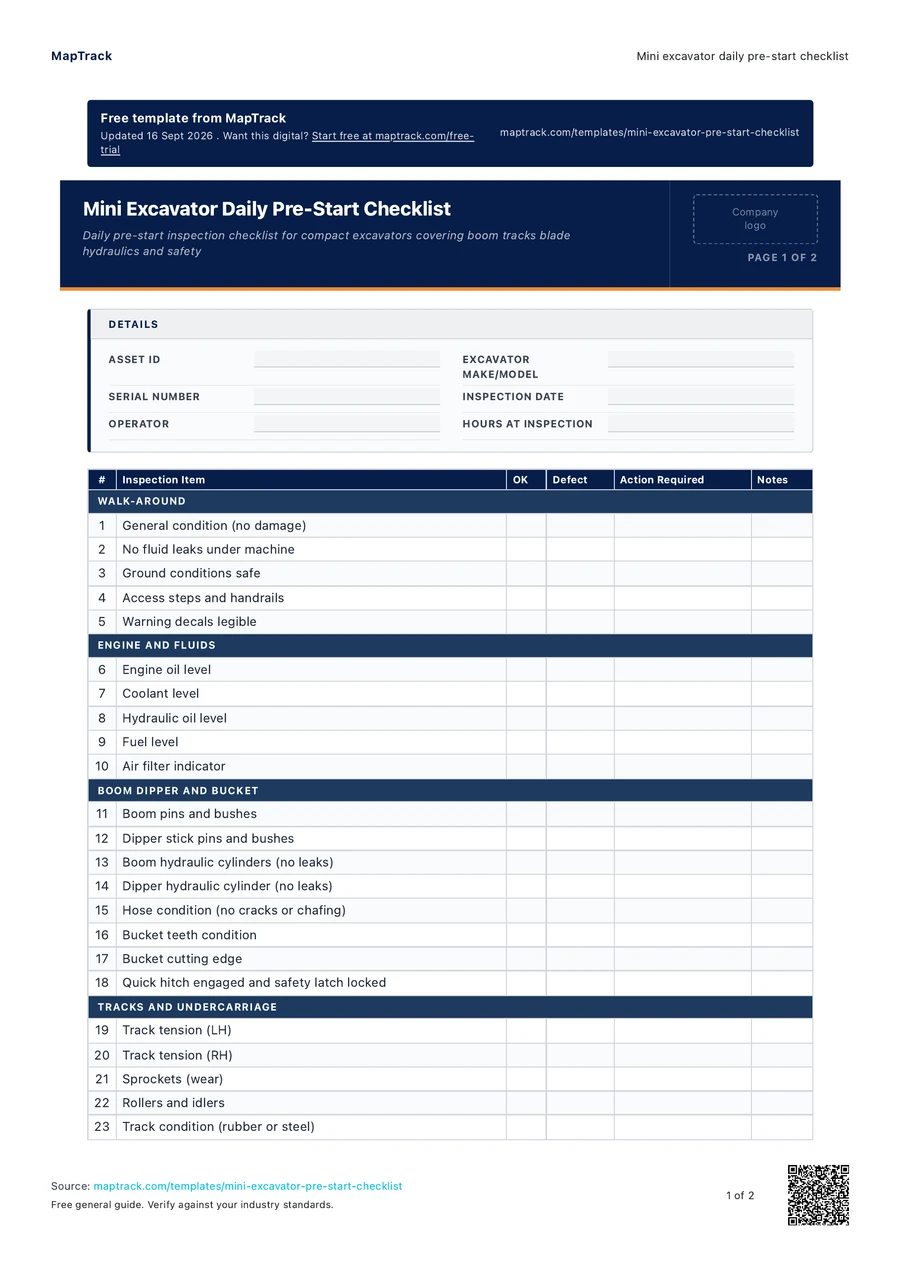
Record the mini excavator checks and findings before use. Download the PDF or customise a digital form for your team.
Loading PDF page...

Read the form fields
39 checks · 5 sections · Sign-off
39 checks
The fields in the printable form, in a view that fits your screen.
- Asset ID
- Excavator make/model
- Serial number
- Inspection date
- Operator
- Hours at inspection
Walk-Around
Engine and Fluids
Boom Dipper and Bucket
Tracks and Undercarriage
Cab Controls and Safety
Declaration & Sign-Off
I confirm that all items have been inspected/completed as indicated above. Any defects or concerns have been noted and reported.
Completed By
Printed name · Signature · Date
Reviewed / Approved By
Printed name · Signature · Date
ILLUSTRATIVE RECORD
A worked record example
Sample entries, not a customer inspection or a product screenshot.
Illustrative example. Adapt the detail to your equipment, project and workplace procedures.
- Asset
- MINI-014
- Checklist item
- 24
- Observation
- Damage found on the dozer blade cutting edge.
- Status
- Reported; assessment pending.
- Next owner and action
- Maintenance supervisor to assess the finding and record the next action.
Keep the finding and the follow-up together; a tick alone doesn't explain an unresolved defect.
The MapTrack mini excavator daily pre-start checklist contains 39 checks across 5 sections.

Make this form your own
Add your fields and logo. Give your team a form they can use on site.
Free trial. No credit card. Work email needed.
Customise & use this form now for free



“MapTrack beat them all in every aspect.”
 Vincent Stone · HSEQ Advisor, Concept Tanks
After signup: customise the template, then save and publish it for your team.
General guidance only. Check the form against your equipment manual, site procedures and local requirements before using it.
Short answer
A mini excavator pre-start checklist records the operator's checks before use: walk-around, fluids, boom, dipper, bucket and attachment, tracks, dozer blade, controls and safety items, with the machine ID, operator, findings and sign-off. Operators complete it at the point the manufacturer's instructions and site procedure set. Regulation 213 of the model WHS Regulations requires plant maintenance and inspection by a competent person.
Checked against Managing risks of plant in the workplace (model Code) (November 2024 version (reviewed May 2018; amended 2021, 2023 and 2024)) on by the MapTrack templates team. How we check templates
Key takeaways
- The MapTrack mini excavator daily pre-start checklist contains 39 checks across 5 sections. Sections covered: Walk-Around, Engine and Fluids, Boom Dipper and Bucket, Tracks and Undercarriage, Cab Controls and Safety.
- Record the mini excavator checks and findings before use. Download the PDF or customise a digital form for your team.
- Keep the finding and the follow-up together; a tick alone doesn't explain an unresolved defect.
- Keep the asset or project reference consistent across the form and its supporting records.
What is a mini excavator daily pre-start checklist?
A mini excavator pre-start checklist records the checks made before the equipment is used. This form covers walk-around, fluids, boom, dipper, bucket, tracks, dozer blade, controls and safety items, with space to identify the machine and operator and record findings. Check each applicable item against the equipment instructions and workplace process, rather than treating a ticked box as a guarantee that the machine is safe.
The compact excavator checklist includes the dozer blade as well as the digging equipment. Make sure the selected attachment and machine configuration are reflected in the checks.
Record a defect clearly enough for the next person to understand it: identify the item, describe the observation and note who it was reported to. Follow the site's process for taking unsafe equipment out of use and arranging assessment. Keep any repair and return-to-service decision connected to the same asset ID.
The PDF is a starting point for the record, not a complete inspection procedure for every model. Review it before use, add any missing checks and explain items that don't apply. An item that couldn't be checked needs follow-up; it isn't the same as an item that is not applicable. Use the Notes column to explain that distinction.
Learn more about pre-start inspections in MapTrack.
Doing pre-starts on mini excavators? See the asset tracking solution for civil contractors with pre-starts on phones and services on the hours.
Choose the format that fits your team
Download the PDF
Use the original printable form for a paper workflow. Check it against your equipment and site procedure before the job.
Keep completed copies in your own record system and arrange any follow-up through your normal process.
Download free PDFCustomise a form in MapTrack
Start a free trial, adjust the digital form to your workflow, then save and publish it for your team to use.
Your account uses the digital template. Sample answers on this page and completed PDF records aren't imported automatically.
Customise & use this form now for freeFree trial. No credit card. Work email needed.
Benefits of using this mini excavator daily pre-start checklist
- Equipment reference: recording the mini excavator ID connects the completed check to the right machine, site and maintenance history.
- Clear findings: an item-by-item record gives the reviewer a place to look for defects, limitations and follow-up notes.
- Operator handover: a dated record helps the next person see what was checked and which findings still need attention.
- Consistent review: the same field order helps the team compare records while still allowing checks specific to each machine.
- Maintenance context: linking a reported defect to its repair record lets a reviewer follow the issue from observation to completion.
- Useful sign-off: names and dates identify who completed and reviewed the record without implying that the form certifies the equipment.
What to include in a mini excavator daily pre-start checklist
- Walk-around inspection: check for leaks damage loose components and ground conditions around the machine
- Engine and fluids: check engine oil coolant hydraulic oil fuel level and air filter indicator
- Boom and dipper stick: inspect pins and bushes hydraulic cylinders hoses and check for cracks or damage
- Bucket and quick hitch: inspect bucket teeth cutting edge and confirm quick hitch pin engagement and safety latch
- Tracks and undercarriage: check track tension sprockets rollers idlers and rubber or steel track condition
- Dozer blade: inspect blade cutting edge cylinder and pins for wear and correct operation
- Cab and controls: check ROPS/FOPS canopy seatbelt mirrors horn lights joystick and travel pedal or lever operation
- Safety devices: verify fire extinguisher first aid kit emergency stop and warning decals are present
How to use this mini excavator daily pre-start checklist
Identify the equipment and operator
Record the mini excavator ID, operator, date and the other details requested on the form. Confirm the checklist is appropriate for the machine and fitted equipment.
Use the equipment instructions
Follow the manufacturer's safe inspection procedure and your workplace requirements for each applicable check. Only perform tasks you are trained and authorised to carry out.
Record the result of each check
Mark the result using the form's columns and add a clear note for a defect or incomplete check. Explain items that don't apply rather than leaving their status ambiguous.
Report defects and arrange follow-up
Identify the equipment and affected item when reporting a finding. Follow the site's process for unsafe equipment and assessment, and keep the relevant job or defect reference with the record.
Complete and retain the record
Sign and date the completed check and obtain the required review. Keep unresolved findings visible and connect any later repair and return-to-service decision to the same asset ID.
Try MapTrack free
Full access to every feature. No credit card required. Per-asset pricing so you scale as your fleet grows.
- No credit card required
How often should you complete this checklist?
Use the mini excavator pre-start record at the point specified by the equipment instructions and workplace procedure, including the checks required before operation. Review whether another check is needed after a change of operator, location, attachment or equipment condition. Don't use this generic form to set universal servicing or electrical-testing intervals.
Keep daily observations separate from scheduled maintenance, specialist inspection and repair records. Record the relevant hour-meter reading where the form provides for it, and use the manufacturer's schedule and applicable workplace requirements to plan the next service. Report a new fault when it is found, rather than waiting for the next scheduled form.
Which record do you need?
These records do different jobs. Keep the same asset ID across them so the history is easy to follow.
Equipment maintenance log
Keep servicing and repairs in date order..
Use the same asset ID to connect the history to this record..
Work order / job card
Record an individual maintenance task..
Keep the work completed, parts, labour and sign-off together..
Machinery breakdown report
Investigate an unplanned equipment failure..
Record the symptoms, assessment and recurrence-prevention actions..
Make this form your own
From your template to your team.
Start with this template, adjust it for your equipment and site, then save and publish the digital form for your team.
- 01
Start your free trial
Use your work email to create your MapTrack account.
- 02
Customise, save and publish
Adjust the template fields and branding for your site.
- 03
Complete it on the job
Record checks, add photos and export a branded PDF.
Keep working offline
Load the form before you lose reception. Complete it offline and sync when you're back online.
Scan the asset. Open its form.
Use an asset's QR code to find and complete the forms that belong to it.
Show what you found
Capture photos and attach files so the next person has the details they need.
Take a branded PDF with you
Download completed forms as PDF reports with your company logo.
The trial uses a digital template. Completed paper records aren't imported automatically.
Frequently asked questions
Practical answers about the form, record keeping and using MapTrack.
The PDF includes 39 numbered checks covering walk-around, fluids, boom, dipper, bucket, tracks, dozer blade, controls and safety items. It also includes equipment and operator details and sign-off. Review the individual checks against your machine and attachments before using it. Add any model-specific requirements and record findings clearly, including anything that couldn't be checked.
Link to this answerFollow the equipment instructions and your workplace's process for checks before operation. Consider changes in the machine, operator, location or attachment when deciding whether a fresh check is needed. Keep scheduled servicing and specialist testing separate; a completed mini excavator pre-start form doesn't replace either of those records.
Link to this answerUse the Defect, Action Required and Notes columns to describe the finding and the follow-up. For example, record damage to the dozer blade cutting edge against item 24. Identify the machine and report the issue under your site process, keeping the assessment and repair reference with the completed record.
Link to this answerThis form uses OK, Defect, Action Required and Notes columns rather than an N/A column. Explain a non-applicable item in Notes, including the machine or attachment reason. If a check couldn't be completed, record that limitation and the required follow-up instead of marking the item OK without an inspection.
Link to this answerDon't use a machine-weight threshold from a generic checklist to decide operator requirements. Check the plant, attachment, task and jurisdiction, and verify the person's competence for that work. Safe Work Australia's excavation guidance discusses operator competence and situations involving licensing; a completed pre-start form isn't evidence of competence on its own.
Link to this answerNo. A pre-start records checks before operation; a service record documents maintenance performed at the required interval or in response to a fault. Keep the same asset ID on both. If a pre-start finding needs repair, connect it to the relevant job card and keep the completion evidence with the history.
Link to this answerKeep the mini excavator ID, item number and finding together in the record. The blade, tracks and attachment checks can lead to different follow-up jobs, so say which item needs attention. Record the responsible person and unresolved status, then connect the completed assessment or repair before the record is closed.
Link to this answerYes. Use the PDF download form on this page; starting a MapTrack trial is optional. Check the full mini excavator form before using it and adapt the checks to the equipment and workplace. Keep completed copies with the relevant asset records so findings and follow-up can be read together.
Link to this answerApplicable regulatory standards
This template is a starting point for your records. It isn't an approval, certification or replacement for the instructions and requirements that apply to your work.
| Standard | Edition | Clauses this template relies on | Source |
|---|---|---|---|
| Model Code of Practice: Managing risks of plant in the workplaceModel Code guidance on inspecting plant and on maintenance and repair when a check finds a fault. | November 2024 version (reviewed May 2018; amended 2021, 2023 and 2024) |
| Safe Work Australia |
| Model Work Health and Safety RegulationsThe plant risk duty, and inspection and maintenance by a competent person following manufacturer recommendations. | Model WHS Regulations as at 5 December 2025 (cited within as the Work Health and Safety Regulations 2011) |
| Safe Work Australia (drafted by the Parliamentary Counsel's Committee) |
| Model Code of Practice: Excavation workModel Code of Practice on managing the risks of excavation work. | October 2018 version | Whole instrument | Safe Work Australia |
| Earth-moving machinery - Safety, Part 5: Requirements for hydraulic excavators (ISO 20474-5:2017, MOD)Design safety requirements for hydraulic excavators; a machine standard, not an inspection routine. | AS 20474.5:2025 | Whole instrument | Standards AustraliaSold by the publisher |
Model Code of Practice: Managing risks of plant in the workplace
Edition: November 2024 version (reviewed May 2018; amended 2021, 2023 and 2024)
Model Code guidance on inspecting plant and on maintenance and repair when a check finds a fault.
- Section 3.5: Inspecting plant: how and when plant should be inspected by a competent person, reflecting reg 213.
- Section 3.6: Maintenance, repair and cleaning of plant, following manufacturer instructions and by competent people.
Model Work Health and Safety Regulations
Edition: Model WHS Regulations as at 5 December 2025 (cited within as the Work Health and Safety Regulations 2011)
The plant risk duty, and inspection and maintenance by a competent person following manufacturer recommendations.
- reg 203: A person managing or controlling plant must manage its risks in line with Part 3.1.
- reg 213: Plant must be maintained, inspected and, if necessary, tested by a competent person, following manufacturer or competent person recommendations; annual inspection applies only if neither is practicable.
Safe Work Australia (drafted by the Parliamentary Counsel's Committee)
Model Code of Practice: Excavation work
Edition: October 2018 version
Model Code of Practice on managing the risks of excavation work.
Earth-moving machinery - Safety, Part 5: Requirements for hydraulic excavators (ISO 20474-5:2017, MOD)
Edition: AS 20474.5:2025
Design safety requirements for hydraulic excavators; a machine standard, not an inspection routine.
Standards AustraliaSold by the publisher
Each source was read at its publisher and the page checked on 26 October 2026. The publisher's current text is the authority.
MapTrack publishes this template. The linked authorities publish their own guidance; they haven't endorsed this form.
The numbers behind this mini excavator daily pre-start checklist
The pages below gather the figures behind this kind of check. Each figure on them carries its source and date, so you can quote it in a toolbox talk, a budget case or a board paper without chasing the original report.
Get the free template
Enter your email above to download the full mini excavator daily pre-start checklist as a PDF.
Cite this template
Writing about this topic? You’re welcome to quote this checklist. Here’s the wording to use so your readers can find the original.
The MapTrack mini excavator daily pre-start checklist contains 39 checks across 5 sections.
- Short attribution
- MapTrack Mini excavator daily pre-start checklist, https://www.maptrack.com/templates/mini-excavator-pre-start-checklist
- Reference list
- MapTrack. (2026). Mini excavator daily pre-start checklist [Checklist template]. Retrieved from https://www.maptrack.com/templates/mini-excavator-pre-start-checklist
Free to reuse with credit under a Creative Commons Attribution 4.0 licence. If you’d rather link straight to it, the page is https://www.maptrack.com/templates/mini-excavator-pre-start-checklist.
Embed this free template on your website
Run an industry blog, trade association site, or training resource? Drop a preview of this free mini excavator daily pre-start checklist straight into your page. The snippet is self-contained, needs no scripts, and links readers back to the full free template.
<div style="max-width:480px;font-family:system-ui,-apple-system,'Segoe UI',Roboto,sans-serif;border:1px solid #E5E7EB;border-radius:12px;padding:20px;background:#ffffff;">
  <p style="font-size:12px;font-weight:700;letter-spacing:0.05em;text-transform:uppercase;color:#071D49;margin:0;">Free template</p>
  <p style="font-size:18px;font-weight:700;color:#071D49;margin:6px 0 0;">Mini excavator daily pre-start checklist</p>
  <ul style="margin:12px 0 0;padding-left:18px;color:#374151;font-size:14px;line-height:1.6;">
    <li style="margin:4px 0;">Walk-around inspection: check for leaks damage loose components and ground conditions around the machine</li>
    <li style="margin:4px 0;">Engine and fluids: check engine oil coolant hydraulic oil fuel level and air filter indicator</li>
    <li style="margin:4px 0;">Boom and dipper stick: inspect pins and bushes hydraulic cylinders hoses and check for cracks or damage</li>
    <li style="margin:4px 0;">Bucket and quick hitch: inspect bucket teeth cutting edge and confirm quick hitch pin engagement and safety latch</li>
    <li style="margin:4px 0;">Tracks and undercarriage: check track tension sprockets rollers idlers and rubber or steel track condition</li>
    <li style="margin:4px 0;">Dozer blade: inspect blade cutting edge cylinder and pins for wear and correct operation</li>
  </ul>
  <p style="font-size:13px;color:#6B7280;margin:14px 0 0;padding-top:12px;border-top:1px solid #E5E7EB;">Free <a href="https://www.maptrack.com/templates/mini-excavator-pre-start-checklist" style="color:#071D49;font-weight:600;text-decoration:none;">Mini excavator daily pre-start checklist</a> by MapTrack</p>
</div>Free to reuse, including commercially. This template is published under a Creative Commons Attribution 4.0 licence. Copy it, adapt it, put it on your own site or in your own docs. All we ask is that you credit MapTrack with a link back to this page. The snippet above already includes that credit, so if you use it as-is you’re covered.
About the author

Co-Founder & Commercial Director
Jarrod has spent over a decade in technology consulting and asset management, including roles at Accenture (mining and heavy industry) and CGI as an Asset Management Consultant. He co-founded MapTrack and built and scaled its original platform, then rebuilt it with Lachlan and Alex from thousands of customer conversations and 300+ user research sessions with field teams. His consulting background gives him deep insight into the operational and compliance challenges facing asset-intensive Australian businesses.
View LinkedIn profile →Ready for your next job?
Keep the PDF handy, or customise the digital form for your team.