
Free template · PDF
Free environmental incident report form
Free environmental incident report form (PDF-ready). Document spills, emissions, contamination and EPA notification requirements. Digitise with MapTrack.
Loading PDF page...
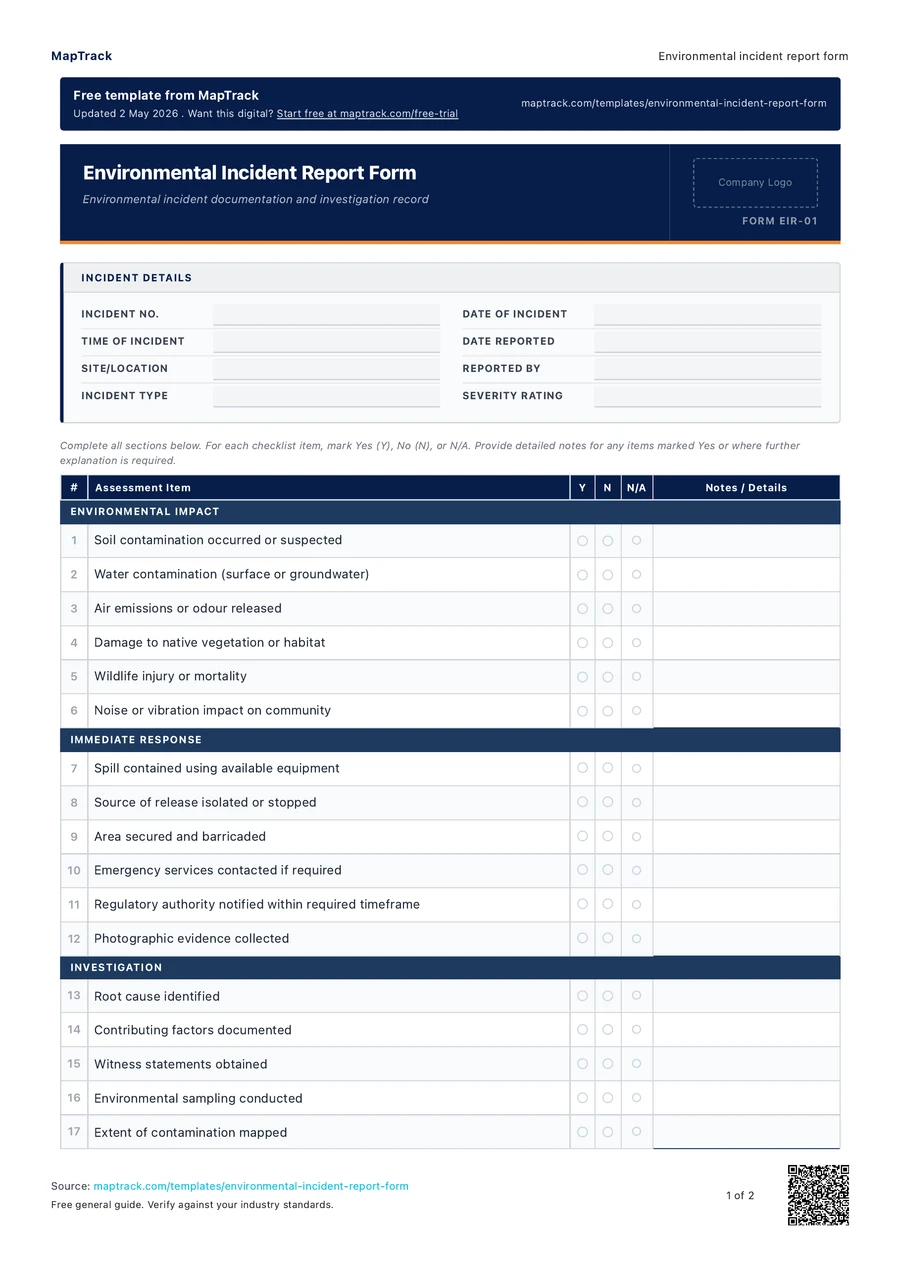

Read the form fields
24 checks · 4 sections · Sign-off
24 checks
The fields in the printable form, in a view that fits your screen.
- Incident No.
- Date of Incident
- Time of Incident
- Date Reported
- Site/Location
- Reported By
- Incident Type
- Severity Rating
Environmental Impact
Immediate Response
Investigation
Corrective Actions
Declaration
I confirm that this report accurately describes the environmental incident, the immediate response actions taken, investigation findings, and corrective measures implemented. All relevant regulatory notification requirements have been met.
Investigating Officer
Name · Signature · Date
Environmental Manager Approval
Name · Signature · Date
The MapTrack environmental incident report form contains 24 checks across 4 sections.

Co-Founder & Commercial Director
Make this form your own
Add your fields and logo. Give your team a form they can use on site.
Free 30-day trial. No credit card. Work email needed.
Customise & use this form now for free



“MapTrack beat them all in every aspect.”
 Vincent Stone · HSEQ Advisor, Concept Tanks
After signup: customise the template, then save and publish it for your team.
General guidance only. Check the form against your equipment manual, site procedures and local requirements before using it.
Key takeaways
- The MapTrack environmental incident report form contains 24 checks across 4 sections. Sections covered: Environmental Impact, Immediate Response, Investigation, Corrective Actions.
- Incident details: date, time discovered, time incident occurred (if different), location, person discovering the incident.
- Incident description: what happened, type of incident (spill, emission, contamination, noise, dust, other), substance involved.
- Quantity and extent: volume or quantity released, area affected, direction of spread, environmental receptors (waterway, groundwater, air, soil).
What is an environmental incident report form?
An environmental incident report form is a document used to record the details, response actions and regulatory notifications for any event that causes or threatens harm to the environment. This includes chemical spills, fuel leaks, uncontrolled emissions, water contamination, noise complaints, dust events, waste mismanagement and damage to sensitive habitats. The form captures the incident timeline, location, substances involved, environmental receptors affected, containment and clean-up actions, regulatory notifications and root cause analysis.
State environmental protection legislation such as the Protection of the Environment Operations Act 1997 (NSW) requires immediate notification of pollution incidents that cause or threaten material harm to the environment. The EPA, local council, Ministry of Health, SafeWork and Fire and Rescue must all be notified for notifiable incidents. The WHS Act 2011 also requires notification of incidents that expose workers to hazardous substances. Failing to report an environmental incident is itself an offence that can attract significant penalties. A standardised incident report form ensures all required information is captured, notifications are made to the correct authorities within the required timeframes and the organisation has a complete record for investigation and regulatory compliance.
Learn more about compliance and inspections in MapTrack.
Choose the format that fits your team
Download the PDF
Use the original printable form for a paper workflow. Check it against your equipment and site procedure before the job.
Keep completed copies in your own record system and arrange any follow-up through your normal process.
Download free PDFCustomise a form in MapTrack
Start a free trial, adjust the digital form to your workflow, then save and publish it for your team to use.
Your account uses the digital template. Sample answers on this page and completed PDF records aren't imported automatically.
Customise & use this form now for freeFree 30-day trial. No credit card. Work email needed.
Benefits of using this environmental incident report form
- Regulatory compliance: ensures pollution incidents are reported to all required authorities within mandated timeframes.
- Complete documentation: captures all details needed for incident investigation, EPA reporting and insurance claims.
- Structured response: guides responders through containment, clean-up and notification steps in the correct sequence.
- Root cause analysis: the form includes sections for identifying contributing factors and preventive actions.
- Legal protection: a thorough incident report demonstrates the organisation responded promptly and transparently.
- Continuous improvement: incident data feeds into the environmental management system to prevent recurrence.
What to include in an environmental incident report form
- Incident details: date, time discovered, time incident occurred (if different), location, person discovering the incident.
- Incident description: what happened, type of incident (spill, emission, contamination, noise, dust, other), substance involved.
- Quantity and extent: volume or quantity released, area affected, direction of spread, environmental receptors (waterway, groundwater, air, soil).
- Immediate actions: containment measures, clean-up started, emergency services called, area secured.
- Regulatory notifications: EPA notified (yes/no, time), council notified, SafeWork notified, Ministry of Health notified, fire brigade notified.
- Environmental impact: observed or likely impact on water quality, soil, vegetation, wildlife, air quality, neighbouring properties.
- Clean-up and remediation: clean-up actions completed, waste disposed, sampling conducted, remediation plan.
- Root cause: immediate cause, contributing factors, underlying systemic causes.
- Corrective actions: actions to prevent recurrence, responsible person, target date.
- Sign-off: reporter name, supervisor name, environmental manager, date.
How to use this environmental incident report form
Secure the incident area and ensure personnel safety
Ensure the area is safe before approaching. If hazardous substances are involved, use appropriate PPE. Evacuate personnel if necessary. Stop the source of the release if it can be done safely. Contain the spill or emission to prevent further environmental impact.
Record the incident details as soon as possible
Document the date, time, location, substance involved, estimated quantity and the extent of the release. Note any environmental receptors affected or threatened (waterways, drains, groundwater, sensitive vegetation, neighbouring properties). Take photographs and video of the incident area.
Make regulatory notifications within required timeframes
Assess whether the incident is a notifiable pollution incident under state EPA legislation. If so, notify the EPA, local council, Ministry of Health, SafeWork and Fire and Rescue immediately. Record the time of each notification and the person contacted. Most states require immediate notification by the fastest available means.
Manage the clean-up and collect environmental samples
Direct the clean-up using the spill response procedure and appropriate resources. Collect environmental samples (soil, water, air) to assess the extent of contamination. Engage a specialist environmental consultant for significant incidents. Dispose of contaminated waste through licensed waste contractors.
Complete the root cause analysis and corrective actions
Investigate the incident to identify the immediate cause, contributing factors and underlying systemic issues. Record corrective actions with responsible persons and target dates. Update the environmental management plan, procedures and training to prevent recurrence. File the completed report with the site environmental records.
How often should you complete this form?
An environmental incident report form is completed every time an environmental incident occurs, regardless of severity. The form should be initiated immediately when the incident is discovered and completed within 24 hours for significant incidents. Regular review of incident reports (monthly or quarterly) should be conducted as part of the environmental management system to identify trends and systemic issues. The incident reporting procedure should be reviewed annually and updated to reflect any changes in regulatory requirements or organisational structure.
Make this form your own
From your template to your team.
Start with this template, adjust it for your equipment and site, then save and publish the digital form for your team.
- 01
Start your free trial
Use your work email to create your MapTrack account.
- 02
Customise, save and publish
Adjust the template fields and branding for your site.
- 03
Complete it on the job
Record checks, add photos and export a branded PDF.
Keep working offline
Load the form before you lose reception. Complete it offline and sync when you're back online.
Scan the asset. Open its form.
Use an asset's QR code to find and complete the forms that belong to it.
Show what you found
Capture photos and attach files so the next person has the details they need.
Take a branded PDF with you
Download completed forms as PDF reports with your company logo.
The trial uses a digital template. Completed paper records aren't imported automatically.
Frequently asked questions
Practical answers about the form, record keeping and using MapTrack.
Under the Protection of the Environment Operations Act 1997 (NSW) and equivalent state legislation, a pollution incident that causes or threatens material harm to the environment must be reported immediately. Material harm means harm that is not trivial, including actual or potential harm to human health, property or the environment. The EPA, local council, Ministry of Health, SafeWork and Fire and Rescue must all be notified. Each state has specific notification requirements, but the general principle is immediate notification by the fastest available means.
Link to this answerFailing to report a notifiable pollution incident is a separate offence under state environmental protection legislation. In NSW, penalties for failure to notify can reach $2 million for corporations. The incident itself may attract additional penalties for the pollution offence. Directors and managers can be held personally liable for failure to notify if they knew or ought to have known about the incident. Prompt and transparent reporting, combined with effective response actions, can mitigate penalties.
Link to this answerAn environmental incident report should include the date, time and location of the incident, what happened, substances involved, quantity released, environmental receptors affected, immediate response actions, regulatory notifications made, clean-up and remediation actions, environmental sampling results, root cause analysis and corrective actions. Photographs, sample results and notification records should be attached. The report should be thorough enough to satisfy both internal investigation and regulatory reporting requirements.
Link to this answerThe person who discovers the incident should initiate the report and notify their supervisor immediately. The site manager or environmental manager is typically responsible for assessing whether the incident is notifiable, making regulatory notifications and coordinating the response. Under the WHS Act and environmental protection legislation, the PCBU has the ultimate responsibility for incident reporting and response. All workers should be trained to recognise and report environmental incidents.
Link to this answerEnvironmental incident reports and supporting evidence (photographs, sample results, notification logs, corrective action records) should be retained for a minimum of seven years to satisfy EPA record-keeping expectations under the Protection of the Environment Operations Act 1997 (NSW) and equivalent state legislation. Where the incident resulted in soil or groundwater contamination, records should be retained indefinitely as part of the contaminated land history under state contaminated land Acts. Incidents that also meet the WHS Act notifiable incident threshold must be retained for at least five years under WHS Regulations 2011 Schedule 14, and records relating to insurance claims should follow the insurer retention period.
Link to this answerApplicable regulatory standards
This form is a starting point. Check the current requirements that apply to your equipment, work and location. The form alone does not establish compliance.
- Protection of the Environment Operations Act 1997 (NSW), Part 5.7 - Duty to notify pollution incidents
- WHS Act 2011, Section 38 - Duty to notify of notifiable incidents
MapTrack publishes this template. The linked authorities publish their own guidance; they haven't endorsed this form.
The numbers behind this environmental incident report form
Every figure below is sourced and dated, so you can quote it in a toolbox talk, a budget case or a board paper without having to chase the original report.
Cite this template
Writing about this topic? You’re welcome to quote this checklist. Here’s the wording to use so your readers can find the original.
The MapTrack environmental incident report form contains 24 checks across 4 sections.
- Short attribution
- MapTrack Environmental incident report form, https://www.maptrack.com/templates/environmental-incident-report-form
- Reference list
- MapTrack. (2026). Environmental incident report form [Checklist template]. Retrieved from https://www.maptrack.com/templates/environmental-incident-report-form
Free to reuse with credit under a Creative Commons Attribution 4.0 licence. If you’d rather link straight to it, the page is https://www.maptrack.com/templates/environmental-incident-report-form.
Embed this free template on your website
Run an industry blog, trade association site, or training resource? Drop a preview of this free environmental incident report form straight into your page. The snippet is self-contained, needs no scripts, and links readers back to the full free template.
<div style="max-width:480px;font-family:system-ui,-apple-system,'Segoe UI',Roboto,sans-serif;border:1px solid #E5E7EB;border-radius:12px;padding:20px;background:#ffffff;">
  <p style="font-size:12px;font-weight:700;letter-spacing:0.05em;text-transform:uppercase;color:#071D49;margin:0;">Free template</p>
  <p style="font-size:18px;font-weight:700;color:#071D49;margin:6px 0 0;">Environmental incident report form</p>
  <ul style="margin:12px 0 0;padding-left:18px;color:#374151;font-size:14px;line-height:1.6;">
    <li style="margin:4px 0;">Incident details: date, time discovered, time incident occurred (if different), location, person discovering the incident.</li>
    <li style="margin:4px 0;">Incident description: what happened, type of incident (spill, emission, contamination, noise, dust, other), substance involved.</li>
    <li style="margin:4px 0;">Quantity and extent: volume or quantity released, area affected, direction of spread, environmental receptors (waterway, groundwater, air, soil).</li>
    <li style="margin:4px 0;">Immediate actions: containment measures, clean-up started, emergency services called, area secured.</li>
    <li style="margin:4px 0;">Regulatory notifications: EPA notified (yes/no, time), council notified, SafeWork notified, Ministry of Health notified, fire brigade notified.</li>
    <li style="margin:4px 0;">Environmental impact: observed or likely impact on water quality, soil, vegetation, wildlife, air quality, neighbouring properties.</li>
  </ul>
  <p style="font-size:13px;color:#6B7280;margin:14px 0 0;padding-top:12px;border-top:1px solid #E5E7EB;">Free <a href="https://www.maptrack.com/templates/environmental-incident-report-form" style="color:#071D49;font-weight:600;text-decoration:none;">Environmental incident report form</a> by MapTrack</p>
</div>Free to reuse, including commercially. This template is published under a Creative Commons Attribution 4.0 licence. Copy it, adapt it, put it on your own site or in your own docs. All we ask is that you credit MapTrack with a link back to this page. The snippet above already includes that credit, so if you use it as-is you’re covered.
About the author

Co-Founder & Commercial Director
Jarrod has spent over a decade in technology consulting and asset management, including roles at Accenture (mining and heavy industry) and CGI as an Asset Management Consultant. He co-founded MapTrack and built and scaled its original platform, then rebuilt it with Lachlan and Alex from thousands of customer conversations and 300+ user research sessions with field teams. His consulting background gives him deep insight into the operational and compliance challenges facing asset-intensive Australian businesses.
View LinkedIn profile →Ready for your next job?
Keep the PDF handy, or customise the digital form for your team.