
Free air quality monitoring log
Free air quality monitoring log (PDF-ready). Record VOC, particulate and gas readings for WES and EPA compliance. Digitise with MapTrack.
Updated 2 Oct 2026
Air Quality Monitoring Log
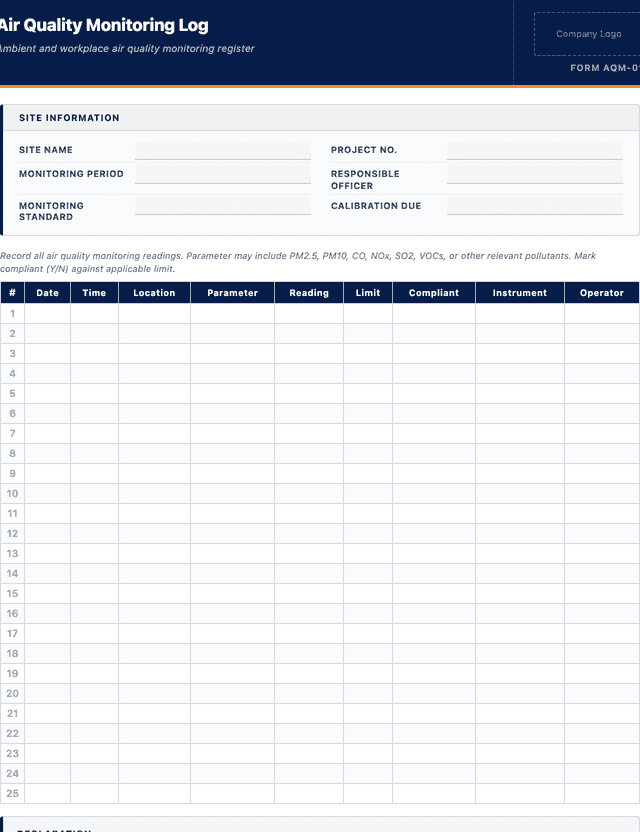
Record all air quality monitoring readings. Parameter may include PM2.5, PM10, CO, NOx, SO2, VOCs, or other relevant pollutants. Mark compliant (Y/N) against applicable limit.
| # | Date | Time | Location | Parameter | Reading | Limit | Compliant | Instrument | Operator |
|---|---|---|---|---|---|---|---|---|---|
| e.g. | 12/03/2024 | - | Depot A | - | 3,120 | - | - | - | S. Carter |
| 1 | |||||||||
| 2 | |||||||||
| 3 | |||||||||
| 4 | |||||||||
| 5 |
The PDF includes all 25 numbered rows, ready to print or fill on screen.
Monitoring Officer
Name
Signature
Date
Site Manager Review
Name
Signature
Date
How to use: download the PDF, print or complete digitally on any device.
- PDF format, ready to print or fill on screen
- Use as-is or customise to suit your operation
- Go digital in MapTrack for photos, reminders and audit trails
Two ways to use it
Use in MapTrack →Use it digitally instead
Unlimited usersThese same 9 columns, already built.




- Scan the asset’s QR tag with any phone
- Submitted forms can trigger alerts
- Photos on fails, audit-ready records
- Export responses, PDF reports with your logo
Free trial. No credit card needed.
Trusted by teams across Australia and New Zealand
We respect your privacy. Unsubscribe anytime.
These templates are free general guides provided as-is. They do not constitute legal, safety or compliance advice. You are responsible for ensuring any form meets your specific workplace obligations, industry standards and applicable regulations.
Don't just download it - use it live. Start a free workspace with this air quality monitoring log already built, so your crew can run it from a phone.

Co-Founder & Commercial Director
Key takeaways
- The MapTrack air quality monitoring log has 9 columns and room for 25 entries. Columns: Date, Time, Location, Parameter, Reading, Limit, Compliant, Instrument, Operator.
Enter your email below to download this air quality monitoring log as a ready-to-use PDF.
Used by construction, mining and field service teams











What is an air quality monitoring log?
An air quality monitoring log is a document used to record airborne contaminant measurements including volatile organic compounds (VOCs), gases (carbon monoxide, hydrogen sulphide, nitrogen dioxide), particulate matter and other pollutants at workplace locations and site boundaries. The log captures the monitoring date, location, contaminant type, measurement instrument, concentration reading, applicable workplace exposure standard (WES) or EPA limit, and whether the result is within the permissible level.
Air quality monitoring is essential for both worker health protection and environmental compliance. The WHS Regulations 2011, Part 3.2, Division 7 require PCBUs to ensure worker exposure to airborne contaminants does not exceed Safe Work Australia workplace exposure standards (regulation 49). State EPA legislation requires industrial facilities to monitor and report emissions that may affect ambient air quality. National Environment Protection Measures (NEPMs) set ambient air quality standards for criteria pollutants. Without documented air quality monitoring, organisations cannot demonstrate compliance with either occupational or environmental regulations, and workers may be exposed to harmful concentrations of airborne contaminants.
Learn more about compliance and inspections in MapTrack.
Benefits of using this air quality monitoring log
- Worker health protection: tracks airborne contaminant levels against workplace exposure standards to prevent occupational illness.
- EPA compliance: documents ambient air quality monitoring required by EPA licences and development approvals.
- Hazard identification: identifies work areas, processes and conditions that generate elevated contaminant levels.
- Control verification: post-control monitoring confirms that ventilation, enclosure and extraction systems are effective.
- Trend analysis: comparing readings over time reveals deteriorating conditions, process changes or seasonal patterns.
- Legal evidence: documented monitoring demonstrates the PCBU has taken reasonably practicable steps to manage airborne risks.
Benefits of digitising forms in MapTrack
When you move your log / registers from paper to MapTrack, you get:
- Field users can easily scan a QR code to complete a form on mobile. Unlimited users.
- Email the right people when a form is submitted, with an automation you set up.
- File every completed form against the asset, location or person it covers.
- Download any completed form as a PDF, with failed answers listed at the top.
- Fill in forms offline; they upload when the device is back online.
- Build conditional logic (show or hide questions based on answers).
- Take pictures or attach photos. Not possible with a paper-based form.
- Electronic signatures.
- Edit forms later without reprinting.
- Set who can view, fill in or edit forms with user roles.
- Upload a paper form (PDF, Word, Excel or a photo) and MapTrack's AI builds a digital version for you to check.
- Log spill response actions and containment measures with timestamped evidence.
- Keep waste manifests and disposal records as forms and files against each site.
- Download each completed environmental record as a PDF for an audit.
Book a demo to see how MapTrack handles log / registers.
Try MapTrack free for 30 days
Full access to every feature. No credit card required. Per-asset pricing so you scale as your fleet grows.
- No credit card required
- 30 days free trial
- Cancel anytime
1-2 days/week saved
“Bloody amazing! We used to spend 1-2 days a week tracking and managing our generators alone.”

Steve McAllister
Asset Coordinator, Saunders International
What to include in an air quality monitoring log
This air quality monitoring log covers 10 key areas:
- Site details: site name, facility type, monitoring programme reference, responsible person.
- Monitoring event: date, time start and end, weather conditions (temperature, humidity, wind speed, wind direction).
- Monitoring location: area description, site plan reference, indoor or outdoor, distance from emission source.
- Equipment: instrument type (photoionisation detector, gas detector, particulate sampler), ID, calibration date.
- Contaminant measured: substance name, CAS number (if applicable), measurement units (ppm, mg/m3, ug/m3).
- Measurement result: concentration reading, averaging period (15-minute, 8-hour TWA, instantaneous peak).
- Applicable standard: WES value, EPA licence limit or NEPM ambient standard, result comparison (below/at/above).
- Controls in place: ventilation, extraction, enclosure, RPE, process controls.
- Exceedance actions: if standard exceeded, immediate actions taken, area evacuated or restricted, additional controls.
- Sign-off: monitoring officer name and qualifications, date, next monitoring event.
How to use this air quality monitoring log
- Plan the monitoring programme and prepare instruments: Identify the contaminants to be monitored based on the substances used or generated on site. Select the appropriate monitoring instruments (PID for VOCs, electrochemical sensors for gases, gravimetric samplers for particulates). Calibrate instruments per the manufacturer instructions using certified calibration gases or standards.
- Deploy monitoring equipment at designated locations: For occupational monitoring, position personal samplers in the worker breathing zone or deploy area monitors at representative work locations. For environmental monitoring, position instruments at site boundary locations specified in the EPA licence. Record the exact location, start time and weather conditions.
- Collect readings over the required monitoring period: For short-term exposure limit (STEL) monitoring, collect 15-minute samples during peak exposure tasks. For TWA monitoring, sample over the full 8-hour shift. For ambient monitoring, follow the EPA-specified averaging period. Record instantaneous readings and continuous data logger output where applicable.
- Retrieve data, calculate exposure and compare to standards: Download data from instruments and calculate time-weighted averages. Compare occupational readings to Safe Work Australia WES values. Compare ambient readings to EPA licence limits or NEPM standards. Flag any readings that exceed or approach the applicable standard.
- Record results, act on exceedances and file the log: Enter all results on the monitoring log with the applicable standard and comparison outcome. For exceedances, implement immediate controls (increase ventilation, provide RPE, restrict access), investigate the cause and record corrective actions. File the completed log in the occupational health and environmental management records.
In MapTrack, you can track environmental compliance and waste management digitally. Each submission is stored as a timestamped PDF against the asset record.
Get the free templateEnter your email above to download the full air quality monitoring log as a PDF.Back to download formHow often should you complete this log / register?
Air quality monitoring frequency depends on the contaminants, risk level and regulatory requirements. For occupational exposure monitoring, quarterly monitoring is recommended for processes using hazardous chemicals, with re-monitoring after any process or control changes. EPA licence conditions typically specify continuous, daily, monthly or quarterly ambient monitoring depending on the contaminant and facility risk. Baseline monitoring should be conducted when new processes or substances are introduced. Safe Work Australia recommends repeating monitoring whenever there is a reason to believe exposures may have changed.
Frequently asked questions
Applicable regulatory standards
This template is a starting point. Check the current requirements that apply to your equipment, work and location. The template alone does not establish compliance.
- WHS Regulations 2011, Part 3.2, Division 7 - Managing risks from airborne contaminants (regulations 49 and 50)
- National Environment Protection (Ambient Air Quality) Measure (NEPM)
Check the current source
Air quality monitoring log preview
The numbers behind this air quality monitoring log
Every figure below is sourced and dated, so you can quote it in a toolbox talk, a budget case or a board paper without having to chase the original report.
Embed this free template on your website
Run an industry blog, trade association site, or training resource? Drop a preview of this free air quality monitoring log straight into your page. The snippet is self-contained, needs no scripts, and links readers back to the full free template.
<div style="max-width:480px;font-family:system-ui,-apple-system,'Segoe UI',Roboto,sans-serif;border:1px solid #E5E7EB;border-radius:12px;padding:20px;background:#ffffff;">
  <p style="font-size:12px;font-weight:700;letter-spacing:0.05em;text-transform:uppercase;color:#071D49;margin:0;">Free template</p>
  <p style="font-size:18px;font-weight:700;color:#071D49;margin:6px 0 0;">Air quality monitoring log</p>
  <ul style="margin:12px 0 0;padding-left:18px;color:#374151;font-size:14px;line-height:1.6;">
    <li style="margin:4px 0;">Site details: site name, facility type, monitoring programme reference, responsible person.</li>
    <li style="margin:4px 0;">Monitoring event: date, time start and end, weather conditions (temperature, humidity, wind speed, wind direction).</li>
    <li style="margin:4px 0;">Monitoring location: area description, site plan reference, indoor or outdoor, distance from emission source.</li>
    <li style="margin:4px 0;">Equipment: instrument type (photoionisation detector, gas detector, particulate sampler), ID, calibration date.</li>
    <li style="margin:4px 0;">Contaminant measured: substance name, CAS number (if applicable), measurement units (ppm, mg/m3, ug/m3).</li>
    <li style="margin:4px 0;">Measurement result: concentration reading, averaging period (15-minute, 8-hour TWA, instantaneous peak).</li>
  </ul>
  <p style="font-size:13px;color:#6B7280;margin:14px 0 0;padding-top:12px;border-top:1px solid #E5E7EB;">Free <a href="https://www.maptrack.com/templates/air-quality-monitoring-log" style="color:#071D49;font-weight:600;text-decoration:none;">Air quality monitoring log</a> by MapTrack</p>
</div>Free to reuse, including commercially. This template is published under a Creative Commons Attribution 4.0 licence. Copy it, adapt it, put it on your own site or in your own docs. All we ask is that you credit MapTrack with a link back to this page. The snippet above already includes that credit, so if you use it as-is you’re covered.
Cite this template
Writing about this topic? You’re welcome to quote this checklist. Here’s the wording to use so your readers can find the original.
The MapTrack air quality monitoring log has 9 columns and room for 25 entries.
- Short attribution
- MapTrack Air quality monitoring log, https://www.maptrack.com/templates/air-quality-monitoring-log
- Reference list
- MapTrack. (2026). Air quality monitoring log [Checklist template]. Retrieved from https://www.maptrack.com/templates/air-quality-monitoring-log
Free to reuse with credit under a Creative Commons Attribution 4.0 licence. If you’d rather link straight to it, the page is https://www.maptrack.com/templates/air-quality-monitoring-log.
Need to track environmental compliance and waste management digitally?
Register every asset in MapTrack, attach digital forms, and get a complete history of every inspection, service and compliance record.
Compliance and inspections · All templates · Pricing · Book a demo