
Free bunding and secondary containment inspection
Free bunding and secondary containment inspection per AS 1940. Quarterly structural, drainage and capacity verification for bulk chemical storage.
Updated 5 May 2026
Bunding and Secondary Containment Inspection
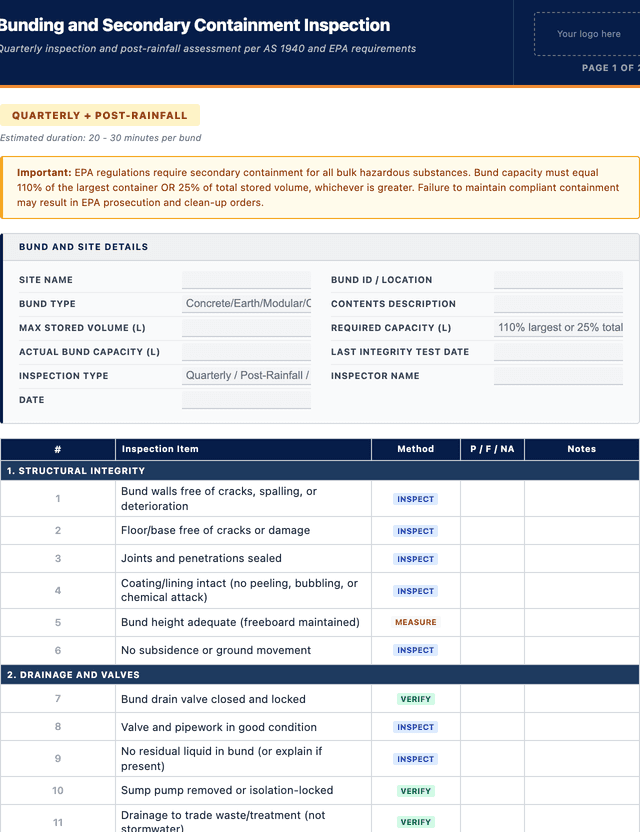
Quarterly inspection and post-rainfall assessment per AS 1940 and EPA requirements
1. Structural Integrity
2. Drainage and Valves
3. Capacity Verification
4. Containment Fittings
5. Contents and Labelling
6. Emergency Response
How to use: download the PDF, print or complete digitally on any device.
- PDF format, ready to print or fill on screen
- Use as-is or customise to suit your operation
- Go digital in MapTrack for photos, reminders and audit trails
Two ways to use it
Use in MapTrack →Use it digitally instead
Unlimited usersThese same 28 checks, already built.




- Scan the asset’s QR tag with any phone
- Submitted forms can trigger alerts
- Photos on fails, audit-ready records
- Export responses, PDF reports with your logo
Free trial. No credit card needed.
Trusted by teams across Australia and New Zealand
We respect your privacy. Unsubscribe anytime.
These templates are free general guides provided as-is. They do not constitute legal, safety or compliance advice. You are responsible for ensuring any form meets your specific workplace obligations, industry standards and applicable regulations.
Don't just download it - use it live. Start a free workspace with this bunding and secondary containment inspection already built, so your crew can run it from a phone.

Co-Founder & Commercial Director
Key takeaways
- The MapTrack bunding and secondary containment inspection contains 28 checks across 6 sections. Sections covered: 1. Structural Integrity, 2. Drainage and Valves, 3. Capacity Verification, 4. Containment Fittings, 5. Contents and Labelling, 6. Emergency Response.
Enter your email below to download this bunding and secondary containment inspection as a ready-to-use PDF.
Used by construction, mining and field service teams











What is a bunding and secondary containment inspection?
A bunding and secondary containment inspection is a quarterly compliance assessment of all bunded areas and secondary containment systems at sites storing bulk hazardous substances. Under AS 1940 (The storage and handling of flammable and combustible liquids) and state EPA regulations, every facility storing bulk quantities of hazardous liquids must maintain secondary containment (bunding) capable of holding at least 110% of the volume of the largest container within the bund, or 25% of the total stored volume, whichever is greater. The bund must prevent any spilled, leaked or released material from reaching stormwater drains, waterways, groundwater or neighbouring properties.
Bunding systems include concrete bund walls, lined earthen bunds, self-bunded tanks (double-skinned), portable bunding for temporary storage and drip trays for smaller containers. Over time, bunds degrade through cracking, chemical attack, weathering, vehicle damage and settlement. Drainage valves left open (a common compliance failure) completely defeat the containment purpose. Accumulated rainwater reduces available capacity below the minimum requirement. Incompatible materials stored within the same bund create secondary risks if a spill occurs. This quarterly inspection covers structural integrity, drainage valve position, capacity verification (accounting for rainwater, equipment and other items reducing available volume), pipe and fitting penetrations, contained contents compliance and emergency response readiness. Additional inspections are required after significant rainfall events that may have filled or stressed the bund.
Learn more about compliance and inspections in MapTrack.
Benefits of using this bunding and secondary containment inspection
- Environmental protection: confirms that secondary containment will function as designed if a spill occurs, preventing contamination of soil, groundwater and waterways.
- EPA compliance: satisfies state EPA licence conditions and AS 1940 requirements for maintenance of secondary containment systems with documented evidence.
- Capacity assurance: verifies that available containment capacity has not been reduced below the minimum requirement by accumulated rainwater, equipment or debris.
- Drainage valve compliance: the single most common bunding failure is a drainage valve left open. Weekly or quarterly checks catch this before a spill event exposes the non-compliance.
- Penalty avoidance: EPA fines for non-compliant bunding can exceed $500,000 for serious environmental harm, plus clean-up costs which frequently reach millions of dollars.
- Insurance protection: environmental impairment liability policies require evidence of maintained secondary containment as a condition of coverage for pollution events.
Benefits of digitising forms in MapTrack
When you digitise bunding checklists in MapTrack, you get:
- Field users can easily scan a QR code to complete a form on mobile. Unlimited users.
- Email the right people when a form is submitted, with an automation you set up.
- File every completed form against the asset, location or person it covers.
- Download any completed form as a PDF, with failed answers listed at the top.
- Fill in forms offline; they upload when the device is back online.
- Build conditional logic (show or hide questions based on answers).
- Take pictures or attach photos. Not possible with a paper-based form.
- Electronic signatures.
- Edit forms later without reprinting.
- Set who can view, fill in or edit forms with user roles.
- Upload a paper form (PDF, Word, Excel or a photo) and MapTrack's AI builds a digital version for you to check.
- Log spill response actions and containment measures with timestamped evidence.
- Keep waste manifests and disposal records as forms and files against each site.
- Download each completed environmental record as a PDF for an audit.
Book a demo to see how MapTrack handles bunding checklists.
Try MapTrack free for 30 days
Full access to every feature. No credit card required. Per-asset pricing so you scale as your fleet grows.
- No credit card required
- 30 days free trial
- Cancel anytime
1-2 days/week saved
“Bloody amazing! We used to spend 1-2 days a week tracking and managing our generators alone.”

Steve McAllister
Asset Coordinator, Saunders International
What to include in a bunding and secondary containment inspection
This bunding and secondary containment inspection covers 9 key areas:
- Bund identification: location, bund number or name, contained substances (DG class), number and size of containers/tanks within the bund, required minimum capacity (110% or 25% calculation).
- Structural integrity: bund walls (cracks, spalling, erosion, settlement), floor condition (cracks, chemical attack, coating condition), joint sealant condition, coating or liner integrity.
- Drainage system: valve position (must be closed), valve condition (corrosion, leaks, operability), drain destination when valve is opened, approval process for draining accumulated water.
- Capacity verification: visual assessment of available capacity, accumulated rainwater depth, equipment or items stored within the bund reducing capacity, calculated remaining capacity vs minimum requirement.
- Penetrations and fittings: pipe penetrations sealed, cable penetrations sealed, no unsealed holes through bund walls, expansion joints intact.
- Contents compliance: all containers within the bund are compatible with each other and the bund material, no incompatible chemicals co-bunded, containers properly sealed and labelled.
- Emergency readiness: spill kit accessible, absorbents appropriate for the contained chemicals, containment booms available (for large bunds), emergency contact information posted.
- Surrounding area: no stormwater drains within the bund footprint, grade directing any overflow away from sensitive receptors, warning signage in place.
- Actions and non-conformances: corrective actions for any deficiency, responsible person and due date.
How to use this bunding and secondary containment inspection
- Visually inspect the bund walls, floor and joints for structural defects.: Walk the full perimeter of the bund inspecting all walls for cracks (particularly at corners and wall-floor joints), spalling concrete, erosion of earthen bunds, settlement or movement, and coating or liner damage. Inspect the bund floor for cracks, chemical attack evidence (staining, softening), and coating condition. Check all construction joints, expansion joints and sealant for deterioration.
- Verify all drainage valves are closed and in serviceable condition.: Check every drainage valve within and associated with the bund. Confirm all valves are in the closed position. Test valve operability by partially opening and reclosing (do not discharge contents to stormwater). Inspect valve bodies for corrosion, leakage past the seal, and mechanical damage. Verify that the valve is a type that fails closed. Document any valve found in the open position as a critical non-conformance.
- Assess available containment capacity against the minimum requirement.: Measure or estimate the depth of accumulated rainwater within the bund. Note any equipment, pallets, hoses or other items stored within the bund that reduce available containment volume. Calculate the actual available capacity (total bund volume minus rainwater minus displacement from stored items) and compare to the minimum requirement (110% of largest container or 25% of total stored volume). Arrange water removal if capacity is compromised.
- Inspect all penetrations, fittings, contained vessels and chemical compatibility.: Check every pipe, cable and conduit penetration through the bund wall or floor for intact seals. Verify no new penetrations have been made without proper sealing. Inspect all containers and tanks within the bund for leaks, corrosion and label legibility. Confirm all chemicals within the bund are compatible with each other and with the bund material (for example, acids will attack concrete without appropriate coating).
- Verify emergency readiness, record findings and schedule corrective actions.: Confirm spill response equipment is accessible and appropriate for the chemicals stored. Check absorbent quantities and condition. Verify emergency contact information and spill response procedures are posted at the bund. Record all findings, photograph any defects, assign corrective actions with responsible persons and due dates. Schedule the next quarterly inspection and note any additional post-rainfall inspections required.
In MapTrack, you can track environmental compliance and waste management digitally. Each submission is stored as a timestamped PDF against the asset record.
Get the free templateEnter your email above to download the full bunding and secondary containment inspection as a PDF.Back to download formHow often should you complete this checklist?
Quarterly inspection is the standard frequency for bunding and secondary containment systems under normal conditions. Additional inspections must be conducted after significant rainfall events (typically greater than 25mm in 24 hours) to verify capacity has not been compromised by accumulated water, and after any spill event within or adjacent to the bund. High-risk sites or those with EPA licence conditions may require monthly inspections. Drainage valve position should ideally be checked weekly as a simple pass/fail. In MapTrack, quarterly inspections are automatically scheduled for each bund location, with weather-triggered additional inspections generated when rainfall thresholds are exceeded at the site.
Frequently asked questions
Applicable regulatory standards
This template is a starting point. Check the current requirements that apply to your equipment, work and location. The template alone does not establish compliance.
- AS 1940 The storage and handling of flammable and combustible liquids
- EPA Regulations (state-specific) - Secondary containment requirements for scheduled premises
- WHS Regulations 2011, Chapter 7 - Hazardous chemicals storage
- Environment Protection Act (VIC/NSW/QLD/WA/SA) - Duty to prevent pollution
Check the current source
Bunding and secondary containment inspection preview
The numbers behind this bunding and secondary containment inspection
Every figure below is sourced and dated, so you can quote it in a toolbox talk, a budget case or a board paper without having to chase the original report.
Embed this free template on your website
Run an industry blog, trade association site, or training resource? Drop a preview of this free bunding and secondary containment inspection straight into your page. The snippet is self-contained, needs no scripts, and links readers back to the full free template.
<div style="max-width:480px;font-family:system-ui,-apple-system,'Segoe UI',Roboto,sans-serif;border:1px solid #E5E7EB;border-radius:12px;padding:20px;background:#ffffff;">
  <p style="font-size:12px;font-weight:700;letter-spacing:0.05em;text-transform:uppercase;color:#071D49;margin:0;">Free template</p>
  <p style="font-size:18px;font-weight:700;color:#071D49;margin:6px 0 0;">Bunding and secondary containment inspection</p>
  <ul style="margin:12px 0 0;padding-left:18px;color:#374151;font-size:14px;line-height:1.6;">
    <li style="margin:4px 0;">Bund identification: location, bund number or name, contained substances (DG class), number and size of containers/tanks within the bund, required minimum capacity (110% or 25% calculation).</li>
    <li style="margin:4px 0;">Structural integrity: bund walls (cracks, spalling, erosion, settlement), floor condition (cracks, chemical attack, coating condition), joint sealant condition, coating or liner integrity.</li>
    <li style="margin:4px 0;">Drainage system: valve position (must be closed), valve condition (corrosion, leaks, operability), drain destination when valve is opened, approval process for draining accumulated water.</li>
    <li style="margin:4px 0;">Capacity verification: visual assessment of available capacity, accumulated rainwater depth, equipment or items stored within the bund reducing capacity, calculated remaining capacity vs minimum requirement.</li>
    <li style="margin:4px 0;">Penetrations and fittings: pipe penetrations sealed, cable penetrations sealed, no unsealed holes through bund walls, expansion joints intact.</li>
    <li style="margin:4px 0;">Contents compliance: all containers within the bund are compatible with each other and the bund material, no incompatible chemicals co-bunded, containers properly sealed and labelled.</li>
  </ul>
  <p style="font-size:13px;color:#6B7280;margin:14px 0 0;padding-top:12px;border-top:1px solid #E5E7EB;">Free <a href="https://www.maptrack.com/templates/bunding-containment-inspection" style="color:#071D49;font-weight:600;text-decoration:none;">Bunding and secondary containment inspection</a> by MapTrack</p>
</div>Free to reuse, including commercially. This template is published under a Creative Commons Attribution 4.0 licence. Copy it, adapt it, put it on your own site or in your own docs. All we ask is that you credit MapTrack with a link back to this page. The snippet above already includes that credit, so if you use it as-is you’re covered.
Cite this template
Writing about this topic? You’re welcome to quote this checklist. Here’s the wording to use so your readers can find the original.
The MapTrack bunding and secondary containment inspection contains 28 checks across 6 sections.
- Short attribution
- MapTrack Bunding and secondary containment inspection, https://www.maptrack.com/templates/bunding-containment-inspection
- Reference list
- MapTrack. (2026). Bunding and secondary containment inspection [Checklist template]. Retrieved from https://www.maptrack.com/templates/bunding-containment-inspection
Free to reuse with credit under a Creative Commons Attribution 4.0 licence. If you’d rather link straight to it, the page is https://www.maptrack.com/templates/bunding-containment-inspection.
Need to track environmental compliance and waste management digitally?
Register every bunding in MapTrack, attach digital forms, and get a complete history of every inspection, service and compliance record.
Compliance and inspections · All templates · Pricing · Book a demo