
Free environmental site inspection checklist
Free environmental site inspection checklist (PDF-ready). Covers erosion, sediment control, waste, spill kits, dust, noise, flora/fauna and water quality.
Updated 2 Oct 2026
Environmental Site Inspection Checklist
Environmental compliance and management plan inspection record
Erosion & Sediment Control
Waste Management
Chemical & Fuel Storage
Dust & Air Quality
Noise & Vibration
Water Quality & Discharge
Flora, Fauna & Heritage
Inspector Sign-off
Signature
Print name
Date & time
Project Manager / Environmental Officer Acknowledgement
Signature
Print name
Date
How to use: download the PDF, print or complete digitally on any device.
- PDF format, ready to print or fill on screen
- Use as-is or customise to suit your operation
- Go digital in MapTrack for photos, reminders and audit trails
Two ways to use it
Use in MapTrack →Use it digitally instead
Unlimited usersThese same 24 checks, already built.




- Scan the asset’s QR tag with any phone
- Submitted forms can trigger alerts
- Photos on fails, audit-ready records
- Export responses, PDF reports with your logo
Free trial. No credit card needed.
Trusted by teams across Australia and New Zealand
We respect your privacy. Unsubscribe anytime.
These templates are free general guides provided as-is. They do not constitute legal, safety or compliance advice. You are responsible for ensuring any form meets your specific workplace obligations, industry standards and applicable regulations.
Don't just download it - use it live. Start a free workspace with this environmental site inspection checklist already built, so your crew can run it from a phone.

Co-Founder & Commercial Director
Key takeaways
- The MapTrack environmental site inspection checklist contains 24 checks across 7 sections. Sections covered: Erosion & Sediment Control, Waste Management, Chemical & Fuel Storage, Dust & Air Quality, Noise & Vibration, Water Quality & Discharge, Flora, Fauna & Heritage.
Enter your email below to download this environmental site inspection checklist as a ready-to-use PDF.
Used by construction, mining and field service teams










What is an environmental site inspection checklist?
An environmental site inspection checklist is a structured form used to assess and document the condition of environmental controls on a construction, mining or project site. It covers erosion and sediment control, waste management, chemical and fuel storage, dust and air quality, noise and vibration, water quality and discharge, and the protection of flora, fauna and heritage items. Regular environmental inspections help site teams identify non-compliances before they become regulatory issues, protect waterways and ecosystems, and provide documented evidence that environmental management plan commitments are being met. If the site runs an environmental management system to AS/NZS ISO 14001:2016, file completed checklists with its records and raise a corrective action for each failed item.
Environmental site inspections are typically required by conditions of consent, EPA licences and environmental management plans as a condition of project approval. Inspectors walk the site perimeter and active work areas to verify that erosion controls are intact, waste is correctly stored and separated, chemical storage meets bunding requirements, dust and noise suppression measures are operating, and protected areas remain undisturbed. Failure to conduct and document these inspections can result in EPA compliance notices, stop-work orders, fines running into tens of thousands of dollars, and reputational damage with clients and the community. The completed checklist gives regulators, auditors and community stakeholders a dated record of what was inspected, what failed and what was done about it. Under section 19 of the WHS Act 2011, the person conducting the business or undertaking must ensure, so far as is reasonably practicable, that work on site doesn't put the health and safety of workers or other people at risk, and under section 27 its officers must exercise due diligence to make sure it does.
Learn more about compliance and inspections in MapTrack.
Benefits of using this environmental site inspection checklist
- Regulatory compliance: documented inspections demonstrate your site meets EPA, council and conditions of consent requirements.
- Erosion and sediment control: catch failures in sediment fences, basins and diversion drains before sediment reaches waterways.
- Spill prevention: verify bunding, spill kits and refuelling controls are in place to prevent soil and water contamination.
- Dust and noise management: confirm suppression measures are operating and activities stay within approved hours and limits.
- Heritage and biodiversity protection: verify exclusion zones are intact and no unauthorised clearing or disturbance has occurred.
- Audit trail: maintain a verifiable inspection history for EPA audits, community complaints and incident investigations.
Benefits of digitising forms in MapTrack
When you move your checklists from paper to MapTrack, you get:
- Field users can easily scan a QR code to complete a form on mobile. Unlimited users.
- Email the right people when a form is submitted, with an automation you set up.
- File every completed form against the asset, location or person it covers.
- Download any completed form as a PDF, with failed answers listed at the top.
- Fill in forms offline; they upload when the device is back online.
- Build conditional logic (show or hide questions based on answers).
- Take pictures or attach photos. Not possible with a paper-based form.
- Electronic signatures.
- Edit forms later without reprinting.
- Set who can view, fill in or edit forms with user roles.
- Upload a paper form (PDF, Word, Excel or a photo) and MapTrack's AI builds a digital version for you to check.
- Assign audits and send reminder emails to the people doing them.
- Keep every audit, inspection and sign-off against the asset or site it covers.
- Track corrective actions as work orders from finding to close-out, with each change in the activity log.
Book a demo to see how MapTrack handles checklists.
Try MapTrack free for 30 days
Full access to every feature. No credit card required. Per-asset pricing so you scale as your fleet grows.
- No credit card required
- 30 days free trial
- Cancel anytime
1-2 days/week saved
“Bloody amazing! We used to spend 1-2 days a week tracking and managing our generators alone.”

Steve McAllister
Asset Coordinator, Saunders International
What to include in an environmental site inspection checklist
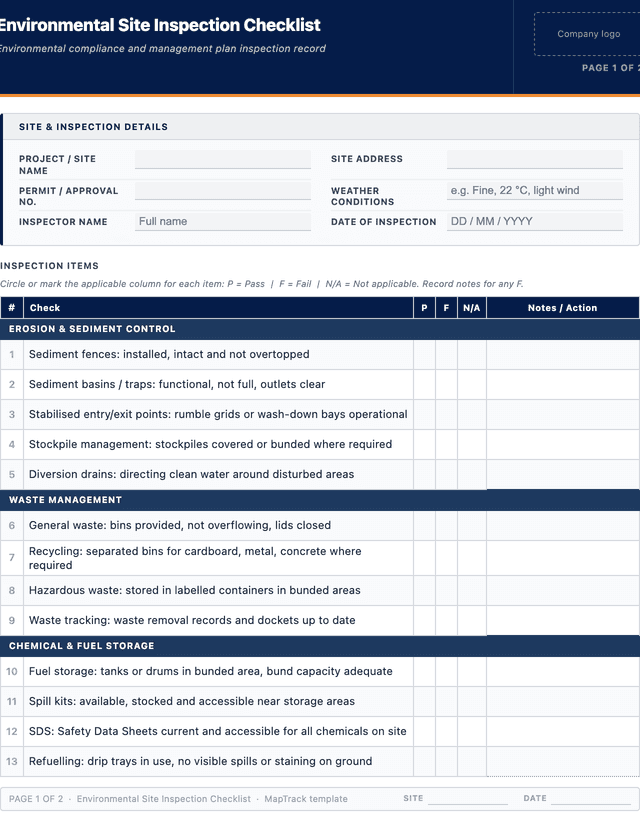
This environmental site inspection checklist covers 11 key areas:
- Site details: project name, address, permit/approval number, weather conditions.
- Inspector details: name, inspection date.
- Erosion and sediment control: sediment fences, basins, entry/exit points, stockpile management, diversion drains.
- Waste management: general waste, recycling, hazardous waste storage, waste tracking records.
- Chemical and fuel storage: bunding, spill kits, Safety Data Sheets, refuelling controls.
- Dust and air quality: dust suppression, exposed areas, vehicle speed limits.
- Noise and vibration: approved work hours, mitigation measures.
- Water quality and discharge: stormwater protection, dewatering, concrete wash-out containment.
- Flora, fauna and heritage: vegetation exclusion zones, wildlife protection, heritage items.
- Corrective actions: issue, description, action taken.
- Sign-off: inspector and project manager / environmental officer.
How to use this environmental site inspection checklist
- Record site details including project name, address, permit number and current weather conditions.: Note recent rainfall amounts if applicable, as this affects erosion control performance. Record wind speed and direction if dust management is a concern for the site.
- Walk the site perimeter and check all erosion and sediment control measures are intact and functioning.: Inspect sediment fences for damage, undermining or accumulated sediment. Check basins, diversion drains and entry/exit points are clear and operating as designed in the erosion and sediment control plan.
- Inspect waste storage areas, ensuring bins are not overflowing and hazardous waste is correctly stored and labelled.: Confirm general waste, recycling and hazardous waste are separated correctly. Check waste tracking records are up to date and hazardous waste containers have appropriate labelling and Safety Data Sheets.
- Check fuel and chemical storage areas for adequate bunding, stocked spill kits and current Safety Data Sheets.: Verify bunding capacity meets the minimum requirement (typically 110% of the largest container). Confirm spill kits are stocked and accessible, and that refuelling controls are in place to prevent spills.
- Assess dust suppression measures and confirm noisy activities are within approved hours.: Check water carts, sprinklers or other dust suppression systems are operating on exposed areas. Confirm noisy activities comply with the approved hours in the conditions of consent and that noise mitigation measures are in place.
- Check stormwater drains are protected and any dewatering or wash-out areas are properly contained.: Confirm inlet protection is installed on all stormwater drains within the site boundary. Verify concrete wash-out areas are lined and contained, and that dewatering discharge meets water quality requirements.
- Verify vegetation exclusion zones, heritage fencing and wildlife protections are in place.: Walk the perimeter of exclusion zones and confirm fencing is intact with no encroachment. Check for any evidence of unauthorised clearing, disturbance to heritage items, or wildlife interactions requiring reporting.
- Record any non-compliances and corrective actions. Report to the project manager or environmental officer.: Photograph each non-compliance and record the location, description and required corrective action. Assign responsibility and a due date for each item. Escalate high-risk issues to the environmental officer immediately.
- Sign off and date the form.: Both the inspector and the project manager or environmental officer should sign the completed checklist. File the record in the project environmental management system for audit and regulatory purposes.
In MapTrack, you can automate compliance tracking and audit trails. Each submission is stored as a timestamped PDF against the asset record.
Get the free templateEnter your email above to download the full environmental site inspection checklist as a PDF.Back to download formHow often should you complete this checklist?
Complete environmental site inspections weekly on active construction and project sites. Conduct additional inspections after significant rainfall events (typically over 10 mm in 24 hours), before and after holiday shutdowns, and when new activities begin that could affect environmental controls. Lower-risk sites or sites in maintenance phase may use a monthly inspection schedule. Always follow the frequency specified in your environmental management plan and conditions of consent, as these are typically set by the approving authority and failure to comply can result in compliance notices. In MapTrack, you can schedule inspections at the required frequency and receive automated reminders when they are due.
Frequently asked questions
Applicable regulatory standards
This template is a starting point. Check the current requirements that apply to your equipment, work and location. The template alone does not establish compliance.
- AS/NZS ISO 14001 - Environmental management systems
- EPA state environmental protection legislation (relevant jurisdiction)
- WHS Act 2011 (Section 19 - Primary duty of care)
- ISO 45001:2018 Clause 6.1 - Actions to address risks and opportunities
Environmental site inspection checklist preview
The numbers behind this environmental site inspection checklist
Every figure below is sourced and dated, so you can quote it in a toolbox talk, a budget case or a board paper without having to chase the original report.
Embed this free template on your website
Run an industry blog, trade association site, or training resource? Drop a preview of this free environmental site inspection checklist straight into your page. The snippet is self-contained, needs no scripts, and links readers back to the full free template.
<div style="max-width:480px;font-family:system-ui,-apple-system,'Segoe UI',Roboto,sans-serif;border:1px solid #E5E7EB;border-radius:12px;padding:20px;background:#ffffff;">
  <p style="font-size:12px;font-weight:700;letter-spacing:0.05em;text-transform:uppercase;color:#071D49;margin:0;">Free template</p>
  <p style="font-size:18px;font-weight:700;color:#071D49;margin:6px 0 0;">Environmental site inspection checklist</p>
  <ul style="margin:12px 0 0;padding-left:18px;color:#374151;font-size:14px;line-height:1.6;">
    <li style="margin:4px 0;">Site details: project name, address, permit/approval number, weather conditions.</li>
    <li style="margin:4px 0;">Inspector details: name, inspection date.</li>
    <li style="margin:4px 0;">Erosion and sediment control: sediment fences, basins, entry/exit points, stockpile management, diversion drains.</li>
    <li style="margin:4px 0;">Waste management: general waste, recycling, hazardous waste storage, waste tracking records.</li>
    <li style="margin:4px 0;">Chemical and fuel storage: bunding, spill kits, Safety Data Sheets, refuelling controls.</li>
    <li style="margin:4px 0;">Dust and air quality: dust suppression, exposed areas, vehicle speed limits.</li>
  </ul>
  <p style="font-size:13px;color:#6B7280;margin:14px 0 0;padding-top:12px;border-top:1px solid #E5E7EB;">Free <a href="https://www.maptrack.com/templates/environmental-site-inspection-checklist" style="color:#071D49;font-weight:600;text-decoration:none;">Environmental site inspection checklist</a> by MapTrack</p>
</div>Free to reuse, including commercially. This template is published under a Creative Commons Attribution 4.0 licence. Copy it, adapt it, put it on your own site or in your own docs. All we ask is that you credit MapTrack with a link back to this page. The snippet above already includes that credit, so if you use it as-is you’re covered.
Cite this template
Writing about this topic? You’re welcome to quote this checklist. Here’s the wording to use so your readers can find the original.
The MapTrack environmental site inspection checklist contains 24 checks across 7 sections.
- Short attribution
- MapTrack Environmental site inspection checklist, https://www.maptrack.com/templates/environmental-site-inspection-checklist
- Reference list
- MapTrack. (2026). Environmental site inspection checklist [Checklist template]. Retrieved from https://www.maptrack.com/templates/environmental-site-inspection-checklist
Free to reuse with credit under a Creative Commons Attribution 4.0 licence. If you’d rather link straight to it, the page is https://www.maptrack.com/templates/environmental-site-inspection-checklist.
Need to automate compliance tracking and audit trails?
Register every asset in MapTrack, attach digital forms, and get a complete history of every inspection, service and compliance record.
Compliance and inspections · All templates · Pricing · Book a demo