
Free template · PDF
Free cold chain temperature log
Free cold chain temperature log (PDF-ready). Monitor fridge, freezer and transport temperatures, target ranges and corrective action.
Loading PDF page...
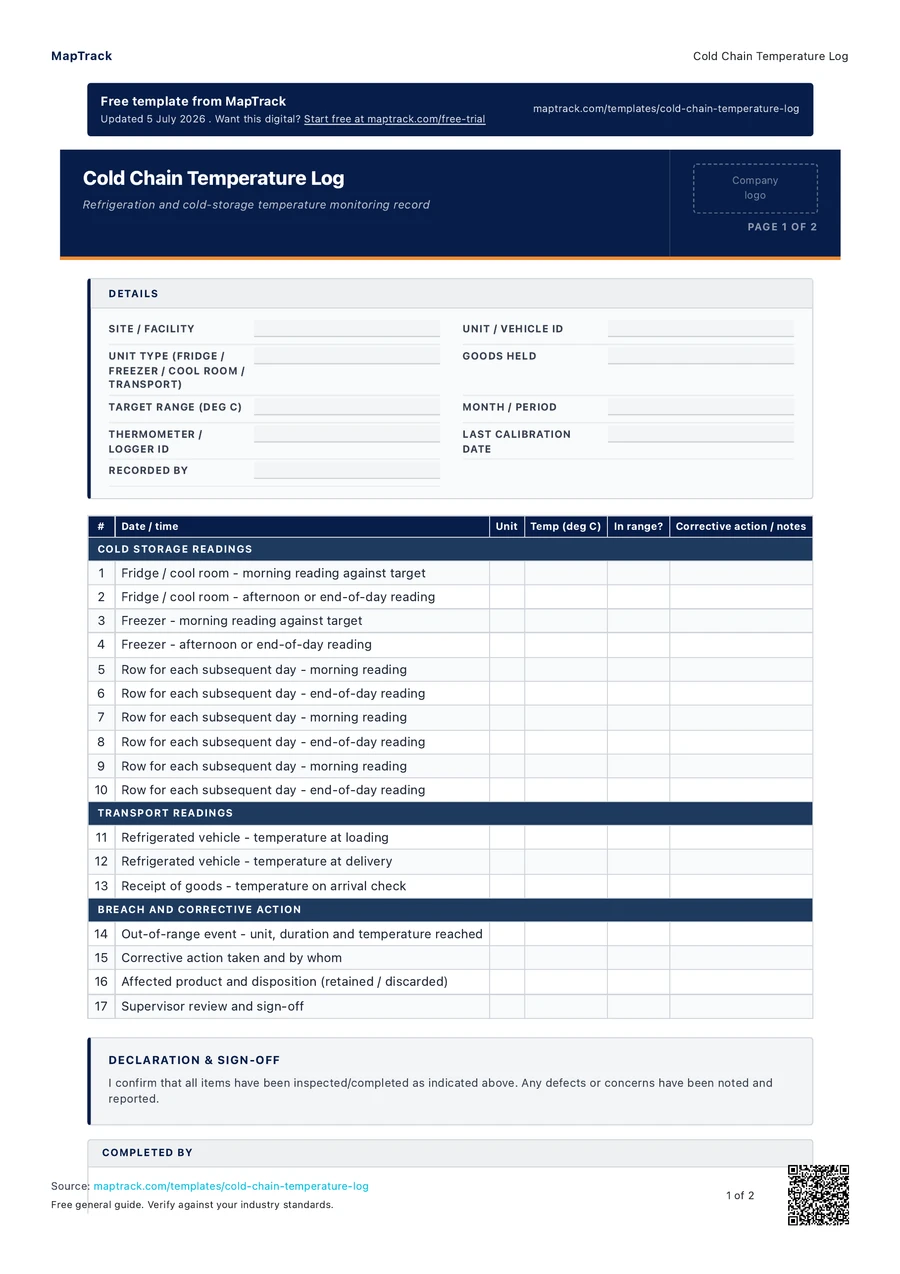

Read the form fields
17 checks · 3 sections · Sign-off
17 checks
The fields in the printable form, in a view that fits your screen.
- Site / facility
- Unit / vehicle ID
- Unit type (fridge / freezer / cool room / transport)
- Goods held
- Target range (deg C)
- Month / period
- Thermometer / logger ID
- Last calibration date
- Recorded by
COLD STORAGE READINGS
TRANSPORT READINGS
BREACH AND CORRECTIVE ACTION
Declaration & Sign-Off
I confirm that all items have been inspected/completed as indicated above. Any defects or concerns have been noted and reported.
Completed By
Printed name · Signature · Date
Reviewed / Approved By
Printed name · Signature · Date
The MapTrack cold chain temperature log contains 17 checks across 3 sections.

Co-Founder & Commercial Director
Make this form your own
Add your fields and logo. Give your team a form they can use on site.
Free 30-day trial. No credit card. Work email needed.
Upload & use this form now for free


“MapTrack beat them all in every aspect.”
 Vincent Stone · HSEQ Advisor, Concept Tanks
After signup: upload this PDF, check the form MapTrack drafts, then save and publish it for your team.
General guidance only. Check the form against your equipment manual, site procedures and local requirements before using it.
Key takeaways
- The MapTrack cold chain temperature log contains 17 checks across 3 sections. Sections covered: COLD STORAGE READINGS, TRANSPORT READINGS, BREACH AND CORRECTIVE ACTION.
- Site or facility and the unit or vehicle being monitored
- Unit type: fridge, freezer, cool room, or transport
- Target temperature range for the goods held
What is a cold chain temperature log?
A cold chain temperature log is a monitoring record that captures the temperature of refrigerated and frozen storage, and refrigerated transport, at set intervals against a defined target range. Each reading records the unit or location, the date and time, the measured temperature, whether it was within the target range, and the corrective action taken if it was not. Kept for fridges, freezers, cool rooms and delivery vehicles, it is the running evidence that goods stayed within their required temperature from receipt through storage to dispatch or use.
This log matters because temperature is the single most important control for both food safety and the integrity of temperature-sensitive products, but the two regimes are separate and must not be mixed. For food, the Food Standards Code Standard 3.2.2 requires refrigerated potentially hazardous food to be held at 5 degrees C or below (frozen food kept frozen hard), and the FSANZ 2-hour/4-hour rule governs time out of temperature control. For pharmaceuticals and vaccines, the cold chain is +2 to +8 degrees C under Therapeutic Goods Administration guidance and the PIC/S Guide to GMP, with the National Vaccine Storage Guidelines 'Strive for 5' aiming for +5 degrees C in a purpose-built vaccine fridge. There is no general 2 to 8 degrees C rule for food, and the food 5/60 danger zone does not apply to medicines. A consistent log ties every reading to the correct target for that product and a corrective action, so a breach is caught and dealt with rather than discovered too late.
Learn more about compliance and inspections in MapTrack.
Choose the format that fits your team
Download the PDF
Use the original printable form for a paper workflow. Check it against your equipment and site procedure before the job.
Keep completed copies in your own record system and arrange any follow-up through your normal process.
Download free PDFCustomise a form in MapTrack
Start a free trial, upload this PDF and MapTrack drafts the form. Adjust it to your workflow, then save and publish it for your team to use.
Sample answers on this page and completed PDF records aren't imported automatically.
Upload & use this form now for freeFree 30-day trial. No credit card. Work email needed.
Benefits of using this cold chain temperature log
- Early breach detection: regular readings catch a failing fridge or freezer before the stock inside is spoiled or made unsafe.
- Product integrity evidence: a continuous temperature record proves goods were held in range from receipt through to dispatch or use.
- Correct target ranges: recording the target for each unit stops chilled food and pharmaceuticals being held at the wrong temperature.
- Corrective action trail: a place to record what was done when a reading was out of range shows breaches were managed, not ignored.
- Equipment insight: repeated out-of-range readings on one unit expose a failing seal, thermostat or compressor before it fails completely.
- Audit and recall support: a dated temperature log is the first evidence an auditor, inspector or recall investigation will ask to see.
What to include in a cold chain temperature log
- Site or facility and the unit or vehicle being monitored
- Unit type: fridge, freezer, cool room, or transport
- Target temperature range for the goods held
- Date and time of each reading
- Measured temperature
- Whether the reading is within range (yes or no)
- Corrective action taken for any out-of-range reading
- Product affected and disposition if a breach occurred
- Person who took the reading
- Thermometer or data-logger identifier and last calibration date
How to use this cold chain temperature log
Set the target range for each unit
Define the correct target range for the goods each unit holds before you start logging: 5 degrees C or below for chilled food under FSANZ Standard 3.2.2, or +2 to +8 degrees C for temperature-sensitive medicines and vaccines under TGA guidance. Keep the food and pharmaceutical ranges separate; logging against the wrong target is worse than not logging, because it gives false assurance.
Take readings at set intervals
Read and record the temperature at the frequency set for the unit, commonly at the start and end of each day for storage and at loading and delivery for transport. Use a calibrated thermometer or data logger, and record the actual measured value, not a rounded or assumed one.
Compare each reading to the target
Mark whether each reading is within the target range. An in-range reading confirms the unit is holding; an out-of-range reading is a trigger for immediate action, so the comparison must be made at the time of reading, not reconstructed later.
Act on and record any breach
For any out-of-range reading, take corrective action straight away, such as moving stock, adjusting or repairing the unit, and assessing whether the goods are still safe or usable. Record the action and the disposition of any affected product so the breach is fully accounted for.
Review and keep calibration current
Review the log regularly for patterns of drift or repeat breaches on a unit, and keep thermometers and data loggers calibrated so readings are trustworthy. File completed logs for the retention period your food safety program or quality system requires.
How often should you complete this form?
Take readings at the frequency set for each unit and product. For chilled and frozen food storage this is commonly at least at the start and end of each day, and for refrigerated transport at loading and at delivery. Higher-risk goods or units with a history of drift may need more frequent checks or continuous data logging with alarms.
Review the completed log regularly, weekly for most operations, to spot units drifting towards their limits and to confirm corrective actions were closed out. Recalibrate thermometers and data loggers on a set schedule so the readings stay trustworthy, and keep completed logs for the retention period your food safety program, quality system or regulator requires.
Make this form your own
From your template to your team.
Upload this PDF and MapTrack drafts the form. Adjust it for your equipment and site, then save and publish the digital form for your team.
- 01
Start your free trial
Use your work email to create your MapTrack account.
- 02
Customise, save and publish
Adjust the template fields and branding for your site.
- 03
Complete it on the job
Record checks, add photos and export a branded PDF.
Keep working offline
Load the form before you lose reception. Complete it offline and sync when you're back online.
Scan the asset. Open its form.
Use an asset's QR code to find and complete the forms that belong to it.
Show what you found
Capture photos and attach files so the next person has the details they need.
Take a branded PDF with you
Download completed forms as PDF reports with your company logo.
Completed paper records aren't imported automatically.
Frequently asked questions
Practical answers about the form, record keeping and using MapTrack.
The correct range depends on the goods, and the food and pharmaceutical regimes are separate. Under the Food Standards Code Standard 3.2.2, potentially hazardous chilled food is kept at 5 degrees C or below and frozen food kept frozen hard, with the FSANZ 2-hour/4-hour rule limiting time out of temperature control. Temperature-sensitive medicines and vaccines are stored at +2 to +8 degrees C under Therapeutic Goods Administration guidance and the PIC/S Guide to GMP, with the National Vaccine Storage Guidelines 'Strive for 5' aiming for +5 degrees C. Never apply the 2 to 8 degrees C range to food or the food 5/60 danger zone to medicines. Always use the target specified for the actual product, and confirm the applicable range with your food enforcement agency or the product manufacturer.
Link to this answerFor storage units such as fridges, freezers and cool rooms, record temperatures at least at the start and end of each day, and more often for higher-risk goods. For refrigerated transport, record at loading and at delivery. Many operations use continuous data loggers with alarms in addition to manual checks, so a breach triggers an alert immediately rather than waiting for the next reading. Set the specific frequency in your food safety program or quality system based on the risk of the goods and the reliability of the unit.
Link to this answerAct immediately. Take corrective action to bring the unit back into range, such as closing a door, adjusting the thermostat, moving stock to another unit, or calling for repair. Then assess the goods: how far out of range, for how long, and whether they are still safe or usable. Record the reading, the corrective action and the disposition of any affected product. For food, follow your food safety program's rules on when out-of-range stock must be discarded; for pharmaceuticals, follow the manufacturer's stability guidance before returning stock to use.
Link to this answerYes. A temperature log is only as trustworthy as the device taking the readings. Thermometers and data loggers should be calibrated or accuracy-checked on a set schedule, and the log should record which device was used and when it was last checked. An uncalibrated thermometer can read several degrees out, which either hides a real breach or triggers false ones. Keep calibration records alongside the temperature log so an auditor can see the readings were taken with a verified device.
Link to this answerYes, it is completely free. It downloads as a PDF you can keep or print as a pad for the cool room or vehicle. You do not need a MapTrack account. If you want to move beyond paper, MapTrack records temperature checks and inspections against each unit, captures readings and corrective actions on mobile, and keeps the full monitoring history in one place. Start a free trial or book a demo to see how.
Link to this answerApplicable regulatory standards
This form is a starting point. Check the current requirements that apply to your equipment, work and location. The form alone does not establish compliance.
- Food cold chain: Australia New Zealand Food Standards Code, Standard 3.2.2 (temperature control - 5 degrees C or below) and the FSANZ 2-hour/4-hour rule
- Pharmaceutical cold chain: Therapeutic Goods Administration guidance and the PIC/S Guide to GMP (PE009-17) - +2 to +8 degrees C for temperature-sensitive medicines
- Vaccines: National Vaccine Storage Guidelines 'Strive for 5' (+2 to +8 degrees C, aiming for +5 degrees C)
- Model Work Health and Safety (WHS) Regulations - plant maintenance duties for refrigeration equipment (in Victoria, the OHS Regulations 2017 (Vic))
MapTrack publishes this template. The linked authorities publish their own guidance; they haven't endorsed this form.
The numbers behind this cold chain temperature log
Every figure below is sourced and dated, so you can quote it in a toolbox talk, a budget case or a board paper without having to chase the original report.
Cite this template
Writing about this topic? You’re welcome to quote this checklist. Here’s the wording to use so your readers can find the original.
The MapTrack cold chain temperature log contains 17 checks across 3 sections.
- Short attribution
- MapTrack Cold Chain Temperature Log, https://www.maptrack.com/templates/cold-chain-temperature-log
- Reference list
- MapTrack. (2026). Cold Chain Temperature Log [Checklist template]. Retrieved from https://www.maptrack.com/templates/cold-chain-temperature-log
Free to reuse with credit under a Creative Commons Attribution 4.0 licence. If you’d rather link straight to it, the page is https://www.maptrack.com/templates/cold-chain-temperature-log.
Embed this free template on your website
Run an industry blog, trade association site, or training resource? Drop a preview of this free cold chain temperature log straight into your page. The snippet is self-contained, needs no scripts, and links readers back to the full free template.
<div style="max-width:480px;font-family:system-ui,-apple-system,'Segoe UI',Roboto,sans-serif;border:1px solid #E5E7EB;border-radius:12px;padding:20px;background:#ffffff;">
  <p style="font-size:12px;font-weight:700;letter-spacing:0.05em;text-transform:uppercase;color:#071D49;margin:0;">Free template</p>
  <p style="font-size:18px;font-weight:700;color:#071D49;margin:6px 0 0;">Cold Chain Temperature Log</p>
  <ul style="margin:12px 0 0;padding-left:18px;color:#374151;font-size:14px;line-height:1.6;">
    <li style="margin:4px 0;">Site or facility and the unit or vehicle being monitored</li>
    <li style="margin:4px 0;">Unit type: fridge, freezer, cool room, or transport</li>
    <li style="margin:4px 0;">Target temperature range for the goods held</li>
    <li style="margin:4px 0;">Date and time of each reading</li>
    <li style="margin:4px 0;">Measured temperature</li>
    <li style="margin:4px 0;">Whether the reading is within range (yes or no)</li>
  </ul>
  <p style="font-size:13px;color:#6B7280;margin:14px 0 0;padding-top:12px;border-top:1px solid #E5E7EB;">Free <a href="https://www.maptrack.com/templates/cold-chain-temperature-log" style="color:#071D49;font-weight:600;text-decoration:none;">Cold Chain Temperature Log</a> by MapTrack</p>
</div>Free to reuse, including commercially. This template is published under a Creative Commons Attribution 4.0 licence. Copy it, adapt it, put it on your own site or in your own docs. All we ask is that you credit MapTrack with a link back to this page. The snippet above already includes that credit, so if you use it as-is you’re covered.
About the author

Co-Founder & Commercial Director
Jarrod has spent over a decade in technology consulting and asset management, including roles at Accenture (mining and heavy industry) and CGI as an Asset Management Consultant. He co-founded MapTrack and built and scaled its original platform, then rebuilt it with Lachlan and Alex from thousands of customer conversations and 300+ user research sessions with field teams. His consulting background gives him deep insight into the operational and compliance challenges facing asset-intensive Australian businesses.
View LinkedIn profile →Ready for your next job?
Keep the PDF handy, or upload it to MapTrack and turn it into a digital form for your team.