
Free audit checklist template
Free audit checklist template (printable PDF). Run ISO 9001, 45001 or 14001 internal audits and capture evidence and findings. Download free.
Updated 28 Sept 2026
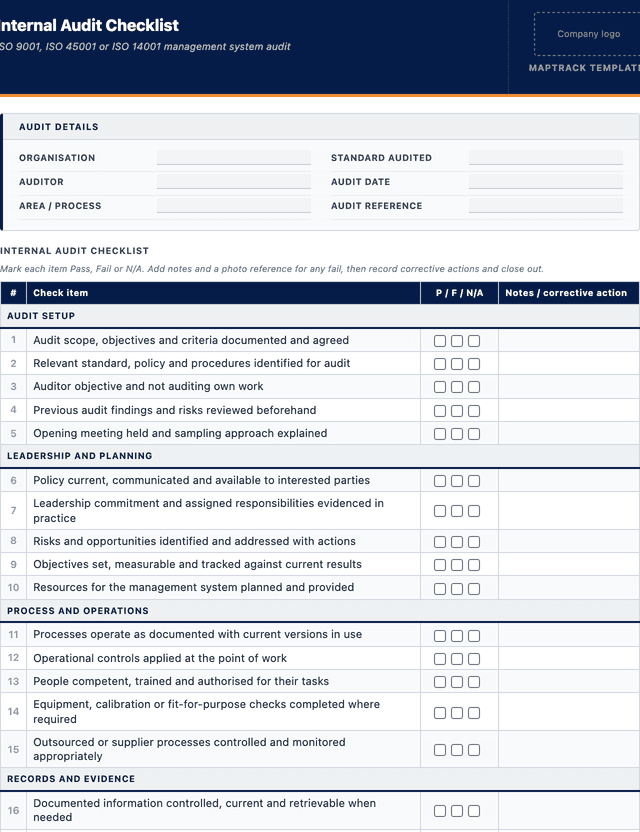
Internal Audit Checklist
ISO 9001, ISO 45001 or ISO 14001 management system audit
Audit setup
Leadership and planning
Process and operations
Records and evidence
Findings and follow-up
Completed by
Signature
Print name
Role
Date
Reviewed / approved by
Signature
Print name
Role
Date
How to use: download the PDF, print or complete digitally on any device.
- PDF format, ready to print or fill on screen
- Use as-is or customise to suit your operation
- Go digital in MapTrack for photos, reminders and audit trails
Two ways to use it
Use in MapTrack →Use it digitally instead
Unlimited usersUpload this PDF and MapTrack drafts the form for you.




- Scan the asset’s QR tag with any phone
- Submitted forms can trigger alerts
- Photos on fails, audit-ready records
- Export responses, PDF reports with your logo
Free trial. No credit card needed.
Trusted by teams across Australia and New Zealand
We respect your privacy. Unsubscribe anytime.
These templates are free general guides provided as-is. They do not constitute legal, safety or compliance advice. You are responsible for ensuring any form meets your specific workplace obligations, industry standards and applicable regulations.
Don't just download it - use it live. Start a free workspace, upload this audit checklist template and MapTrack drafts it as a form your crew can run from a phone.

Co-Founder & Commercial Director
Key takeaways
- The MapTrack audit checklist template contains 22 checks across 5 sections. Sections covered: Audit setup, Leadership and planning, Process and operations, Records and evidence, Findings and follow-up.
- One generic checklist drives ISO 9001, ISO 45001 and ISO 14001 internal audits.
- Built around ISO 19011:2018 auditing guidance and the clause 9.2 internal audit requirement.
- Every line is a conform or non-conform check with space for objective evidence.
- Auditors must stay objective and impartial and not audit their own work.
- Findings flow to corrective actions and close only once verified effective.
Enter your email below to download this audit checklist template as a ready-to-use PDF.
Used by construction, mining and field service teams









What is an audit checklist template?
An internal audit checklist is a structured working document an auditor uses to verify that a management system conforms to its planned arrangements, to the requirements of the relevant standard and to the way the organisation has said it will operate. It guides the auditor through scope and criteria, document and record review, leadership and policy, risk and objectives, process conformance, competence, monitoring and measurement, and the handling of non-conformities, so evidence is gathered consistently and nothing material is missed.
This template is deliberately generic so the same structure works for an ISO 9001 quality audit, an ISO 45001 safety audit or an ISO 14001 environmental audit. It follows the auditing approach set out in ISO 19011:2018 and the internal audit requirement common to those standards at clause 9.2. Each line is a conform or non-conform check with space to record objective evidence, the people interviewed, the documents sampled and any finding raised for follow-up.
Learn more about compliance and inspections in MapTrack.
Benefits of using this audit checklist template
- Consistent coverage: every auditor works through the same clauses so results stay comparable across sites and years.
- Defensible evidence: dedicated space for objective evidence, samples and interviewees supports the evidence-based approach.
- Multi-standard ready: one structure serves ISO 9001 quality, ISO 45001 safety and ISO 14001 environmental audits.
- Faster preparation: a ready scope, criteria and question set removes hours of blank-page planning before each audit.
- Clear findings trail: conform and non-conform fields link directly to corrective actions and verified close-out.
- Audit-ready records: completed checklists become the documented information your certification body expects to see.
Benefits of digitising forms in MapTrack
When you move your checklists from paper to MapTrack, you get:
- Field users can easily scan a QR code to complete a form on mobile. Unlimited users.
- Email the right people when a form is submitted, with an automation you set up.
- File every completed form against the asset, location or person it covers.
- Download any completed form as a PDF, with failed answers listed at the top.
- Fill in forms offline; they upload when the device is back online.
- Build conditional logic (show or hide questions based on answers).
- Take pictures or attach photos. Not possible with a paper-based form.
- Electronic signatures.
- Edit forms later without reprinting.
- Set who can view, fill in or edit forms with user roles.
- Upload a paper form (PDF, Word, Excel or a photo) and MapTrack's AI builds a digital version for you to check.
- Assign audits and send reminder emails to the people doing them.
- Keep every audit, inspection and sign-off against the asset or site it covers.
- Track corrective actions as work orders from finding to close-out, with each change in the activity log.
Book a demo to see how MapTrack handles checklists.
Try MapTrack free for 30 days
Full access to every feature. No credit card required. Per-asset pricing so you scale as your fleet grows.
- No credit card required
- 30 days free trial
- Cancel anytime
1-2 days/week saved
“Bloody amazing! We used to spend 1-2 days a week tracking and managing our generators alone.”

Steve McAllister
Asset Coordinator, Saunders International
What to include in an audit checklist template
This audit checklist template covers 9 key areas:
- Audit scope, objectives and the criteria being audited (standard, policy and procedures).
- Auditor and auditee details, dates, areas, shifts and processes in scope.
- Document and record review covering the manual, procedures and current versions.
- Leadership and policy questions on commitment, the policy and assigned responsibilities.
- Risk, opportunities and objectives, including how they are planned and measured.
- Process conformance checks with space for objective evidence and samples taken.
- Competence, training, awareness and authorisation records for the people doing the work.
- Monitoring, measurement, analysis and previous audit and management review outputs.
- Findings register with classification, corrective action owner, due date and verification.
How to use this audit checklist template
- Plan and define scope: Agree the objectives, scope and criteria with the auditee before you start, decide which processes, sites and shifts are in scope, review previous findings and risks, and confirm the standard and internal documents you will audit against.
- Open the audit: Hold a short opening meeting to confirm scope, criteria, timing and the sampling approach, explain how findings will be reported and classified, and make sure the right process owners and records will be available throughout the audit.
- Collect and verify evidence: Work through the checklist by interviewing people, observing the work and sampling documents and records, record the objective evidence you actually see, and verify information against the criteria rather than accepting unsupported statements as proof.
- Raise and classify findings: For each line decide conform or non-conform, write the evidence and the requirement not met, classify findings as major, minor or opportunity for improvement, and agree them with the auditee so there is no surprise at the closing meeting.
- Report and follow up: Present results at a closing meeting, issue the report to relevant management, agree corrective actions with owners and due dates, then verify root cause has been addressed and close each non-conformity only once evidence confirms it is effective.
In MapTrack, you can automate compliance tracking and audit trails. Each submission is stored as a timestamped PDF against the asset record.
Get the free templateEnter your email above to download the full audit checklist template as a PDF.Back to download formHow often should you complete this checklist?
Most management system standards require internal audits at planned intervals rather than on a fixed calendar date, so the right frequency depends on the criticality of each process, the results of previous audits and any changes affecting the organisation. A common pattern is a rolling annual programme where higher-risk or poorly performing areas are audited more often, and every part of the system is covered at least once before the next certification or surveillance visit.
In practice many organisations run their full internal audit programme over a twelve month cycle, breaking it into shorter audits by process or department so the workload is manageable. Trigger an extra audit when you change a process, move sites, introduce new equipment, see a spike in non-conformities or complaints, or prepare for an external audit. Record the planned schedule and any changes so you can show the programme is risk-based and complete.
Frequently asked questions
Applicable regulatory standards
This template is a starting point. Check the current requirements that apply to your equipment, work and location. The template alone does not establish compliance.
- ISO 19011:2018 (Guidelines for auditing management systems)
- ISO 9001 (Quality management systems, clause 9.2 internal audit)
- ISO 45001:2018 (Occupational health and safety management systems, clause 9.2 internal audit)
- ISO 14001:2015 (Environmental management systems, clause 9.2 internal audit)
Audit checklist template preview
The numbers behind this audit checklist template
Every figure below is sourced and dated, so you can quote it in a toolbox talk, a budget case or a board paper without having to chase the original report.
Embed this free template on your website
Run an industry blog, trade association site, or training resource? Drop a preview of this free audit checklist template straight into your page. The snippet is self-contained, needs no scripts, and links readers back to the full free template.
<div style="max-width:480px;font-family:system-ui,-apple-system,'Segoe UI',Roboto,sans-serif;border:1px solid #E5E7EB;border-radius:12px;padding:20px;background:#ffffff;">
  <p style="font-size:12px;font-weight:700;letter-spacing:0.05em;text-transform:uppercase;color:#071D49;margin:0;">Free template</p>
  <p style="font-size:18px;font-weight:700;color:#071D49;margin:6px 0 0;">Audit checklist template</p>
  <ul style="margin:12px 0 0;padding-left:18px;color:#374151;font-size:14px;line-height:1.6;">
    <li style="margin:4px 0;">Audit scope, objectives and the criteria being audited (standard, policy and procedures).</li>
    <li style="margin:4px 0;">Auditor and auditee details, dates, areas, shifts and processes in scope.</li>
    <li style="margin:4px 0;">Document and record review covering the manual, procedures and current versions.</li>
    <li style="margin:4px 0;">Leadership and policy questions on commitment, the policy and assigned responsibilities.</li>
    <li style="margin:4px 0;">Risk, opportunities and objectives, including how they are planned and measured.</li>
    <li style="margin:4px 0;">Process conformance checks with space for objective evidence and samples taken.</li>
  </ul>
  <p style="font-size:13px;color:#6B7280;margin:14px 0 0;padding-top:12px;border-top:1px solid #E5E7EB;">Free <a href="https://www.maptrack.com/templates/audit-checklist-template" style="color:#071D49;font-weight:600;text-decoration:none;">Audit checklist template</a> by MapTrack</p>
</div>Free to reuse, including commercially. This template is published under a Creative Commons Attribution 4.0 licence. Copy it, adapt it, put it on your own site or in your own docs. All we ask is that you credit MapTrack with a link back to this page. The snippet above already includes that credit, so if you use it as-is you’re covered.
Cite this template
Writing about this topic? You’re welcome to quote this checklist. Here’s the wording to use so your readers can find the original.
The MapTrack audit checklist template contains 22 checks across 5 sections.
- Short attribution
- MapTrack Audit checklist template, https://www.maptrack.com/templates/audit-checklist-template
- Reference list
- MapTrack. (2026). Audit checklist template [Checklist template]. Retrieved from https://www.maptrack.com/templates/audit-checklist-template
Free to reuse with credit under a Creative Commons Attribution 4.0 licence. If you’d rather link straight to it, the page is https://www.maptrack.com/templates/audit-checklist-template.
Need to automate compliance tracking and audit trails?
Register every asset in MapTrack, attach digital forms, and get a complete history of every inspection, service and compliance record.
Compliance and inspections · All templates · Pricing · Book a demo