
Free operator competency and licence matrix
Free competency matrix template (PDF). Map workers to plant, high-risk work licences, VOC and ticket expiry dates so only authorised people operate plant.
Updated 4 June 2026
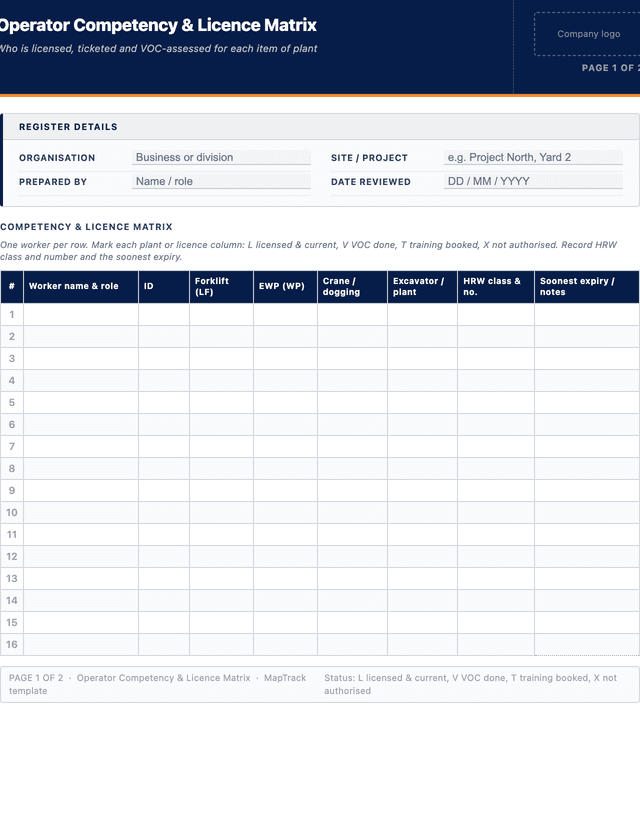
Operator Competency & Licence Matrix
One worker per row. Mark each plant or licence column: L licensed & current, V VOC done, T training booked, X not authorised. Record HRW class and number and the soonest expiry.
| # | Worker name & role | ID | Forklift (LF) | EWP (WP) | Crane / dogging | Excavator / plant | HRW class & no. | Soonest expiry / notes |
|---|---|---|---|---|---|---|---|---|
| e.g. | - | EXC-102 | - | - | - | - | - | Annual service booked |
| 1 | ||||||||
| 2 | ||||||||
| 3 | ||||||||
| 4 | ||||||||
| 5 |
The PDF includes all 28 numbered rows, ready to print or fill on screen.
Prepared / verified by
Signature
Print name
Date
Site or HSEQ manager
Signature
Print name
Date
How to use: download the PDF, print or complete digitally on any device.
- PDF format, ready to print or fill on screen
- Use as-is or customise to suit your operation
- Go digital in MapTrack for photos, reminders and audit trails
Two ways to use it
Use in MapTrack →Use it digitally instead
Unlimited usersUpload this PDF and MapTrack drafts the form for you.




- Scan the asset’s QR tag with any phone
- Submitted forms can trigger alerts
- Photos on fails, audit-ready records
- Export responses, PDF reports with your logo
Free trial. No credit card needed.
Trusted by teams across Australia and New Zealand
We respect your privacy. Unsubscribe anytime.
These templates are free general guides provided as-is. They do not constitute legal, safety or compliance advice. You are responsible for ensuring any form meets your specific workplace obligations, industry standards and applicable regulations.
Don't just download it - use it live. Start a free workspace, upload this operator competency and licence matrix and MapTrack drafts it as a form your crew can run from a phone.

Co-Founder & Commercial Director
Key takeaways
- The MapTrack operator competency and licence matrix has 8 columns and room for 28 entries. Columns: Worker name & role, ID, Forklift (LF), EWP (WP), Crane / dogging, Excavator / plant, HRW class & no., Soonest expiry / notes.
- A competency matrix maps each worker against the plant they are authorised to operate, with licence numbers, VOC dates and ticket expiry in one view.
- It is the fastest way to answer 'who can run this machine today' and to spot expired or missing authorisations before someone operates plant.
- High-risk work under the WHS Regulations 2011 needs a current HRW licence; the matrix records the class and number so it can be verified on site.
- A verification of competency (VOC) confirms practical skill on a specific machine; record the VOC date and expiry, not just the statutory licence.
Enter your email below to download this operator competency and licence matrix as a ready-to-use PDF.
Used by construction, mining and field service teams










What is an operator competency and licence matrix?
An operator competency and licence matrix is a single grid that shows which workers are authorised to operate which items of plant or perform which high-risk activities. Worker names run down the rows and the plant types, licence classes or competency units run across the columns. In each cell you record the status: licensed and current, verification of competency (VOC) completed, training booked, or not authorised, along with the licence or ticket number and its expiry date. It turns a pile of separate licence cards and training certificates into one view that a supervisor can read at a glance before allocating work.
The matrix is used by site managers, supervisors and training coordinators across construction, mining, civil, manufacturing and plant hire to make sure only competent, authorised people operate plant such as forklifts, elevating work platforms, cranes, excavators and dogging or rigging tasks. Under the WHS Regulations 2011, certain high-risk work requires a current high-risk work (HRW) licence, and a person conducting a business must verify a worker holds it before that work starts. In MapTrack, each worker and asset carries its own record, so licence and VOC expiry dates can be tracked against the plant they apply to and flagged before they lapse, rather than discovered after an incident or during an audit.
Learn more about compliance and inspections in MapTrack.
Benefits of using this operator competency and licence matrix
- Authorisation at a glance: one grid shows who can legally and competently operate each item of plant, so work is allocated to authorised people only.
- Expiry control: recording licence, ticket and VOC expiry dates against each worker makes lapsing authorisations visible before they are needed on site.
- Audit evidence: a completed matrix is the practical record an auditor or regulator asks for to confirm operators were competent and authorised.
- Gap visibility: empty or amber cells expose where you are short of licensed operators for a machine, so training can be booked before it bites.
- VOC tracking: the matrix separates a statutory HRW licence from a site VOC, so practical competency on a specific machine is not assumed from a ticket alone.
- Faster mobilisation: when crews move between sites, a current matrix confirms in minutes who can run the plant on the new job without re-checking every card.
- Incident defence: after an incident, the matrix shows the operator was authorised and competent at the time, supporting the reasonably practicable test.
Benefits of digitising forms in MapTrack
When you move your matrixs from paper to MapTrack, you get:
- Field users can easily scan a QR code to complete a form on mobile. Unlimited users.
- Email the right people when a form is submitted, with an automation you set up.
- File every completed form against the asset, location or person it covers.
- Download any completed form as a PDF, with failed answers listed at the top.
- Fill in forms offline; they upload when the device is back online.
- Build conditional logic (show or hide questions based on answers).
- Take pictures or attach photos. Not possible with a paper-based form.
- Electronic signatures.
- Edit forms later without reprinting.
- Set who can view, fill in or edit forms with user roles.
- Upload a paper form (PDF, Word, Excel or a photo) and MapTrack's AI builds a digital version for you to check.
- Assign audits and send reminder emails to the people doing them.
- Keep every audit, inspection and sign-off against the asset or site it covers.
- Track corrective actions as work orders from finding to close-out, with each change in the activity log.
Book a demo to see how MapTrack handles matrixs.
Try MapTrack free for 30 days
Full access to every feature. No credit card required. Per-asset pricing so you scale as your fleet grows.
- No credit card required
- 30 days free trial
- Cancel anytime
1-2 days/week saved
“Bloody amazing! We used to spend 1-2 days a week tracking and managing our generators alone.”

Steve McAllister
Asset Coordinator, Saunders International
What to include in an operator competency and licence matrix
This operator competency and licence matrix covers 10 key areas:
- Matrix details: organisation, site or project, prepared by, and the date the matrix was last reviewed.
- Worker name and role: the person and their position, one per row.
- Employee or contractor ID: a reference linking the worker to their personnel or induction record.
- Plant or competency columns: each item of plant, licence class or competency unit assessed, one per column.
- Authorisation status: a consistent code per cell such as licensed and current, VOC done, training booked, or not authorised.
- High-risk work licence class and number: the HRW class (for example LF, WP, CN) and the licence card number where it applies.
- VOC date: when verification of competency was last completed on that machine or task.
- Expiry date: the soonest expiry of the licence, ticket, medical or VOC that governs the authorisation.
- Evidence reference: where the licence copy, ticket or VOC record is filed for verification.
- Verified by and date: who confirmed the authorisations and when the matrix was signed off.
How to use this operator competency and licence matrix
- List the plant and high-risk activities that need a column on the matrix.: Walk the site or fleet and decide which machines, licence classes and competency units carry a real authorisation requirement, such as forklifts, elevating work platforms, cranes, excavators and dogging or rigging. Each one becomes a column so the grid covers every controlled task.
- Add every worker as a row with their role and personnel ID.: List each person who may be allocated to that plant, including contractors and labour hire, with their position and an employee or induction reference. Capturing contractors in the same matrix prevents an unauthorised operator slipping through because they sit outside the payroll system.
- Record the authorisation status in each cell with a consistent code.: For each worker and machine, mark licensed and current, VOC done, training booked or not authorised. Use one agreed legend so any supervisor reads the grid the same way, and leave a cell blank only where the worker is genuinely not assessed for that plant.
- Capture the licence class, number and the controlling expiry date.: Where the task needs a high-risk work licence, record the class and card number and check it against the official register. Note the soonest expiry across the licence, ticket, medical or VOC, because the earliest date is the one that actually limits the authorisation.
- Verify a VOC where practical competency matters, not just the ticket.: For machines where a generic licence does not prove site competency, complete a verification of competency on that specific plant and record the date. This closes the common gap where a worker holds a valid ticket but has never operated your particular machine or attachment.
- Review the matrix on a set cycle and act on every expiry and gap.: Set a review date, then before each cycle chase licences and VOCs that are due to expire and book training to fill empty columns. Sign off the reviewed matrix so there is a dated record that authorisations were current at that point in time.
In MapTrack, you can automate compliance tracking and audit trails. Each submission is stored as a timestamped PDF against the asset record.
Get the free templateEnter your email above to download the full operator competency and licence matrix as a PDF.Back to download formHow often should you complete this matrix?
Review the competency and licence matrix at least quarterly, and update it immediately whenever a worker joins, leaves, gains a new ticket or has a licence or VOC expire. Check it every time crews are mobilised to a new site or a new item of plant arrives, so authorisations are confirmed before work starts rather than after. High-turnover sites with contractors and labour hire benefit from a monthly check. In MapTrack, licence and VOC expiry dates are held against each worker and the plant they apply to, so an upcoming expiry is flagged automatically instead of being missed in a static grid.
Frequently asked questions
Applicable regulatory standards
This template is a starting point. Check the current requirements that apply to your equipment, work and location. The template alone does not establish compliance.
- WHS Regulations 2011, Part 4.5 - High Risk Work (licensing requirements for high-risk work such as forklifts, cranes and EWPs)
- WHS Act 2011, Section 19 - Primary duty of care (ensuring workers are competent and authorised for the plant they operate)
- Model Code of Practice - How to Manage Work Health and Safety Risks (assessing and verifying worker competency)
Operator competency and licence matrix preview
The numbers behind this operator competency and licence matrix
Every figure below is sourced and dated, so you can quote it in a toolbox talk, a budget case or a board paper without having to chase the original report.
Embed this free template on your website
Run an industry blog, trade association site, or training resource? Drop a preview of this free operator competency and licence matrix straight into your page. The snippet is self-contained, needs no scripts, and links readers back to the full free template.
<div style="max-width:480px;font-family:system-ui,-apple-system,'Segoe UI',Roboto,sans-serif;border:1px solid #E5E7EB;border-radius:12px;padding:20px;background:#ffffff;">
  <p style="font-size:12px;font-weight:700;letter-spacing:0.05em;text-transform:uppercase;color:#071D49;margin:0;">Free template</p>
  <p style="font-size:18px;font-weight:700;color:#071D49;margin:6px 0 0;">Operator competency and licence matrix</p>
  <ul style="margin:12px 0 0;padding-left:18px;color:#374151;font-size:14px;line-height:1.6;">
    <li style="margin:4px 0;">Matrix details: organisation, site or project, prepared by, and the date the matrix was last reviewed.</li>
    <li style="margin:4px 0;">Worker name and role: the person and their position, one per row.</li>
    <li style="margin:4px 0;">Employee or contractor ID: a reference linking the worker to their personnel or induction record.</li>
    <li style="margin:4px 0;">Plant or competency columns: each item of plant, licence class or competency unit assessed, one per column.</li>
    <li style="margin:4px 0;">Authorisation status: a consistent code per cell such as licensed and current, VOC done, training booked, or not authorised.</li>
    <li style="margin:4px 0;">High-risk work licence class and number: the HRW class (for example LF, WP, CN) and the licence card number where it applies.</li>
  </ul>
  <p style="font-size:13px;color:#6B7280;margin:14px 0 0;padding-top:12px;border-top:1px solid #E5E7EB;">Free <a href="https://www.maptrack.com/templates/equipment-competency-licence-matrix" style="color:#071D49;font-weight:600;text-decoration:none;">Operator competency and licence matrix</a> by MapTrack</p>
</div>Free to reuse, including commercially. This template is published under a Creative Commons Attribution 4.0 licence. Copy it, adapt it, put it on your own site or in your own docs. All we ask is that you credit MapTrack with a link back to this page. The snippet above already includes that credit, so if you use it as-is you’re covered.
Cite this template
Writing about this topic? You’re welcome to quote this checklist. Here’s the wording to use so your readers can find the original.
The MapTrack operator competency and licence matrix has 8 columns and room for 28 entries.
- Short attribution
- MapTrack Operator competency and licence matrix, https://www.maptrack.com/templates/equipment-competency-licence-matrix
- Reference list
- MapTrack. (2026). Operator competency and licence matrix [Checklist template]. Retrieved from https://www.maptrack.com/templates/equipment-competency-licence-matrix
Free to reuse with credit under a Creative Commons Attribution 4.0 licence. If you’d rather link straight to it, the page is https://www.maptrack.com/templates/equipment-competency-licence-matrix.
Need to automate compliance tracking and audit trails?
Register every asset in MapTrack, attach digital forms, and get a complete history of every inspection, service and compliance record.
Compliance and inspections · All templates · Pricing · Book a demo