
Free vehicle allocation policy template
Free vehicle allocation policy template (PDF-ready). Set eligibility, vehicle categories, allocation criteria, tool-of-trade rules and return conditions.
Updated 22 June 2026
How to use: download the PDF, print or complete digitally on any device.
- PDF format, ready to print or fill on screen
- Use as-is or customise to suit your operation
- Go digital in MapTrack for photos, reminders and audit trails
Download free PDF template
Use in MapTrack →



Trusted by teams across Australia and New Zealand
We respect your privacy. Unsubscribe anytime.
Or set it up in MapTrack
- Fill it in on a phone, attach photos to any check
- Automatic reports and audit trails
- Upload the PDF and MapTrack drafts the form for you
Free 30-day trial. No credit card. Personal email accepted.
Don't just download it - use it live. Start a free workspace, upload this vehicle allocation policy template and MapTrack drafts it as a form your crew can run from a phone.

Co-Founder & Commercial Director
Key takeaways
- A vehicle allocation policy defines who gets a vehicle, what type, and on what terms, removing case by case decisions.
- Tying every vehicle to a genuine need or defined entitlement keeps the fleet sized to the work.
- Distinguishing tool-of-trade from private-use vehicles is central to correct fringe benefits treatment.
- Bounded vehicle categories with price and emission caps stop allocations drifting upward over time.
- Stated return conditions mean vehicles come back in known condition on a change of role or departure.
Enter your email below to download this vehicle allocation policy template as a ready-to-use PDF.
Used by construction, mining and field service teams











What is a vehicle allocation policy template?
A vehicle allocation policy is the document that sets out who is entitled to a work vehicle, what type of vehicle they receive, and on what terms. It removes the ad hoc, case by case decisions that create inequity and cost creep by defining clear eligibility rules, the vehicle categories available, the criteria used to match a person or role to a category, and the treatment of different arrangements such as tool-of-trade vehicles, novated leases and pool vehicles. It also sets the conditions that apply while a vehicle is held and the process for returning it when a person changes role or leaves.
Vehicles are an expensive and visible benefit, so allocating them by precedent or negotiation rather than policy quickly leads to an oversized fleet, inconsistent entitlements and avoidable fringe benefits exposure. A documented policy makes allocation defensible and repeatable: it ties each vehicle to a genuine operational need or a defined entitlement, distinguishes a tool-of-trade vehicle used for work from a benefit vehicle available for private use, and clarifies the tax and cost treatment of each. Because vehicle entitlements can form part of employment terms under the Fair Work Act 2009 and can trigger car fringe benefits under the Fringe Benefits Tax Assessment Act 1986, getting the policy right protects both the fleet budget and the organisation's tax and employment position.
Learn more about GPS and fleet tracking in MapTrack.
Benefits of using this vehicle allocation policy template
- Right-sized fleet: tying every vehicle to a defined need or entitlement stops the fleet growing by precedent and exposes vehicles that are no longer justified.
- Consistent and fair: clear eligibility and category rules mean two people in the same role get the same entitlement, removing negotiation and perceived favouritism.
- Controlled cost: defined categories and price or emission caps keep vehicle choices within budget rather than drifting up with each new allocation.
- Tax clarity: distinguishing tool-of-trade from private-use vehicles and documenting the basis supports correct fringe benefits treatment and substantiation.
- Cleaner exits: stated return conditions for a change of role or departure mean vehicles come back in known condition without case by case argument.
- Defensible decisions: a written policy gives managers a clear basis to approve or decline a request rather than relying on precedent or pressure.
Benefits of digitising forms in MapTrack
When you move your policys from paper to MapTrack, you get:
- Field users can easily scan a QR code to complete a form on mobile. Unlimited users.
- Email the right people when a form is submitted, with an automation you set up.
- File every completed form against the asset, location or person it covers.
- Download any completed form as a PDF, with failed answers listed at the top.
- Fill in forms offline; they upload when the device is back online.
- Build conditional logic (show or hide questions based on answers).
- Take pictures or attach photos. Not possible with a paper-based form.
- Electronic signatures.
- Edit forms later without reprinting.
- Set who can view, fill in or edit forms with user roles.
- Upload a paper form (PDF, Word, Excel or a photo) and MapTrack's AI builds a digital version for you to check.
- Schedule services by odometer, engine hours or date for every vehicle.
- Keep fuel receipts and service records with each vehicle's inspections.
- Record repair costs on each work order against the vehicle.
Book a demo to see how MapTrack handles policys.
Try MapTrack free for 30 days
Full access to every feature. No credit card required. Per-asset pricing so you scale as your fleet grows.
- No credit card required
- 30 days free trial
- Cancel anytime
Intuitive for field crews
“MapTrack's a great platform - intuitive for the guys out in the field and also has fantastic support.”

Matthew Anderson
Maintenance Planning Supervisor, Supagas
What to include in a vehicle allocation policy template
This vehicle allocation policy template covers 9 key areas:
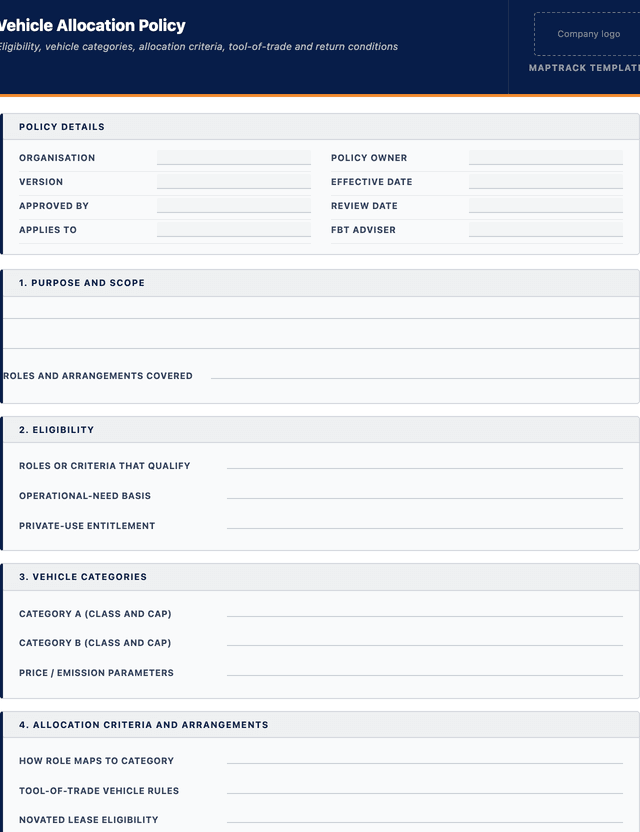
- Purpose and scope: which roles, employment types and vehicle arrangements the policy covers
- Eligibility: the roles or criteria that qualify a person for a vehicle, and any private-use entitlement
- Vehicle categories: the classes of vehicle available, with price, type or emission parameters for each
- Allocation criteria: how a role or person is matched to a category, including operational need and travel
- Tool-of-trade vehicles: definition, permitted private use, and the work-use basis required
- Novated lease arrangements: eligibility, how they differ from a provided vehicle, and employee obligations
- Pool and shared vehicles: when a pool vehicle is provided instead of an allocated one
- Conditions of use: driver responsibilities, private use rules, insurance, and fuel and maintenance obligations
- Return conditions: notice, condition standards, and the process on change of role or departure
How to use this vehicle allocation policy template
- Define eligibility and operational need: Set the roles or criteria that genuinely justify a vehicle, separating an operational need to travel for work from a benefit entitlement attached to a role. Anchoring eligibility to need rather than seniority alone is what keeps the fleet sized to the work.
- Build the vehicle categories: Define a small set of vehicle classes with clear price, type and emission parameters for each, and map roles to categories. Bounded categories prevent each allocation drifting upward and make the budget impact of an entitlement predictable.
- Set the rules for each arrangement: Document how tool-of-trade vehicles, novated leases, provided benefit vehicles and pool vehicles each work, including the private-use position and the work-use basis. The arrangements carry different cost and tax treatment, so the distinctions must be explicit.
- Specify conditions of use: State the driver responsibilities while a vehicle is held: permitted private use, who may drive it, insurance and excess, and the fuel and maintenance obligations. Clear conditions during the term prevent disputes about cost and condition at the end.
- Define return and review: Set the notice, condition standards and process for returning a vehicle on a change of role or departure, including odometer, keys and any damage. Review the policy and the category parameters at least annually so they keep pace with cost and emission expectations.
In MapTrack, you can track your fleet with GPS and digital pre-starts. Each submission is stored as a timestamped PDF against the asset record.
Get the free templateEnter your email above to download the full vehicle allocation policy template as a PDF.Back to download formHow often should you complete this policy?
Review the vehicle allocation policy at least annually, and whenever there is a material change such as a new fringe benefits position, a shift toward hybrid or electric vehicles, a restructure that changes who travels for work, or a budget reset on vehicle categories. The category price and emission parameters in particular date quickly and should be revisited each year.
Apply the policy at every allocation event rather than only at review time. The benefit comes from each new vehicle decision being tested against the eligibility and category rules, so the fleet stays sized to genuine need instead of growing by precedent.
Frequently asked questions
Applicable regulatory standards
This template is a starting point. Check the current requirements that apply to your equipment, work and location. The template alone does not establish compliance.
- Fringe Benefits Tax Assessment Act 1986 and ATO guidance (car fringe benefits and tool-of-trade vehicles)
- Work Health and Safety Act 2011 (safe and fit-for-purpose work vehicles)
- Fair Work Act 2009 (vehicle entitlements forming part of employment terms)
- ISO 55001:2024 Asset management (fleet sizing and whole-of-life cost)
Vehicle allocation policy template preview
The numbers behind this vehicle allocation policy template
Every figure below is sourced and dated, so you can quote it in a toolbox talk, a budget case or a board paper without having to chase the original report.
Embed this free template on your website
Run an industry blog, trade association site, or training resource? Drop a preview of this free vehicle allocation policy template straight into your page. The snippet is self-contained, needs no scripts, and links readers back to the full free template.
<div style="max-width:480px;font-family:system-ui,-apple-system,'Segoe UI',Roboto,sans-serif;border:1px solid #E5E7EB;border-radius:12px;padding:20px;background:#ffffff;">
  <p style="font-size:12px;font-weight:700;letter-spacing:0.05em;text-transform:uppercase;color:#071D49;margin:0;">Free template</p>
  <p style="font-size:18px;font-weight:700;color:#071D49;margin:6px 0 0;">Vehicle allocation policy template</p>
  <ul style="margin:12px 0 0;padding-left:18px;color:#374151;font-size:14px;line-height:1.6;">
    <li style="margin:4px 0;">Purpose and scope: which roles, employment types and vehicle arrangements the policy covers</li>
    <li style="margin:4px 0;">Eligibility: the roles or criteria that qualify a person for a vehicle, and any private-use entitlement</li>
    <li style="margin:4px 0;">Vehicle categories: the classes of vehicle available, with price, type or emission parameters for each</li>
    <li style="margin:4px 0;">Allocation criteria: how a role or person is matched to a category, including operational need and travel</li>
    <li style="margin:4px 0;">Tool-of-trade vehicles: definition, permitted private use, and the work-use basis required</li>
    <li style="margin:4px 0;">Novated lease arrangements: eligibility, how they differ from a provided vehicle, and employee obligations</li>
  </ul>
  <p style="font-size:13px;color:#6B7280;margin:14px 0 0;padding-top:12px;border-top:1px solid #E5E7EB;">Free <a href="https://www.maptrack.com/templates/vehicle-allocation-policy-template" style="color:#071D49;font-weight:600;text-decoration:none;">Vehicle allocation policy template</a> by MapTrack</p>
</div>Free to reuse, including commercially. This template is published under a Creative Commons Attribution 4.0 licence. Copy it, adapt it, put it on your own site or in your own docs. All we ask is that you credit MapTrack with a link back to this page. The snippet above already includes that credit, so if you use it as-is you’re covered.
Cite this template
Writing about this topic? You’re welcome to quote this checklist. Here’s the wording to use so your readers can find the original.
- Short attribution
- MapTrack Vehicle allocation policy template, https://www.maptrack.com/templates/vehicle-allocation-policy-template
- Reference list
- MapTrack. (2026). Vehicle allocation policy template [Checklist template]. Retrieved from https://www.maptrack.com/templates/vehicle-allocation-policy-template
Free to reuse with credit under a Creative Commons Attribution 4.0 licence. If you’d rather link straight to it, the page is https://www.maptrack.com/templates/vehicle-allocation-policy-template.
Need to track your fleet with GPS and digital pre-starts?
Register every asset in MapTrack, attach digital forms, and get a complete history of every inspection, service and compliance record.
GPS and fleet tracking · All templates · Pricing · Book a demo