
Free fleet risk assessment template
Free fleet risk assessment template (PDF-ready). Identify driving, vehicle, load and environment hazards, rate risk, set controls and residual risk.
Updated 2 Oct 2026
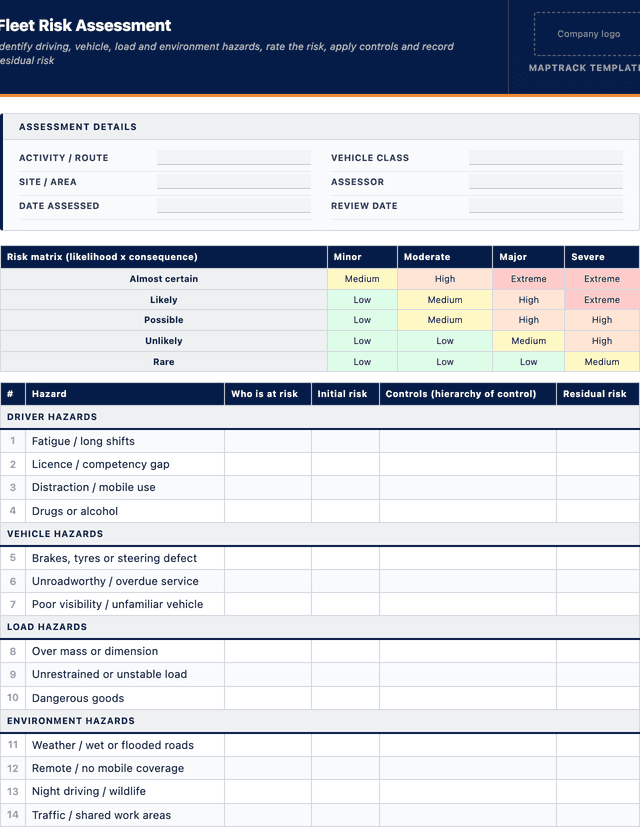
Fleet Risk Assessment
Identify driving, vehicle, load and environment hazards, rate the risk, apply controls and record residual risk
Driver hazards
Vehicle hazards
Load hazards
Environment hazards
Assessed by
Signature
Print name
Date
Reviewed / approved by (manager)
Signature
Print name
Date
How to use: download the PDF, print or complete digitally on any device.
- PDF format, ready to print or fill on screen
- Use as-is or customise to suit your operation
- Go digital in MapTrack for photos, reminders and audit trails
Two ways to use it
Use in MapTrack →Use it digitally instead
Unlimited usersUpload this PDF and MapTrack drafts the form for you.




- Scan the asset’s QR tag with any phone
- Submitted forms can trigger alerts
- Photos on fails, audit-ready records
- Export responses, PDF reports with your logo
Free trial. No credit card needed.
Trusted by teams across Australia and New Zealand
We respect your privacy. Unsubscribe anytime.
These templates are free general guides provided as-is. They do not constitute legal, safety or compliance advice. You are responsible for ensuring any form meets your specific workplace obligations, industry standards and applicable regulations.
Don't just download it - use it live. Start a free workspace, upload this fleet risk assessment template and MapTrack drafts it as a form your crew can run from a phone.

Co-Founder & Commercial Director
Key takeaways
- The MapTrack fleet risk assessment template contains 14 checks across 4 sections. Sections covered: Driver hazards, Vehicle hazards, Load hazards, Environment hazards.
- A fleet risk assessment works through driver, vehicle, load and environment hazards in turn so none are skipped.
- A shared likelihood and consequence matrix keeps every hazard rated consistently across assessors and over time.
- Controls should use the hierarchy of control, preferring elimination and engineering over signage and reminders.
- Residual risk that is still high means stronger controls are needed before the activity proceeds.
- A dated, methodical assessment is evidence of managing risk under WHS duties and Chain of Responsibility.
Enter your email below to download this fleet risk assessment template as a ready-to-use PDF.
Used by construction, mining and field service teams











What is a fleet risk assessment template?
A fleet risk assessment template is a structured form for identifying what could go wrong when vehicles are operated, rating how serious each risk is, and recording the controls that bring it down to an acceptable level. It works through the main sources of road risk in turn: the driver, the vehicle, the load, and the operating environment. For each hazard it captures who could be harmed, the likelihood and consequence, the risk rating from a matrix, the controls applied using the hierarchy of control, the residual risk after those controls, and the actions, owners and dates needed to close any gaps.
A documented risk assessment matters because the Work Health and Safety Act and Regulation require risks to health and safety to be managed so far as is reasonably practicable, and for heavy vehicles the Heavy Vehicle National Law adds duties around fatigue, mass, dimension and roadworthiness across the whole chain. Following a recognised method such as ISO 31000 makes the assessment consistent and defensible. The completed form becomes the evidence that fleet hazards were identified and treated before an incident, and it feeds directly into the fleet safety program and journey plans that put those controls into daily practice.
Learn more about GPS and fleet tracking in MapTrack.
Benefits of using this fleet risk assessment template
- Hazards surfaced early: working through driver, vehicle, load and environment in turn catches the road risks that informal checks routinely miss.
- Consistent rating: a shared likelihood and consequence matrix means every hazard is scored the same way rather than on individual judgement.
- Right controls: applying the hierarchy of control pushes the assessment past signage and reminders toward controls that actually reduce the risk.
- Residual risk visible: recording the risk that remains after controls shows whether the activity is acceptable or needs more work before it proceeds.
- Clear actions: every gap gets an owner and a due date, so the assessment drives change instead of sitting in a folder as a tick-box record.
- Compliance evidence: a dated, methodical assessment is objective proof that fleet risk was managed under WHS duties and Chain of Responsibility.
- Feeds the program: the findings flow straight into the fleet safety program, journey plans and prestart checks that apply the controls daily.
Benefits of digitising forms in MapTrack
When you move your risk assessments from paper to MapTrack, you get:
- Field users can easily scan a QR code to complete a form on mobile. Unlimited users.
- Email the right people when a form is submitted, with an automation you set up.
- File every completed form against the asset, location or person it covers.
- Download any completed form as a PDF, with failed answers listed at the top.
- Fill in forms offline; they upload when the device is back online.
- Build conditional logic (show or hide questions based on answers).
- Take pictures or attach photos. Not possible with a paper-based form.
- Electronic signatures.
- Edit forms later without reprinting.
- Set who can view, fill in or edit forms with user roles.
- Upload a paper form (PDF, Word, Excel or a photo) and MapTrack's AI builds a digital version for you to check.
- Schedule services by odometer, engine hours or date for every vehicle.
- Keep fuel receipts and service records with each vehicle's inspections.
- Record repair costs on each work order against the vehicle.
Book a demo to see how MapTrack handles risk assessments.
Try MapTrack free for 30 days
Full access to every feature. No credit card required. Per-asset pricing so you scale as your fleet grows.
- No credit card required
- 30 days free trial
- Cancel anytime
Intuitive for field crews
“MapTrack's a great platform - intuitive for the guys out in the field and also has fantastic support.”

Matthew Anderson
Maintenance Planning Supervisor, Supagas
What to include in a fleet risk assessment template
This fleet risk assessment template covers 8 key areas:
- Assessment details: activity or route assessed, vehicle class, sites, assessor, date, and review date
- Driver hazards: licence and competency, fatigue, distraction, drugs and alcohol, inexperience, and lone work
- Vehicle hazards: roadworthiness, brakes and tyres, defects, load space, visibility, and unfamiliar vehicles
- Load hazards: mass and dimension limits, load restraint, dangerous goods, manual handling, and unstable loads
- Environment hazards: weather, road and terrain, traffic, remote or no-coverage areas, wildlife, and night driving
- Risk rating: likelihood and consequence for each hazard with an initial risk level from the matrix
- Controls: the control measures applied for each hazard, using the hierarchy of control
- Residual risk and actions: the risk remaining after controls, plus actions, owners, due dates and sign-off
How to use this fleet risk assessment template
- Define the scope and gather the team: Set what the assessment covers, whether a route, a vehicle class or a task, and the sites involved. Involve the drivers who do the work and a safety representative, because the people on the road see hazards that never reach the office.
- Identify hazards across all four sources: Work through driver, vehicle, load and environment hazards in turn so nothing is skipped. For each one, record what could go wrong and who could be harmed, including other road users and the public, not just the driver in the cab.
- Rate each risk with the matrix: Score the likelihood and consequence of each hazard using the same matrix every time, then read off the initial risk level. A consistent matrix stops the same hazard being rated high by one assessor and low by another and keeps the priorities meaningful.
- Apply controls and reassess residual risk: Choose controls using the hierarchy of control, preferring elimination and engineering over signage and reminders, then rate the residual risk that remains. If the residual risk is still too high, the activity needs stronger controls before it goes ahead.
- Assign actions, sign off and review: Give every outstanding action an owner and a due date, have the assessment signed off, and set a review date. Revisit the assessment when the route, vehicle, load or conditions change, or after an incident, so the controls stay matched to the real risk.
In MapTrack, you can track your fleet with GPS and digital pre-starts. Each submission is stored as a timestamped PDF against the asset record.
Get the free templateEnter your email above to download the full fleet risk assessment template as a PDF.Back to download formHow often should you complete this risk assessment?
Complete a fleet risk assessment before a new or changed activity begins, such as a new route, a different vehicle class, a new load type, or work in unfamiliar or remote conditions. Keep the assessment current with a scheduled review, at least annually for ongoing operations, so the controls keep pace with how the fleet actually runs.
Reassess sooner whenever the risk picture changes: a serious incident or near miss, a change to the Heavy Vehicle National Law or WHS duties, new equipment or vehicles, or a seasonal shift such as wet-season roads or harvest traffic. A risk assessment is only useful while it reflects current conditions, so tie the review to real triggers rather than treating it as a once-a-year form to refile.
Frequently asked questions
Applicable regulatory standards
This template is a starting point. Check the current requirements that apply to your equipment, work and location. The template alone does not establish compliance.
- Work Health and Safety Act 2011 and Work Health and Safety Regulation 2025 (NSW), duty to manage risks to health and safety
- Heavy Vehicle National Law (HVNL), NHVR and Chain of Responsibility (fatigue, mass, dimension and roadworthiness)
- ISO 31000:2018 Risk management guidelines
- ISO 39001:2012 Road traffic safety management systems
Fleet risk assessment template preview
The numbers behind this fleet risk assessment template
Every figure below is sourced and dated, so you can quote it in a toolbox talk, a budget case or a board paper without having to chase the original report.
Embed this free template on your website
Run an industry blog, trade association site, or training resource? Drop a preview of this free fleet risk assessment template straight into your page. The snippet is self-contained, needs no scripts, and links readers back to the full free template.
<div style="max-width:480px;font-family:system-ui,-apple-system,'Segoe UI',Roboto,sans-serif;border:1px solid #E5E7EB;border-radius:12px;padding:20px;background:#ffffff;">
  <p style="font-size:12px;font-weight:700;letter-spacing:0.05em;text-transform:uppercase;color:#071D49;margin:0;">Free template</p>
  <p style="font-size:18px;font-weight:700;color:#071D49;margin:6px 0 0;">Fleet risk assessment template</p>
  <ul style="margin:12px 0 0;padding-left:18px;color:#374151;font-size:14px;line-height:1.6;">
    <li style="margin:4px 0;">Assessment details: activity or route assessed, vehicle class, sites, assessor, date, and review date</li>
    <li style="margin:4px 0;">Driver hazards: licence and competency, fatigue, distraction, drugs and alcohol, inexperience, and lone work</li>
    <li style="margin:4px 0;">Vehicle hazards: roadworthiness, brakes and tyres, defects, load space, visibility, and unfamiliar vehicles</li>
    <li style="margin:4px 0;">Load hazards: mass and dimension limits, load restraint, dangerous goods, manual handling, and unstable loads</li>
    <li style="margin:4px 0;">Environment hazards: weather, road and terrain, traffic, remote or no-coverage areas, wildlife, and night driving</li>
    <li style="margin:4px 0;">Risk rating: likelihood and consequence for each hazard with an initial risk level from the matrix</li>
  </ul>
  <p style="font-size:13px;color:#6B7280;margin:14px 0 0;padding-top:12px;border-top:1px solid #E5E7EB;">Free <a href="https://www.maptrack.com/templates/fleet-risk-assessment-template" style="color:#071D49;font-weight:600;text-decoration:none;">Fleet risk assessment template</a> by MapTrack</p>
</div>Free to reuse, including commercially. This template is published under a Creative Commons Attribution 4.0 licence. Copy it, adapt it, put it on your own site or in your own docs. All we ask is that you credit MapTrack with a link back to this page. The snippet above already includes that credit, so if you use it as-is you’re covered.
Cite this template
Writing about this topic? You’re welcome to quote this checklist. Here’s the wording to use so your readers can find the original.
The MapTrack fleet risk assessment template contains 14 checks across 4 sections.
- Short attribution
- MapTrack Fleet risk assessment template, https://www.maptrack.com/templates/fleet-risk-assessment-template
- Reference list
- MapTrack. (2026). Fleet risk assessment template [Checklist template]. Retrieved from https://www.maptrack.com/templates/fleet-risk-assessment-template
Free to reuse with credit under a Creative Commons Attribution 4.0 licence. If you’d rather link straight to it, the page is https://www.maptrack.com/templates/fleet-risk-assessment-template.
Need to track your fleet with GPS and digital pre-starts?
Register every asset in MapTrack, attach digital forms, and get a complete history of every inspection, service and compliance record.
GPS and fleet tracking · All templates · Pricing · Book a demo