
Free template · PDF
Free fleet policy template
Free fleet and vehicle use policy template (PDF-ready). Set eligibility, private use, driver duties, fuel cards, infringements and incident rules.
Loading PDF page...

Read the form fields
4 checks · Sign-off
4 checks
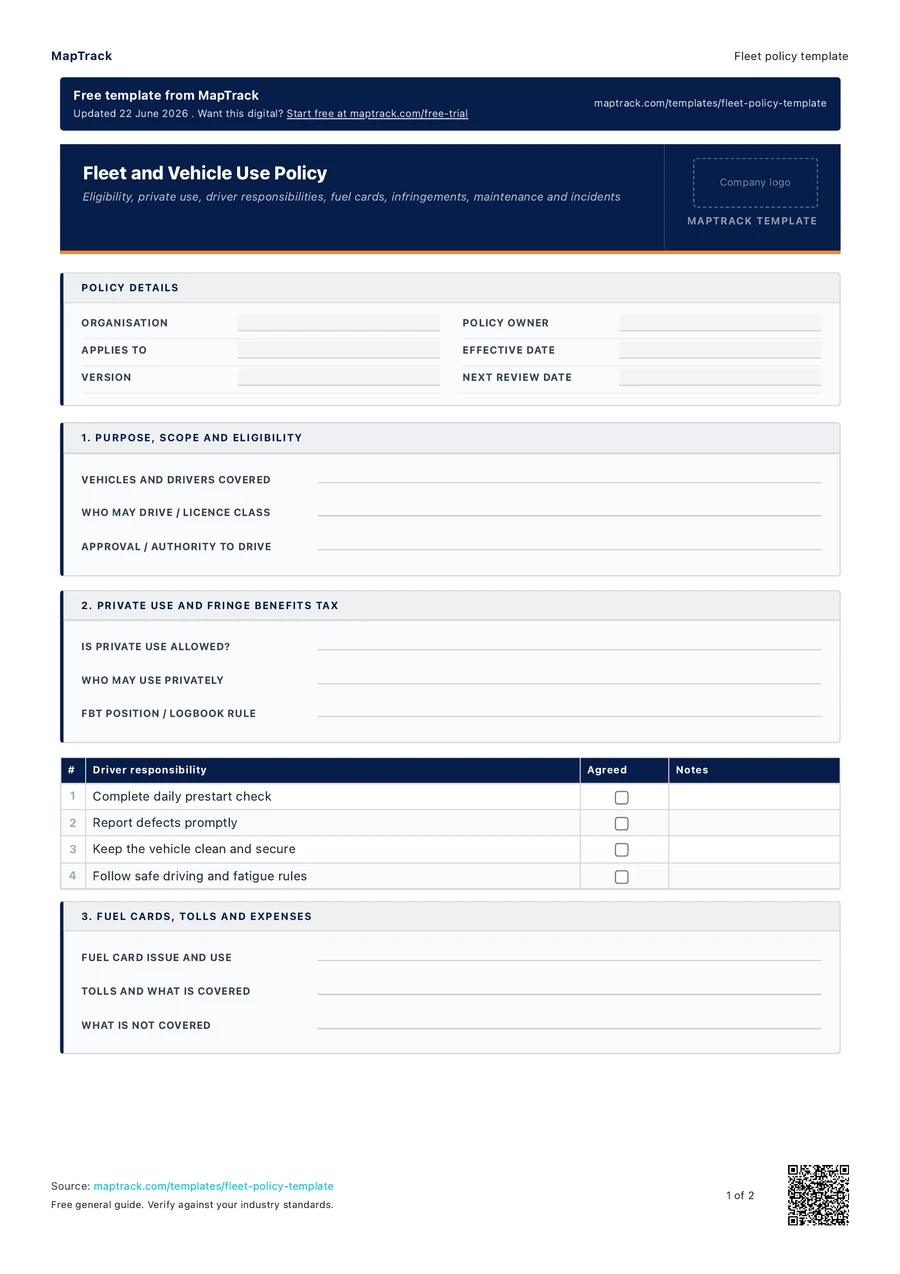
The fields in the printable form, in a view that fits your screen.
- Organisation
- Policy owner
- Applies to
- Effective date
- Version
- Next review date
Checklist
Driver acknowledgement (I have read and accept this policy)
Signature · Print name · Date
Issued / approved by (manager)
Signature · Print name · Date
The MapTrack fleet policy template contains 4 checks.

Make this form your own
Add your fields and logo. Give your team a form they can use on site.
Free 30-day trial. No credit card. Work email needed.
Upload & use this form now for free



“MapTrack beat them all in every aspect.”
 Vincent Stone · HSEQ Advisor, Concept Tanks
After signup: upload this PDF, check the form MapTrack drafts, then save and publish it for your team.
General guidance only. Check the form against your equipment manual, site procedures and local requirements before using it.
Key takeaways
- The MapTrack fleet policy template contains 4 checks.
- A fleet policy is the rules each driver reads and signs, covering eligibility, private use, fuel, infringements and incidents.
- Private use of a company vehicle can create a fringe benefits tax liability, so the policy should state the position clearly.
- The driver in control is normally responsible for infringements and demerit points, set out via driver nomination.
- Personal vehicles used for work, the grey fleet, carry the same WHS duty and must be inside the policy.
- Having every driver sign the policy creates a record that the rules were communicated, understood and accepted.
What is a fleet policy template?
A fleet policy template is a plain document that sets out the rules for using a company vehicle: who is eligible, what private use is allowed, what the driver is responsible for, and how fuel cards, infringements, maintenance and incidents are handled. It also covers the use of a personal vehicle for work, often called the grey fleet, so that those trips are not left outside the rules. Where a fleet management plan sets the strategy and a risk assessment analyses the hazards, the policy is the part each driver actually reads and signs, turning the operating model into clear day-to-day expectations.
A written policy matters because vehicles carry real safety, financial and tax consequences, and unclear rules are where most of the disputes and exposures start. A good policy supports the safe systems of work required under the Work Health and Safety Act, gives drivers certainty about private use and the fringe benefits tax treatment that can flow from it, and sets out who pays for infringements and what must happen after an incident. Having every driver sign the policy creates a clear record that the rules were communicated and accepted, which protects both the driver and the business.
Learn more about GPS and fleet tracking in MapTrack.
Choose the format that fits your team
Download the PDF
Use the original printable form for a paper workflow. Check it against your equipment and site procedure before the job.
Keep completed copies in your own record system and arrange any follow-up through your normal process.
Download free PDFCustomise a form in MapTrack
Start a free trial, upload this PDF and MapTrack drafts the form. Adjust it to your workflow, then save and publish it for your team to use.
Sample answers on this page and completed PDF records aren't imported automatically.
Upload & use this form now for freeFree 30-day trial. No credit card. Work email needed.
Benefits of using this fleet policy template
- Clear expectations: a single set of rules means every driver knows what is allowed, what is required, and what is not, before they take the keys.
- Fewer disputes: setting private use, fuel card and infringement rules up front removes the grey areas where most vehicle disputes start.
- Safety support: linking driver duties to prestart checks, defect reporting and safe driving rules backs the safe systems of work WHS requires.
- Tax certainty: stating the private use position helps the business handle the fringe benefits tax treatment of company vehicles correctly.
- Cost discipline: rules for fuel cards, tolls and personal use protect the fleet budget from leakage and unapproved spend.
- Grey fleet covered: setting rules for personal vehicles used on work trips brings those trips inside the policy instead of outside it.
- Signed record: having each driver acknowledge the policy creates evidence that the rules were communicated, understood and accepted.
What to include in a fleet policy template
- Purpose and scope: what the policy covers, which vehicles and drivers it applies to, and the effective date
- Eligibility and authority to drive: who may drive, licence class and verification, and any approval needed
- Private use: whether private use is allowed, who may drive privately, and the fringe benefits tax position
- Driver responsibilities: prestart checks, defect reporting, cleanliness, securing the vehicle, and safe driving rules
- Fuel cards and expenses: how fuel cards are issued and used, tolls, what is covered, and what is not
- Infringements and demerit points: who is responsible for fines, nomination of the driver, and demerit point handling
- Maintenance and servicing: booking servicing, reporting faults, tyres, and keeping the vehicle roadworthy
- Incidents and personal vehicles: crash and breakdown reporting steps, insurance, and rules for personal vehicles used for work
How to use this fleet policy template
Set the scope and eligibility
Define which vehicles and drivers the policy covers, who is eligible to drive, the licence class required, and any approval needed. Clear eligibility from the start prevents unauthorised drivers and makes the rest of the policy straightforward to apply.
Decide the private use and tax position
State whether private use is allowed, who may use a vehicle privately, and how the fringe benefits tax treatment is handled. Private use is one of the most common sources of confusion, so spell it out and confirm the tax position with your finance team.
Define driver responsibilities and cost rules
Set the prestart, defect reporting and safe driving expectations, then the rules for fuel cards, tolls, infringements and demerit points. Drivers follow rules they understand, so keep each one specific and avoid vague language that invites argument later.
Set maintenance, incident and personal vehicle rules
Lay out how servicing is booked, how faults are reported, what to do after a crash or breakdown, and the rules for using a personal vehicle on work trips. Covering the grey fleet brings those trips inside the policy instead of leaving a gap.
Communicate, sign and review
Issue the policy to every driver, have each one acknowledge and sign it, and keep the record. Review the policy on a set cycle and when tax rules, the Heavy Vehicle National Law or your fleet change, so it stays current and enforceable.
How often should you complete this policy?
Issue the fleet policy to every driver when they join or first take a vehicle, and have them acknowledge and sign it so there is a record that the rules were communicated and accepted. Reissue it for signature whenever the policy is materially updated, rather than assuming drivers have noticed a change.
Review the policy on a set cycle, at least annually, and whenever something material changes: a change to fringe benefits tax rules, the Heavy Vehicle National Law or road transport law, a shift in the fleet or vehicle types, or a recurring problem such as unpaid infringements or unreported incidents. Keeping the policy current and re-signed is what makes it enforceable, since a rule no one has seen or accepted is difficult to rely on after the fact.
Make this form your own
From your template to your team.
Upload this PDF and MapTrack drafts the form. Adjust it for your equipment and site, then save and publish the digital form for your team.
- 01
Start your free trial
Use your work email to create your MapTrack account.
- 02
Customise, save and publish
Adjust the template fields and branding for your site.
- 03
Complete it on the job
Record checks, add photos and export a branded PDF.
Keep working offline
Load the form before you lose reception. Complete it offline and sync when you're back online.
Scan the asset. Open its form.
Use an asset's QR code to find and complete the forms that belong to it.
Show what you found
Capture photos and attach files so the next person has the details they need.
Take a branded PDF with you
Download completed forms as PDF reports with your company logo.
Completed paper records aren't imported automatically.
Frequently asked questions
Practical answers about the form, record keeping and using MapTrack.
Private use of a company vehicle can be a car fringe benefit under the Fringe Benefits Tax Assessment Act, which may create an FBT liability for the business. What counts as private use, and how the benefit is valued, depends on the arrangement and the records kept, such as logbooks. This template sets the private use rules so expectations are clear, but it is not tax advice. Confirm the treatment for your vehicles and arrangements with your accountant or the Australian Taxation Office so the policy and your FBT position line up.
Link to this answerAs a rule, the driver in control of the vehicle at the time is responsible for the infringement and any demerit points, and the policy should make that clear. When a fine is issued to the company as the registered operator, the business nominates the driver who was in control so the penalty and points are directed correctly. Setting this out in the policy, along with how nomination works and any handling charge, removes the argument and keeps responsibility with the person who was actually driving.
Link to this answerA fleet policy is the set of rules drivers and managers must follow, covering eligibility, private use, fuel cards, infringements, maintenance and incidents. A fleet management plan is the broader operating model that sets strategy for acquiring, maintaining, funding and measuring the fleet over its life. The policy is what an individual driver reads and signs, while the plan is how the fleet is run as an asset base. Most operations need both, and the policy usually sits underneath the plan and reflects its decisions.
Link to this answerYes. Personal vehicles used for work trips, often called the grey fleet, carry the same WHS duty as company vehicles, so leaving them out creates a real gap. The policy should require a current licence, registration and insurance, a roadworthy vehicle, and the same safe driving and fatigue rules that apply to the fleet. It should also set out what the business will and will not reimburse. Bringing the grey fleet inside the policy means those trips are managed rather than invisible.
Link to this answerYes, it is completely free. It downloads as a PDF you can keep or print for your fleet file. You do not need a MapTrack account. If you want to move beyond a static document, MapTrack keeps vehicle records, registration and licence dates, service history and prestart checks in one place, with reminders before things fall due so the policy is backed by live records. Start free or book a demo to see how.
Link to this answerApplicable regulatory standards
This form is a starting point. Check the current requirements that apply to your equipment, work and location. The form alone does not establish compliance.
- Work Health and Safety Act 2011 and Work Health and Safety Regulation 2025 (NSW), safe systems of work for driving
- Heavy Vehicle National Law (HVNL), NHVR and Chain of Responsibility (where heavy vehicles are operated)
- Fringe Benefits Tax Assessment Act 1986 (private use of a company vehicle as a car fringe benefit)
- Australian Road Rules and applicable state and territory road transport legislation
- Model WHS Regulations (Safe Work Australia)
- Model Work Health and Safety Act (Safe Work Australia)
- Heavy Vehicle National Law and Regulations (NHVR)
MapTrack publishes this template. The linked authorities publish their own guidance; they haven't endorsed this form.
The numbers behind this fleet policy template
Every figure below is sourced and dated, so you can quote it in a toolbox talk, a budget case or a board paper without having to chase the original report.
Cite this template
Writing about this topic? You’re welcome to quote this checklist. Here’s the wording to use so your readers can find the original.
The MapTrack fleet policy template contains 4 checks.
- Short attribution
- MapTrack Fleet policy template, https://www.maptrack.com/templates/fleet-policy-template
- Reference list
- MapTrack. (2026). Fleet policy template [Checklist template]. Retrieved from https://www.maptrack.com/templates/fleet-policy-template
Free to reuse with credit under a Creative Commons Attribution 4.0 licence. If you’d rather link straight to it, the page is https://www.maptrack.com/templates/fleet-policy-template.
Embed this free template on your website
Run an industry blog, trade association site, or training resource? Drop a preview of this free fleet policy template straight into your page. The snippet is self-contained, needs no scripts, and links readers back to the full free template.
<div style="max-width:480px;font-family:system-ui,-apple-system,'Segoe UI',Roboto,sans-serif;border:1px solid #E5E7EB;border-radius:12px;padding:20px;background:#ffffff;">
  <p style="font-size:12px;font-weight:700;letter-spacing:0.05em;text-transform:uppercase;color:#071D49;margin:0;">Free template</p>
  <p style="font-size:18px;font-weight:700;color:#071D49;margin:6px 0 0;">Fleet policy template</p>
  <ul style="margin:12px 0 0;padding-left:18px;color:#374151;font-size:14px;line-height:1.6;">
    <li style="margin:4px 0;">Purpose and scope: what the policy covers, which vehicles and drivers it applies to, and the effective date</li>
    <li style="margin:4px 0;">Eligibility and authority to drive: who may drive, licence class and verification, and any approval needed</li>
    <li style="margin:4px 0;">Private use: whether private use is allowed, who may drive privately, and the fringe benefits tax position</li>
    <li style="margin:4px 0;">Driver responsibilities: prestart checks, defect reporting, cleanliness, securing the vehicle, and safe driving rules</li>
    <li style="margin:4px 0;">Fuel cards and expenses: how fuel cards are issued and used, tolls, what is covered, and what is not</li>
    <li style="margin:4px 0;">Infringements and demerit points: who is responsible for fines, nomination of the driver, and demerit point handling</li>
  </ul>
  <p style="font-size:13px;color:#6B7280;margin:14px 0 0;padding-top:12px;border-top:1px solid #E5E7EB;">Free <a href="https://www.maptrack.com/templates/fleet-policy-template" style="color:#071D49;font-weight:600;text-decoration:none;">Fleet policy template</a> by MapTrack</p>
</div>Free to reuse, including commercially. This template is published under a Creative Commons Attribution 4.0 licence. Copy it, adapt it, put it on your own site or in your own docs. All we ask is that you credit MapTrack with a link back to this page. The snippet above already includes that credit, so if you use it as-is you’re covered.
About the author

Co-Founder & Commercial Director
Jarrod has spent over a decade in technology consulting and asset management, including roles at Accenture (mining and heavy industry) and CGI as an Asset Management Consultant. He co-founded MapTrack and built and scaled its original platform, then rebuilt it with Lachlan and Alex from thousands of customer conversations and 300+ user research sessions with field teams. His consulting background gives him deep insight into the operational and compliance challenges facing asset-intensive Australian businesses.
View LinkedIn profile →Ready for your next job?
Keep the PDF handy, or upload it to MapTrack and turn it into a digital form for your team.