
Free fuel management policy template
Free fuel management policy template (PDF-ready). Set fuel-card rules, purchasing controls, efficiency targets, fraud controls and fleet reporting.
Updated 22 June 2026
How to use: download the PDF, print or complete digitally on any device.
- PDF format, ready to print or fill on screen
- Use as-is or customise to suit your operation
- Go digital in MapTrack for photos, reminders and audit trails
Download free PDF template
Use in MapTrack →



Trusted by teams across Australia and New Zealand
We respect your privacy. Unsubscribe anytime.
Or set it up in MapTrack
- Fill it in on a phone, attach photos to any check
- Automatic reports and audit trails
- Upload the PDF and MapTrack drafts the form for you
Free 30-day trial. No credit card. Personal email accepted.
Don't just download it - use it live. Start a free workspace, upload this fuel management policy template and MapTrack drafts it as a form your crew can run from a phone.

Co-Founder & Commercial Director
Key takeaways
- A fuel management policy sets the rules behind every fill, where a fuel log only records the fill itself.
- Fuel is a large controllable cost that leaks through small, repeated losses unless it is actively reconciled.
- Reconciling card statements against logged fills and odometer movement is the control that exposes most fraud.
- Name a single owner of fuel cost and an exception process, or the spend becomes nobody's problem.
- Consistent odometer and receipt records also support FBT and ATO substantiation where private use exists.
Enter your email below to download this fuel management policy template as a ready-to-use PDF.
Used by construction, mining and field service teams









What is a fuel management policy template?
A fuel management policy is the document that sets out how an organisation buys, controls, monitors and reports on the fuel its fleet consumes. It is distinct from a fuel log, which simply records each fill: the policy defines the rules behind those fills. It covers who is authorised to purchase fuel and on what, the approved fuel types and suppliers, spend and volume limits, the records every driver must keep, the efficiency targets the fleet is held to, and the controls that detect and deter fuel theft and misuse. It also names the person accountable for fuel cost and sets out how performance is reviewed.
Fuel is one of the largest controllable running costs in any fleet, and it is also one of the easiest to leak through small, repeated losses that never show up as a single obvious event. A clear policy turns fuel from an untracked expense into a managed one: it gives drivers unambiguous rules, gives managers a basis to question outliers, and creates the reconciliation discipline that exposes filling a personal vehicle, buying non-fuel items, or odometer entries that do not add up. Tying the policy to whole-of-life cost thinking under ISO 55001, and to the fringe benefits and record-keeping expectations of the ATO where private use is involved, keeps both the spend and the tax position defensible.
Learn more about GPS and fleet tracking in MapTrack.
Benefits of using this fuel management policy template
- Lower fuel spend: clear purchasing rules and efficiency targets give managers a basis to question outliers and pull the fleet back toward benchmark consumption.
- Fraud deterrence: defined controls and routine reconciliation make filling a personal vehicle or buying non-fuel items far harder to hide and easier to catch.
- Consistent records: every driver follows the same rules for receipts, odometer readings and card use, so the data is complete enough to actually analyse.
- Clear accountability: naming who owns fuel cost and who approves exceptions stops the spend being everyone's problem and therefore no one's.
- Tax and audit readiness: documented private-use and record-keeping rules support fringe benefits reporting and stand up to an ATO or internal review.
- Better decisions: reliable consumption data per vehicle feeds replacement, rightsizing and route decisions instead of guesswork at budget time.
Benefits of digitising forms in MapTrack
When you move your policys from paper to MapTrack, you get:
- Field users can easily scan a QR code to complete a form on mobile. Unlimited users.
- Email the right people when a form is submitted, with an automation you set up.
- File every completed form against the asset, location or person it covers.
- Download any completed form as a PDF, with failed answers listed at the top.
- Fill in forms offline; they upload when the device is back online.
- Build conditional logic (show or hide questions based on answers).
- Take pictures or attach photos. Not possible with a paper-based form.
- Electronic signatures.
- Edit forms later without reprinting.
- Set who can view, fill in or edit forms with user roles.
- Upload a paper form (PDF, Word, Excel or a photo) and MapTrack's AI builds a digital version for you to check.
- Schedule services by odometer, engine hours or date for every vehicle.
- Keep fuel receipts and service records with each vehicle's inspections.
- Record repair costs on each work order against the vehicle.
Book a demo to see how MapTrack handles policys.
Try MapTrack free for 30 days
Full access to every feature. No credit card required. Per-asset pricing so you scale as your fleet grows.
- No credit card required
- 30 days free trial
- Cancel anytime
Intuitive for field crews
“MapTrack's a great platform - intuitive for the guys out in the field and also has fantastic support.”

Matthew Anderson
Maintenance Planning Supervisor, Supagas
What to include in a fuel management policy template
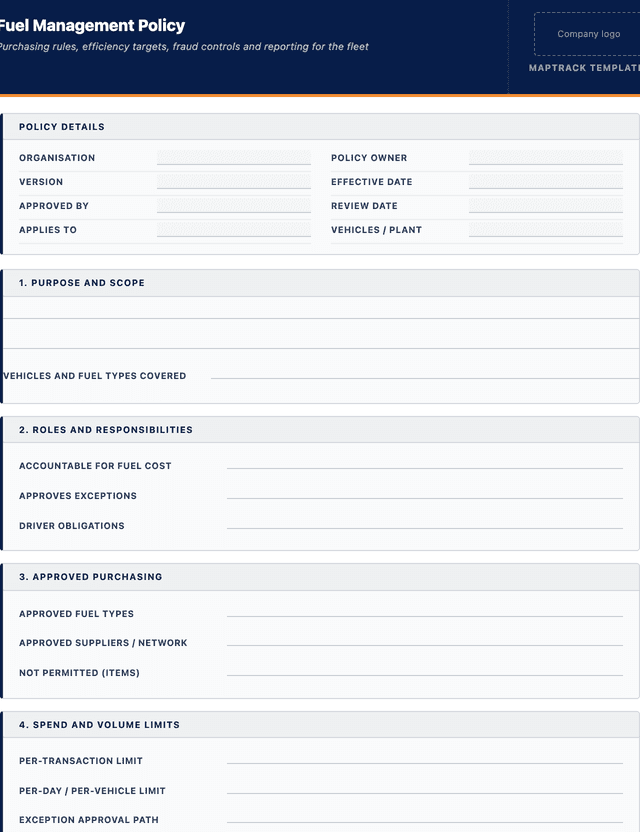
This fuel management policy template covers 9 key areas:
- Purpose and scope: which vehicles, drivers, plant and fuel types the policy covers
- Roles and responsibilities: who owns fuel cost, who approves exceptions, and driver obligations
- Approved purchasing: authorised fuel types, suppliers or networks, and what may not be bought
- Fuel cards and accounts: how cards are issued, used and secured (cross-reference the fuel-card policy)
- Spend and volume limits: per-transaction, per-day and per-vehicle limits with an exception process
- Record-keeping: required odometer readings, receipts, and reconciliation to fuel logs
- Efficiency targets: expected consumption benchmarks and how underperformance is managed
- Fraud controls: reconciliation, exception reporting, and consequences for misuse
- Reporting and review: which fuel reports are produced, how often, and who reviews them
How to use this fuel management policy template
- Set the scope and accountability: Define which vehicles, plant and drivers the policy covers and name the person accountable for fuel cost. Without a single owner, fuel spend drifts because questioning an outlier is nobody's clear job and exceptions get approved by default.
- Define purchasing rules and limits: Specify the approved fuel types, suppliers or card networks, and what may not be purchased on a fuel account. Set sensible per-transaction, per-day and per-vehicle limits, and document a fast exception path so the rules do not strand legitimate trips.
- Establish records and efficiency targets: Require an odometer reading and a receipt against every fill, and set the consumption benchmark each vehicle class is expected to meet. Consistent records are what let you compare actual litres per hundred kilometres against target and spot the outliers.
- Build the fraud and reconciliation controls: Reconcile card and fuel statements against logged fills and odometer movement, and define the exception reports that flag double fills, after-hours purchases or volumes that exceed tank capacity. State the consequences for misuse so the deterrent is real.
- Communicate, report and review: Issue the policy to every driver, have them acknowledge it, and produce a regular fuel report that compares spend and efficiency by vehicle. Review the policy at least annually and after any fraud finding so the controls keep pace with how the fleet operates.
In MapTrack, you can track your fleet with GPS and digital pre-starts. Each submission is stored as a timestamped PDF against the asset record.
Get the free templateEnter your email above to download the full fuel management policy template as a PDF.Back to download formHow often should you complete this policy?
Treat the policy as a living control, not a one-off document. Review it at least annually, and immediately after any fuel fraud finding, a major fuel price shift, or a change in the fleet profile such as moving to hybrids or electric vehicles. Reconcile fuel data far more often than that, monthly at a minimum, because controls that are written but never checked deter no one.
Produce the fuel efficiency and exception reports on a regular cycle and put them in front of the accountable owner. The policy only saves money if the consumption it sets targets against is actually reviewed and the outliers are followed up.
Frequently asked questions
Applicable regulatory standards
This template is a starting point. Check the current requirements that apply to your equipment, work and location. The template alone does not establish compliance.
- Work Health and Safety Act 2011 (safe refuelling and handling of fuels)
- Fringe Benefits Tax Assessment Act 1986 and ATO guidance (fuel and vehicle benefits)
- ISO 55001:2024 Asset management (whole-of-life vehicle running costs)
- Australian Consumer Law (fair dealing in fuel purchasing arrangements)
Fuel management policy template preview
The numbers behind this fuel management policy template
Every figure below is sourced and dated, so you can quote it in a toolbox talk, a budget case or a board paper without having to chase the original report.
Embed this free template on your website
Run an industry blog, trade association site, or training resource? Drop a preview of this free fuel management policy template straight into your page. The snippet is self-contained, needs no scripts, and links readers back to the full free template.
<div style="max-width:480px;font-family:system-ui,-apple-system,'Segoe UI',Roboto,sans-serif;border:1px solid #E5E7EB;border-radius:12px;padding:20px;background:#ffffff;">
  <p style="font-size:12px;font-weight:700;letter-spacing:0.05em;text-transform:uppercase;color:#071D49;margin:0;">Free template</p>
  <p style="font-size:18px;font-weight:700;color:#071D49;margin:6px 0 0;">Fuel management policy template</p>
  <ul style="margin:12px 0 0;padding-left:18px;color:#374151;font-size:14px;line-height:1.6;">
    <li style="margin:4px 0;">Purpose and scope: which vehicles, drivers, plant and fuel types the policy covers</li>
    <li style="margin:4px 0;">Roles and responsibilities: who owns fuel cost, who approves exceptions, and driver obligations</li>
    <li style="margin:4px 0;">Approved purchasing: authorised fuel types, suppliers or networks, and what may not be bought</li>
    <li style="margin:4px 0;">Fuel cards and accounts: how cards are issued, used and secured (cross-reference the fuel-card policy)</li>
    <li style="margin:4px 0;">Spend and volume limits: per-transaction, per-day and per-vehicle limits with an exception process</li>
    <li style="margin:4px 0;">Record-keeping: required odometer readings, receipts, and reconciliation to fuel logs</li>
  </ul>
  <p style="font-size:13px;color:#6B7280;margin:14px 0 0;padding-top:12px;border-top:1px solid #E5E7EB;">Free <a href="https://www.maptrack.com/templates/fuel-management-policy-template" style="color:#071D49;font-weight:600;text-decoration:none;">Fuel management policy template</a> by MapTrack</p>
</div>Free to reuse, including commercially. This template is published under a Creative Commons Attribution 4.0 licence. Copy it, adapt it, put it on your own site or in your own docs. All we ask is that you credit MapTrack with a link back to this page. The snippet above already includes that credit, so if you use it as-is you’re covered.
Cite this template
Writing about this topic? You’re welcome to quote this checklist. Here’s the wording to use so your readers can find the original.
- Short attribution
- MapTrack Fuel management policy template, https://www.maptrack.com/templates/fuel-management-policy-template
- Reference list
- MapTrack. (2026). Fuel management policy template [Checklist template]. Retrieved from https://www.maptrack.com/templates/fuel-management-policy-template
Free to reuse with credit under a Creative Commons Attribution 4.0 licence. If you’d rather link straight to it, the page is https://www.maptrack.com/templates/fuel-management-policy-template.
Need to track your fleet with GPS and digital pre-starts?
Register every asset in MapTrack, attach digital forms, and get a complete history of every inspection, service and compliance record.
GPS and fleet tracking · All templates · Pricing · Book a demo