
Free drivers work diary template (NHVR-aligned)
Free driver's work diary template aligned to HVNL fatigue management. Record work and rest periods for heavy vehicle compliance. Print-ready PDF.
Updated 10 Aug 2026
How to use: download the PDF, print or complete digitally on any device.
- PDF format, ready to print or fill on screen
- Use as-is or customise to suit your operation
- Go digital in MapTrack for photos, reminders and audit trails
Download free PDF template
Use in MapTrack →



Trusted by teams across Australia and New Zealand
We respect your privacy. Unsubscribe anytime.
Or set it up in MapTrack
- Fill it in on a phone, attach photos to any check
- Automatic reports and audit trails
- Upload the PDF and MapTrack drafts the form for you
Free 30-day trial. No credit card. Personal email accepted.
Don't just download it - use it live. Start a free workspace, upload this drivers work diary template (NHVR-aligned) and MapTrack drafts it as a form your crew can run from a phone.

Co-Founder & Commercial Director
Enter your email below to download this drivers work diary template (NHVR-aligned) as a ready-to-use PDF.
Used by construction, mining and field service teams











What is a drivers work diary template (NHVR-aligned)?
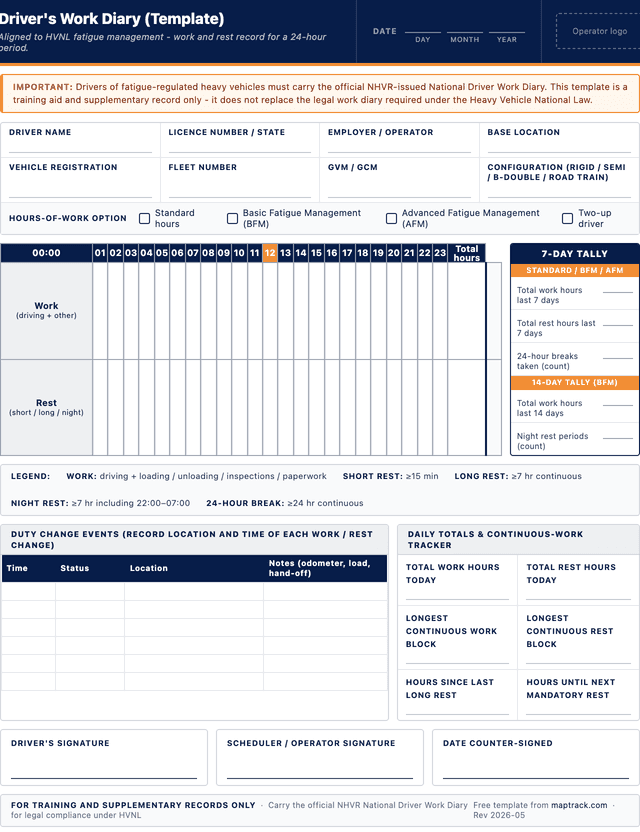
A driver's work diary template is a structured 24-hour record of work and rest periods used to support fatigue management under the Heavy Vehicle National Law (HVNL). The Australian work diary uses two primary status categories - work (which includes driving plus loading, unloading, inspections, paperwork and any other tasks for the operator) and rest (with sub-types including short rest of 15 minutes or more, long rest of 7 hours or more continuous, night rest of 7 hours including the period 22:00 to 07:00, and 24-hour breaks). The grid uses 24 hourly columns subdivided into 15-minute increments, with a right-hand cumulative tracker for 7-day and 14-day work and rest totals.
Under the Heavy Vehicle (Fatigue Management) National Regulation administered by the National Heavy Vehicle Regulator (NHVR), drivers of fatigue-regulated heavy vehicles (most rigid and articulated vehicles over 12 tonnes GVM, all buses over 4.5 tonnes GVM carrying passengers, and combinations over 12 tonnes GCM) must record work and rest periods. Hours-of-work options include Standard Hours (a maximum of 12 hours work in any 24-hour period with a 7-hour continuous rest), Basic Fatigue Management (BFM, allowing up to 14 hours work in 24 with operator accreditation), and Advanced Fatigue Management (AFM, scheduled hours subject to NHVR approval). Each option carries cumulative work and rest limits across 7-day and 14-day windows.
Important: drivers of fatigue-regulated heavy vehicles must carry the official NHVR-issued National Driver Work Diary while operating; the bound book is the legal record under HVNL. This template is a training aid, supplementary record and reference document , it does not replace the NHVR-issued diary. Use it to coach new drivers on how to fill out the diary, to keep an internal duplicate at the depot, to record work and rest for fleet vehicles below the fatigue-regulated threshold, or to track sleep planning ahead of a long shift. The 7-day and 14-day cumulative tally on the right side helps drivers and schedulers verify that the planned roster stays within Standard Hours, BFM or AFM limits before the shift begins.
Learn more about GPS and fleet tracking in MapTrack.
Managing fatigue across heavy vehicles? Our fleet guide explains NHVR compliance and chain of responsibility, including the fatigue rules.
Benefits of using this drivers work diary template (NHVR-aligned)
- HVNL-aligned format: mirrors the work and rest structure used in the NHVR National Driver Work Diary, supporting consistent recording across the fleet.
- Schedule planning: 7-day and 14-day cumulative tracker helps schedulers verify rosters stay within Standard Hours, BFM or AFM limits before drivers depart.
- Driver training: an effective tool for inducting new drivers, demonstrating how to record work and rest events accurately in the official work diary.
- Supplementary record: provides operators with an internal duplicate of work and rest data for accreditation evidence, audit preparation and incident investigation.
- Light fleet support: gives operators of vehicles below the 12-tonne fatigue-regulated threshold a structured fatigue record, even though the NHVR diary is not legally required.
- Chain of responsibility: documented work and rest records help every party in the supply chain demonstrate they took reasonable steps to manage driver fatigue.
Benefits of digitising forms in MapTrack
When you digitise heavy vehicle log / registers in MapTrack, you get:
- Field users can easily scan a QR code to complete a form on mobile. Unlimited users.
- Email the right people when a form is submitted, with an automation you set up.
- File every completed form against the asset, location or person it covers.
- Download any completed form as a PDF, with failed answers listed at the top.
- Fill in forms offline; they upload when the device is back online.
- Build conditional logic (show or hide questions based on answers).
- Take pictures or attach photos. Not possible with a paper-based form.
- Electronic signatures.
- Edit forms later without reprinting.
- Set who can view, fill in or edit forms with user roles.
- Upload a paper form (PDF, Word, Excel or a photo) and MapTrack's AI builds a digital version for you to check.
- Schedule services by odometer, engine hours or date for every vehicle.
- Keep fuel receipts and service records with each vehicle's inspections.
- Record repair costs on each work order against the vehicle.
Book a demo to see how MapTrack handles heavy vehicle log / registers.
Try MapTrack free for 30 days
Full access to every feature. No credit card required. Per-asset pricing so you scale as your fleet grows.
- No credit card required
- 30 days free trial
- Cancel anytime
Intuitive for field crews
“MapTrack's a great platform - intuitive for the guys out in the field and also has fantastic support.”

Matthew Anderson
Maintenance Planning Supervisor, Supagas
What to include in a drivers work diary template (NHVR-aligned)
This drivers work diary template (NHVR-aligned) covers 9 key areas:
- Date fields: day, month and year for the 24-hour period covered by the diary entry.
- Driver details: full name, licence number and issuing state, employer or operator, and base location.
- Vehicle details: registration, fleet number, GVM/GCM and configuration (rigid, semi-trailer, B-double or road train).
- Hours-of-work option: Standard Hours, Basic Fatigue Management (BFM), Advanced Fatigue Management (AFM) or two-up driver scheme.
- Work and rest grid: two rows (work and rest) with 24 hourly columns from 00:00 to 23:00, each subdivided into 15-minute increments.
- Duty change events table: time, status, location and notes for every transition between work and rest, including odometer and load details.
- Daily totals: total work hours, total rest hours, longest continuous work block, longest continuous rest block, hours since last long rest and hours until next mandatory rest.
- Cumulative tally: total work hours and rest hours over the previous 7 days, count of 24-hour breaks and night rest periods, plus a 14-day total for BFM operators.
- Counter-signatures: driver signature, scheduler or operator signature and the date the entry was counter-signed.
How to use this drivers work diary template (NHVR-aligned)
- Complete the driver, vehicle and hours-of-work option fields before starting the shift.: Print the driver name, licence number and issuing state, employer or operator name, and base location. Record the vehicle registration, fleet number, GVM/GCM and configuration. Tick the applicable hours-of-work option (Standard Hours, BFM, AFM or two-up driver). The hours-of-work option determines the daily and weekly limits that apply for the rest of the diary entry.
- Mark work and rest blocks on the 24-hour grid as they occur, using the 15-minute subdivisions for accuracy.: Draw a horizontal line on the work row whenever the driver is performing any task for the operator (driving, loading or unloading, inspecting the vehicle, paperwork, fuelling). Draw a horizontal line on the rest row when the driver is free from any task. Use the 15-minute subdivisions to record start and end times to the nearest quarter hour. Mark every change of status with a vertical line on the grid.
- Record each duty change in the events table with time, status, location and notes.: For every transition between work and rest, write the time of the change, the new status (work or which type of rest), the location (suburb and state, or roadhouse name) and a short note covering odometer reading, load number, hand-off detail or rest sub-type. The events table provides the audit trail that supports the grid and helps reconstruct the day if questions arise.
- At the end of the shift, complete the daily totals and continuous-work tracker.: Total the work hours and rest hours from the grid. Identify the longest continuous block of work and the longest continuous block of rest. Calculate hours since the last long rest (7 hours or more continuous) and the hours remaining until the next mandatory rest based on the chosen hours-of-work option. The continuous-work tracker is critical under Standard Hours, where work cannot exceed 5.25 hours before a short rest is required.
- Update the 7-day and 14-day cumulative tally and verify compliance with the chosen option.: Add today's work hours and rest hours to the rolling 7-day totals on the right-hand panel. For BFM operators, also update the 14-day work hours total. Count the number of 24-hour breaks and night rest periods recorded across the 7 days. Compare the totals to the limits for Standard Hours (72 hr / 7 days), BFM (100 hr / 14 days with required night rest) or AFM (operator-specific schedule).
- Counter-sign the entry and submit to the operator or scheduler for review.: The driver signs and dates the entry to certify the work and rest record is accurate. The scheduler or operator counter-signs to confirm review. The completed template should be retained alongside the NHVR Driver Work Diary copy as part of the operator's fatigue management evidence base. Operators with BFM or AFM accreditation must keep records to demonstrate compliance during NHVR audits.
In MapTrack, you can track your fleet with GPS and digital pre-starts. Each submission is stored as a timestamped PDF against the asset record.
Get the free templateEnter your email above to download the full drivers work diary template (NHVR-aligned) as a PDF.Back to download formHow often should you complete this log / register?
Drivers of fatigue-regulated heavy vehicles must record their work and rest periods continuously while subject to the HVNL Fatigue Management Regulation. The official NHVR-issued National Driver Work Diary must be filled in for each 24-hour period and carried in the vehicle while driving. This template should be used as a training aid before a driver starts using the official diary, as a supplementary internal record kept at the depot, or as a complete fatigue record for vehicles below the 12-tonne fatigue-regulated threshold where the official diary is not legally required. Schedulers should review the 7-day cumulative tally before issuing each new shift to confirm the planned roster stays within the chosen Standard Hours, BFM or AFM limits.
Frequently asked questions
Applicable regulatory standards
This template is a starting point. Check the current requirements that apply to your equipment, work and location. The template alone does not establish compliance.
- Heavy Vehicle National Law (HVNL) - Chapter 6 fatigue management
- Heavy Vehicle (Fatigue Management) National Regulation
- NHVR National Driver Work Diary requirements
- WHS Act 2011, Section 19 - Primary duty of care
- NHVR accreditation guidelines for BFM and AFM
Drivers work diary template (NHVR-aligned) preview
The numbers behind this drivers work diary template (NHVR-aligned)
Every figure below is sourced and dated, so you can quote it in a toolbox talk, a budget case or a board paper without having to chase the original report.
Embed this free template on your website
Run an industry blog, trade association site, or training resource? Drop a preview of this free drivers work diary template (NHVR-aligned) straight into your page. The snippet is self-contained, needs no scripts, and links readers back to the full free template.
<div style="max-width:480px;font-family:system-ui,-apple-system,'Segoe UI',Roboto,sans-serif;border:1px solid #E5E7EB;border-radius:12px;padding:20px;background:#ffffff;">
  <p style="font-size:12px;font-weight:700;letter-spacing:0.05em;text-transform:uppercase;color:#071D49;margin:0;">Free template</p>
  <p style="font-size:18px;font-weight:700;color:#071D49;margin:6px 0 0;">Drivers work diary template (NHVR-aligned)</p>
  <ul style="margin:12px 0 0;padding-left:18px;color:#374151;font-size:14px;line-height:1.6;">
    <li style="margin:4px 0;">Date fields: day, month and year for the 24-hour period covered by the diary entry.</li>
    <li style="margin:4px 0;">Driver details: full name, licence number and issuing state, employer or operator, and base location.</li>
    <li style="margin:4px 0;">Vehicle details: registration, fleet number, GVM/GCM and configuration (rigid, semi-trailer, B-double or road train).</li>
    <li style="margin:4px 0;">Hours-of-work option: Standard Hours, Basic Fatigue Management (BFM), Advanced Fatigue Management (AFM) or two-up driver scheme.</li>
    <li style="margin:4px 0;">Work and rest grid: two rows (work and rest) with 24 hourly columns from 00:00 to 23:00, each subdivided into 15-minute increments.</li>
    <li style="margin:4px 0;">Duty change events table: time, status, location and notes for every transition between work and rest, including odometer and load details.</li>
  </ul>
  <p style="font-size:13px;color:#6B7280;margin:14px 0 0;padding-top:12px;border-top:1px solid #E5E7EB;">Free <a href="https://www.maptrack.com/templates/drivers-work-diary-nhvr" style="color:#071D49;font-weight:600;text-decoration:none;">Drivers work diary template (NHVR-aligned)</a> by MapTrack</p>
</div>Free to reuse, including commercially. This template is published under a Creative Commons Attribution 4.0 licence. Copy it, adapt it, put it on your own site or in your own docs. All we ask is that you credit MapTrack with a link back to this page. The snippet above already includes that credit, so if you use it as-is you’re covered.
Cite this template
Writing about this topic? You’re welcome to quote this checklist. Here’s the wording to use so your readers can find the original.
- Short attribution
- MapTrack Drivers work diary template (NHVR-aligned), https://www.maptrack.com/templates/drivers-work-diary-nhvr
- Reference list
- MapTrack. (2026). Drivers work diary template (NHVR-aligned) [Checklist template]. Retrieved from https://www.maptrack.com/templates/drivers-work-diary-nhvr
Free to reuse with credit under a Creative Commons Attribution 4.0 licence. If you’d rather link straight to it, the page is https://www.maptrack.com/templates/drivers-work-diary-nhvr.
Need to track your fleet with GPS and digital pre-starts?
Register every heavy vehicle in MapTrack, attach digital forms, and get a complete history of every inspection, service and compliance record.
GPS and fleet tracking · All templates · Pricing · Book a demo