
Free spider lift pre-start checklist
Free spider lift pre-start checklist (PDF-ready). Outriggers, tracks, slope sensor, boom, basket and emergency descent: AS 2550.10, AS/NZS 1418.10.
Updated 12 Oct 2026
Spider lift pre-start checklist
Daily operator pre-start, per AS 2550.10 and AS 1418.10
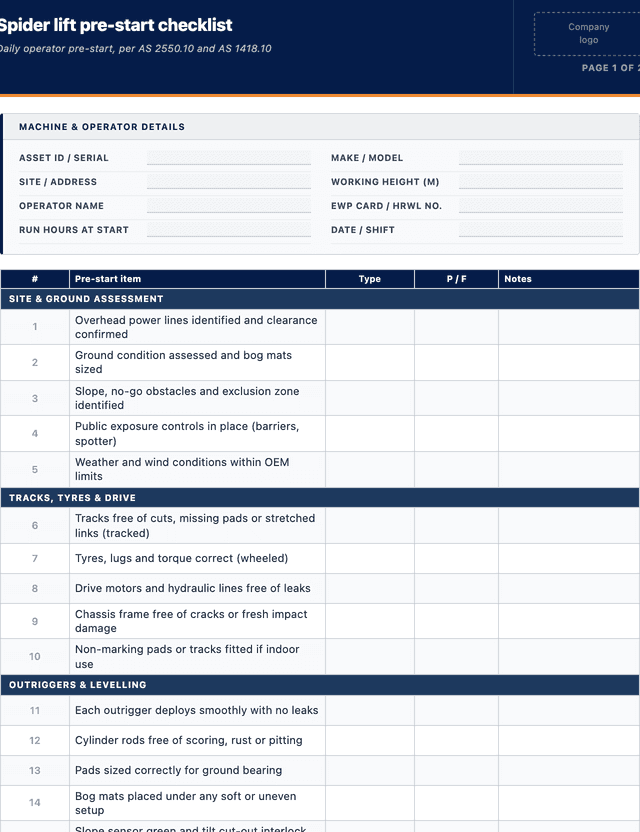
Site & ground assessment
Tracks, tyres & drive
Outriggers & levelling
Boom & jib
Controls & emergency stops
Power & emergency descent
Licensing & documentation
How to use: download the PDF, print or complete digitally on any device.
- PDF format, ready to print or fill on screen
- Use as-is or customise to suit your operation
- Go digital in MapTrack for photos, reminders and audit trails
Download free PDF template
Use in MapTrack →



Trusted by teams across Australia and New Zealand
We respect your privacy. Unsubscribe anytime.
Or set it up in MapTrack
- Fill it in on a phone, attach photos to any check
- Automatic reports and audit trails
- Upload the PDF and MapTrack drafts the form for you
Free 30-day trial. No credit card. Personal email accepted.
Don't just download it - use it live. Start a free workspace, upload this spider lift pre-start checklist and MapTrack drafts it as a form your crew can run from a phone.

Co-Founder & Commercial Director
Key takeaways
- The MapTrack spider lift pre-start checklist contains 35 checks across 7 sections. Sections covered: Site & ground assessment, Tracks, tyres & drive, Outriggers & levelling, Boom & jib, Controls & emergency stops, Power & emergency descent, Licensing & documentation.
Enter your email below to download this spider lift pre-start checklist as a ready-to-use PDF.
Used by construction, mining and field service teams











What is a spider lift pre-start checklist?
A spider lift pre-start checklist is a structured daily inspection completed by the licensed operator before any deployment of a tracked or wheeled compact mobile elevating work platform (MEWP) of the spider-lift family. Spider lifts are typically arboriculture, heritage facade, indoor cinema and church, and narrow-access lifts where a boom lift cannot fit and a scissor lift cannot reach. They deploy on four outriggers with pads or bog mats, and rely on a telescopic-articulating boom with a jib to reach over obstacles. That changes the pre-start emphasis from drive and ride safety to outrigger deployment, ground bearing, slope sensing and basket condition.
A proper spider lift pre-start walks the operator through the tracked or wheeled drive system, outrigger and stabiliser deployment, ground condition under each pad, slope sensor and tilt cut-out, the full telescopic and articulating boom, the jib and basket assembly, harness anchor points, the emergency descent (gravity manual or hand-pump hydraulic), narrow-access steering modes and the power source (battery, fuel or hybrid). In Australia the governing standards are AS 2550.10 (mobile elevating work platforms: safe use) and AS/NZS 1418.10 (design), under the plant duties in Part 5.1 of the WHS Regulations. IPAF 1b/3b operator tickets, ANSI A92.20, OSHA 1926.453 and HSE PUWER 1998 are the international references used on multinational sites.
Learn more about pre-start inspections in MapTrack.
Benefits of using this spider lift pre-start checklist
- Catch outrigger and ground bearing issues early: Verify pad bearing and bog mat condition before loading the boom, preventing mid-shift sink and unplanned topple risk.
- Confirm slope sensor and tilt cut-out are live: A working tilt cut-out is the single most important interlock on a spider lift on uneven ground.
- Plant duty evidence: A signed daily record supports the plant duties in Part 5.1 of the WHS Regulations and the safe-use practices in AS 2550.10, and supports IPAF or ANSI audits on multinational sites.
- Protect tracks, outriggers and telescopic sections from preventable wear: Daily checks of pins, hoses and cylinder rods extend boom life and reduce hire-fleet damage charges.
- Verify emergency descent before sending the operator up: Confirms the manual gravity or hand-pump system works and that the ground attendant knows the procedure.
- Confirm basket and anchor condition before harness attachment: Catches cracked anchor welds, damaged basket gates and missing inertia reel anchor points.
- Build a defensible audit trail per asset: Daily logs per serial number support insurer claims, hire return condition reports and post-incident investigations.
Benefits of digitising forms in MapTrack
When you digitise spider lift checklists in MapTrack, you get:
- Field users can easily scan a QR code to complete a form on mobile. Unlimited users.
- Email the right people when a form is submitted, with an automation you set up.
- File every completed form against the asset, location or person it covers.
- Download any completed form as a PDF, with failed answers listed at the top.
- Fill in forms offline; they upload when the device is back online.
- Build conditional logic (show or hide questions based on answers).
- Take pictures or attach photos. Not possible with a paper-based form.
- Electronic signatures.
- Edit forms later without reprinting.
- Set who can view, fill in or edit forms with user roles.
- Upload a paper form (PDF, Word, Excel or a photo) and MapTrack's AI builds a digital version for you to check.
- Make the pre-start form required when a machine is checked out to an operator.
- Record who did each pre-start and when, and where if you turn location capture on.
- Link each pre-start to the asset record for a complete inspection history.
Book a demo to see how MapTrack handles spider lift checklists.
Try MapTrack free for 30 days
Full access to every feature. No credit card required. Per-asset pricing so you scale as your fleet grows.
- No credit card required
- 30 days free trial
- Cancel anytime
1-2 days/week saved
“Bloody amazing! We used to spend 1-2 days a week tracking and managing our generators alone.”

Steve McAllister
Asset Coordinator, Saunders International
What to include in a spider lift pre-start checklist
This spider lift pre-start checklist covers 12 key areas:
- Tracks or wheels, drive motors, tensioners and rubber pads inspected.
- Outrigger jacks, pads and cylinders extended and visually checked for leaks.
- Ground condition under each pad assessed, with bog mats placed where required.
- Slope sensor, tilt indicator and platform tilt cut-out interlock tested.
- Telescopic boom sections, pins, hoses and cylinder rods checked for damage.
- Jib articulation, pivot pins and limit switches inspected and tested.
- Basket frame, gate, floor mesh and harness anchor points inspected.
- Emergency descent system (gravity or hand-pump) tested per OEM manual.
- Lower and upper control consoles functional with emergency stops tested.
- Battery state of charge, hybrid fuel level and charger cable condition checked.
- Site walk for no-go obstacles, overhead lines, soft ground and slope hazards.
- Operator IPAF 1b/3b ticket, high-risk work licence and induction current.
How to use this spider lift pre-start checklist
- Confirm operator competency and walk the site.: Verify the operator holds a current EWP yellow card or IPAF 1b/3b ticket and the high-risk work licence required for the configuration. Walk the work zone for overhead lines, soft ground, slope, no-go obstacles, public exposure and weather conditions before driving the machine in.
- Inspect tracks or wheels and drive system.: Walk a full lap of the chassis. Check tracks for cuts, missing pads or stretched links, or wheels for tyre condition and lug torque. Inspect drive motors, hydraulic lines and the chassis for leaks, cracks or fresh impact damage from the last shift.
- Deploy outriggers and verify ground bearing.: Position the machine and deploy each outrigger in turn, watching cylinder rods for scoring or leaks. Confirm each pad is on firm ground or a properly sized bog mat. Verify the slope sensor goes green and the platform tilt cut-out interlock arms before any boom movement.
- Inspect boom, jib and basket from the ground.: Walk the full extension path visually. Inspect each telescopic section, wear pads, hoses and cylinder rods. Check jib pivot pins, jib cylinder, basket frame, gate, mesh floor and the dedicated harness anchor points for cracked welds or missing pins.
- Test controls and safety devices.: Start the lift, test the lower control console first, then move to the basket. Test boom up/down, slew, telescope, jib articulation, basket rotation, foot-pedal interlock, emergency stop on both consoles and the slope tilt cut-out (tilt the platform to verify it cuts drive).
- Verify emergency descent and brief the ground attendant.: Test the manual gravity or hand-pump hydraulic descent per the OEM procedure. Confirm a ground attendant is identified, knows how to operate the lower controls and emergency descent, and has a means of communication with the operator.
- Sign and lodge the record.: Sign and date the checklist, log any defects with a photo, fix on the spot if minor or tag-out if not. In MapTrack the pre-start attaches to the asset record so run hours, defect history and the next service interval are visible to the next operator.
In MapTrack, you can run digital pre-starts attached to each asset. Each submission is stored as a timestamped PDF against the asset record.
Get the free templateEnter your email above to download the full spider lift pre-start checklist as a PDF.Back to download formHow often should you complete this checklist?
A full spider lift pre-start is required at the start of every shift the lift is operated, and again whenever the operator changes mid-shift, the lift is relocated to a new setup point with different ground conditions, or it is brought back into service after a fault. AS 2550.10 makes daily inspection the responsibility of the competent operator. On top of the daily pre-start, run a weekly or 50-hour inspection per the OEM manual, a monthly or 250-hour inspection, an annual periodic inspection, and a major inspection after 10 years of service and every 5 years after that (AS 2550.10:2025, according to EWPA guidance). MapTrack schedules pre-start, 50-hour, 250-hour, 500-hour, annual and major inspection intervals against each spider lift serial.
Frequently asked questions
Applicable regulatory standards
This template is a starting point. Check the current requirements that apply to your equipment, work and location. The template alone does not establish compliance.
- AS 2550.10:2025 - Cranes, hoists and winches - Safe use - Mobile elevating work platforms
- AS/NZS 1418.10:2025 - Cranes, hoists and winches - Mobile elevating work platforms (design)
- WHS Regulations - Part 5.1 (general duties for plant, including maintenance and inspection by a competent person, regulation 213)
- OSHA 1926.453
- HSE PUWER 1998
Check the current source
- Model WHS Regulations (Safe Work Australia)
- OSHA 29 CFR Part 1926, Safety and Health Regulations for Construction
- Provision and Use of Work Equipment Regulations 1998 (PUWER)
- AS/NZS 1418.10:2025, Cranes, hoists and winches, elevating work platforms (Standards Australia)
- AS 2550 series, Cranes, hoists and winches, safe use (Standards Australia listing)
Spider Lift Pre-Start Checklist preview
The numbers behind this spider lift pre-start checklist
Every figure below is sourced and dated, so you can quote it in a toolbox talk, a budget case or a board paper without having to chase the original report.
Embed this free template on your website
Run an industry blog, trade association site, or training resource? Drop a preview of this free spider lift pre-start checklist straight into your page. The snippet is self-contained, needs no scripts, and links readers back to the full free template.
<div style="max-width:480px;font-family:system-ui,-apple-system,'Segoe UI',Roboto,sans-serif;border:1px solid #E5E7EB;border-radius:12px;padding:20px;background:#ffffff;">
  <p style="font-size:12px;font-weight:700;letter-spacing:0.05em;text-transform:uppercase;color:#071D49;margin:0;">Free template</p>
  <p style="font-size:18px;font-weight:700;color:#071D49;margin:6px 0 0;">Spider Lift Pre-Start Checklist</p>
  <ul style="margin:12px 0 0;padding-left:18px;color:#374151;font-size:14px;line-height:1.6;">
    <li style="margin:4px 0;">Tracks or wheels, drive motors, tensioners and rubber pads inspected.</li>
    <li style="margin:4px 0;">Outrigger jacks, pads and cylinders extended and visually checked for leaks.</li>
    <li style="margin:4px 0;">Ground condition under each pad assessed, with bog mats placed where required.</li>
    <li style="margin:4px 0;">Slope sensor, tilt indicator and platform tilt cut-out interlock tested.</li>
    <li style="margin:4px 0;">Telescopic boom sections, pins, hoses and cylinder rods checked for damage.</li>
    <li style="margin:4px 0;">Jib articulation, pivot pins and limit switches inspected and tested.</li>
  </ul>
  <p style="font-size:13px;color:#6B7280;margin:14px 0 0;padding-top:12px;border-top:1px solid #E5E7EB;">Free <a href="https://www.maptrack.com/templates/spider-lift-pre-start-checklist" style="color:#071D49;font-weight:600;text-decoration:none;">Spider Lift Pre-Start Checklist</a> by MapTrack</p>
</div>Free to reuse, including commercially. This template is published under a Creative Commons Attribution 4.0 licence. Copy it, adapt it, put it on your own site or in your own docs. All we ask is that you credit MapTrack with a link back to this page. The snippet above already includes that credit, so if you use it as-is you’re covered.
Cite this template
Writing about this topic? You’re welcome to quote this checklist. Here’s the wording to use so your readers can find the original.
The MapTrack spider lift pre-start checklist contains 35 checks across 7 sections.
- Short attribution
- MapTrack Spider Lift Pre-Start Checklist, https://www.maptrack.com/templates/spider-lift-pre-start-checklist
- Reference list
- MapTrack. (2026). Spider Lift Pre-Start Checklist [Checklist template]. Retrieved from https://www.maptrack.com/templates/spider-lift-pre-start-checklist
Free to reuse with credit under a Creative Commons Attribution 4.0 licence. If you’d rather link straight to it, the page is https://www.maptrack.com/templates/spider-lift-pre-start-checklist.
Need to run digital pre-starts attached to each asset?
Register every spider lift in MapTrack, attach digital forms, and get a complete history of every inspection, service and compliance record.
Pre-start inspections · All templates · Pricing · Book a demo