
Free portable generator pre-start checklist
Free portable generator pre-start checklist (PDF-ready). Covers fuel, oil, leads, RCD, earthing, exhaust and PPE for site-deliverable units.
Updated 24 May 2026
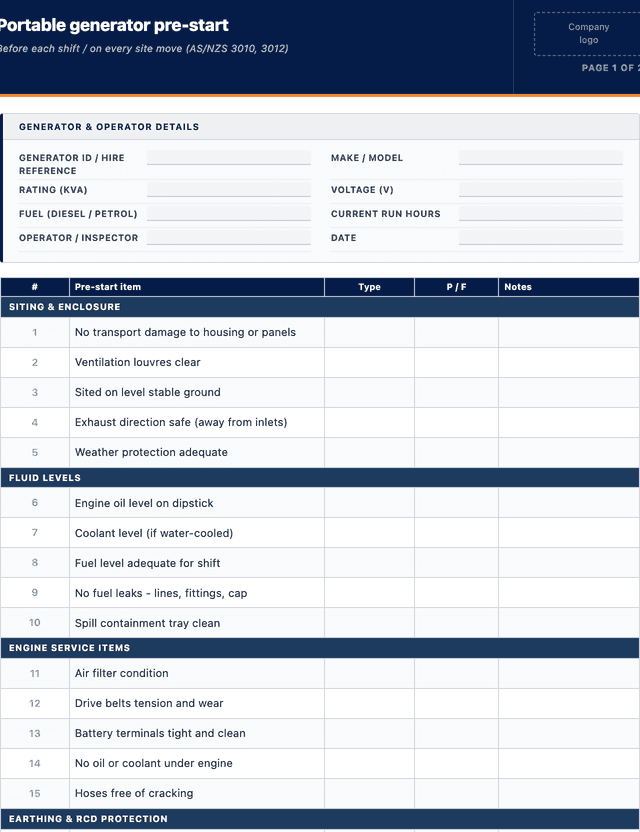
Portable generator pre-start
Before each shift / on every site move (AS/NZS 3010, 3012)
Siting & enclosure
Fluid levels
Engine service items
Earthing & RCD protection
Outlets & leads
Fire & site safety
How to use: download the PDF, print or complete digitally on any device.
- PDF format, ready to print or fill on screen
- Use as-is or customise to suit your operation
- Go digital in MapTrack for photos, reminders and audit trails
Download free PDF template
Use in MapTrack →



Trusted by teams across Australia and New Zealand
We respect your privacy. Unsubscribe anytime.
Or set it up in MapTrack
- Fill it in on a phone, attach photos to any check
- Automatic reports and audit trails
- Upload the PDF and MapTrack drafts the form for you
Free 30-day trial. No credit card. Personal email accepted.
Don't just download it - use it live. Start a free workspace, upload this portable generator pre-start checklist and MapTrack drafts it as a form your crew can run from a phone.

Co-Founder & Commercial Director
Key takeaways
- The MapTrack portable generator pre-start checklist contains 30 checks across 6 sections. Sections covered: Siting & enclosure, Fluid levels, Engine service items, Earthing & RCD protection, Outlets & leads, Fire & site safety.
Enter your email below to download this portable generator pre-start checklist as a ready-to-use PDF.
Used by construction, mining and field service teams











What is a portable generator pre-start checklist?
A portable generator pre-start checklist is a structured form used by site supervisors, electricians and equipment operators to confirm a wheeled or skid-mounted generator is safe to start and run before any load is connected. It captures fuel level, engine oil and coolant, fuel and oil leaks, the earth stake or earth bond, RCD push-button test, lead and outlet condition, exhaust positioning, fire extinguisher access and the test-and-tag currency of the unit itself. Portable generators move between sites, suffer rough handling in transport and are often the only power source on a worksite, which makes a documented pre-start a non-negotiable step before the first connection of the day.
Portable generator hazards differ from stationary or standby units. The wheeled or skid platform exposes the engine to transport vibration, water ingress and impact damage. Site delivery means the earthing arrangement (AS/NZS 3010, AS/NZS 3012) has to be re-established on every move, and fuel storage, exhaust routing and weather protection have to be reconsidered for each location. Under WHS Regulations 2011, AS/NZS 3010:2017 (Electrical installations - Generating sets), AS/NZS 3012:2019 (Electrical installations - Construction and demolition sites) and AS/NZS 3760:2022 (in-service inspection and testing), the PCBU must ensure the generator is inspected by a competent person before use and that its electrical safety system (earthing, RCDs and leads) is verified at every set-up. A completed pre-start checklist is the documented evidence that this happened, and links the unit to its hire history, last service and next test-and-tag due date.
Learn more about pre-start inspections in MapTrack.
Benefits of using this portable generator pre-start checklist
- Electrical safety on site: a documented RCD push-button test and earth verification every time the unit is set up prevents electrocution from a faulty residual current device or missing earth bond.
- AS/NZS 3010 and 3012 compliance: meets the construction-site generator inspection expectations and gives the principal contractor the records they require for site induction and audit.
- Fire and fuel control: forces a positive check of fuel-line condition, spill containment, exhaust position and fire extinguisher access before the engine starts, the leading causes of generator fires on sites.
- Hire fleet protection: hire companies use a pre-start record to evidence the unit was delivered safe and to capture any operator-induced damage at handover, supporting damage claims and warranty calls.
- Service interval tracking: every pre-start logs current run hours so the next 250/500/1000-hour service can be triggered automatically rather than discovered after a failure.
- Carbon monoxide control: a structured check of exhaust direction, ventilation and enclosed-space warnings prevents the CO poisoning incidents that account for the most serious generator-related injuries each year.
- Operator accountability: signed pre-start records create a clear chain of custody between hire desk, supervisor and operator, so if a fault appears under load it is traceable.
Benefits of digitising forms in MapTrack
When you digitise portable generator checklists in MapTrack, you get:
- Field users can easily scan a QR code to complete a form on mobile. Unlimited users.
- Email the right people when a form is submitted, with an automation you set up.
- File every completed form against the asset, location or person it covers.
- Download any completed form as a PDF, with failed answers listed at the top.
- Fill in forms offline; they upload when the device is back online.
- Build conditional logic (show or hide questions based on answers).
- Take pictures or attach photos. Not possible with a paper-based form.
- Electronic signatures.
- Edit forms later without reprinting.
- Set who can view, fill in or edit forms with user roles.
- Upload a paper form (PDF, Word, Excel or a photo) and MapTrack's AI builds a digital version for you to check.
- Make the pre-start form required when a machine is checked out to an operator.
- Record who did each pre-start and when, and where if you turn location capture on.
- Link each pre-start to the asset record for a complete inspection history.
Book a demo to see how MapTrack handles portable generator checklists.
Try MapTrack free for 30 days
Full access to every feature. No credit card required. Per-asset pricing so you scale as your fleet grows.
- No credit card required
- 30 days free trial
- Cancel anytime
1-2 days/week saved
“Bloody amazing! We used to spend 1-2 days a week tracking and managing our generators alone.”

Steve McAllister
Asset Coordinator, Saunders International
What to include in a portable generator pre-start checklist
This portable generator pre-start checklist covers 10 key areas:
- Generator details: asset ID or hire reference, make/model, kVA rating, voltage, fuel type (diesel, petrol, dual-fuel), site location, date, operator/inspector name and current run hours.
- External and physical condition: housing, panels, ventilation louvres, lifting points, skid or wheel frame, exhaust outlet position and weather protection.
- Fuel system and spill containment: fuel level, no visible leaks, fuel-line condition, spill tray or bund condition, fuel cap secure, refuelling path clear of ignition sources.
- Engine and fluids: engine oil level and condition, coolant level (water-cooled units), air-filter condition, drive belts, battery terminals and electrolyte (if fitted).
- Earthing and bonding: earth stake driven or bonding cable connected per AS/NZS 3010 and AS/NZS 3012, earth lead in good condition, earth resistance acceptable.
- Electrical output and protection: output voltage at 230 V or 400 V as rated, frequency at 50 Hz, RCD or safety switch push-button test, circuit breakers free of damage, neutral-earth link verified.
- Leads and outlets: outlet sockets free of damage and dirt, leads and extension cords test-and-tag current, no exposed conductors, weatherproof covers in place.
- Safety equipment and zone: fire extinguisher within reach, exclusion zone or barricade set out, signage and warning labels legible, exhaust direction away from work areas and inlet vents.
- Compliance and documentation: test-and-tag tag current under AS/NZS 3760, last service record present, operating manual on site, any required electrical safety compliance certificates.
- Overall result: pass, monitor or fail with a defect register entry for any failed item.
How to use this portable generator pre-start checklist
- Record generator and site details before starting any check.: Note the asset ID or hire reference, make/model, kVA rating, voltage, fuel type, current run hours from the hour meter, site location and date. This links the inspection to the specific unit, its hire history and its next service interval.
- Inspect the external condition and confirm the unit is sited correctly.: Walk around the generator with the engine off and look for transport damage, dents, missing panels or weather protection, broken louvres or lifting-point cracks. Confirm the exhaust outlet points away from work areas, building inlets and ignition sources, and the unit sits on stable level ground with adequate ventilation.
- Check fluids and the fuel system before any priming or start.: Verify engine-oil level on the dipstick within the cross-hatched range, coolant level (water-cooled units) between min and max, and fuel level adequate for the planned run time. Inspect fuel lines for cracking, leaks or chafing, confirm the fuel cap seals and check the spill containment tray or bund is in place and clean.
- Establish earthing and bonding per AS/NZS 3010 and AS/NZS 3012.: For a portable generator powering a site, drive the earth stake or connect to the site earth bond and verify with a low-resistance test. Check the earth lead for damage and confirm the earth-fault protection on the generator is wired through. On a hire unit, verify the earthing arrangement is the type specified on the hire docket and the site electrical safety management plan.
- Test the RCD with the integrated push button at no load.: Press the test button on the RCD or safety switch and verify it trips immediately. Reset, then confirm the indicator returns to the live state. Repeat for each separately protected outlet circuit. A failed push-button test means the unit must be tagged out of service and replaced before any load is connected.
- Inspect leads, outlets and the overall electrical system.: Check each output socket for damage, contamination and weatherproof cover condition. Inspect every lead or extension cord for current test-and-tag tags under AS/NZS 3760 and for cuts, exposed conductors or damaged plugs. Confirm circuit breakers move freely and the neutral-earth link arrangement matches the site requirement.
- Start the unit, confirm output and check for unusual signs.: With no load connected, start the engine and let it warm up. Confirm output voltage and frequency on the panel meter, listen for unusual noises or vibration, check for oil or coolant leaks, and confirm the exhaust is exiting cleanly. Press the emergency stop button to confirm it shuts the engine down, then restart.
- Record overall result, sign off and apply tags.: Record the pass, monitor or fail outcome, list any defects in the register with the action taken or work order raised, sign and date the form, and apply a serviceable or out-of-service tag. Brief the operator on the exclusion zone, fire extinguisher location and refuelling plan before handover.
In MapTrack, you can run digital pre-starts attached to each asset. Each submission is stored as a timestamped PDF against the asset record.
Get the free templateEnter your email above to download the full portable generator pre-start checklist as a PDF.Back to download formHow often should you complete this checklist?
Complete a pre-start inspection every time the portable generator is moved, set up at a new site, or before the first start of each shift. Hire units must be inspected on delivery before any load is connected, and again at any major change in operating conditions such as wet weather, relocation across the site or a fuel-tank refill. A weekly inspection extends the pre-start to include load testing on a known test load and a deeper fluid and air-filter assessment.
Beyond daily and weekly checks, manufacturer service intervals at 250, 500 and 1,000 run hours (or annually, whichever is sooner) drive scheduled servicing. Test and tag of the generator and all leads is required under AS/NZS 3760 - typically every three months for construction-site equipment, six monthly for other commercial sites. The site electrical safety management plan, principal contractor rules and AS/NZS 3012 may specify additional periodic verification of earthing and RCDs. Always follow whichever interval is most stringent. In MapTrack, you can attach the inspection schedule to each generator asset, automate reminders by run hours and site move, and centralise the inspection history across an entire hire fleet.
Frequently asked questions
Applicable regulatory standards
This template is a starting point. Check the current requirements that apply to your equipment, work and location. The template alone does not establish compliance.
- AS/NZS 3010:2017 - Electrical installations: Generating sets
- AS/NZS 3012:2019 - Electrical installations - Construction and demolition sites
- AS/NZS 3760:2022 - In-service safety inspection and testing of electrical equipment
- WHS Regulations 2011 - Chapter 5, Part 5.1 (general duties for plant)
Portable generator pre-start checklist preview
The numbers behind this portable generator pre-start checklist
Every figure below is sourced and dated, so you can quote it in a toolbox talk, a budget case or a board paper without having to chase the original report.
Embed this free template on your website
Run an industry blog, trade association site, or training resource? Drop a preview of this free portable generator pre-start checklist straight into your page. The snippet is self-contained, needs no scripts, and links readers back to the full free template.
<div style="max-width:480px;font-family:system-ui,-apple-system,'Segoe UI',Roboto,sans-serif;border:1px solid #E5E7EB;border-radius:12px;padding:20px;background:#ffffff;">
  <p style="font-size:12px;font-weight:700;letter-spacing:0.05em;text-transform:uppercase;color:#071D49;margin:0;">Free template</p>
  <p style="font-size:18px;font-weight:700;color:#071D49;margin:6px 0 0;">Portable generator pre-start checklist</p>
  <ul style="margin:12px 0 0;padding-left:18px;color:#374151;font-size:14px;line-height:1.6;">
    <li style="margin:4px 0;">Generator details: asset ID or hire reference, make/model, kVA rating, voltage, fuel type (diesel, petrol, dual-fuel), site location, date, operator/inspector name and current run hours.</li>
    <li style="margin:4px 0;">External and physical condition: housing, panels, ventilation louvres, lifting points, skid or wheel frame, exhaust outlet position and weather protection.</li>
    <li style="margin:4px 0;">Fuel system and spill containment: fuel level, no visible leaks, fuel-line condition, spill tray or bund condition, fuel cap secure, refuelling path clear of ignition sources.</li>
    <li style="margin:4px 0;">Engine and fluids: engine oil level and condition, coolant level (water-cooled units), air-filter condition, drive belts, battery terminals and electrolyte (if fitted).</li>
    <li style="margin:4px 0;">Earthing and bonding: earth stake driven or bonding cable connected per AS/NZS 3010 and AS/NZS 3012, earth lead in good condition, earth resistance acceptable.</li>
    <li style="margin:4px 0;">Electrical output and protection: output voltage at 230 V or 400 V as rated, frequency at 50 Hz, RCD or safety switch push-button test, circuit breakers free of damage, neutral-earth link verified.</li>
  </ul>
  <p style="font-size:13px;color:#6B7280;margin:14px 0 0;padding-top:12px;border-top:1px solid #E5E7EB;">Free <a href="https://www.maptrack.com/templates/portable-generator-pre-start-checklist" style="color:#071D49;font-weight:600;text-decoration:none;">Portable generator pre-start checklist</a> by MapTrack</p>
</div>Free to reuse, including commercially. This template is published under a Creative Commons Attribution 4.0 licence. Copy it, adapt it, put it on your own site or in your own docs. All we ask is that you credit MapTrack with a link back to this page. The snippet above already includes that credit, so if you use it as-is you’re covered.
Cite this template
Writing about this topic? You’re welcome to quote this checklist. Here’s the wording to use so your readers can find the original.
The MapTrack portable generator pre-start checklist contains 30 checks across 6 sections.
- Short attribution
- MapTrack Portable generator pre-start checklist, https://www.maptrack.com/templates/portable-generator-pre-start-checklist
- Reference list
- MapTrack. (2026). Portable generator pre-start checklist [Checklist template]. Retrieved from https://www.maptrack.com/templates/portable-generator-pre-start-checklist
Free to reuse with credit under a Creative Commons Attribution 4.0 licence. If you’d rather link straight to it, the page is https://www.maptrack.com/templates/portable-generator-pre-start-checklist.
Need to run digital pre-starts attached to each asset?
Register every portable generator in MapTrack, attach digital forms, and get a complete history of every inspection, service and compliance record.
Pre-start inspections · All templates · Pricing · Book a demo