
Free NDIS asset and equipment compliance checklist
Free NDIS asset and equipment compliance checklist (PDF-ready). Check assistive tech, maintenance, registers and safety for disability providers.
Updated 10 Aug 2026
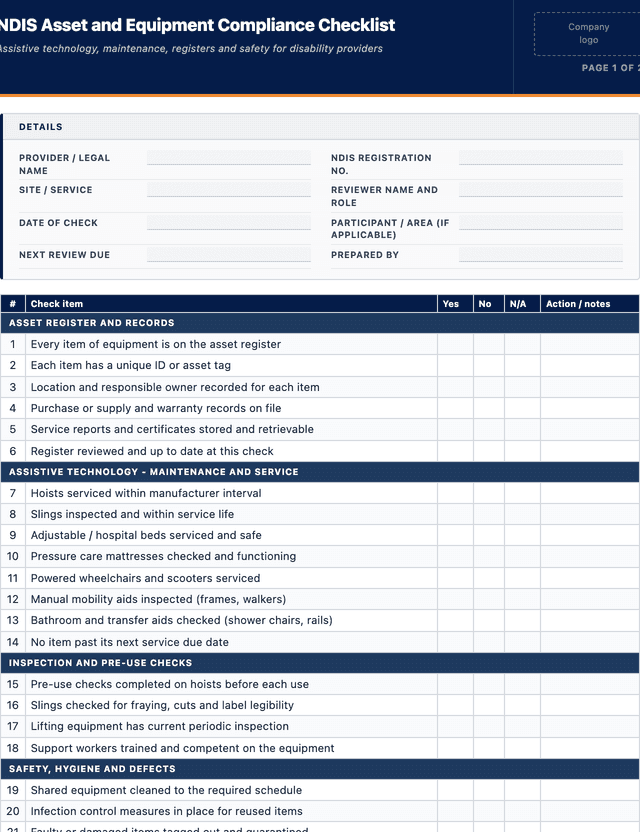
NDIS Asset and Equipment Compliance Checklist
Assistive technology, maintenance, registers and safety for disability providers
ASSET REGISTER AND RECORDS
ASSISTIVE TECHNOLOGY - MAINTENANCE AND SERVICE
INSPECTION AND PRE-USE CHECKS
SAFETY, HYGIENE AND DEFECTS
How to use: download the PDF, print or complete digitally on any device.
- PDF format, ready to print or fill on screen
- Use as-is or customise to suit your operation
- Go digital in MapTrack for photos, reminders and audit trails
Download free PDF template
Use in MapTrack →



Trusted by teams across Australia and New Zealand
We respect your privacy. Unsubscribe anytime.
Or set it up in MapTrack
- Fill it in on a phone, attach photos to any check
- Automatic reports and audit trails
- Upload the PDF and MapTrack drafts the form for you
Free 30-day trial. No credit card. Personal email accepted.
Don't just download it - use it live. Start a free workspace, upload this NDIS asset and equipment compliance checklist and MapTrack drafts it as a form your crew can run from a phone.

Co-Founder & Commercial Director
Key takeaways
- The MapTrack NDIS asset and equipment compliance checklist contains 23 checks across 4 sections. Sections covered: ASSET REGISTER AND RECORDS, ASSISTIVE TECHNOLOGY - MAINTENANCE AND SERVICE, INSPECTION AND PRE-USE CHECKS, SAFETY, HYGIENE AND DEFECTS.
Enter your email below to download this NDIS asset and equipment compliance checklist as a ready-to-use PDF.
Used by construction, mining and field service teams







What is an NDIS asset and equipment compliance checklist?
An NDIS asset and equipment compliance checklist is a structured check that a registered disability provider uses to confirm the general equipment it supplies or uses is safe, maintained, registered and fit for the participant. It walks through the equipment register, the maintenance and inspection status of equipment such as hoists, wheelchairs, beds and pressure care, the servicing of higher-risk items, infection control and cleaning, and the records that prove each item is safe to use. It brings the provider's duty of care over physical equipment into a single, repeatable review rather than leaving it to memory across many participants and sites.
Providers registered with the NDIS Quality and Safeguards Commission must meet the NDIS Practice Standards (the current consolidated version is dated November 2021). General equipment upkeep sits under the Core Module service-environment requirement: equipment must be maintained, fit for purpose, safe, clean and used in line with the manufacturer's guidelines. This checklist covers that general upkeep only. Assistive technology (AT) provision, specialist disability accommodation, and regulated restrictive practices and behaviour support are governed by their own separate modules and rules, so keep those out of a generic equipment check and manage them under the correct module. Faulty or unserviced equipment, such as a hoist that has missed its service or a bed rail that has not been checked, is a direct risk to a vulnerable person and a compliance failure. A checklist turns the Core Module environment requirement into concrete checks a coordinator or support worker can run, and produces the dated evidence the Commission expects to see during an audit or after an incident.
Learn more about compliance and inspections in MapTrack.
Benefits of using this NDIS asset and equipment compliance checklist
- Participant safety: checking hoists, beds and mobility equipment are serviced protects vulnerable people from faulty gear.
- Register completeness: confirming every item is on the asset register stops equipment being used with no maintenance record.
- Service currency: due-date checks surface assistive technology that has missed its inspection or service before it is used.
- Practice Standards alignment: the checklist maps directly to the NDIS environment and equipment expectations the Commission audits.
- Infection control: cleaning and hygiene checks on shared equipment reduce cross-contamination risk between participants.
- Audit evidence: a dated, completed checklist is the record the NDIS Commission expects to show equipment was managed safely.
- Incident readiness: a maintained register and check history shows equipment was serviced and safe if an incident is reviewed.
Benefits of digitising forms in MapTrack
When you move from paper or static PDFs to digital forms in MapTrack, you get:
- Field users can easily scan a QR code to complete a form on mobile. Unlimited users.
- Email the right people when a form is submitted, with an automation you set up.
- File every completed form against the asset, location or person it covers.
- Download any completed form as a PDF, with failed answers listed at the top.
- Fill in forms offline; they upload when the device is back online.
- Build conditional logic (show or hide questions based on answers).
- Take pictures or attach photos. Not possible with a paper-based form.
- Electronic signatures.
- Edit forms later without reprinting.
- Set who can view, fill in or edit forms with user roles.
- Upload a paper form (PDF, Word, Excel or a photo) and MapTrack's AI builds a digital version for you to check.
- Assign audits and send reminder emails to the people doing them.
- Keep every audit, inspection and sign-off against the asset or site it covers.
- Track corrective actions as work orders from finding to close-out, with each change in the activity log.
Book a demo to see how MapTrack handles forms.
Try MapTrack free for 30 days
Full access to every feature. No credit card required. Per-asset pricing so you scale as your fleet grows.
- No credit card required
- 30 days free trial
- Cancel anytime
1-2 days/week saved
“Bloody amazing! We used to spend 1-2 days a week tracking and managing our generators alone.”

Steve McAllister
Asset Coordinator, Saunders International
What to include in an NDIS asset and equipment compliance checklist
This NDIS asset and equipment compliance checklist covers 10 key areas:
- Provider and registration details: legal name, NDIS registration number, and site or service
- Participant or service area the equipment supports, where relevant
- Reviewer name, role, and date of the check
- Asset register status: every item listed with an ID, owner and location
- Assistive technology items: hoists, slings, wheelchairs, beds, pressure care, and mobility aids
- Maintenance and service status: last service, next due, and provider for higher-risk items
- Inspection and pre-use checks for hoists, slings and lifting equipment
- Infection control: cleaning schedule and status for shared equipment
- Safety and defect status: tagged out, quarantined or awaiting repair items
- Records and evidence: service reports, certificates, and where they are stored
How to use this NDIS asset and equipment compliance checklist
- Confirm the equipment register is complete: Check that every item of assistive technology and equipment in use is listed on the asset register with an ID, a location and an owner. Equipment that is not on the register is equipment with no maintenance record, so a piece of gear in use that is missing from the list is the first thing to find and add before anything else.
- Check maintenance and service currency: For each item, confirm the last service date and that the next service is not overdue, paying particular attention to higher-risk assistive technology such as hoists, slings, beds and pressure care. Anything past its service date should be flagged and, if it affects safety, taken out of use until the service is done and recorded.
- Verify inspection and pre-use checks: Confirm that hoists, slings and other lifting equipment have current inspections and that support workers do the required pre-use checks before each use. A hoist or sling is high-consequence equipment for a participant, so the pre-use check that catches a frayed sling or a fault is as important as the scheduled service.
- Check infection control and defect status: Confirm shared equipment is cleaned to the required schedule and that any faulty, damaged or recalled items are tagged out, quarantined and clearly not in use. Cleaning of shared equipment reduces cross-contamination between participants, and a clear defect status stops a known-faulty item being picked up and used by mistake.
- Confirm records and close out actions: Check that service reports, certificates and check records are on file and easy to produce, then list any actions the review found, with an owner and a due date. A checklist only improves safety if the gaps it finds are fixed, so close the loop rather than filing a completed form with open issues still outstanding.
In MapTrack, you can automate compliance tracking and audit trails. Each submission is stored as a timestamped PDF against the asset record.
Get the free templateEnter your email above to download the full NDIS asset and equipment compliance checklist as a PDF.Back to download formHow often should you complete this form?
Run the full compliance check on a regular cycle, commonly quarterly, and always before a scheduled NDIS Commission audit or after any equipment-related incident. Higher-risk assistive technology such as hoists and slings needs pre-use checks every time it is used, on top of the scheduled service intervals set by the manufacturer.
Update the asset register continuously as equipment is added, serviced, repaired or retired, so the check is run against a current list rather than a stale one. Review the results at a regular quality or governance meeting to confirm overdue services and defects are being cleared. A check that is only run when an auditor is due tends to surface a backlog of overdue services all at once, which is exactly the situation the routine is meant to prevent.
Frequently asked questions
Applicable regulatory standards
This template is a starting point. Check the current requirements that apply to your equipment, work and location. The template alone does not establish compliance.
- NDIS Practice Standards and Quality Indicators (November 2021 consolidated version), administered by the NDIS Quality and Safeguards Commission - Core Module service-environment requirement (general equipment maintained, fit for purpose, safe and clean)
- National Disability Insurance Scheme Act 2013 and the National Disability Insurance Scheme (Provider Registration and Practice Standards) Rules 2018
- Note: assistive technology provision, and regulated restrictive practices and behaviour support, sit under their own separate modules/rules (for example the NDIS (Restrictive Practices and Behaviour Support) Rules 2018) - not this general equipment check
- Model Work Health and Safety (WHS) Regulations (duty to maintain plant and equipment), as enacted in each state and territory; in Victoria, the Occupational Health and Safety Regulations 2017 (Vic)
NDIS Asset and Equipment Compliance Checklist preview
The numbers behind this NDIS asset and equipment compliance checklist
Every figure below is sourced and dated, so you can quote it in a toolbox talk, a budget case or a board paper without having to chase the original report.
Embed this free template on your website
Run an industry blog, trade association site, or training resource? Drop a preview of this free NDIS asset and equipment compliance checklist straight into your page. The snippet is self-contained, needs no scripts, and links readers back to the full free template.
<div style="max-width:480px;font-family:system-ui,-apple-system,'Segoe UI',Roboto,sans-serif;border:1px solid #E5E7EB;border-radius:12px;padding:20px;background:#ffffff;">
  <p style="font-size:12px;font-weight:700;letter-spacing:0.05em;text-transform:uppercase;color:#071D49;margin:0;">Free template</p>
  <p style="font-size:18px;font-weight:700;color:#071D49;margin:6px 0 0;">NDIS Asset and Equipment Compliance Checklist</p>
  <ul style="margin:12px 0 0;padding-left:18px;color:#374151;font-size:14px;line-height:1.6;">
    <li style="margin:4px 0;">Provider and registration details: legal name, NDIS registration number, and site or service</li>
    <li style="margin:4px 0;">Participant or service area the equipment supports, where relevant</li>
    <li style="margin:4px 0;">Reviewer name, role, and date of the check</li>
    <li style="margin:4px 0;">Asset register status: every item listed with an ID, owner and location</li>
    <li style="margin:4px 0;">Assistive technology items: hoists, slings, wheelchairs, beds, pressure care, and mobility aids</li>
    <li style="margin:4px 0;">Maintenance and service status: last service, next due, and provider for higher-risk items</li>
  </ul>
  <p style="font-size:13px;color:#6B7280;margin:14px 0 0;padding-top:12px;border-top:1px solid #E5E7EB;">Free <a href="https://www.maptrack.com/templates/ndis-asset-compliance-checklist" style="color:#071D49;font-weight:600;text-decoration:none;">NDIS Asset and Equipment Compliance Checklist</a> by MapTrack</p>
</div>Free to reuse, including commercially. This template is published under a Creative Commons Attribution 4.0 licence. Copy it, adapt it, put it on your own site or in your own docs. All we ask is that you credit MapTrack with a link back to this page. The snippet above already includes that credit, so if you use it as-is you’re covered.
Cite this template
Writing about this topic? You’re welcome to quote this checklist. Here’s the wording to use so your readers can find the original.
The MapTrack NDIS asset and equipment compliance checklist contains 23 checks across 4 sections.
- Short attribution
- MapTrack NDIS Asset and Equipment Compliance Checklist, https://www.maptrack.com/templates/ndis-asset-compliance-checklist
- Reference list
- MapTrack. (2026). NDIS Asset and Equipment Compliance Checklist [Checklist template]. Retrieved from https://www.maptrack.com/templates/ndis-asset-compliance-checklist
Free to reuse with credit under a Creative Commons Attribution 4.0 licence. If you’d rather link straight to it, the page is https://www.maptrack.com/templates/ndis-asset-compliance-checklist.
Need to automate compliance tracking and audit trails?
Register every asset in MapTrack, attach digital forms, and get a complete history of every inspection, service and compliance record.
Compliance and inspections · All templates · Pricing · Book a demo