
Free template · PDF
Free lifting equipment register
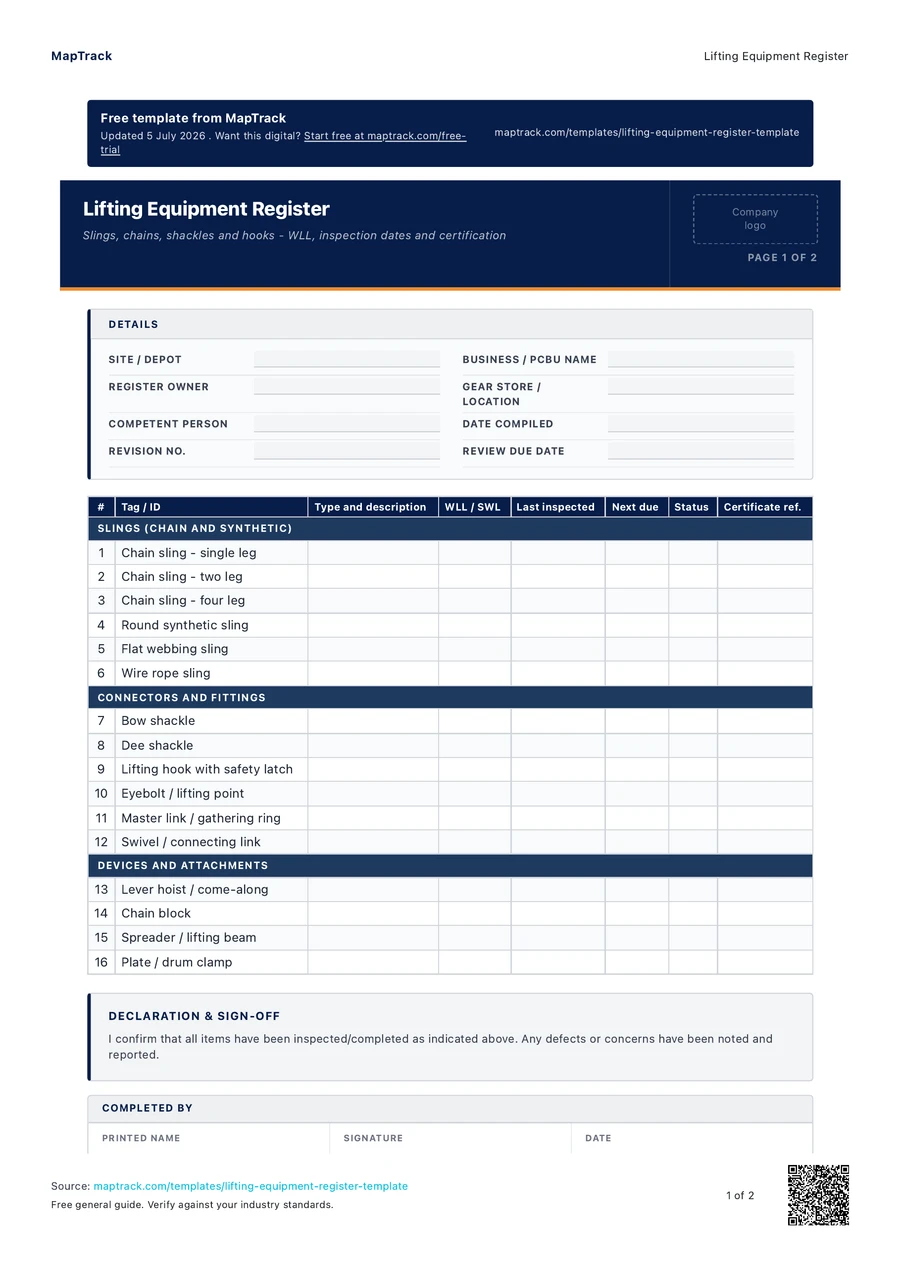
Free lifting equipment register (PDF-ready). Track slings, chains, shackles and hooks with SWL, inspection dates and certification in one place.
Loading PDF page...

Read the form fields
16 checks · 3 sections · Sign-off
16 checks
The fields in the printable form, in a view that fits your screen.
- Site / depot
- Business / PCBU name
- Register owner
- Gear store / location
- Competent person
- Date compiled
- Revision no.
- Review due date
SLINGS (CHAIN AND SYNTHETIC)
CONNECTORS AND FITTINGS
DEVICES AND ATTACHMENTS
Declaration & Sign-Off
I confirm that all items have been inspected/completed as indicated above. Any defects or concerns have been noted and reported.
Completed By
Printed name · Signature · Date
Reviewed / Approved By
Printed name · Signature · Date
The MapTrack lifting equipment register contains 16 checks across 3 sections.

Co-Founder & Commercial Director
Make this form your own
Add your fields and logo. Give your team a form they can use on site.
Free 30-day trial. No credit card. Work email needed.
Upload & use this form now for free



“MapTrack beat them all in every aspect.”
 Vincent Stone · HSEQ Advisor, Concept Tanks
After signup: upload this PDF, check the form MapTrack drafts, then save and publish it for your team.
General guidance only. Check the form against your equipment manual, site procedures and local requirements before using it.
Key takeaways
- The MapTrack lifting equipment register contains 16 checks across 3 sections. Sections covered: SLINGS (CHAIN AND SYNTHETIC), CONNECTORS AND FITTINGS, DEVICES AND ATTACHMENTS.
- Register header: site or depot, business or PCBU name, register owner, and revision date
- Item ID or tag number, unique to each piece of lifting gear
- Type and description: chain sling, synthetic sling, shackle, hook, eyebolt, lever hoist or spreader beam
What is a lifting equipment register?
A lifting equipment register is a controlled list of every item of lifting gear on a site or in a fleet, from chain and synthetic slings through to shackles, hooks, eyebolts, spreader beams and lever hoists. For each item it records a unique ID or tag number, the type and description, the working load limit (WLL) or safe working load (SWL), the date it entered service, the last and next inspection dates, the current condition, and a reference to its test or proof-load certificate. It is the single source of truth for what gear you own, whether it is in date, and whether it is safe to sling a load with.
Lifting gear is high consequence plant: a failed sling or shackle can drop a load onto people. Under the model Work Health and Safety (WHS) Regulations enacted in each state and territory (in Victoria, the Occupational Health and Safety Regulations 2017 (Vic)), a person conducting a business or undertaking must maintain plant so it stays safe and keep records of inspection and maintenance. There is no single Australian Standard for a lifting register itself, so anchor it to the care-and-use standard for each tackle type: wire-rope slings to AS 1666.2-2009, grade T chain slings to AS 3775.2-2004, and the crane or appliance to AS 2550.1-2011 (safe use). A live register turns those duties into a routine you can prove, because every item has a tag, a due date and a certificate you can produce on request rather than gear that quietly falls out of test.
Learn more about asset tracking in MapTrack.
Choose the format that fits your team
Download the PDF
Use the original printable form for a paper workflow. Check it against your equipment and site procedure before the job.
Keep completed copies in your own record system and arrange any follow-up through your normal process.
Download free PDFCustomise a form in MapTrack
Start a free trial, upload this PDF and MapTrack drafts the form. Adjust it to your workflow, then save and publish it for your team to use.
Sample answers on this page and completed PDF records aren't imported automatically.
Upload & use this form now for freeFree 30-day trial. No credit card. Work email needed.
Benefits of using this lifting equipment register
- In-date at a glance: due-date columns show which slings, chains and shackles are approaching or past inspection before they get used.
- Load safety: recording the WLL or SWL against every item stops the wrong sling being rigged to a load it cannot carry.
- Certificate control: linking each item to its proof-load or test certificate keeps the paperwork with the gear for audits and hire returns.
- Quarantine discipline: a condition and status column makes it obvious when damaged gear has been tagged out and removed from service.
- Asset accountability: unique tag numbers mean a specific shackle or hook can be traced through inspection history, not just a generic type.
- Audit evidence: a dated, controlled register is objective proof of a maintained lifting program during a WHS review or after an incident.
- Purchasing insight: seeing which gear fails inspection most often guides what to replace, standardise on, or stop buying.
What to include in a lifting equipment register
- Register header: site or depot, business or PCBU name, register owner, and revision date
- Item ID or tag number, unique to each piece of lifting gear
- Type and description: chain sling, synthetic sling, shackle, hook, eyebolt, lever hoist or spreader beam
- Working load limit (WLL) or safe working load (SWL), with reeving or configuration where relevant
- Manufacturer, model and serial or batch number
- Date of manufacture and date placed into service
- Last inspection date, inspector and result
- Next inspection due date and inspection interval
- Current condition and status: in service, quarantined, or destroyed
- Certificate reference: proof load, test or manufacturer's certificate number and location
How to use this lifting equipment register
Tag and list every item
Give each piece of lifting gear a unique, durable tag or ID and record it as its own line in the register. Do not lump a set of slings under one entry, because inspection and quarantine decisions are made per item, not per type or per bundle.
Capture the load rating and certificate
Record the WLL or SWL exactly as marked on the item or its tag, along with the manufacturer, serial or batch number and the certificate reference. This is the information a competent person needs to verify the gear is legitimate and rated for the loads it will carry on your site.
Set the inspection interval and due date
Assign an inspection interval based on the relevant care-and-use standard (AS 1666.2 for wire rope, AS 3775.2 for chain, AS 2550.1 for the appliance), the manufacturer's instructions and how hard the gear is worked, then calculate the next due date from the last inspection. Harsh environments and heavy duty cycles shorten the interval, so do not just default every item to twelve months.
Record inspections and quarantine failures
After each periodic inspection by a competent person, record the date, the inspector and the result against the item. Any gear that fails must be marked as quarantined or destroyed immediately and physically removed from service so it cannot be picked up and rigged by mistake.
Review the register and chase due items
Run a regular review of the register to find items approaching or past their due date, arrange their inspection, and confirm quarantined gear has been dealt with. A register only protects people if someone owns it and acts on the due dates rather than letting the list drift out of date.
How often should you complete this form?
Update the register whenever gear is bought, put into service, inspected, damaged, quarantined or destroyed, so it always reflects the gear actually on site. New items are added the day they arrive, and inspection results are entered the same day the inspection is done.
Periodic inspection intervals follow the care-and-use standard for the tackle (AS 1666.2 for wire rope, AS 3775.2 for chain, AS 2550.1 for the appliance), the manufacturer's instructions and the duty the gear sees, commonly quarterly (every three months) for general use, with a competent person doing the formal inspection. Operators should also do a quick visual pre-use check every time gear is rigged. Review the whole register at least monthly to catch anything drifting toward its due date before it is used out of test.
Make this form your own
From your template to your team.
Upload this PDF and MapTrack drafts the form. Adjust it for your equipment and site, then save and publish the digital form for your team.
- 01
Start your free trial
Use your work email to create your MapTrack account.
- 02
Customise, save and publish
Adjust the template fields and branding for your site.
- 03
Complete it on the job
Record checks, add photos and export a branded PDF.
Keep working offline
Load the form before you lose reception. Complete it offline and sync when you're back online.
Scan the asset. Open its form.
Use an asset's QR code to find and complete the forms that belong to it.
Show what you found
Capture photos and attach files so the next person has the details they need.
Take a branded PDF with you
Download completed forms as PDF reports with your company logo.
Completed paper records aren't imported automatically.
Frequently asked questions
Practical answers about the form, record keeping and using MapTrack.
The model WHS Regulations, enacted in each state and territory (in Victoria, the OHS Regulations 2017 (Vic)), require a PCBU to maintain plant, including lifting gear, so it remains safe to use, and to keep records of inspection and maintenance. There is no dedicated Australian Standard for a lifting register, so the inspection regime comes from the care-and-use standard for each tackle type: AS 1666.2-2009 for wire-rope slings, AS 3775.2-2004 for grade T chain slings, and AS 2550.1-2011 for the crane or appliance. A register that lists each item's WLL, inspection dates and certificate reference is how you show a competent person inspected the gear, that damaged items were quarantined, and that everything in use is in date and rated for its loads.
Link to this answerOperators should visually check gear before each use. Formal periodic inspection by a competent person is commonly quarterly (every three months) for general use, depending on the relevant care-and-use standard (AS 1666.2 for wire rope, AS 3775.2 for chain, AS 2550.1 for the appliance), the manufacturer's instructions and how hard the gear is worked. Gear used in harsh or heavy-duty conditions is inspected more often. The register carries the interval and next due date for each item so nothing gets used past its inspection date.
Link to this answerWorking load limit (WLL) is the maximum load an item is rated to carry as marked by the manufacturer, and is the term used on most modern gear. Safe working load (SWL) is the older term for the same idea, sometimes adjusted for a specific configuration or reeving. Record whichever is marked on the item, and never rig a load above that figure. For slings, remember the rating changes with the angle and the reeving method.
Link to this answerAny item that fails inspection or is damaged must be taken out of service straight away. Mark it as quarantined or destroyed in the register, physically tag it out, and remove it from the gear store so it cannot be picked up and used by mistake. Do not leave a failed sling or shackle in the same bin as serviceable gear. Destroy items beyond repair so they cannot re-enter service.
Link to this answerYes, it is completely free. It downloads as a PDF you can keep or print for the gear store. You do not need a MapTrack account. If you want to move beyond paper, MapTrack keeps a live asset register with inspection due dates, certificates and full history for every item of lifting gear, and flags what is coming due before it gets used. Start a free trial or book a demo to see how.
Link to this answerApplicable regulatory standards
This form is a starting point. Check the current requirements that apply to your equipment, work and location. The form alone does not establish compliance.
- Model Work Health and Safety (WHS) Regulations, as enacted in each state and territory (plant maintenance and inspection duties); in Victoria, the Occupational Health and Safety Regulations 2017 (Vic)
- AS 1666.2-2009 Wire-rope slings - Care and use; AS 3775.2-2004 Chain slings - Grade T - Care and use (periodic inspection of slings)
- AS 2550.1-2011 Cranes, hoists and winches - Safe use - General requirements (periodic inspection of the appliance)
- ISO 55001:2024 Asset management - Asset management system - Requirements (controlled asset records and history)
- ISO 55001:2024, Asset management system requirements (ISO catalogue)
- AS 2550 series, Cranes, hoists and winches, safe use (Standards Australia listing)
MapTrack publishes this template. The linked authorities publish their own guidance; they haven't endorsed this form.
The numbers behind this lifting equipment register
Every figure below is sourced and dated, so you can quote it in a toolbox talk, a budget case or a board paper without having to chase the original report.
Cite this template
Writing about this topic? You’re welcome to quote this checklist. Here’s the wording to use so your readers can find the original.
The MapTrack lifting equipment register contains 16 checks across 3 sections.
- Short attribution
- MapTrack Lifting Equipment Register, https://www.maptrack.com/templates/lifting-equipment-register-template
- Reference list
- MapTrack. (2026). Lifting Equipment Register [Checklist template]. Retrieved from https://www.maptrack.com/templates/lifting-equipment-register-template
Free to reuse with credit under a Creative Commons Attribution 4.0 licence. If you’d rather link straight to it, the page is https://www.maptrack.com/templates/lifting-equipment-register-template.
Embed this free template on your website
Run an industry blog, trade association site, or training resource? Drop a preview of this free lifting equipment register straight into your page. The snippet is self-contained, needs no scripts, and links readers back to the full free template.
<div style="max-width:480px;font-family:system-ui,-apple-system,'Segoe UI',Roboto,sans-serif;border:1px solid #E5E7EB;border-radius:12px;padding:20px;background:#ffffff;">
  <p style="font-size:12px;font-weight:700;letter-spacing:0.05em;text-transform:uppercase;color:#071D49;margin:0;">Free template</p>
  <p style="font-size:18px;font-weight:700;color:#071D49;margin:6px 0 0;">Lifting Equipment Register</p>
  <ul style="margin:12px 0 0;padding-left:18px;color:#374151;font-size:14px;line-height:1.6;">
    <li style="margin:4px 0;">Register header: site or depot, business or PCBU name, register owner, and revision date</li>
    <li style="margin:4px 0;">Item ID or tag number, unique to each piece of lifting gear</li>
    <li style="margin:4px 0;">Type and description: chain sling, synthetic sling, shackle, hook, eyebolt, lever hoist or spreader beam</li>
    <li style="margin:4px 0;">Working load limit (WLL) or safe working load (SWL), with reeving or configuration where relevant</li>
    <li style="margin:4px 0;">Manufacturer, model and serial or batch number</li>
    <li style="margin:4px 0;">Date of manufacture and date placed into service</li>
  </ul>
  <p style="font-size:13px;color:#6B7280;margin:14px 0 0;padding-top:12px;border-top:1px solid #E5E7EB;">Free <a href="https://www.maptrack.com/templates/lifting-equipment-register-template" style="color:#071D49;font-weight:600;text-decoration:none;">Lifting Equipment Register</a> by MapTrack</p>
</div>Free to reuse, including commercially. This template is published under a Creative Commons Attribution 4.0 licence. Copy it, adapt it, put it on your own site or in your own docs. All we ask is that you credit MapTrack with a link back to this page. The snippet above already includes that credit, so if you use it as-is you’re covered.
About the author

Co-Founder & Commercial Director
Jarrod has spent over a decade in technology consulting and asset management, including roles at Accenture (mining and heavy industry) and CGI as an Asset Management Consultant. He co-founded MapTrack and built and scaled its original platform, then rebuilt it with Lachlan and Alex from thousands of customer conversations and 300+ user research sessions with field teams. His consulting background gives him deep insight into the operational and compliance challenges facing asset-intensive Australian businesses.
View LinkedIn profile →Ready for your next job?
Keep the PDF handy, or upload it to MapTrack and turn it into a digital form for your team.