
Free asset compliance register
Free asset compliance register (PDF). Track each asset's inspection and certification due dates, standard, responsible person, status and evidence link.
Updated 4 June 2026
How to use: download the PDF, print or complete digitally on any device.
- PDF format, ready to print or fill on screen
- Use as-is or customise to suit your operation
- Go digital in MapTrack for photos, reminders and audit trails
Download free PDF template
Use in MapTrack →



Trusted by teams across Australia and New Zealand
We respect your privacy. Unsubscribe anytime.
Or set it up in MapTrack
- Fill it in on a phone, attach photos to any check
- Automatic reports and audit trails
- Upload the PDF and MapTrack drafts the form for you
Free 30-day trial. No credit card. Personal email accepted.
Don't just download it - use it live. Start a free workspace, upload this asset compliance register and MapTrack drafts it as a form your crew can run from a phone.

Co-Founder & Commercial Director
Key takeaways
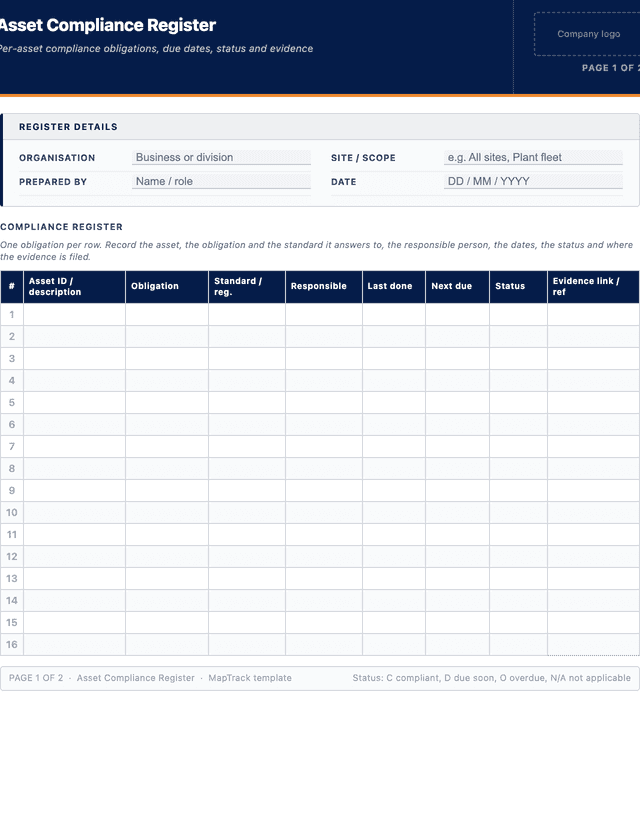
- The MapTrack asset compliance register has 8 columns and room for 28 entries. Columns: Asset ID / description, Obligation, Standard / reg., Responsible, Last done, Next due, Status, Evidence link / ref.
- An asset compliance register lists each asset against its compliance obligations: the standard, the due date, the responsible person and the current status.
- It answers a different question to an asset register: not what you own, but whether each asset is compliant and inspected on time.
- Recording the next due date and an evidence link per obligation turns the register into an audit-ready view of overdue and upcoming items.
- WHS Regulations 2011 Chapter 5 require records of inspection, testing and maintenance for plant; this register is where those obligations are tracked.
Enter your email below to download this asset compliance register as a ready-to-use PDF.
Used by construction, mining and field service teams









What is an asset compliance register?
An asset compliance register is a structured record that lists each asset against the compliance obligations that apply to it. For every asset it captures the obligation type (such as statutory inspection, certification, calibration or test), the standard or regulation it answers to, the responsible person, the date the obligation was last met, the next due date, the current status and a link to the evidence. It is the document that lets a manager see, across the whole asset base, which assets are compliant, which are due soon and which are overdue, without opening a separate file for each machine.
It is distinct from a basic asset register, which records what you own and where it is. The compliance register layers obligations on top of those assets and tracks whether each one is being met on time. Maintenance managers, compliance officers and site managers in construction, mining, facilities and manufacturing use it to stay audit-ready and to prove plant is inspected, tested and certified as required. Under the WHS Regulations 2011, Chapter 5, duty holders must inspect, test and maintain plant and keep records of that work, and some plant must be registered or certified before use. In MapTrack, each asset carries its inspections, certifications and due dates directly on its profile, so the compliance position is live and an overdue obligation is flagged automatically rather than surfacing only at audit time.
Learn more about compliance and inspections in MapTrack.
Benefits of using this asset compliance register
- Audit-ready view: one register shows the compliance status of every asset, so an auditor's request is answered without assembling files machine by machine.
- Overdue control: a next-due date and status against each obligation makes overdue inspections and lapsed certifications obvious before they become a finding.
- Clear accountability: naming a responsible person per obligation removes the ambiguity over who owns each inspection, test or certification.
- Evidence on hand: an evidence link against each obligation means the certificate or report can be produced quickly when a regulator or client asks.
- Standard traceability: recording the standard each obligation answers to shows precisely why an asset is inspected and to what requirement it conforms.
- Risk prioritisation: sorting by due date and status surfaces the highest-risk overdue plant first, so limited inspection resource goes where it matters.
- Renewal planning: upcoming due dates let you plan inspections, calibrations and certifications ahead instead of reacting once items are already overdue.
Benefits of digitising forms in MapTrack
When you move your registers from paper to MapTrack, you get:
- Field users can easily scan a QR code to complete a form on mobile. Unlimited users.
- Email the right people when a form is submitted, with an automation you set up.
- File every completed form against the asset, location or person it covers.
- Download any completed form as a PDF, with failed answers listed at the top.
- Fill in forms offline; they upload when the device is back online.
- Build conditional logic (show or hide questions based on answers).
- Take pictures or attach photos. Not possible with a paper-based form.
- Electronic signatures.
- Edit forms later without reprinting.
- Set who can view, fill in or edit forms with user roles.
- Upload a paper form (PDF, Word, Excel or a photo) and MapTrack's AI builds a digital version for you to check.
- Assign audits and send reminder emails to the people doing them.
- Keep every audit, inspection and sign-off against the asset or site it covers.
- Track corrective actions as work orders from finding to close-out, with each change in the activity log.
Book a demo to see how MapTrack handles registers.
Try MapTrack free for 30 days
Full access to every feature. No credit card required. Per-asset pricing so you scale as your fleet grows.
- No credit card required
- 30 days free trial
- Cancel anytime
1-2 days/week saved
“Bloody amazing! We used to spend 1-2 days a week tracking and managing our generators alone.”

Steve McAllister
Asset Coordinator, Saunders International
What to include in an asset compliance register
This asset compliance register covers 10 key areas:
- Register details: organisation, site or scope covered, prepared by, and the date.
- Asset ID and description: the tag or ID and a clear name for the asset the obligation applies to.
- Obligation type: the compliance activity, such as statutory inspection, certification, calibration, test or registration.
- Standard or regulation: the standard, code or regulation the obligation answers to (for example a WHS regulation or an AS standard).
- Responsible person: the named owner accountable for meeting that obligation.
- Last completed date: when the obligation was last met.
- Frequency: how often the obligation recurs (for example annual, six-monthly, before use).
- Next due date: when the obligation is next due so overdue items are visible.
- Status: a consistent code such as compliant, due soon, overdue or not applicable.
- Evidence link or reference: where the certificate, report or record is filed for verification.
How to use this asset compliance register
- List the assets that carry a compliance obligation within your scope.: Decide which sites or asset classes the register covers, then list the assets that are subject to inspection, testing, calibration or certification. Pull from your asset register so the compliance register stays linked to the same asset IDs and nothing inspectable is left off the list.
- Record the obligations and the standard each asset answers to.: For each asset, capture every applicable obligation and the standard, code or regulation behind it, such as a WHS regulation for registrable plant or an AS standard for an inspection. Listing the obligation against its source makes it clear why the asset is inspected and to what requirement.
- Assign a responsible person to each obligation.: Name the individual accountable for meeting each obligation rather than a team, so there is no ambiguity over who arranges the inspection or certification. A single named owner per obligation is what keeps items from falling between roles when people are busy or away.
- Record the last completed date, frequency and next due date.: Enter when each obligation was last met, how often it recurs and calculate the next due date from that frequency. The next due date is the engine of the register, because it is what lets you sort the whole asset base into compliant, due soon and overdue.
- Set the status and attach the evidence for each obligation.: Mark each obligation compliant, due soon, overdue or not applicable, and record where the certificate, inspection report or calibration record is filed. Having the evidence reference on the same line means proof of compliance is produced in seconds during an audit.
- Review the register on a cycle and act on overdue and upcoming items.: Run a scheduled review, sort by due date and status, and book the inspections and certifications that are overdue or due soon. Update the status and dates as work is completed and sign off the review so there is a dated record the asset base was current at that point.
In MapTrack, you can automate compliance tracking and audit trails. Each submission is stored as a timestamped PDF against the asset record.
Get the free templateEnter your email above to download the full asset compliance register as a PDF.Back to download formHow often should you complete this register?
Review the asset compliance register at least monthly so overdue inspections and certifications are caught early, and update each line as obligations are met or new assets are added. Run a full reconciliation against the asset register quarterly and before any external audit or client review, so no inspectable asset is missing an obligation. Assets with frequent statutory inspections, such as cranes or pressure equipment, warrant a closer watch. In MapTrack, each asset carries its inspections and due dates on its own profile, so the compliance position updates as work is logged and overdue items are flagged automatically.
Frequently asked questions
Applicable regulatory standards
This template is a starting point. Check the current requirements that apply to your equipment, work and location. The template alone does not establish compliance.
- WHS Regulations 2011, Chapter 5 - Plant and Structures (duties to inspect, test and maintain plant and keep records)
- ISO 55001 - Asset Management Systems (systematic control and assurance over the asset base)
- WHS Act 2011, Section 19 - Primary duty of care (ensuring plant is safe and compliant so far as is reasonably practicable)
Asset compliance register preview
The numbers behind this asset compliance register
Every figure below is sourced and dated, so you can quote it in a toolbox talk, a budget case or a board paper without having to chase the original report.
Embed this free template on your website
Run an industry blog, trade association site, or training resource? Drop a preview of this free asset compliance register straight into your page. The snippet is self-contained, needs no scripts, and links readers back to the full free template.
<div style="max-width:480px;font-family:system-ui,-apple-system,'Segoe UI',Roboto,sans-serif;border:1px solid #E5E7EB;border-radius:12px;padding:20px;background:#ffffff;">
  <p style="font-size:12px;font-weight:700;letter-spacing:0.05em;text-transform:uppercase;color:#071D49;margin:0;">Free template</p>
  <p style="font-size:18px;font-weight:700;color:#071D49;margin:6px 0 0;">Asset compliance register</p>
  <ul style="margin:12px 0 0;padding-left:18px;color:#374151;font-size:14px;line-height:1.6;">
    <li style="margin:4px 0;">Register details: organisation, site or scope covered, prepared by, and the date.</li>
    <li style="margin:4px 0;">Asset ID and description: the tag or ID and a clear name for the asset the obligation applies to.</li>
    <li style="margin:4px 0;">Obligation type: the compliance activity, such as statutory inspection, certification, calibration, test or registration.</li>
    <li style="margin:4px 0;">Standard or regulation: the standard, code or regulation the obligation answers to (for example a WHS regulation or an AS standard).</li>
    <li style="margin:4px 0;">Responsible person: the named owner accountable for meeting that obligation.</li>
    <li style="margin:4px 0;">Last completed date: when the obligation was last met.</li>
  </ul>
  <p style="font-size:13px;color:#6B7280;margin:14px 0 0;padding-top:12px;border-top:1px solid #E5E7EB;">Free <a href="https://www.maptrack.com/templates/asset-compliance-register-template" style="color:#071D49;font-weight:600;text-decoration:none;">Asset compliance register</a> by MapTrack</p>
</div>Free to reuse, including commercially. This template is published under a Creative Commons Attribution 4.0 licence. Copy it, adapt it, put it on your own site or in your own docs. All we ask is that you credit MapTrack with a link back to this page. The snippet above already includes that credit, so if you use it as-is you’re covered.
Cite this template
Writing about this topic? You’re welcome to quote this checklist. Here’s the wording to use so your readers can find the original.
The MapTrack asset compliance register has 8 columns and room for 28 entries.
- Short attribution
- MapTrack Asset compliance register, https://www.maptrack.com/templates/asset-compliance-register-template
- Reference list
- MapTrack. (2026). Asset compliance register [Checklist template]. Retrieved from https://www.maptrack.com/templates/asset-compliance-register-template
Free to reuse with credit under a Creative Commons Attribution 4.0 licence. If you’d rather link straight to it, the page is https://www.maptrack.com/templates/asset-compliance-register-template.
Need to automate compliance tracking and audit trails?
Register every asset in MapTrack, attach digital forms, and get a complete history of every inspection, service and compliance record.
Compliance and inspections · All templates · Pricing · Book a demo