
Free lifting equipment inspection checklist
Free lifting equipment inspection checklist for slings, shackles, chain blocks and lifting accessories (PDF-ready). Download free.
Updated 25 Sept 2026
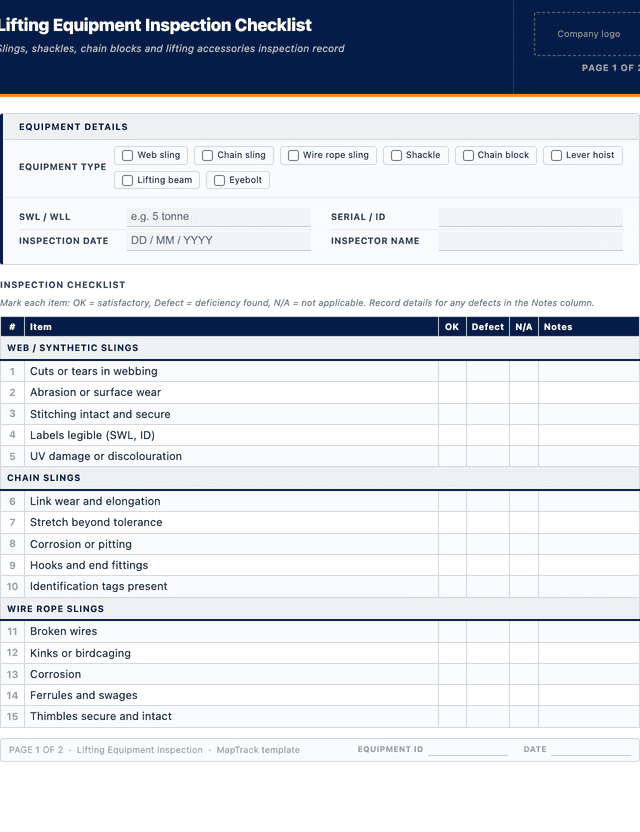
Lifting Equipment Inspection Checklist
Slings, shackles, chain blocks and lifting accessories inspection record
Web / Synthetic Slings
Chain Slings
Wire Rope Slings
Shackles & Hardware
Chain Blocks & Hoists
Inspector sign-off
Signature
Print name
Date
Supervisor sign-off
Signature
Print name
Date
How to use: download the PDF, print or complete digitally on any device.
- PDF format, ready to print or fill on screen
- Use as-is or customise to suit your operation
- Go digital in MapTrack for photos, reminders and audit trails
Two ways to use it
Use in MapTrack →Use it digitally instead
Unlimited usersThese same 25 checks, already built.




- Scan the asset’s QR tag with any phone
- Submitted forms can trigger alerts
- Photos on fails, audit-ready records
- Export responses, PDF reports with your logo
Free trial. No credit card needed.
Trusted by teams across Australia and New Zealand
We respect your privacy. Unsubscribe anytime.
These templates are free general guides provided as-is. They do not constitute legal, safety or compliance advice. You are responsible for ensuring any form meets your specific workplace obligations, industry standards and applicable regulations.
Don't just download it - use it live. Start a free workspace with this lifting equipment inspection checklist already built, so your crew can run it from a phone.

Co-Founder & Commercial Director
Key takeaways
- The MapTrack lifting equipment inspection checklist contains 25 checks across 5 sections. Sections covered: Web / Synthetic Slings, Chain Slings, Wire Rope Slings, Shackles & Hardware, Chain Blocks & Hoists.
Enter your email below to download this lifting equipment inspection checklist as a ready-to-use PDF.
Used by construction, mining and field service teams











What is a lifting equipment inspection checklist?
A lifting equipment inspection checklist is a structured form used to inspect and document the condition of slings, shackles, chain blocks, lever hoists, lifting beams and other lifting accessories at regular intervals. It covers all safety-critical components for each equipment type, ensuring that lifting gear is safe to use, correctly rated and properly identified. The checklist provides documented evidence of compliance with Australian WHS regulations and AS 4991 requirements for lifting devices. Inspections are grouped by equipment category, with specific pass/fail criteria for web slings, chain slings, wire rope slings, shackles and chain blocks, making it straightforward for a competent inspector to assess each item systematically.
Lifting equipment failures can result in dropped loads, crushing injuries and fatalities. Australian WHS Regulations 2011, Chapter 5, require that plant used for lifting be inspected by a competent person at regular intervals and before each use. AS 2550 (Cranes, hoists and winches, Safe use) provides the overarching safe-use requirements, while AS 1418 covers the design and construction standards for cranes and hoists. In Great Britain, Regulation 9 of the Lifting Operations and Lifting Equipment Regulations 1998 (LOLER), which is widely referenced internationally, requires thorough examination of lifting equipment at specified intervals and before first use. Maintaining a documented inspection register for every piece of lifting equipment demonstrates compliance with these standards and provides a traceable history that supports safety audits, insurance claims and incident investigations. Organisations that fail to maintain lifting equipment records face enforcement action, increased insurance premiums and significant legal exposure in the event of an incident involving lifting gear.
Learn more about compliance and inspections in MapTrack.
Benefits of using this lifting equipment inspection checklist
- Safety: identify worn, damaged or degraded lifting gear before it fails under load, preventing dropped loads and potential injuries or fatalities.
- Compliance: documented inspections demonstrate your organisation meets WHS regulations and AS 4991 requirements for lifting devices used in the workplace.
- Reduced risk: catch defects during scheduled inspections rather than discovering them during a critical lift, when the consequences of failure are highest.
- Traceability: maintain a complete inspection history for every sling, shackle and hoist in your inventory.
- Insurance requirements: many insurers require documented inspection records for lifting equipment as a condition of cover, and claims may be rejected without them.
- Cost savings: extend the service life of lifting gear by identifying issues early and scheduling replacements proactively.
Benefits of digitising forms in MapTrack
When you digitise lifting equipment checklists in MapTrack, you get:
- Field users can easily scan a QR code to complete a form on mobile. Unlimited users.
- Email the right people when a form is submitted, with an automation you set up.
- File every completed form against the asset, location or person it covers.
- Download any completed form as a PDF, with failed answers listed at the top.
- Fill in forms offline; they upload when the device is back online.
- Build conditional logic (show or hide questions based on answers).
- Take pictures or attach photos. Not possible with a paper-based form.
- Electronic signatures.
- Edit forms later without reprinting.
- Set who can view, fill in or edit forms with user roles.
- Upload a paper form (PDF, Word, Excel or a photo) and MapTrack's AI builds a digital version for you to check.
- Assign audits and send reminder emails to the people doing them.
- Keep every audit, inspection and sign-off against the asset or site it covers.
- Track corrective actions as work orders from finding to close-out, with each change in the activity log.
Book a demo to see how MapTrack handles lifting equipment checklists.
Try MapTrack free for 30 days
Full access to every feature. No credit card required. Per-asset pricing so you scale as your fleet grows.
- No credit card required
- 30 days free trial
- Cancel anytime
1-2 days/week saved
“Bloody amazing! We used to spend 1-2 days a week tracking and managing our generators alone.”

Steve McAllister
Asset Coordinator, Saunders International
What to include in a lifting equipment inspection checklist
This lifting equipment inspection checklist covers 8 key areas:
- Equipment details: type, SWL/WLL, serial/ID number, inspection date, inspector name.
- Web/synthetic slings: cuts, abrasion, stitching, labels, UV damage.
- Chain slings: link wear, stretch, corrosion, hooks, identification tags.
- Wire rope slings: broken wires, kinks, corrosion, ferrules, thimbles.
- Shackles and hardware: pin wear, body distortion, markings, thread condition.
- Chain blocks and hoists: chain condition, hook, brake, handle, label, load test.
- Overall outcome: fit for use, requires repair or condemn.
- Sign-off: inspector, supervisor.
How to use this lifting equipment inspection checklist
- Record equipment type, SWL/WLL and identification details.: Identify the item by its unique tag or serial number and cross-reference against your lifting equipment register. Record the safe working load or working load limit, the equipment type and the manufacturer details.
- Select the relevant equipment type section on the checklist.: Use the section specific to the equipment being inspected (web slings, chain slings, wire rope slings, shackles or chain blocks). Each section lists the inspection criteria relevant to that equipment type.
- Visually inspect each component and mark OK, Defect or N/A.: Examine each component under good lighting. For slings, check for cuts, abrasion, stitching damage and label legibility. For shackles, check pin wear, body distortion and marking clarity. For chain blocks, check the chain, hook and brake.
- Record details for any defects found, including severity.: Describe each defect clearly, noting its location and severity. Reference the applicable discard criteria from AS 4991 to determine whether the defect requires repair, monitoring or immediate condemnation.
- Determine outcome: fit for use, requires repair or condemn.: Based on the inspection findings and the AS 4991 discard criteria, classify the equipment as fit for continued use, requiring repair before use, or condemned and withdrawn from service permanently.
- Sign off and update the lifting equipment register.: The inspector and supervisor should sign the completed checklist. Update the lifting equipment register with the inspection result, next inspection due date, and any corrective actions required.
In MapTrack, you can automate compliance tracking and audit trails. Each submission is stored as a timestamped PDF against the asset record.
Get the free templateEnter your email above to download the full lifting equipment inspection checklist as a PDF.Back to download formHow often should you complete this checklist?
Lifting equipment inspections follow a tiered schedule. Pre-use visual checks are performed before each lift. Formal inspections are typically performed quarterly for frequently used items and annually for all lifting gear. Equipment exposed to harsh environments, corrosive chemicals or heavy-duty cycles may require monthly inspections. After any incident, suspected overload or repair, a full inspection must be completed before the equipment is returned to service. In MapTrack, you can schedule each inspection tier and track compliance across your entire lifting equipment register.
Frequently asked questions
Applicable regulatory standards
This template is a starting point. Check the current requirements that apply to your equipment, work and location. The template alone does not establish compliance.
- AS 2550 - Cranes, hoists and winches (Safe use)
- AS 1418 - Cranes, hoists and winches
- LOLER 1998 - Regulation 9 (thorough examination)
- WHS Regulations 2011, Chapter 5 - Plant and Structures
Lifting equipment inspection checklist preview
The numbers behind this lifting equipment inspection checklist
Every figure below is sourced and dated, so you can quote it in a toolbox talk, a budget case or a board paper without having to chase the original report.
Embed this free template on your website
Run an industry blog, trade association site, or training resource? Drop a preview of this free lifting equipment inspection checklist straight into your page. The snippet is self-contained, needs no scripts, and links readers back to the full free template.
<div style="max-width:480px;font-family:system-ui,-apple-system,'Segoe UI',Roboto,sans-serif;border:1px solid #E5E7EB;border-radius:12px;padding:20px;background:#ffffff;">
  <p style="font-size:12px;font-weight:700;letter-spacing:0.05em;text-transform:uppercase;color:#071D49;margin:0;">Free template</p>
  <p style="font-size:18px;font-weight:700;color:#071D49;margin:6px 0 0;">Lifting equipment inspection checklist</p>
  <ul style="margin:12px 0 0;padding-left:18px;color:#374151;font-size:14px;line-height:1.6;">
    <li style="margin:4px 0;">Equipment details: type, SWL/WLL, serial/ID number, inspection date, inspector name.</li>
    <li style="margin:4px 0;">Web/synthetic slings: cuts, abrasion, stitching, labels, UV damage.</li>
    <li style="margin:4px 0;">Chain slings: link wear, stretch, corrosion, hooks, identification tags.</li>
    <li style="margin:4px 0;">Wire rope slings: broken wires, kinks, corrosion, ferrules, thimbles.</li>
    <li style="margin:4px 0;">Shackles and hardware: pin wear, body distortion, markings, thread condition.</li>
    <li style="margin:4px 0;">Chain blocks and hoists: chain condition, hook, brake, handle, label, load test.</li>
  </ul>
  <p style="font-size:13px;color:#6B7280;margin:14px 0 0;padding-top:12px;border-top:1px solid #E5E7EB;">Free <a href="https://www.maptrack.com/templates/lifting-equipment-inspection-checklist" style="color:#071D49;font-weight:600;text-decoration:none;">Lifting equipment inspection checklist</a> by MapTrack</p>
</div>Free to reuse, including commercially. This template is published under a Creative Commons Attribution 4.0 licence. Copy it, adapt it, put it on your own site or in your own docs. All we ask is that you credit MapTrack with a link back to this page. The snippet above already includes that credit, so if you use it as-is you’re covered.
Cite this template
Writing about this topic? You’re welcome to quote this checklist. Here’s the wording to use so your readers can find the original.
The MapTrack lifting equipment inspection checklist contains 25 checks across 5 sections.
- Short attribution
- MapTrack Lifting equipment inspection checklist, https://www.maptrack.com/templates/lifting-equipment-inspection-checklist
- Reference list
- MapTrack. (2026). Lifting equipment inspection checklist [Checklist template]. Retrieved from https://www.maptrack.com/templates/lifting-equipment-inspection-checklist
Free to reuse with credit under a Creative Commons Attribution 4.0 licence. If you’d rather link straight to it, the page is https://www.maptrack.com/templates/lifting-equipment-inspection-checklist.
Need to automate compliance tracking and audit trails?
Register every lifting equipment in MapTrack, attach digital forms, and get a complete history of every inspection, service and compliance record.
Compliance and inspections · All templates · Pricing · Book a demo