
Free corrective and preventive action (CAPA)
Free CAPA template (PDF-ready). Log the problem, root cause, corrective and preventive action, verification and effectiveness in one form.
Updated 28 Sept 2026
Corrective and Preventive Action (CAPA)
Problem, root cause, corrective and preventive action, verification and effectiveness
PROBLEM AND CONTAINMENT
ROOT CAUSE ANALYSIS
CORRECTIVE AND PREVENTIVE ACTION
VERIFICATION AND EFFECTIVENESS
How to use: download the PDF, print or complete digitally on any device.
- PDF format, ready to print or fill on screen
- Use as-is or customise to suit your operation
- Go digital in MapTrack for photos, reminders and audit trails
Two ways to use it
Use in MapTrack →Use it digitally instead
Unlimited usersUpload this PDF and MapTrack drafts the form for you.




- Scan the asset’s QR tag with any phone
- Submitted forms can trigger alerts
- Photos on fails, audit-ready records
- Export responses, PDF reports with your logo
Free trial. No credit card needed.
Trusted by teams across Australia and New Zealand
We respect your privacy. Unsubscribe anytime.
These templates are free general guides provided as-is. They do not constitute legal, safety or compliance advice. You are responsible for ensuring any form meets your specific workplace obligations, industry standards and applicable regulations.
Don't just download it - use it live. Start a free workspace, upload this corrective and preventive action (CAPA) and MapTrack drafts it as a form your crew can run from a phone.

Co-Founder & Commercial Director
Key takeaways
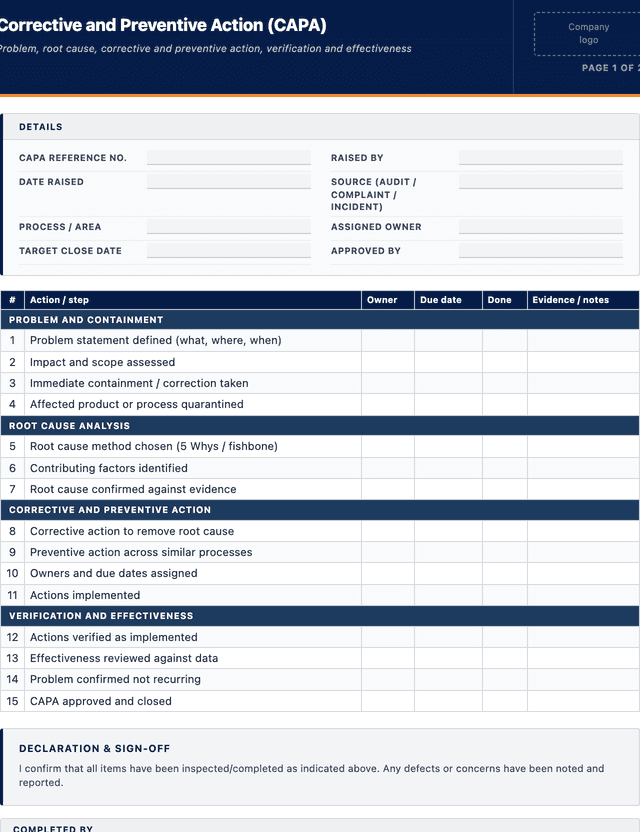
- The MapTrack corrective and preventive action (CAPA) contains 15 checks across 4 sections. Sections covered: PROBLEM AND CONTAINMENT, ROOT CAUSE ANALYSIS, CORRECTIVE AND PREVENTIVE ACTION, VERIFICATION AND EFFECTIVENESS.
Enter your email below to download this corrective and preventive action (CAPA) as a ready-to-use PDF.
Used by construction, mining and field service teams










What is a corrective and preventive action (CAPA)?
A corrective and preventive action (CAPA) template is a structured form for taking a problem all the way from what went wrong to proof that it will not happen again. It captures the problem or nonconformity, the immediate containment or correction, the root cause found through analysis, the corrective action that removes that cause, any preventive action that stops the same cause appearing elsewhere, the verification that the actions were done, and the effectiveness check that confirms the problem has actually stopped. Each action carries an owner and a due date, so a CAPA is a tracked commitment rather than a note in a meeting.
A quick note on the label: "CAPA" (Corrective and Preventive Action) is common industry and US FDA terminology (21 CFR 820 and ISO 13485 for medical devices). ISO 9001 has no clause or defined term called "CAPA", and it does not require a "CAPA procedure". In the current edition, ISO 9001:2026, corrective action sits in clause 10.2 (Nonconformity and corrective action) and there is no separate preventive-action clause: the 2015 edition removed the preventive-action clause of the 2008 edition (old clause 8.5.3), and prevention is now handled through risk-based thinking, principally clause 6.1 (Actions to address risks and opportunities). This template uses the familiar CAPA label but maps to clause 10.2, and lets you capture risk-based preventive actions alongside the corrective ones. Done well, it stops the same defect, breakdown, complaint or audit finding recurring, because it forces the team past a quick fix to the underlying cause. Done poorly, it becomes a log of corrections that never touch why the problem keeps coming back, which is why the root-cause and effectiveness steps are the parts that matter most.
Learn more about compliance and inspections in MapTrack.
Benefits of using this corrective and preventive action (CAPA)
- Root-cause discipline: a dedicated analysis step forces the team past the symptom to the cause, so the fix actually holds.
- Correction versus prevention: separating immediate containment from preventive action stops teams closing out at the quick fix.
- Clear ownership: every corrective and preventive action carries a named owner and due date rather than a vague group commitment.
- Effectiveness proof: a mandatory effectiveness check confirms the problem has stopped, not just that the action was completed.
- Recurrence control: applying preventive action across similar processes stops the same cause reappearing in another area or line.
- Audit evidence: a completed CAPA is direct evidence of the nonconformity and improvement handling ISO 9001 Clause 10.2 expects.
- Trend insight: a set of CAPAs over time reveals which processes and causes generate the most problems and deserve deeper work.
Benefits of digitising forms in MapTrack
When you move from paper or static PDFs to digital forms in MapTrack, you get:
- Field users can easily scan a QR code to complete a form on mobile. Unlimited users.
- Email the right people when a form is submitted, with an automation you set up.
- File every completed form against the asset, location or person it covers.
- Download any completed form as a PDF, with failed answers listed at the top.
- Fill in forms offline; they upload when the device is back online.
- Build conditional logic (show or hide questions based on answers).
- Take pictures or attach photos. Not possible with a paper-based form.
- Electronic signatures.
- Edit forms later without reprinting.
- Set who can view, fill in or edit forms with user roles.
- Upload a paper form (PDF, Word, Excel or a photo) and MapTrack's AI builds a digital version for you to check.
- Assign audits and send reminder emails to the people doing them.
- Keep every audit, inspection and sign-off against the asset or site it covers.
- Track corrective actions as work orders from finding to close-out, with each change in the activity log.
Book a demo to see how MapTrack handles forms.
Try MapTrack free for 30 days
Full access to every feature. No credit card required. Per-asset pricing so you scale as your fleet grows.
- No credit card required
- 30 days free trial
- Cancel anytime
1-2 days/week saved
“Bloody amazing! We used to spend 1-2 days a week tracking and managing our generators alone.”

Steve McAllister
Asset Coordinator, Saunders International
What to include in a corrective and preventive action (CAPA)
This corrective and preventive action (CAPA) covers 10 key areas:
- CAPA reference number, date raised, and who raised it
- Source of the issue: audit finding, customer complaint, nonconforming product, incident, or internal review
- Problem statement: a clear, specific description of what went wrong and where
- Immediate containment or correction taken to limit the impact now
- Root cause analysis: 5 Whys, fishbone or other method tracing the problem to its source
- Corrective action: what will be done to remove the root cause, with owner and due date
- Preventive action: what will be done to stop the cause recurring elsewhere, with owner and due date
- Verification: confirmation each action was implemented as planned
- Effectiveness review: evidence the problem has not recurred, with a review date
- Approval and close-out: sign-off by the responsible manager and date closed
How to use this corrective and preventive action (CAPA)
- Define the problem and contain it: Write a specific problem statement describing what went wrong, where and when, backed by data where you have it. Take any immediate containment needed to limit the impact now, such as quarantining stock or stopping a process, and record it, but be clear that containment is not the corrective action.
- Find the root cause: Use a structured method such as 5 Whys or a fishbone diagram to trace the problem to its underlying cause rather than stopping at the first plausible explanation. A weak root cause produces a weak fix, so keep asking why until you reach a cause you can act on and that explains the evidence.
- Decide corrective and preventive actions: Set a corrective action that removes the root cause of this specific problem, and a preventive action that stops the same cause appearing in similar processes, products or sites. Give each action a named owner and a realistic due date, because actions without an owner and a date are the ones that quietly never happen.
- Verify the actions were done: Once the due dates pass, confirm that each corrective and preventive action was actually implemented as planned, and record the evidence. Verification checks that the work was done. It is a separate step from the effectiveness review, which comes later and checks whether the work solved the problem.
- Review effectiveness and close out: After enough time has passed, review whether the problem has actually stopped recurring, using data or observation rather than assumption. If it has, have the responsible manager approve and close the CAPA. If it has not, reopen the root-cause analysis, because a problem that recurs means the real cause was never found.
In MapTrack, you can automate compliance tracking and audit trails. Each submission is stored as a timestamped PDF against the asset record.
Get the free templateEnter your email above to download the full corrective and preventive action (CAPA) as a PDF.Back to download formHow often should you complete this form?
Raise a CAPA whenever a nonconformity, complaint, incident or audit finding is significant enough that a simple correction will not stop it happening again. Not every minor slip needs a CAPA, but anything with a real cost, safety or customer impact, or that has recurred, should get one.
Track open CAPAs at a regular management or quality meeting to chase overdue actions and confirm effectiveness reviews are being done. Review the full set of closed CAPAs periodically, at least at the management review, to spot patterns in causes and sources. A rising CAPA count is not necessarily bad, because it can mean problems are being surfaced rather than hidden, but a pile of overdue or ineffective CAPAs is a clear warning sign.
Frequently asked questions
Applicable regulatory standards
This template is a starting point. Check the current requirements that apply to your equipment, work and location. The template alone does not establish compliance.
- ISO 9001 Quality management systems - Requirements, clause 10.2 (Nonconformity and corrective action)
- ISO 9001 clause 6.1 (Actions to address risks and opportunities) - where preventive/risk-based thinking now sits; note ISO 9001 has no standalone preventive-action clause and no clause or defined term called CAPA
- ISO 45001:2018 clause 10.2 (Incident, nonconformity and corrective action)
- Plan-Do-Check-Act (PDCA / Deming cycle) - a continual-improvement method, not a standard; the CAPA flow follows it
Corrective and Preventive Action (CAPA) preview
The numbers behind this corrective and preventive action (CAPA)
Every figure below is sourced and dated, so you can quote it in a toolbox talk, a budget case or a board paper without having to chase the original report.
Embed this free template on your website
Run an industry blog, trade association site, or training resource? Drop a preview of this free corrective and preventive action (CAPA) straight into your page. The snippet is self-contained, needs no scripts, and links readers back to the full free template.
<div style="max-width:480px;font-family:system-ui,-apple-system,'Segoe UI',Roboto,sans-serif;border:1px solid #E5E7EB;border-radius:12px;padding:20px;background:#ffffff;">
  <p style="font-size:12px;font-weight:700;letter-spacing:0.05em;text-transform:uppercase;color:#071D49;margin:0;">Free template</p>
  <p style="font-size:18px;font-weight:700;color:#071D49;margin:6px 0 0;">Corrective and Preventive Action (CAPA)</p>
  <ul style="margin:12px 0 0;padding-left:18px;color:#374151;font-size:14px;line-height:1.6;">
    <li style="margin:4px 0;">CAPA reference number, date raised, and who raised it</li>
    <li style="margin:4px 0;">Source of the issue: audit finding, customer complaint, nonconforming product, incident, or internal review</li>
    <li style="margin:4px 0;">Problem statement: a clear, specific description of what went wrong and where</li>
    <li style="margin:4px 0;">Immediate containment or correction taken to limit the impact now</li>
    <li style="margin:4px 0;">Root cause analysis: 5 Whys, fishbone or other method tracing the problem to its source</li>
    <li style="margin:4px 0;">Corrective action: what will be done to remove the root cause, with owner and due date</li>
  </ul>
  <p style="font-size:13px;color:#6B7280;margin:14px 0 0;padding-top:12px;border-top:1px solid #E5E7EB;">Free <a href="https://www.maptrack.com/templates/capa-template" style="color:#071D49;font-weight:600;text-decoration:none;">Corrective and Preventive Action (CAPA)</a> by MapTrack</p>
</div>Free to reuse, including commercially. This template is published under a Creative Commons Attribution 4.0 licence. Copy it, adapt it, put it on your own site or in your own docs. All we ask is that you credit MapTrack with a link back to this page. The snippet above already includes that credit, so if you use it as-is you’re covered.
Cite this template
Writing about this topic? You’re welcome to quote this checklist. Here’s the wording to use so your readers can find the original.
The MapTrack corrective and preventive action (CAPA) contains 15 checks across 4 sections.
- Short attribution
- MapTrack Corrective and Preventive Action (CAPA), https://www.maptrack.com/templates/capa-template
- Reference list
- MapTrack. (2026). Corrective and Preventive Action (CAPA) [Checklist template]. Retrieved from https://www.maptrack.com/templates/capa-template
Free to reuse with credit under a Creative Commons Attribution 4.0 licence. If you’d rather link straight to it, the page is https://www.maptrack.com/templates/capa-template.
Need to automate compliance tracking and audit trails?
Register every asset in MapTrack, attach digital forms, and get a complete history of every inspection, service and compliance record.
Compliance and inspections · All templates · Pricing · Book a demo