
Free template · PDF
Free fuel card policy template
Free fuel card policy template (PDF-ready). Cover card issue, PIN security, allowed purchases, limits, reconciliation and loss or misuse for your fleet.
Loading PDF page...
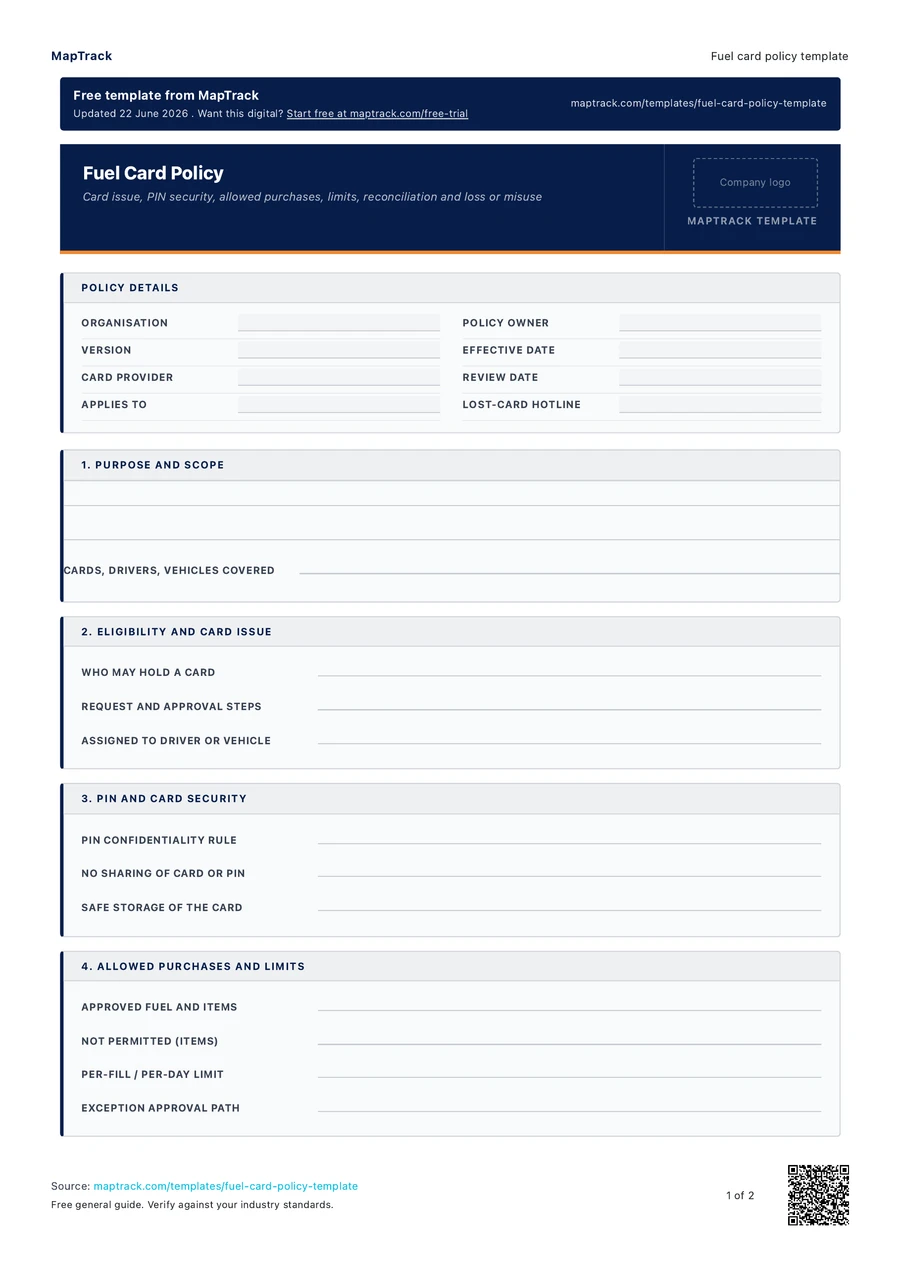

Read the form fields
Card issue, PIN security, allowed purchases, limits, reconciliation and loss or misuse
7 sections
The fields in the printable form, in a view that fits your screen.
Policy details
- Organisation
- Policy owner
- Version
- Effective date
- Card provider
- Review date
- Applies to
- Lost-card hotline
1. Purpose and scope
- Cards, drivers, vehicles covered
2. Eligibility and card issue
- Who may hold a card
- Request and approval steps
- Assigned to driver or vehicle
3. PIN and card security
- PIN confidentiality rule
- No sharing of card or PIN
- Safe storage of the card
4. Allowed purchases and limits
- Approved fuel and items
- Not permitted (items)
- Per-fill / per-day limit
- Exception approval path
5. Reconciliation
- Statement matched against
- Reconciliation frequency
- Who reconciles and reviews
6. Lost, stolen or misused cards
- Who to notify and how fast
- Replacement process
- What counts as misuse
- Consequences of misuse
Cardholder acknowledgement
Signature · Print name · Card no. · Date
Issued / approved by (fleet coordinator)
Signature · Print name · Limit set · Date

Co-Founder & Commercial Director
Make this form your own
Add your fields and logo. Give your team a form they can use on site.
Free 30-day trial. No credit card. Work email needed.
Upload & use this form now for free



“MapTrack beat them all in every aspect.”
 Vincent Stone · HSEQ Advisor, Concept Tanks
After signup: upload this PDF, check the form MapTrack drafts, then save and publish it for your team.
General guidance only. Check the form against your equipment manual, site procedures and local requirements before using it.
Key takeaways
- A fuel card policy governs the cards specifically, sitting underneath the broader fuel management policy.
- PIN discipline and a named cardholder are what tie each transaction to a person who can be asked about it.
- Per-fill and per-vehicle limits cap the loss from any single misuse before it grows.
- A fast lost-or-stolen procedure turns a potential fraud into a contained, same-day event.
- Review the active card list quarterly and cancel cards for people who have left or no longer drive.
What is a fuel card policy template?
A fuel card policy is the document that governs how fuel cards are issued, used, secured and reconciled across a fleet. It is narrower than a fuel management policy: where that covers the whole fuel programme, this one sets the specific rules for the cards themselves. It defines who is eligible for a card, how cards are issued and assigned to a driver or a vehicle, how PINs are kept secure, exactly what may and may not be purchased, the transaction and daily limits, the reconciliation routine, and the steps to follow when a card is lost, stolen or misused. Every cardholder is expected to read and acknowledge it before a card is handed over.
Fuel cards are convenient, which is precisely why they are a common point of leakage. Without clear rules a card becomes an open line of credit at any servo, used for the wrong vehicle, shared by PIN, or run up on snacks and car washes. A tight policy turns the card into a controlled instrument: purchases are restricted to fuel and approved items, limits cap the damage from any single misuse, PIN discipline ties each transaction to a person, and routine reconciliation against odometer and fuel records exposes anything that does not belong. Because cardholder and transaction data is personal information, the policy also sets handling rules consistent with the Privacy Act 1988, and supports the record-keeping the ATO expects where vehicles carry private use.
Learn more about GPS and fleet tracking in MapTrack.
Choose the format that fits your team
Download the PDF
Use the original printable form for a paper workflow. Check it against your equipment and site procedure before the job.
Keep completed copies in your own record system and arrange any follow-up through your normal process.
Download free PDFCustomise a form in MapTrack
Start a free trial, upload this PDF and MapTrack drafts the form. Adjust it to your workflow, then save and publish it for your team to use.
Sample answers on this page and completed PDF records aren't imported automatically.
Upload & use this form now for freeFree 30-day trial. No credit card. Work email needed.
Benefits of using this fuel card policy template
- Controlled spend: restricting cards to fuel and approved items and setting hard limits caps the loss from any single misuse before it grows.
- Personal accountability: PIN discipline and a card assigned to a named driver or vehicle ties every transaction to someone who can be asked about it.
- Faster reconciliation: a consistent card and receipt routine makes matching statements to fills and odometer readings a quick monthly check, not a hunt.
- Loss containment: a clear lost-or-stolen procedure means a card is cancelled within hours, not days, shutting down fraud before it accumulates.
- Fewer disputes: written rules on allowed purchases and limits remove the grey area, so misuse is a clear breach rather than an arguable misunderstanding.
- Privacy compliance: defined handling of cardholder and transaction data keeps the programme aligned with Privacy Act 1988 obligations.
What to include in a fuel card policy template
- Purpose and scope: which cards, drivers and vehicles the policy applies to
- Eligibility and issue: who may hold a card and how cards are requested, approved and assigned
- PIN and card security: PIN confidentiality, no sharing, and safe storage of the physical card
- Allowed purchases: fuel types and approved items, plus an explicit list of what may not be bought
- Transaction limits: per-fill, per-day and per-vehicle limits, and the exception approval path
- Reconciliation: how statements are matched to fills, receipts and odometer readings, and how often
- Lost, stolen or damaged cards: who to notify, how fast, and the replacement process
- Misuse and consequences: what counts as misuse and the disciplinary or recovery steps that follow
- Acknowledgement: a cardholder declaration to sign before the card is issued
How to use this fuel card policy template
Define eligibility and issue rules
Set who qualifies for a fuel card and whether cards are tied to a driver or a vehicle. Document the request, approval and assignment steps so cards are only issued deliberately and there is a clear record of who holds which card.
Set security and PIN rules
Require each cardholder to keep the PIN confidential, never share the card, and store it securely. PIN discipline is what links a transaction to a person, so a shared or written-down PIN undermines every other control in the policy.
Specify allowed purchases and limits
List the fuel types and approved items the card may be used for and the things it may not, such as personal vehicles, food or accessories. Set per-fill, per-day and per-vehicle limits and a quick exception path for legitimate larger purchases.
Establish the reconciliation routine
Define how the card statement is matched against logged fills, receipts and odometer movement, and set the frequency, monthly at a minimum. Reconciliation against an independent source is what catches fills that never reached the assigned vehicle.
Cover loss, misuse and acknowledgement
Set out who to call to cancel a lost or stolen card and how quickly, the replacement process, and the consequences for misuse. Require every cardholder to sign an acknowledgement before issue so the rules are accepted, not assumed.
How often should you complete this policy?
Review the fuel card policy at least annually and immediately after any misuse or loss event, a change of card provider, or a shift in the fleet. Re-issue and re-acknowledge it whenever the rules change materially so no cardholder is operating on an old version.
Reconcile card statements monthly at a minimum, aligned to the billing cycle, and run exception checks more often for high-spend cards. Audit the active card list periodically as well, cancelling cards held by people who have left or no longer need one, because dormant cards are a quiet risk.
Make this form your own
From your template to your team.
Upload this PDF and MapTrack drafts the form. Adjust it for your equipment and site, then save and publish the digital form for your team.
- 01
Start your free trial
Use your work email to create your MapTrack account.
- 02
Customise, save and publish
Adjust the template fields and branding for your site.
- 03
Complete it on the job
Record checks, add photos and export a branded PDF.
Keep working offline
Load the form before you lose reception. Complete it offline and sync when you're back online.
Scan the asset. Open its form.
Use an asset's QR code to find and complete the forms that belong to it.
Show what you found
Capture photos and attach files so the next person has the details they need.
Take a branded PDF with you
Download completed forms as PDF reports with your company logo.
Completed paper records aren't imported automatically.
Frequently asked questions
Practical answers about the form, record keeping and using MapTrack.
Fuel-card transactions identify a driver, a location and a time, so the data is personal information under the Privacy Act 1988 and should be collected, stored and accessed only for managing the fleet. Where the associated vehicle is available for private use, the fuel may also be relevant to fringe benefits, and the ATO expects supporting records. The policy is not tax or legal advice, but mandating consistent records and controlled access to card data supports both obligations. Confirm specifics with your privacy officer and tax adviser.
Link to this answerBoth models work and the right choice depends on the fleet. Vehicle-assigned cards keep fuel tied to a single asset, which simplifies consumption tracking and is well suited to pool and shared vehicles. Driver-assigned cards follow the person and suit field staff who move between vehicles. Whichever you choose, the card must still be tied to a named, accountable individual through PIN entry and an odometer prompt, so every transaction can be traced and questioned.
Link to this answerReport it immediately to the nominated contact, usually the fleet coordinator or the card provider hotline, so the card can be blocked within hours. Most providers can suspend a card in real time, which limits any fraudulent use to a short window. The driver should then follow the replacement process in the policy. The key is speed: a card reported on the day is a contained event, while one reported a week later can mean significant unauthorised spend.
Link to this answerReconcile transactions monthly, but also review the list of active cards at least quarterly. Cancel cards held by people who have left, changed roles, or no longer drive, because a forgotten active card is one of the more common sources of fuel leakage. Pair the card review with the monthly reconciliation so both the transactions and the population of cards stay under control rather than only the spend being watched.
Link to this answerYes, it is completely free. It downloads as a ready-to-print PDF to use as the starting point for your fleet policy. You do not need a MapTrack account. If you want to move beyond paper, MapTrack keeps fuel, cost and odometer records against each vehicle and surfaces exception and consumption reports, so reconciling card statements against actual fills becomes a quick review rather than a manual reconciliation. Start free or book a demo to see how.
Link to this answerApplicable regulatory standards
This form is a starting point. Check the current requirements that apply to your equipment, work and location. The form alone does not establish compliance.
- Fringe Benefits Tax Assessment Act 1986 and ATO guidance (fuel and vehicle benefits)
- Privacy Act 1988 (handling of cardholder and transaction data)
- Australian Consumer Law (terms of fuel-card purchasing arrangements)
- ISO 55001:2024 Asset management (controlled vehicle running-cost records)
MapTrack publishes this template. The linked authorities publish their own guidance; they haven't endorsed this form.
The numbers behind this fuel card policy template
Every figure below is sourced and dated, so you can quote it in a toolbox talk, a budget case or a board paper without having to chase the original report.
Cite this template
Writing about this topic? You’re welcome to quote this checklist. Here’s the wording to use so your readers can find the original.
- Short attribution
- MapTrack Fuel card policy template, https://www.maptrack.com/templates/fuel-card-policy-template
- Reference list
- MapTrack. (2026). Fuel card policy template [Checklist template]. Retrieved from https://www.maptrack.com/templates/fuel-card-policy-template
Free to reuse with credit under a Creative Commons Attribution 4.0 licence. If you’d rather link straight to it, the page is https://www.maptrack.com/templates/fuel-card-policy-template.
Embed this free template on your website
Run an industry blog, trade association site, or training resource? Drop a preview of this free fuel card policy template straight into your page. The snippet is self-contained, needs no scripts, and links readers back to the full free template.
<div style="max-width:480px;font-family:system-ui,-apple-system,'Segoe UI',Roboto,sans-serif;border:1px solid #E5E7EB;border-radius:12px;padding:20px;background:#ffffff;">
  <p style="font-size:12px;font-weight:700;letter-spacing:0.05em;text-transform:uppercase;color:#071D49;margin:0;">Free template</p>
  <p style="font-size:18px;font-weight:700;color:#071D49;margin:6px 0 0;">Fuel card policy template</p>
  <ul style="margin:12px 0 0;padding-left:18px;color:#374151;font-size:14px;line-height:1.6;">
    <li style="margin:4px 0;">Purpose and scope: which cards, drivers and vehicles the policy applies to</li>
    <li style="margin:4px 0;">Eligibility and issue: who may hold a card and how cards are requested, approved and assigned</li>
    <li style="margin:4px 0;">PIN and card security: PIN confidentiality, no sharing, and safe storage of the physical card</li>
    <li style="margin:4px 0;">Allowed purchases: fuel types and approved items, plus an explicit list of what may not be bought</li>
    <li style="margin:4px 0;">Transaction limits: per-fill, per-day and per-vehicle limits, and the exception approval path</li>
    <li style="margin:4px 0;">Reconciliation: how statements are matched to fills, receipts and odometer readings, and how often</li>
  </ul>
  <p style="font-size:13px;color:#6B7280;margin:14px 0 0;padding-top:12px;border-top:1px solid #E5E7EB;">Free <a href="https://www.maptrack.com/templates/fuel-card-policy-template" style="color:#071D49;font-weight:600;text-decoration:none;">Fuel card policy template</a> by MapTrack</p>
</div>Free to reuse, including commercially. This template is published under a Creative Commons Attribution 4.0 licence. Copy it, adapt it, put it on your own site or in your own docs. All we ask is that you credit MapTrack with a link back to this page. The snippet above already includes that credit, so if you use it as-is you’re covered.
About the author

Co-Founder & Commercial Director
Jarrod has spent over a decade in technology consulting and asset management, including roles at Accenture (mining and heavy industry) and CGI as an Asset Management Consultant. He co-founded MapTrack and built and scaled its original platform, then rebuilt it with Lachlan and Alex from thousands of customer conversations and 300+ user research sessions with field teams. His consulting background gives him deep insight into the operational and compliance challenges facing asset-intensive Australian businesses.
View LinkedIn profile →Ready for your next job?
Keep the PDF handy, or upload it to MapTrack and turn it into a digital form for your team.