
Free waste management inspection checklist
Free waste management inspection checklist (PDF-ready). Covers storage, segregation, labelling, containment and EPA compliance. Digitise with MapTrack.
Updated 2 May 2026
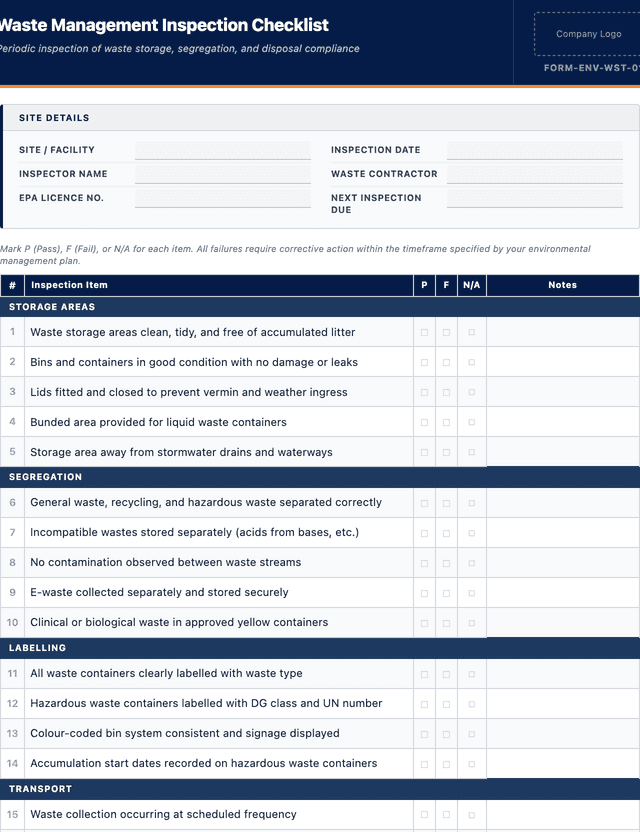
Waste Management Inspection Checklist
Periodic inspection of waste storage, segregation, and disposal compliance
Storage Areas
Segregation
Labelling
Transport
Compliance & Records
How to use: download the PDF, print or complete digitally on any device.
- PDF format, ready to print or fill on screen
- Use as-is or customise to suit your operation
- Go digital in MapTrack for photos, reminders and audit trails
Two ways to use it
Use in MapTrack →Use it digitally instead
Unlimited usersThese same 24 checks, already built.




- Scan the asset’s QR tag with any phone
- Submitted forms can trigger alerts
- Photos on fails, audit-ready records
- Export responses, PDF reports with your logo
Free trial. No credit card needed.
Trusted by teams across Australia and New Zealand
We respect your privacy. Unsubscribe anytime.
These templates are free general guides provided as-is. They do not constitute legal, safety or compliance advice. You are responsible for ensuring any form meets your specific workplace obligations, industry standards and applicable regulations.
Don't just download it - use it live. Start a free workspace with this waste management inspection checklist already built, so your crew can run it from a phone.

Co-Founder & Commercial Director
Key takeaways
- The MapTrack waste management inspection checklist contains 24 checks across 5 sections. Sections covered: Storage Areas, Segregation, Labelling, Transport, Compliance & Records.
Enter your email below to download this waste management inspection checklist as a ready-to-use PDF.
Used by construction, mining and field service teams






What is a waste management inspection checklist?
A waste management inspection checklist is a structured document used to verify that waste storage areas, waste streams, bins and containers on a site are maintained in a safe, compliant and environmentally responsible condition. The checklist covers waste segregation, container labelling, bunding and containment, storage area cleanliness, hazardous waste handling, waste tracking documentation and compliance with EPA licence conditions.
Proper waste management is a regulatory requirement under state environmental protection legislation such as the Protection of the Environment Operations Act 1997 (NSW), the Environment Protection Act 2017 (Vic) and equivalent laws in other states. The WHS Regulations 2011, Chapter 7 also applies where waste includes hazardous chemicals. EPA licences for industrial and commercial premises typically include conditions for waste storage, segregation and disposal. Failing to maintain compliant waste management practices can result in EPA fines, clean-up notices, prosecution and contamination of soil and groundwater that requires expensive remediation.
Learn more about compliance and inspections in MapTrack.
Benefits of using this waste management inspection checklist
- EPA compliance: documents that waste storage and handling meets EPA licence conditions and state environmental legislation.
- Contamination prevention: inspections catch leaking containers, failed bunding and improper storage before contamination occurs.
- Segregation verification: confirms incompatible waste streams are separated to prevent dangerous reactions.
- WHS compliance: hazardous waste handling checks satisfy WHS Regulations 2011 requirements for chemical management.
- Cost control: identifying contaminated recyclable streams reduces disposal costs by improving recycling rates.
- Audit readiness: completed checklists provide evidence for EPA audits, ISO 14001 reviews and customer environmental assessments.
Benefits of digitising forms in MapTrack
When you move your checklists from paper to MapTrack, you get:
- Field users can easily scan a QR code to complete a form on mobile. Unlimited users.
- Email the right people when a form is submitted, with an automation you set up.
- File every completed form against the asset, location or person it covers.
- Download any completed form as a PDF, with failed answers listed at the top.
- Fill in forms offline; they upload when the device is back online.
- Build conditional logic (show or hide questions based on answers).
- Take pictures or attach photos. Not possible with a paper-based form.
- Electronic signatures.
- Edit forms later without reprinting.
- Set who can view, fill in or edit forms with user roles.
- Upload a paper form (PDF, Word, Excel or a photo) and MapTrack's AI builds a digital version for you to check.
- Log spill response actions and containment measures with timestamped evidence.
- Keep waste manifests and disposal records as forms and files against each site.
- Download each completed environmental record as a PDF for an audit.
Book a demo to see how MapTrack handles checklists.
Try MapTrack free for 30 days
Full access to every feature. No credit card required. Per-asset pricing so you scale as your fleet grows.
- No credit card required
- 30 days free trial
- Cancel anytime
1-2 days/week saved
“Bloody amazing! We used to spend 1-2 days a week tracking and managing our generators alone.”

Steve McAllister
Asset Coordinator, Saunders International
What to include in a waste management inspection checklist
This waste management inspection checklist covers 11 key areas:
- Site details: site name, waste storage area location, inspection date, inspector name and role.
- General waste area: bins adequate for volume, area clean, no overflow, collection schedule current.
- Recyclable streams: correctly segregated (paper, cardboard, plastics, metals), no contamination, bins labelled.
- Hazardous waste: containers labelled with waste type and hazard class, SDS available, containers sealed and upright.
- Liquid waste: bunding intact (capacity at least 110% of largest container), no staining or ponding, valves closed.
- Chemical waste: segregation by compatibility class, quantities within EPA licence limits, waste tracking certificates current.
- Construction and demolition waste: separated from general waste, asbestos waste double-bagged and labelled (if applicable).
- Waste documentation: waste tracking records current, EPA licence on display, waste contractor agreements in date.
- Signage: waste stream signs on all bins and storage areas, emergency contact numbers displayed.
- Defect register: item, non-compliance description, corrective action, responsible person, target date.
- Sign-off: inspector signature, site manager acknowledgement, next inspection due.
How to use this waste management inspection checklist
- Walk the waste storage areas and inspect general and recyclable waste streams: Check that general waste bins are not overflowing and the collection schedule is adequate. Verify recyclable streams (paper, cardboard, plastics, metals) are correctly segregated with no cross-contamination. Confirm all bins are labelled with the waste stream type and colour-coded where applicable.
- Inspect hazardous and chemical waste storage: Check that all hazardous waste containers are correctly labelled with the waste type, hazard class and date of first storage. Verify containers are sealed, upright and in good condition (no leaks, corrosion or damage). Confirm incompatible chemicals are segregated per the SDS compatibility chart.
- Check bunding, containment and liquid waste areas: Inspect all bunded areas to confirm the bund is intact, capacity is at least 110% of the largest container, drain valves are closed and there is no staining or ponding from previous leaks. Check that liquid waste containers are on drip trays where required and absorbent materials are available.
- Review waste documentation and tracking records: Confirm waste tracking certificates are current for all regulated waste streams. Check the EPA licence is on display and the facility is operating within its licence conditions (waste types, quantities, storage periods). Verify waste contractor agreements are in date and transporters hold the required licences.
- Record non-conformances and assign corrective actions: Log all non-conformances in the defect register with a description, corrective action, responsible person and target date. High-priority items include leaking containers, failed bunding, missing labelling on hazardous waste and exceeded storage limits. Sign the checklist and schedule the next inspection.
In MapTrack, you can track environmental compliance and waste management digitally. Each submission is stored as a timestamped PDF against the asset record.
Get the free templateEnter your email above to download the full waste management inspection checklist as a PDF.Back to download formHow often should you complete this checklist?
Waste management inspections should be conducted at least monthly for sites with EPA licences or significant waste volumes. Weekly inspections are recommended for construction sites, manufacturing facilities and sites generating hazardous waste. Daily visual checks of waste storage areas should be incorporated into site management routines. The inspection frequency may be specified in the EPA licence conditions or the site environmental management plan. ISO 14001 certified sites should align inspection frequency with their environmental management system audit schedule.
Frequently asked questions
Applicable regulatory standards
This template is a starting point. Check the current requirements that apply to your equipment, work and location. The template alone does not establish compliance.
- Protection of the Environment Operations Act 1997 (NSW) - Waste management obligations
- WHS Regulations 2011, Chapter 7 - Hazardous chemicals
Check the current source
Waste management inspection checklist preview
The numbers behind this waste management inspection checklist
Every figure below is sourced and dated, so you can quote it in a toolbox talk, a budget case or a board paper without having to chase the original report.
Embed this free template on your website
Run an industry blog, trade association site, or training resource? Drop a preview of this free waste management inspection checklist straight into your page. The snippet is self-contained, needs no scripts, and links readers back to the full free template.
<div style="max-width:480px;font-family:system-ui,-apple-system,'Segoe UI',Roboto,sans-serif;border:1px solid #E5E7EB;border-radius:12px;padding:20px;background:#ffffff;">
  <p style="font-size:12px;font-weight:700;letter-spacing:0.05em;text-transform:uppercase;color:#071D49;margin:0;">Free template</p>
  <p style="font-size:18px;font-weight:700;color:#071D49;margin:6px 0 0;">Waste management inspection checklist</p>
  <ul style="margin:12px 0 0;padding-left:18px;color:#374151;font-size:14px;line-height:1.6;">
    <li style="margin:4px 0;">Site details: site name, waste storage area location, inspection date, inspector name and role.</li>
    <li style="margin:4px 0;">General waste area: bins adequate for volume, area clean, no overflow, collection schedule current.</li>
    <li style="margin:4px 0;">Recyclable streams: correctly segregated (paper, cardboard, plastics, metals), no contamination, bins labelled.</li>
    <li style="margin:4px 0;">Hazardous waste: containers labelled with waste type and hazard class, SDS available, containers sealed and upright.</li>
    <li style="margin:4px 0;">Liquid waste: bunding intact (capacity at least 110% of largest container), no staining or ponding, valves closed.</li>
    <li style="margin:4px 0;">Chemical waste: segregation by compatibility class, quantities within EPA licence limits, waste tracking certificates current.</li>
  </ul>
  <p style="font-size:13px;color:#6B7280;margin:14px 0 0;padding-top:12px;border-top:1px solid #E5E7EB;">Free <a href="https://www.maptrack.com/templates/waste-management-inspection-checklist" style="color:#071D49;font-weight:600;text-decoration:none;">Waste management inspection checklist</a> by MapTrack</p>
</div>Free to reuse, including commercially. This template is published under a Creative Commons Attribution 4.0 licence. Copy it, adapt it, put it on your own site or in your own docs. All we ask is that you credit MapTrack with a link back to this page. The snippet above already includes that credit, so if you use it as-is you’re covered.
Cite this template
Writing about this topic? You’re welcome to quote this checklist. Here’s the wording to use so your readers can find the original.
The MapTrack waste management inspection checklist contains 24 checks across 5 sections.
- Short attribution
- MapTrack Waste management inspection checklist, https://www.maptrack.com/templates/waste-management-inspection-checklist
- Reference list
- MapTrack. (2026). Waste management inspection checklist [Checklist template]. Retrieved from https://www.maptrack.com/templates/waste-management-inspection-checklist
Free to reuse with credit under a Creative Commons Attribution 4.0 licence. If you’d rather link straight to it, the page is https://www.maptrack.com/templates/waste-management-inspection-checklist.
Need to track environmental compliance and waste management digitally?
Register every asset in MapTrack, attach digital forms, and get a complete history of every inspection, service and compliance record.
Compliance and inspections · All templates · Pricing · Book a demo