
Free asset management policy template
Free asset management policy template (PDF-ready). ISO 55001-aligned policy covering scope, objectives, lifecycle, risk and review. Download now.
Updated 9 June 2026
How to use: download the PDF, print or complete digitally on any device.
- PDF format, ready to print or fill on screen
- Use as-is or customise to suit your operation
- Go digital in MapTrack for photos, reminders and audit trails
Download free PDF template
Use in MapTrack →



Trusted by teams across Australia and New Zealand
We respect your privacy. Unsubscribe anytime.
Or set it up in MapTrack
- Fill it in on a phone, attach photos to any check
- Automatic reports and audit trails
- Upload the PDF and MapTrack drafts the form for you
Free 30-day trial. No credit card. Personal email accepted.
Don't just download it - use it live. Start a free workspace, upload this asset management policy template and MapTrack drafts it as a form your crew can run from a phone.

Co-Founder & Commercial Director
Key takeaways
- ISO 55001 requires top management to establish a documented asset management policy with a framework for objectives.
- Keep the policy short and stable; let the SAMP and supporting plans carry the detail.
- Link asset management objectives back to organisational objectives so the system stays coherent.
- Cover the full lifecycle: acquire, operate, maintain and dispose, with risk-based decisions throughout.
- Review at least yearly and after any material change, then re-approve and re-issue with a new version.
Enter your email below to download this asset management policy template as a ready-to-use PDF.
Used by construction, mining and field service teams










What is an asset management policy template?
An asset management policy is a short, top-level statement that sets out the intentions and direction of an organisation for managing its assets. Under ISO 55001 it sits at the head of the asset management system, giving everyone a clear mandate for how value is created and protected across the asset base. The policy is deliberately brief and stable, while the detail of objectives, plans and procedures lives in supporting documents such as the strategic asset management plan (SAMP).
ISO 55001 places the policy firmly with top management. Leaders must establish a policy that suits the purpose of the organisation, provides a framework for setting asset management objectives, and commits the organisation to meeting applicable requirements and to continual improvement. The policy must be documented, communicated and made available to relevant interested parties. This template gives you that backbone so you can adapt it to your context rather than starting from a blank page.
Learn more about asset tracking in MapTrack.
Benefits of using this asset management policy template
- Leadership mandate: gives top management a documented commitment that anchors the whole asset management system.
- Standard alignment: maps directly to ISO 55001 expectations so audits and certification reviews go more smoothly.
- Strategic line of sight: links asset management objectives to organisational objectives through the SAMP and supporting plans.
- Consistent decisions: sets risk-based principles that keep acquisition, operation, maintenance and disposal choices aligned.
- Clear accountability: defines roles and responsibilities so ownership of assets and information is never ambiguous.
- Continual improvement: embeds review and update cycles that keep the policy current as the organisation evolves.
Benefits of digitising forms in MapTrack
When you move your policys from paper to MapTrack, you get:
- Field users can easily scan a QR code to complete a form on mobile. Unlimited users.
- Email the right people when a form is submitted, with an automation you set up.
- File every completed form against the asset, location or person it covers.
- Download any completed form as a PDF, with failed answers listed at the top.
- Fill in forms offline; they upload when the device is back online.
- Build conditional logic (show or hide questions based on answers).
- Take pictures or attach photos. Not possible with a paper-based form.
- Electronic signatures.
- Edit forms later without reprinting.
- Set who can view, fill in or edit forms with user roles.
- Upload a paper form (PDF, Word, Excel or a photo) and MapTrack's AI builds a digital version for you to check.
- Keep one asset register with each asset's location, condition and custody history.
- Schedule calibration and record certification and warranty expiry dates against each asset.
- See each asset's value over time in the Asset Depreciation report.
Book a demo to see how MapTrack handles policys.
Try MapTrack free for 30 days
Full access to every feature. No credit card required. Per-asset pricing so you scale as your fleet grows.
- No credit card required
- 30 days free trial
- Cancel anytime
1-2 days/week saved
“Bloody amazing! We used to spend 1-2 days a week tracking and managing our generators alone.”

Steve McAllister
Asset Coordinator, Saunders International
What to include in an asset management policy template
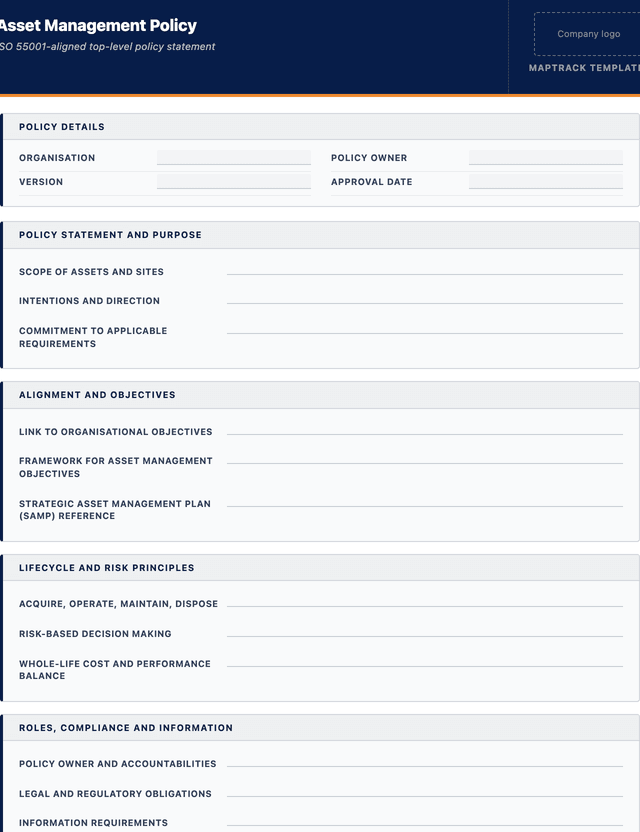
This asset management policy template covers 9 key areas:
- Purpose and scope: why the policy exists and which assets, sites, business units and functions it covers.
- Alignment to organisational objectives: how asset management supports the wider strategy and stated organisational goals.
- Strategic asset management plan link: how the policy connects to the SAMP and the objectives and plans that flow from it.
- Asset management principles: the value, alignment, leadership and assurance themes that guide day-to-day decisions.
- Lifecycle approach: a commitment to managing assets across acquire, operate, maintain and dispose stages.
- Risk-based decision making: how risk, whole-life cost and performance are balanced when choices are made.
- Compliance and information requirements: applicable legal, regulatory and data obligations the organisation will satisfy.
- Roles and responsibilities: who owns the policy, who maintains the system and who is accountable for assets.
- Review and approval: the commitment to continual improvement plus sign-off, version and review-date details.
How to use this asset management policy template
- Confirm context and scope: Work with top management to define which assets, sites and functions the policy will cover and how it relates to the wider organisational strategy. Capture the stakeholders and applicable obligations early so the policy reflects real operating context rather than generic wording.
- Draft the policy statement: Write a concise statement that suits the purpose of the organisation, references the principles you will follow, and commits to meeting applicable requirements and to continual improvement. Keep it brief and durable so the detail can live in the SAMP and supporting procedures instead.
- Link to objectives and the SAMP: Show how the policy provides a framework for setting asset management objectives and how those objectives trace back to organisational goals through the strategic asset management plan. This alignment is what auditors and leaders look for when judging whether the system holds together.
- Assign roles and approval: Name the policy owner, the people accountable for assets and the function that maintains the asset management system. Route the draft to top management for formal approval, because under ISO 55001 leadership ownership of the policy is an explicit requirement, not an optional extra.
- Communicate and schedule review: Publish the approved policy, make it available to interested parties and brief teams on what it means for their work. Record a version number and a planned review date so the document stays current and the continual improvement commitment is demonstrably honoured over time.
In MapTrack, you can manage your full asset register digitally. Each submission is stored as a timestamped PDF against the asset record.
Get the free templateEnter your email above to download the full asset management policy template as a PDF.Back to download formHow often should you complete this policy?
Review the asset management policy at least once a year, and always as part of any management review of the asset management system. An annual cadence keeps the document aligned with current organisational objectives, risk appetite and regulatory obligations, and gives top management a regular point to reaffirm their commitment. Many organisations tie the policy review to their planning cycle so any change in strategy flows straight into the SAMP and supporting plans.
Trigger an out-of-cycle review whenever something material changes. A new strategic direction, a merger or restructure, a significant incident, a shift in legal or regulatory requirements, or a major change to the asset portfolio can all make the existing wording stale. Treat each review as a chance to confirm the policy still suits the purpose of the organisation, then re-approve and re-issue it with an updated version and date.
Frequently asked questions
Applicable regulatory standards
This template is a starting point. Check the current requirements that apply to your equipment, work and location. The template alone does not establish compliance.
- ISO 55000:2024 (Asset management - Overview, principles and terminology)
- ISO 55001:2024 (Asset management - Management systems - Requirements)
- ISO 55002:2018 (Asset management - Guidelines for the application of ISO 55001)
Check the current source
Asset management policy template preview
The numbers behind this asset management policy template
Every figure below is sourced and dated, so you can quote it in a toolbox talk, a budget case or a board paper without having to chase the original report.
Embed this free template on your website
Run an industry blog, trade association site, or training resource? Drop a preview of this free asset management policy template straight into your page. The snippet is self-contained, needs no scripts, and links readers back to the full free template.
<div style="max-width:480px;font-family:system-ui,-apple-system,'Segoe UI',Roboto,sans-serif;border:1px solid #E5E7EB;border-radius:12px;padding:20px;background:#ffffff;">
  <p style="font-size:12px;font-weight:700;letter-spacing:0.05em;text-transform:uppercase;color:#071D49;margin:0;">Free template</p>
  <p style="font-size:18px;font-weight:700;color:#071D49;margin:6px 0 0;">Asset management policy template</p>
  <ul style="margin:12px 0 0;padding-left:18px;color:#374151;font-size:14px;line-height:1.6;">
    <li style="margin:4px 0;">Purpose and scope: why the policy exists and which assets, sites, business units and functions it covers.</li>
    <li style="margin:4px 0;">Alignment to organisational objectives: how asset management supports the wider strategy and stated organisational goals.</li>
    <li style="margin:4px 0;">Strategic asset management plan link: how the policy connects to the SAMP and the objectives and plans that flow from it.</li>
    <li style="margin:4px 0;">Asset management principles: the value, alignment, leadership and assurance themes that guide day-to-day decisions.</li>
    <li style="margin:4px 0;">Lifecycle approach: a commitment to managing assets across acquire, operate, maintain and dispose stages.</li>
    <li style="margin:4px 0;">Risk-based decision making: how risk, whole-life cost and performance are balanced when choices are made.</li>
  </ul>
  <p style="font-size:13px;color:#6B7280;margin:14px 0 0;padding-top:12px;border-top:1px solid #E5E7EB;">Free <a href="https://www.maptrack.com/templates/asset-management-policy-template" style="color:#071D49;font-weight:600;text-decoration:none;">Asset management policy template</a> by MapTrack</p>
</div>Free to reuse, including commercially. This template is published under a Creative Commons Attribution 4.0 licence. Copy it, adapt it, put it on your own site or in your own docs. All we ask is that you credit MapTrack with a link back to this page. The snippet above already includes that credit, so if you use it as-is you’re covered.
Cite this template
Writing about this topic? You’re welcome to quote this checklist. Here’s the wording to use so your readers can find the original.
- Short attribution
- MapTrack Asset management policy template, https://www.maptrack.com/templates/asset-management-policy-template
- Reference list
- MapTrack. (2026). Asset management policy template [Checklist template]. Retrieved from https://www.maptrack.com/templates/asset-management-policy-template
Free to reuse with credit under a Creative Commons Attribution 4.0 licence. If you’d rather link straight to it, the page is https://www.maptrack.com/templates/asset-management-policy-template.
Need to manage your full asset register digitally?
Register every asset in MapTrack, attach digital forms, and get a complete history of every inspection, service and compliance record.