
Free ISO 14001 environmental audit checklist
Free ISO 14001:2015 internal audit checklist (PDF-ready). Covers environmental aspects, compliance obligations, operational control and emergency preparedness.
Updated 10 Aug 2026
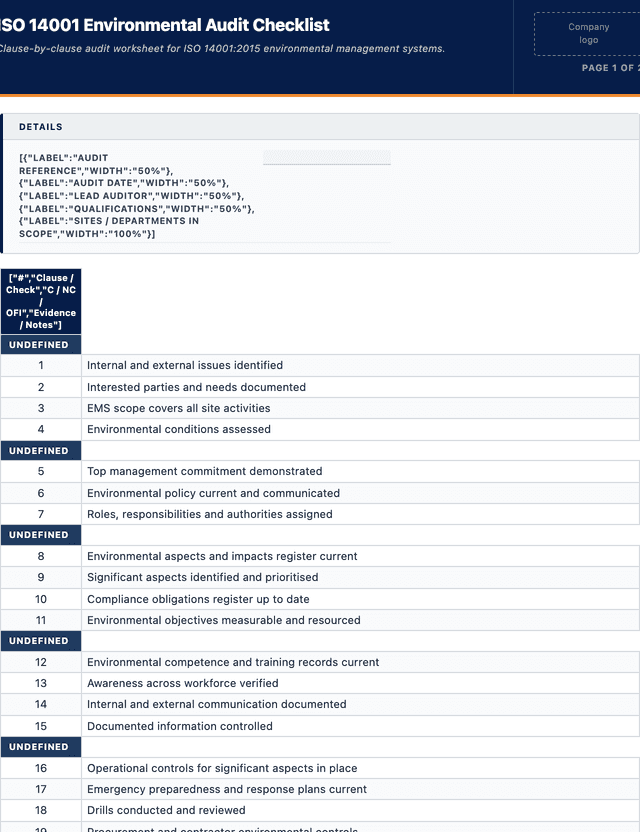
ISO 14001 Environmental Audit Checklist
Clause-by-clause audit worksheet for ISO 14001:2015 environmental management systems.
Context of the organisation
Leadership
Planning: aspects & obligations
Support: competence & communication
Operation & emergency preparedness
Performance evaluation
Improvement
Audit summary
How to use: download the PDF, print or complete digitally on any device.
- PDF format, ready to print or fill on screen
- Use as-is or customise to suit your operation
- Go digital in MapTrack for photos, reminders and audit trails
Two ways to use it
Use in MapTrack →Use it digitally instead
Unlimited usersUpload this PDF and MapTrack drafts the form for you.




- Scan the asset’s QR tag with any phone
- Submitted forms can trigger alerts
- Photos on fails, audit-ready records
- Export responses, PDF reports with your logo
Free trial. No credit card needed.
Trusted by teams across Australia and New Zealand
We respect your privacy. Unsubscribe anytime.
These templates are free general guides provided as-is. They do not constitute legal, safety or compliance advice. You are responsible for ensuring any form meets your specific workplace obligations, industry standards and applicable regulations.
Don't just download it - use it live. Start a free workspace, upload this ISO 14001 environmental audit checklist and MapTrack drafts it as a form your crew can run from a phone.

Co-Founder & Commercial Director
Key takeaways
- The MapTrack ISO 14001 environmental audit checklist contains 30 checks across 8 sections. Sections covered: Context of the organisation, Leadership, Planning: aspects & obligations, Support: competence & communication, Operation & emergency preparedness, Performance evaluation, Improvement, Audit summary.
Enter your email below to download this ISO 14001 environmental audit checklist as a ready-to-use PDF.
Used by construction, mining and field service teams









What is an ISO 14001 environmental audit checklist?
An ISO 14001 environmental audit checklist is a structured worksheet used by environmental compliance officers and EMS coordinators to internally audit an environmental management system against ISO 14001:2015. The checklist translates each clause of the standard into a specific environmental prompt: identifying significant aspects and impacts across emissions, discharges, waste and resource use; verifying that the compliance obligations register reflects current permits and legislation; checking operational controls for the most significant aspects (bunding, segregation, signage, training); reviewing emergency preparedness for spills, fires, chemical releases and natural disasters; and confirming that monitoring and measurement is producing the performance data required for management review.
Clause 9.2 of the standard requires the organisation to conduct internal audits at planned intervals so the EMS can be confirmed as conformant and effective. Auditors apply the same ISO 19011:2018 audit principles used for quality and OH&S audits, but the evidence base is different. Where the ISO 9001 audit centres on customer satisfaction and product conformity, and the ISO 45001 audit centres on workplace hazards and worker participation, the ISO 14001 audit centres on environmental aspects, legal compliance, pollution prevention and continual improvement of environmental performance. This checklist gives environmental teams a consistent way to surface findings before certification body surveillance audits and feed the corrective action register with clause-referenced environmental nonconformities.
Learn more about compliance and inspections in MapTrack.
Benefits of using this ISO 14001 environmental audit checklist
- Environmental aspects coverage: structured prompts ensure every significant environmental aspect (emissions, discharges, waste, resource use, land contamination, biodiversity) is examined under clause 6.1.2 rather than only the most visible aspects.
- Compliance obligations check: clause 6.1.3 prompts confirm the legal and other requirements register is current, applicable to operations, monitored for changes and evidenced through compliance evaluation under clause 9.1.2.
- Operational control verification: clause 8.1 prompts test that controls for significant aspects (procedures, training, signage, equipment, monitoring) are documented, communicated and effective in the field rather than just on paper.
- Emergency preparedness assurance: clause 8.2 prompts verify that emergency response plans cover credible scenarios, drills are conducted, equipment is maintained and lessons learned feed back into the EMS.
- Certification readiness: regular internal audits using this checklist surface nonconformities before the certification body does, giving the organisation time to close out actions ahead of surveillance audits.
- Performance trend visibility: clause 9.1 prompts ensure monitoring and measurement data is being collected, analysed and reported against environmental objectives so the EMS demonstrates measurable improvement.
- Risk and opportunity alignment: clause 6.1.1 prompts assess that environmental risks and opportunities are identified, prioritised and addressed through documented action plans linked to objectives across the EMS.
Benefits of digitising forms in MapTrack
When you move your checklists from paper to MapTrack, you get:
- Field users can easily scan a QR code to complete a form on mobile. Unlimited users.
- Email the right people when a form is submitted, with an automation you set up.
- File every completed form against the asset, location or person it covers.
- Download any completed form as a PDF, with failed answers listed at the top.
- Fill in forms offline; they upload when the device is back online.
- Build conditional logic (show or hide questions based on answers).
- Take pictures or attach photos. Not possible with a paper-based form.
- Electronic signatures.
- Edit forms later without reprinting.
- Set who can view, fill in or edit forms with user roles.
- Upload a paper form (PDF, Word, Excel or a photo) and MapTrack's AI builds a digital version for you to check.
- Assign audits and send reminder emails to the people doing them.
- Keep every audit, inspection and sign-off against the asset or site it covers.
- Track corrective actions as work orders from finding to close-out, with each change in the activity log.
Book a demo to see how MapTrack handles checklists.
Try MapTrack free for 30 days
Full access to every feature. No credit card required. Per-asset pricing so you scale as your fleet grows.
- No credit card required
- 30 days free trial
- Cancel anytime
1-2 days/week saved
“Bloody amazing! We used to spend 1-2 days a week tracking and managing our generators alone.”

Steve McAllister
Asset Coordinator, Saunders International
What to include in an ISO 14001 environmental audit checklist
This ISO 14001 environmental audit checklist covers 11 key areas:
- Audit header: audit reference number, audit date or audit period, lead auditor name and qualifications, audit team members, departments or sites in scope and the previous audit reference.
- Clause 4 (Context): internal and external issues affecting environmental performance, interested parties and their needs, EMS scope including environmental conditions affected.
- Clause 5 (Leadership): top management commitment to environmental performance, environmental policy adequacy and communication, organisational roles and responsibilities for the EMS.
- Clause 6 (Planning): environmental risks and opportunities, identification and evaluation of significant environmental aspects and impacts, compliance obligations register, environmental objectives and action plans.
- Clause 7 (Support): resources for the EMS, competence (including environmental training for operational roles), awareness across the workforce, internal and external communication, documented information control.
- Clause 8 (Operation): operational planning and control of significant aspects, emergency preparedness and response, management of change, procurement and contractor environmental controls.
- Clause 9 (Performance evaluation): environmental monitoring and measurement programme, compliance evaluation, internal audit programme, management review inputs and outputs.
- Clause 10 (Improvement): nonconformity and corrective action register, continual improvement evidence linked to environmental performance.
- Conformity status per item: conforms, minor nonconformity, major nonconformity, opportunity for improvement, not applicable.
- Evidence reviewed: aspects and impacts register, compliance register, monitoring records, permits, licences, training records, drill reports, interviews.
- Audit summary: total findings by category, follow-up actions, agreed close-out dates, next audit date and sign-off by auditor and auditee EMS representative.
How to use this ISO 14001 environmental audit checklist
- Prepare the audit plan and complete the header: review the previous internal and external audit reports, open environmental corrective actions, incident and spill reports, permit compliance status and any environmental complaint records before scheduling the on-site activity.
- Audit clause 4 (Context) and clause 5 (Leadership): interview top management to confirm they can articulate the environmental policy and their role, examine the documented context including environmental conditions and interested parties, and verify EMS scope coverage matches site operations.
- Audit clause 6 (Planning) including aspects and compliance: examine the environmental aspects and impacts register for completeness across emissions, discharges, waste, resource use and land impacts, check the compliance obligations register against current permits and legislation, and verify environmental objectives have action plans.
- Audit clause 7 (Support) and clause 8 (Operation): review competence and environmental training records for operational roles, walk the site to verify operational controls (signage, bunds, spill kits, waste segregation) for the significant aspects, and trace the management of change process for any recent operational changes.
- Audit clause 8.2 (Emergency preparedness): review emergency response plans for spill, fire, chemical release and natural disaster scenarios, examine drill records and outcomes, interview operational staff to confirm they know their emergency roles and inspect emergency equipment for condition and currency.
- Audit clause 9 (Performance evaluation): review monitoring and measurement data for the significant aspects, examine compliance evaluation records, check the internal audit programme coverage and examine management review minutes for evidence that environmental performance, compliance status and improvement opportunities are addressed.
- Hold the closing meeting and document findings: present findings by category, agree corrective action owners and target dates, confirm the next audit date and obtain signatures from the lead auditor and the auditee EMS representative.
In MapTrack, you can automate compliance tracking and audit trails. Each submission is stored as a timestamped PDF against the asset record.
Get the free templateEnter your email above to download the full ISO 14001 environmental audit checklist as a PDF.Back to download formHow often should you complete this checklist?
ISO 14001:2015 clause 9.2 requires internal audits to be conducted at planned intervals but does not specify a fixed frequency. Most organisations audit the entire EMS at least once per calendar year, with high environmental risk areas, recently-changed processes or sites with previous nonconformities audited every six months. The internal audit programme should consider the environmental significance of activities, changes affecting the organisation and the results of previous internal and external audits.
Certification bodies typically expect at least one complete internal audit cycle between surveillance audits, so organisations on a three-year certification cycle generally complete a full EMS audit programme each year. Newly implemented EMS, organisations following major operational change or sites with recent environmental incidents should audit more frequently until the system is mature and the corrective actions are verified effective. The audit programme itself should be reviewed annually as part of management review.
Frequently asked questions
Applicable regulatory standards
This template is a starting point. Check the current requirements that apply to your equipment, work and location. The template alone does not establish compliance.
- ISO 14001:2015 Clause 9.2
- ISO 14001:2015 Clause 6.1.2
- ISO 14001:2015 Clause 8.2
- ISO 19011:2018
ISO 14001 environmental audit checklist preview
The numbers behind this ISO 14001 environmental audit checklist
Every figure below is sourced and dated, so you can quote it in a toolbox talk, a budget case or a board paper without having to chase the original report.
Embed this free template on your website
Run an industry blog, trade association site, or training resource? Drop a preview of this free ISO 14001 environmental audit checklist straight into your page. The snippet is self-contained, needs no scripts, and links readers back to the full free template.
<div style="max-width:480px;font-family:system-ui,-apple-system,'Segoe UI',Roboto,sans-serif;border:1px solid #E5E7EB;border-radius:12px;padding:20px;background:#ffffff;">
  <p style="font-size:12px;font-weight:700;letter-spacing:0.05em;text-transform:uppercase;color:#071D49;margin:0;">Free template</p>
  <p style="font-size:18px;font-weight:700;color:#071D49;margin:6px 0 0;">ISO 14001 environmental audit checklist</p>
  <ul style="margin:12px 0 0;padding-left:18px;color:#374151;font-size:14px;line-height:1.6;">
    <li style="margin:4px 0;">Audit header: audit reference number, audit date or audit period, lead auditor name and qualifications, audit team members, departments or sites in scope and the previous audit reference.</li>
    <li style="margin:4px 0;">Clause 4 (Context): internal and external issues affecting environmental performance, interested parties and their needs, EMS scope including environmental conditions affected.</li>
    <li style="margin:4px 0;">Clause 5 (Leadership): top management commitment to environmental performance, environmental policy adequacy and communication, organisational roles and responsibilities for the EMS.</li>
    <li style="margin:4px 0;">Clause 6 (Planning): environmental risks and opportunities, identification and evaluation of significant environmental aspects and impacts, compliance obligations register, environmental objectives and action plans.</li>
    <li style="margin:4px 0;">Clause 7 (Support): resources for the EMS, competence (including environmental training for operational roles), awareness across the workforce, internal and external communication, documented information control.</li>
    <li style="margin:4px 0;">Clause 8 (Operation): operational planning and control of significant aspects, emergency preparedness and response, management of change, procurement and contractor environmental controls.</li>
  </ul>
  <p style="font-size:13px;color:#6B7280;margin:14px 0 0;padding-top:12px;border-top:1px solid #E5E7EB;">Free <a href="https://www.maptrack.com/templates/iso-14001-environmental-audit-checklist" style="color:#071D49;font-weight:600;text-decoration:none;">ISO 14001 environmental audit checklist</a> by MapTrack</p>
</div>Free to reuse, including commercially. This template is published under a Creative Commons Attribution 4.0 licence. Copy it, adapt it, put it on your own site or in your own docs. All we ask is that you credit MapTrack with a link back to this page. The snippet above already includes that credit, so if you use it as-is you’re covered.
Cite this template
Writing about this topic? You’re welcome to quote this checklist. Here’s the wording to use so your readers can find the original.
The MapTrack ISO 14001 environmental audit checklist contains 30 checks across 8 sections.
- Short attribution
- MapTrack ISO 14001 environmental audit checklist, https://www.maptrack.com/templates/iso-14001-environmental-audit-checklist
- Reference list
- MapTrack. (2026). ISO 14001 environmental audit checklist [Checklist template]. Retrieved from https://www.maptrack.com/templates/iso-14001-environmental-audit-checklist
Free to reuse with credit under a Creative Commons Attribution 4.0 licence. If you’d rather link straight to it, the page is https://www.maptrack.com/templates/iso-14001-environmental-audit-checklist.
Need to automate compliance tracking and audit trails?
Register every asset in MapTrack, attach digital forms, and get a complete history of every inspection, service and compliance record.
Compliance and inspections · All templates · Pricing · Book a demo