
Free template · PDF + XLSX
Free 8D report template
Free 8D report template in Excel (XLSX) and printable PDF. Work D1 to D8, prove root cause and the escape point, and close corrective actions. Download the 8D free.
Loading PDF page...
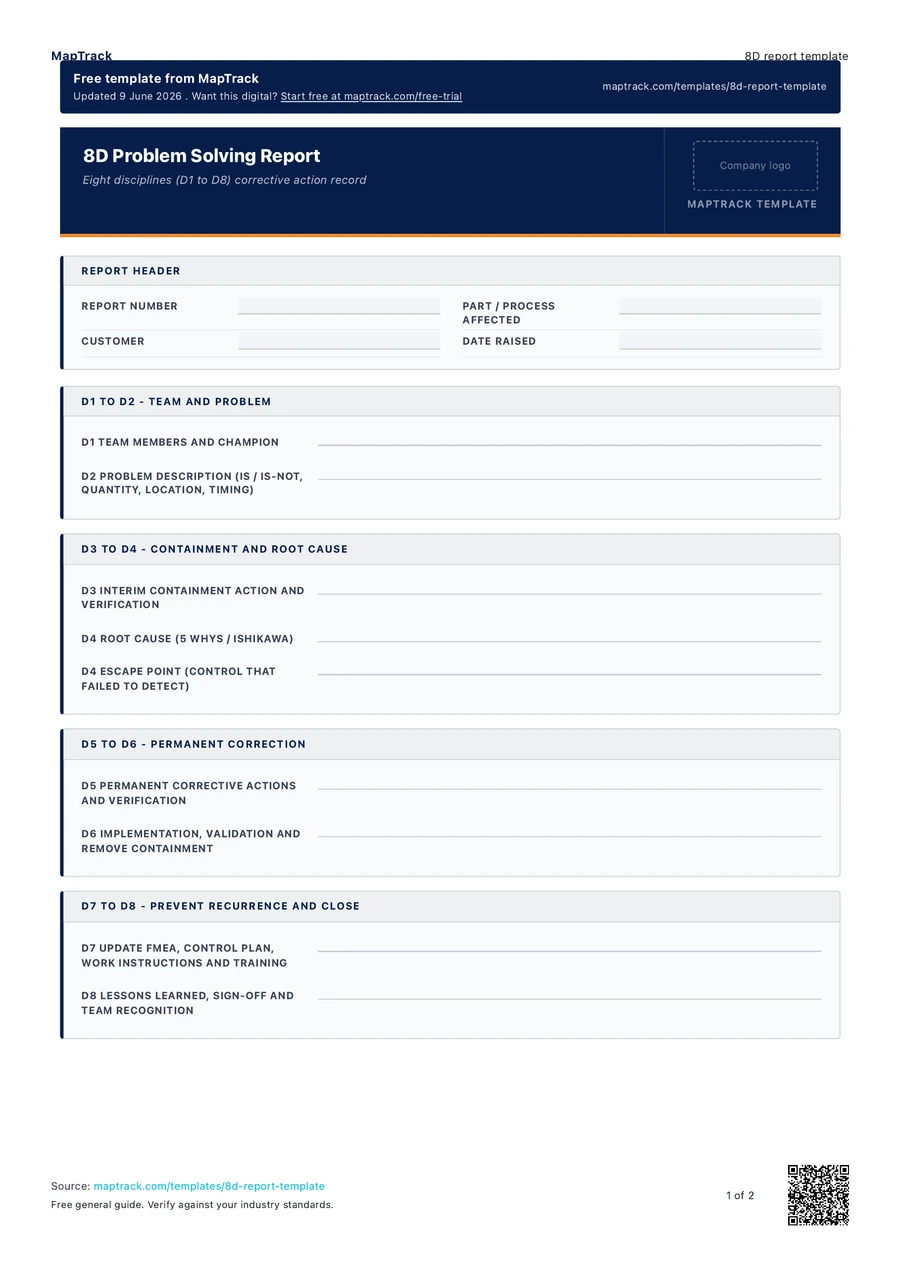

Read the form fields
Eight disciplines (D1 to D8) corrective action record
5 sections
The fields in the printable form, in a view that fits your screen.
Report Header
- Report number
- Part / process affected
- Customer
- Date raised
D1 to D2 - Team and problem
- D1 team members and champion
- D2 problem description (is / is-not, quantity, location, timing)
D3 to D4 - Containment and root cause
- D3 interim containment action and verification
- D4 root cause (5 Whys / Ishikawa)
- D4 escape point (control that failed to detect)
D5 to D6 - Permanent correction
- D5 permanent corrective actions and verification
- D6 implementation, validation and remove containment
D7 to D8 - Prevent recurrence and close
- D7 update FMEA, control plan, work instructions and training
- D8 lessons learned, sign-off and team recognition
Completed by
Signature · Print name · Role · Date
Reviewed / approved by
Signature · Print name · Role · Date

Make this form your own
Add your fields and logo. Give your team a form they can use on site.
Free 30-day trial. No credit card. Work email needed.
Upload & use this form now for free



“MapTrack beat them all in every aspect.”
 Vincent Stone · HSEQ Advisor, Concept Tanks
After signup: upload this PDF, check the form MapTrack drafts, then save and publish it for your team.
General guidance only. Check the form against your equipment manual, site procedures and local requirements before using it.
Key takeaways
- 8D runs eight disciplines, D1 to D8, from team and problem through containment, root cause and permanent prevention.
- D3 containment shields the customer fast while the slower root-cause work continues.
- D4 must verify both the root cause and the escape point that failed to detect the defect.
- D7 makes the fix systemic by updating the FMEA, control plan, work instructions and training.
- Automotive customers often require an 8D, with containment frequently expected inside 24 hours.
What is an 8D report template?
The Eight Disciplines, known as 8D, is a structured, team-based method for solving recurring or high-severity problems and proving the fix held. It runs through eight numbered steps, D1 to D8, and an optional planning step D0, taking a team from the first symptom all the way to a verified permanent correction. Ford created the approach as Team Oriented Problem Solving in 1987 and later refined it into Global 8D, and it is now the default corrective-action language across the automotive supply chain.
An 8D report is the document that records each discipline as the team works it: who is on the team, a quantified problem statement, the interim containment that shielded the customer, the verified root cause and escape point, the chosen permanent corrections, proof they were implemented and effective, the systemic changes that stop recurrence, and recognition for the people who delivered the result. Because every step is evidenced, the finished report doubles as an audit trail a customer or assessor can follow.
Learn more about compliance and inspections in MapTrack.
Choose the format that fits your team
Download the PDF
Use the original printable form for a paper workflow. Check it against your equipment and site procedure before the job.
Keep completed copies in your own record system and arrange any follow-up through your normal process.
Download free PDFCustomise a form in MapTrack
Start a free trial, upload this PDF and MapTrack drafts the form. Adjust it to your workflow, then save and publish it for your team to use.
Sample answers on this page and completed PDF records aren't imported automatically.
Upload & use this form now for freeFree 30-day trial. No credit card. Work email needed.
Available files
- 8D report template Excel workbook (XLSX)
Editable one-sheet workbook with the same header block, D1 to D8 fields and two sign-off blocks as the PDF, for teams that work the 8D on screen.
Benefits of using this 8D report template
- Structure: the eight disciplines give every responder the same disciplined path from symptom to verified fix.
- Customer credibility: a complete 8D is the format most automotive and OEM customers expect after a complaint.
- Real root cause: D4 forces the team past the symptom to the true cause and the escape point that let it through.
- Containment first: D3 protects the customer with interim action while the slower root-cause work continues.
- Prevention built in: D7 updates the FMEA, control plan and work instructions so the same failure cannot return.
- Auditable evidence: each discipline is recorded, so the report satisfies corrective-action records expected by assessors.
What to include in an 8D report template
- Header block: report number, part or process affected, customer, dates raised and due, and current 8D status
- D1 team: members, roles, the champion or sponsor, and the skills the problem demands
- D2 problem description: a quantified statement using is and is-not, with quantity, location and timing
- D3 interim containment: the action that shields the customer, who verified it, and how effectiveness was checked
- D4 root cause and escape point: the verified cause plus the control that should have detected the defect but did not
- D5 permanent corrective actions: the chosen corrections, with the verification that proves each will resolve the cause
- D6 implementation and validation: implementation dates, ongoing controls, and evidence the actions work in production
- D7 prevent recurrence: updates to FMEA, control plan, standards and training, rolled across similar parts and lines
- D8 closure and recognition: lessons learned, sign-off, and recognition of the team that delivered the result
How to use this 8D report template
Stand up the team and describe the problem (D1 to D2)
Form a small cross-functional team with the right process knowledge and a clear champion, then write a fact-based problem statement. Quantify it with is and is-not analysis covering what, where, when and how many, so everyone is solving the same defined problem rather than a vague complaint.
Contain the problem to protect the customer (D3)
Put interim containment in place straight away so no further defective product reaches the customer while the investigation runs. Typical actions are sorting, rework, additional inspection or replacement shipments, and you must verify the containment actually works and record who confirmed it.
Find and verify root cause and escape point (D4)
Use tools such as five whys and an Ishikawa or fishbone diagram to drive past symptoms to the true cause, and verify it with data rather than opinion. Also identify the escape point, the earliest control that should have caught the defect but failed, because both have to be fixed.
Choose, verify and implement permanent corrections (D5 to D6)
Select permanent corrective actions that address the verified root cause and the escape point, and confirm through trials or analysis that each will work without new side effects. Implement them, remove the interim containment, and validate with production evidence that the problem has genuinely stopped.
Make it systemic and recognise the team (D7 to D8)
Prevent recurrence by updating the FMEA, control plan, work instructions and training, and apply the lessons to similar parts, processes and lines. Close the report with documented lessons learned and formal sign-off, then recognise the contributors so the discipline is reinforced for the next problem.
How often should you complete this report?
An 8D is event-driven, not scheduled. You raise one when a significant problem appears: a customer complaint or reject, a repeated internal nonconformity, a safety or regulatory concern, or a warranty trend that a quick fix will not settle. Lower-risk issues can use a lighter tool such as five whys or a simple corrective action form, because not every nonconformity justifies a full eight-discipline investigation.
The pace inside an open 8D matters more than the calendar. Many automotive customers expect interim containment and an initial response within roughly 24 hours, a verified root cause and corrective-action plan within several working days, and full closure within about 30 days, though the exact deadlines come from each customer specific requirement. Treat those as the rhythm to confirm against your own customer rather than fixed universal rules.
Make this form your own
From your template to your team.
Upload this PDF and MapTrack drafts the form. Adjust it for your equipment and site, then save and publish the digital form for your team.
- 01
Start your free trial
Use your work email to create your MapTrack account.
- 02
Customise, save and publish
Adjust the template fields and branding for your site.
- 03
Complete it on the job
Record checks, add photos and export a branded PDF.
Keep working offline
Load the form before you lose reception. Complete it offline and sync when you're back online.
Scan the asset. Open its form.
Use an asset's QR code to find and complete the forms that belong to it.
Show what you found
Capture photos and attach files so the next person has the details they need.
Take a branded PDF with you
Download completed forms as PDF reports with your company logo.
Completed paper records aren't imported automatically.
Frequently asked questions
Practical answers about the form, record keeping and using MapTrack.
IATF 16949 does not name 8D in its own text, but it requires structured problem solving and corrective action that eliminates root cause under the standard. The 8D requirement usually arrives through customer-specific requirements: major OEMs such as Ford mandate the 8D format for supplier corrective actions, and those documents are treated as part of the standard. So in practice, if you supply automotive customers, an 8D is very often the expected response to a complaint, and the report becomes part of your corrective-action records.
Link to this answerISO 9001 Clause 10.2 covers nonconformity and corrective action, which the standard defines as action to eliminate the cause of a nonconformity and to prevent recurrence. The 8D disciplines map cleanly onto that requirement. D3 controls and corrects, D4 establishes and verifies the cause, D5 and D6 implement and validate the action, and D7 checks for similar problems and prevents recurrence. Using 8D is a practical way to generate corrective-action evidence for Clause 10.2.
Link to this answerThe escape point is the earliest control in your process that should have detected the defect but failed to do so, and it sits alongside the root cause in D4. The root cause explains why the defect was created; the escape point explains why it was not caught before it reached the customer. A complete 8D fixes both. If you only address the cause and ignore the escape point, your detection system stays blind, so the next similar defect can still slip through undetected to the customer.
Link to this answerFive whys is a single root-cause technique, and it is used inside D4 of an 8D rather than being a competitor to it. An A3 is a one-page problem-solving story on Toyota lines, strong for communication and lean improvement. The 8D is heavier and more formal: eight defined disciplines, mandatory containment, explicit escape-point analysis, and systemic prevention, which is why it is the automotive standard for customer complaints. Pick five whys for quick issues, A3 for lean storytelling, and 8D when a customer or severity demands rigour.
Link to this answerYes. This 8D report template is completely free, with no account or sign-up required. Download the Excel (XLSX) version to fill in on screen, or print the PDF for the team room and review meetings. If you run many investigations and want them tracked, assigned and auditable instead of scattered across files, MapTrack turns checklists like this into digital forms with assets, due dates and a full corrective-action history. Start free or book a demo to see how.
Link to this answerOpen one the moment a problem is significant enough to justify a team: a customer reject, a repeat nonconformity or a safety concern. Name the team and champion (D1), write a quantified is and is-not problem statement (D2), put interim containment in place so no more defective product leaves (D3), verify the root cause and the escape point that failed to catch it (D4), choose and prove the permanent corrections (D5), implement them and confirm the problem has gone (D6), update the FMEA, control plan and work instructions so it cannot return (D7), then close and recognise the team (D8). Record each discipline in the report as you go, so it stands as an audit trail.
Link to this answerTwo failures show up far more often than a wrong root cause. The first is skipping real containment at D3 because the team is confident of a quick fix, so defective product keeps reaching the customer while the investigation runs. The second is closing at D6 as soon as production looks clean without doing D7, so the FMEA, control plan and work instructions never change and the same failure mode returns months later on a sister part. Treat containment as non-negotiable on day one and treat D7 as the point of the exercise. A third is a vague D2: if the problem is never quantified, the team ends up solving a symptom.
Link to this answerYes. An 8D form, 8D report, 8D format, 8D worksheet and D8 report all describe the same document: the record of the eight disciplines as a team works them, from the D1 team through to D8 closure. Some companies call the blank version a form or worksheet and the completed version a report, and others use one word for both. Supplier quality manuals and customer portals across the automotive supply chain use any of these names. Whatever it is called, the content is the same header block plus eight numbered sections, and this template follows that structure so it can be submitted wherever an 8D is requested.
Link to this answerApplicable regulatory standards
This form is a starting point. Check the current requirements that apply to your equipment, work and location. The form alone does not establish compliance.
- IATF 16949:2016 - automotive quality management system standard; OEM customer-specific requirements routinely mandate the 8D format for corrective action reporting
- AIAG core tools (FMEA, Control Plan, PPAP) - the references an 8D updates at D7 to make a fix systemic
- ISO 9001 Clause 10.2 - nonconformity and corrective action
- Ford Global 8D (G8D) - the modern eight-discipline standard derived from Ford Team Oriented Problem Solving (TOPS), first published in 1987
MapTrack publishes this template. The linked authorities publish their own guidance; they haven't endorsed this form.
The numbers behind this 8D report template
Every figure below is sourced and dated, so you can quote it in a toolbox talk, a budget case or a board paper without having to chase the original report.
Cite this template
Writing about this topic? You’re welcome to quote this checklist. Here’s the wording to use so your readers can find the original.
- Short attribution
- MapTrack 8D report template, https://www.maptrack.com/templates/8d-report-template
- Reference list
- MapTrack. (2026). 8D report template [Checklist template]. Retrieved from https://www.maptrack.com/templates/8d-report-template
Free to reuse with credit under a Creative Commons Attribution 4.0 licence. If you’d rather link straight to it, the page is https://www.maptrack.com/templates/8d-report-template.
Embed this free template on your website
Run an industry blog, trade association site, or training resource? Drop a preview of this free 8D report template straight into your page. The snippet is self-contained, needs no scripts, and links readers back to the full free template.
<div style="max-width:480px;font-family:system-ui,-apple-system,'Segoe UI',Roboto,sans-serif;border:1px solid #E5E7EB;border-radius:12px;padding:20px;background:#ffffff;">
  <p style="font-size:12px;font-weight:700;letter-spacing:0.05em;text-transform:uppercase;color:#071D49;margin:0;">Free template</p>
  <p style="font-size:18px;font-weight:700;color:#071D49;margin:6px 0 0;">8D report template</p>
  <ul style="margin:12px 0 0;padding-left:18px;color:#374151;font-size:14px;line-height:1.6;">
    <li style="margin:4px 0;">Header block: report number, part or process affected, customer, dates raised and due, and current 8D status</li>
    <li style="margin:4px 0;">D1 team: members, roles, the champion or sponsor, and the skills the problem demands</li>
    <li style="margin:4px 0;">D2 problem description: a quantified statement using is and is-not, with quantity, location and timing</li>
    <li style="margin:4px 0;">D3 interim containment: the action that shields the customer, who verified it, and how effectiveness was checked</li>
    <li style="margin:4px 0;">D4 root cause and escape point: the verified cause plus the control that should have detected the defect but did not</li>
    <li style="margin:4px 0;">D5 permanent corrective actions: the chosen corrections, with the verification that proves each will resolve the cause</li>
  </ul>
  <p style="font-size:13px;color:#6B7280;margin:14px 0 0;padding-top:12px;border-top:1px solid #E5E7EB;">Free <a href="https://www.maptrack.com/templates/8d-report-template" style="color:#071D49;font-weight:600;text-decoration:none;">8D report template</a> by MapTrack</p>
</div>Free to reuse, including commercially. This template is published under a Creative Commons Attribution 4.0 licence. Copy it, adapt it, put it on your own site or in your own docs. All we ask is that you credit MapTrack with a link back to this page. The snippet above already includes that credit, so if you use it as-is you’re covered.
About the author

Co-Founder & Commercial Director
Jarrod has spent over a decade in technology consulting and asset management, including roles at Accenture (mining and heavy industry) and CGI as an Asset Management Consultant. He co-founded MapTrack and built and scaled its original platform, then rebuilt it with Lachlan and Alex from thousands of customer conversations and 300+ user research sessions with field teams. His consulting background gives him deep insight into the operational and compliance challenges facing asset-intensive Australian businesses.
View LinkedIn profile →Ready for your next job?
Keep the PDF handy, or upload it to MapTrack and turn it into a digital form for your team.