
Free DMAIC project charter
Free DMAIC project charter template (PDF-ready). Define a Six Sigma improvement: problem, goal, scope, team, metrics and timeline.
Updated 28 Sept 2026
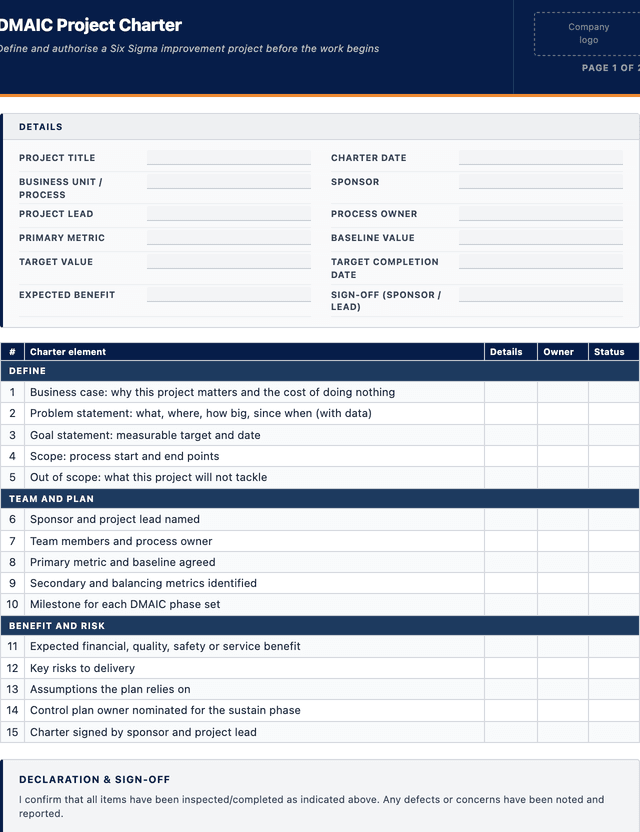
DMAIC Project Charter
Define and authorise a Six Sigma improvement project before the work begins
DEFINE
TEAM AND PLAN
BENEFIT AND RISK
How to use: download the PDF, print or complete digitally on any device.
- PDF format, ready to print or fill on screen
- Use as-is or customise to suit your operation
- Go digital in MapTrack for photos, reminders and audit trails
Two ways to use it
Use in MapTrack →Use it digitally instead
Unlimited usersUpload this PDF and MapTrack drafts the form for you.




- Scan the asset’s QR tag with any phone
- Submitted forms can trigger alerts
- Photos on fails, audit-ready records
- Export responses, PDF reports with your logo
Free trial. No credit card needed.
Trusted by teams across Australia and New Zealand
We respect your privacy. Unsubscribe anytime.
These templates are free general guides provided as-is. They do not constitute legal, safety or compliance advice. You are responsible for ensuring any form meets your specific workplace obligations, industry standards and applicable regulations.
Don't just download it - use it live. Start a free workspace, upload this DMAIC project charter and MapTrack drafts it as a form your crew can run from a phone.

Co-Founder & Commercial Director
Key takeaways
- The MapTrack DMAIC project charter contains 15 checks across 3 sections. Sections covered: DEFINE, TEAM AND PLAN, BENEFIT AND RISK.
Enter your email below to download this DMAIC project charter as a ready-to-use PDF.
Used by construction, mining and field service teams






What is a DMAIC project charter?
A DMAIC project charter is a one to two page document that defines and authorises a structured improvement project before any work begins. DMAIC stands for Define, Measure, Analyse, Improve and Control, the five phases of the Six Sigma improvement method. The charter captures the business case for the project, the problem statement backed by data, the goal and the metric that will prove success, the scope and what is deliberately out of scope, the team and their roles, the sponsor, the key milestones and the expected benefit. It is the agreement between the improvement team and the sponsor about what the project will and will not tackle.
DMAIC is an improvement methodology, not a legislated standard, and this charter treats it that way. Its value is discipline: it forces a team to state the problem clearly and measurably before jumping to solutions, and it stops projects sprawling by fixing the scope and the goal up front. A good charter turns a vague ambition like reduce defects into a specific, bounded, measurable project with an owner and a deadline. Running improvement projects this way supports the continual improvement requirements of ISO 9001 clause 10 by documenting the opportunity, the objective, the actions and the control plan that holds the gain once the project closes.
Learn more about compliance and inspections in MapTrack.
Benefits of using this DMAIC project charter
- A clear problem, not a vague wish: forcing a measurable problem statement up front stops the team solving a symptom or the wrong problem entirely.
- Controlled scope: stating what is in and out of scope prevents the project sprawling into a general clean up that never finishes or delivers.
- Agreed success measure: defining the primary metric and its target means everyone knows what done looks like before the work starts.
- Sponsor alignment: a signed charter is the agreement between the team and the sponsor on goal, resources and timeline, reducing conflict later.
- Data before opinion: the Measure and Analyse framing anchors decisions in evidence rather than the loudest voice in the room.
- Sustained results: the Control phase and its plan lock the improvement into standard work so the gain does not quietly erode after the project ends.
Benefits of digitising forms in MapTrack
When you move from paper or static PDFs to digital forms in MapTrack, you get:
- Field users can easily scan a QR code to complete a form on mobile. Unlimited users.
- Email the right people when a form is submitted, with an automation you set up.
- File every completed form against the asset, location or person it covers.
- Download any completed form as a PDF, with failed answers listed at the top.
- Fill in forms offline; they upload when the device is back online.
- Build conditional logic (show or hide questions based on answers).
- Take pictures or attach photos. Not possible with a paper-based form.
- Electronic signatures.
- Edit forms later without reprinting.
- Set who can view, fill in or edit forms with user roles.
- Upload a paper form (PDF, Word, Excel or a photo) and MapTrack's AI builds a digital version for you to check.
- Assign audits and send reminder emails to the people doing them.
- Keep every audit, inspection and sign-off against the asset or site it covers.
- Track corrective actions as work orders from finding to close-out, with each change in the activity log.
Book a demo to see how MapTrack handles forms.
Try MapTrack free for 30 days
Full access to every feature. No credit card required. Per-asset pricing so you scale as your fleet grows.
- No credit card required
- 30 days free trial
- Cancel anytime
1-2 days/week saved
“Bloody amazing! We used to spend 1-2 days a week tracking and managing our generators alone.”

Steve McAllister
Asset Coordinator, Saunders International
What to include in a DMAIC project charter
This DMAIC project charter covers 10 key areas:
- Project title, charter date, and the business unit or process affected
- Business case: why this project matters and what it costs to leave the problem
- Problem statement: what is wrong, where, how big, and since when, backed by data
- Goal statement: the specific, measurable target and the date to reach it
- Primary metric and baseline, plus any secondary and balancing metrics
- Scope: the process start and end points, and what is explicitly out of scope
- Team and roles: sponsor, project lead, team members and process owner
- High-level plan: the key milestone for each DMAIC phase
- Expected benefit: financial, quality, safety or service improvement
- Risks, assumptions and the sign-off by the sponsor and project lead
How to use this DMAIC project charter
- Write the problem statement with data: State what is wrong, where it happens, how big it is and since when, using numbers rather than adjectives. A problem statement should describe the gap between current and desired performance without naming a cause or a solution, because fixing those too early narrows the project prematurely.
- Set a measurable goal: Turn the problem into a specific goal with a metric, a target and a date, for example reduce first-pass defect rate from twelve percent to four percent by the end of the quarter. If you cannot measure the goal, you cannot tell whether the project has worked, so refine it until it is measurable.
- Define the scope and boundaries: Fix the start and end points of the process you are improving and write down what is explicitly out of scope. This is the single most effective way to stop a project sprawling, because it gives the team and sponsor a clear line to point to when new problems get pulled in.
- Name the team and the sponsor: List the sponsor who authorises the work and clears obstacles, the project lead who runs it, the process owner who inherits the result, and the team members. Confirm each person knows the time commitment expected, because an under resourced improvement project stalls no matter how good the charter is.
- Agree milestones and sign off: Set a target date for the end of each DMAIC phase and the expected benefit, then have the sponsor and project lead sign the charter. The signatures make it a shared commitment rather than a wish list, and the phase milestones give a simple way to track whether the project is on schedule.
In MapTrack, you can automate compliance tracking and audit trails. Each submission is stored as a timestamped PDF against the asset record.
Get the free templateEnter your email above to download the full DMAIC project charter as a PDF.Back to download formHow often should you complete this form?
A charter is written once at the start of each improvement project, during the Define phase, and is then treated as a living reference that can be revised if the scope or goal legitimately changes with sponsor agreement. It is not a recurring form; you complete one per project.
Raise a DMAIC project when a problem is significant, its causes are not obvious, and data is available or can be gathered to understand it. For small, obvious fixes a lighter approach such as a kaizen or a simple A3 is usually faster and more appropriate. Reserve the full DMAIC discipline for problems worth the effort of measuring and analysing before acting.
Frequently asked questions
Applicable regulatory standards
This template is a starting point. Check the current requirements that apply to your equipment, work and location. The template alone does not establish compliance.
- ISO 9001:2026 clause 10 Improvement (including 10.1 continual improvement)
- Six Sigma DMAIC (Define, Measure, Analyse, Improve, Control) - a methodology, not a standard, so there is no standard number to cite
- PDCA / Deming cycle (Plan-Do-Check-Act) - a continuous-improvement method
- Model Work Health and Safety Act and Regulations, as enacted in each state and territory (in Victoria, the Occupational Health and Safety Act 2004 and OHS Regulations 2017) - where an improvement changes a work method with safety risk
DMAIC Project Charter preview
The numbers behind this DMAIC project charter
Every figure below is sourced and dated, so you can quote it in a toolbox talk, a budget case or a board paper without having to chase the original report.
Embed this free template on your website
Run an industry blog, trade association site, or training resource? Drop a preview of this free DMAIC project charter straight into your page. The snippet is self-contained, needs no scripts, and links readers back to the full free template.
<div style="max-width:480px;font-family:system-ui,-apple-system,'Segoe UI',Roboto,sans-serif;border:1px solid #E5E7EB;border-radius:12px;padding:20px;background:#ffffff;">
  <p style="font-size:12px;font-weight:700;letter-spacing:0.05em;text-transform:uppercase;color:#071D49;margin:0;">Free template</p>
  <p style="font-size:18px;font-weight:700;color:#071D49;margin:6px 0 0;">DMAIC Project Charter</p>
  <ul style="margin:12px 0 0;padding-left:18px;color:#374151;font-size:14px;line-height:1.6;">
    <li style="margin:4px 0;">Project title, charter date, and the business unit or process affected</li>
    <li style="margin:4px 0;">Business case: why this project matters and what it costs to leave the problem</li>
    <li style="margin:4px 0;">Problem statement: what is wrong, where, how big, and since when, backed by data</li>
    <li style="margin:4px 0;">Goal statement: the specific, measurable target and the date to reach it</li>
    <li style="margin:4px 0;">Primary metric and baseline, plus any secondary and balancing metrics</li>
    <li style="margin:4px 0;">Scope: the process start and end points, and what is explicitly out of scope</li>
  </ul>
  <p style="font-size:13px;color:#6B7280;margin:14px 0 0;padding-top:12px;border-top:1px solid #E5E7EB;">Free <a href="https://www.maptrack.com/templates/dmaic-project-charter-template" style="color:#071D49;font-weight:600;text-decoration:none;">DMAIC Project Charter</a> by MapTrack</p>
</div>Free to reuse, including commercially. This template is published under a Creative Commons Attribution 4.0 licence. Copy it, adapt it, put it on your own site or in your own docs. All we ask is that you credit MapTrack with a link back to this page. The snippet above already includes that credit, so if you use it as-is you’re covered.
Cite this template
Writing about this topic? You’re welcome to quote this checklist. Here’s the wording to use so your readers can find the original.
The MapTrack DMAIC project charter contains 15 checks across 3 sections.
- Short attribution
- MapTrack DMAIC Project Charter, https://www.maptrack.com/templates/dmaic-project-charter-template
- Reference list
- MapTrack. (2026). DMAIC Project Charter [Checklist template]. Retrieved from https://www.maptrack.com/templates/dmaic-project-charter-template
Free to reuse with credit under a Creative Commons Attribution 4.0 licence. If you’d rather link straight to it, the page is https://www.maptrack.com/templates/dmaic-project-charter-template.
Need to automate compliance tracking and audit trails?
Register every asset in MapTrack, attach digital forms, and get a complete history of every inspection, service and compliance record.
Compliance and inspections · All templates · Pricing · Book a demo