
Free standard work instruction (SWI)
Free standard work instruction (SWI) template (PDF-ready). Document a task step by step with key points, reasons, takt time and cycle time.
Updated 28 Sept 2026
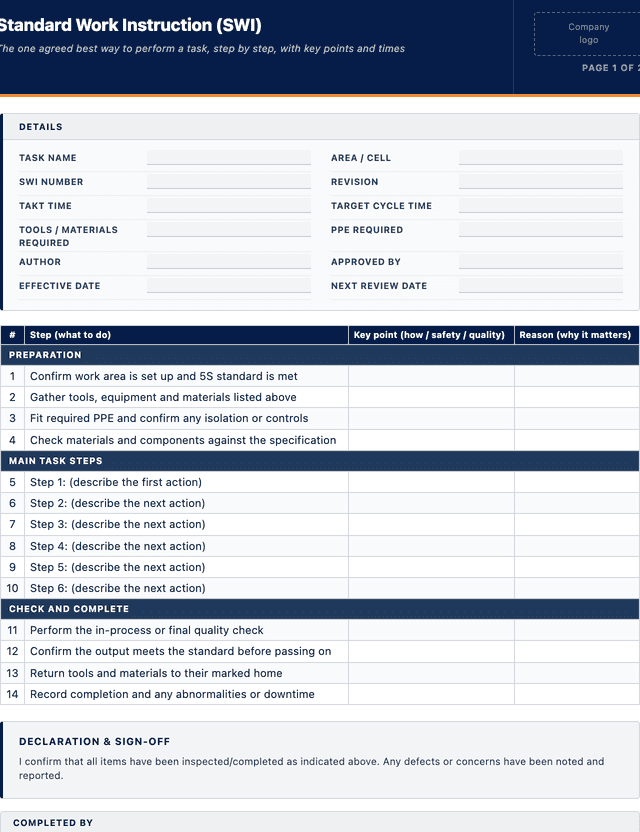
Standard Work Instruction (SWI)
The one agreed best way to perform a task, step by step, with key points and times
PREPARATION
MAIN TASK STEPS
CHECK AND COMPLETE
How to use: download the PDF, print or complete digitally on any device.
- PDF format, ready to print or fill on screen
- Use as-is or customise to suit your operation
- Go digital in MapTrack for photos, reminders and audit trails
Two ways to use it
Use in MapTrack →Use it digitally instead
Unlimited usersUpload this PDF and MapTrack drafts the form for you.




- Scan the asset’s QR tag with any phone
- Submitted forms can trigger alerts
- Photos on fails, audit-ready records
- Export responses, PDF reports with your logo
Free trial. No credit card needed.
Trusted by teams across Australia and New Zealand
We respect your privacy. Unsubscribe anytime.
These templates are free general guides provided as-is. They do not constitute legal, safety or compliance advice. You are responsible for ensuring any form meets your specific workplace obligations, industry standards and applicable regulations.
Don't just download it - use it live. Start a free workspace, upload this standard work instruction (SWI) and MapTrack drafts it as a form your crew can run from a phone.

Co-Founder & Commercial Director
Key takeaways
- The MapTrack standard work instruction (SWI) contains 14 checks across 3 sections. Sections covered: PREPARATION, MAIN TASK STEPS, CHECK AND COMPLETE.
Enter your email below to download this standard work instruction (SWI) as a ready-to-use PDF.
Used by construction, mining and field service teams










What is a standard work instruction (SWI)?
A standard work instruction, or SWI, is a single document that sets out the one agreed best way to perform a specific task, step by step, so that anyone trained can do it the same way and get the same result. It captures each step of the task in sequence, the key point for each step, the reason that key point matters, the tools and materials needed, the takt time the task must keep pace with, and the target cycle time. It usually includes a simple image or sketch for each step so the instruction can be followed at the point of work rather than read like a manual.
Standard work is a core lean practice and this template treats it as such rather than as a legislated form. It is the current best method, written down and improved over time, and it is the baseline every improvement is measured against: you cannot tell whether a change is better if there was no standard to begin with. An SWI is more detailed and more task focused than a broad standard operating procedure, working at the level of a single cycle or job with explicit key points and times. Keeping the current best method documented supports the consistency and continual improvement expectations of ISO 9001, and it makes training faster because the method is written down instead of living only in one experienced operator's head.
Learn more about compliance and inspections in MapTrack.
Benefits of using this standard work instruction (SWI)
- Consistent output: everyone performing the task follows the same steps, so quality and cycle time stop depending on which operator is rostered on.
- Faster onboarding: a clear step, key point and reason format lets a new starter learn the correct method quickly instead of picking up habits informally.
- A baseline for improvement: with the current best method written down, any proposed change can be tested against it rather than argued about from memory.
- Captured know-how: writing the method down keeps critical knowledge in the business when an experienced operator is on leave or moves on.
- Safer methods built in: recording safety key points alongside each step means the safe way and the standard way are the same thing, not competing priorities.
- Clear expectations: an explicit takt and cycle time tells the operator what pace the task is meant to keep so problems show up early rather than at the end of the shift.
Benefits of digitising forms in MapTrack
When you move from paper or static PDFs to digital forms in MapTrack, you get:
- Field users can easily scan a QR code to complete a form on mobile. Unlimited users.
- Email the right people when a form is submitted, with an automation you set up.
- File every completed form against the asset, location or person it covers.
- Download any completed form as a PDF, with failed answers listed at the top.
- Fill in forms offline; they upload when the device is back online.
- Build conditional logic (show or hide questions based on answers).
- Take pictures or attach photos. Not possible with a paper-based form.
- Electronic signatures.
- Edit forms later without reprinting.
- Set who can view, fill in or edit forms with user roles.
- Upload a paper form (PDF, Word, Excel or a photo) and MapTrack's AI builds a digital version for you to check.
- Assign audits and send reminder emails to the people doing them.
- Keep every audit, inspection and sign-off against the asset or site it covers.
- Track corrective actions as work orders from finding to close-out, with each change in the activity log.
Book a demo to see how MapTrack handles forms.
Try MapTrack free for 30 days
Full access to every feature. No credit card required. Per-asset pricing so you scale as your fleet grows.
- No credit card required
- 30 days free trial
- Cancel anytime
1-2 days/week saved
“Bloody amazing! We used to spend 1-2 days a week tracking and managing our generators alone.”

Steve McAllister
Asset Coordinator, Saunders International
What to include in a standard work instruction (SWI)
This standard work instruction (SWI) covers 10 key areas:
- Task name, area or cell, and the SWI number and revision
- Purpose of the task and where it sits in the overall process
- Takt time the task must keep pace with and the target cycle time
- Tools, equipment and materials required to perform the task
- Personal protective equipment and any safety controls for the task
- Each step in sequence, written as a clear action
- The key point for each step: quality, safety or ease of the work
- The reason each key point matters, so operators understand not just what but why
- A simple image, photo or sketch for each step where it helps
- Author, approver, effective date and a place to record the next review
How to use this standard work instruction (SWI)
- Break the task into steps: Watch the task being done and split it into the main steps, the logical chunks of the work. Keep the steps at a consistent level of detail so the instruction is neither a vague summary nor an overwhelming list of tiny movements that no one will read.
- Identify the key point for each step: For each step, capture the key point, the thing that makes the difference to quality, safety or how easy the work is. This is the knowledge an experienced operator has that a new starter does not, so it is the most valuable part of the instruction.
- Record the reason for each key point: Write down why each key point matters, for example that a fitting cross threads if not started by hand, or that a part scratches if set down on bare bench. Explaining the reason means operators follow the method with understanding rather than blindly, and can spot when something is wrong.
- Add times and a visual: Record the takt time the task must keep pace with and the target cycle time so the operator knows the expected pace. Add a photo or simple sketch for each step where words alone are not enough, keeping the instruction usable right at the point of work.
- Validate, train and improve: Have an experienced operator and a supervisor confirm the instruction is correct and workable, then train the team to it and observe them following it. Update the SWI whenever a better method is proven, treating it as the living current best method rather than a document that is written once and forgotten.
In MapTrack, you can automate compliance tracking and audit trails. Each submission is stored as a timestamped PDF against the asset record.
Get the free templateEnter your email above to download the full standard work instruction (SWI) as a PDF.Back to download formHow often should you complete this form?
A standard work instruction is created once for each distinct task and then maintained as a living document. Review it whenever the process, tooling, materials or safety controls change, and whenever a gemba walk or an improvement event proves a better method. Many operations also review each SWI on a fixed cycle, for example annually, so instructions do not silently drift out of date.
Write an SWI for tasks that are repeated, where consistency matters, or where getting it wrong is costly or unsafe. Not every one-off job needs one. The discipline is to keep the document matching what the best operators actually do, because an instruction that no longer reflects the real method is worse than none at all.
Frequently asked questions
Applicable regulatory standards
This template is a starting point. Check the current requirements that apply to your equipment, work and location. The template alone does not establish compliance.
- ISO 9001 clause 8.5.1 Control of production and service provision
- ISO 9001 clause 10 Improvement (continual improvement)
- Lean manufacturing / Toyota Production System (standardised work) - a methodology, not a standard
- Model Work Health and Safety Act and Regulations, as enacted in each state and territory (in Victoria, the Occupational Health and Safety Act 2004 and OHS Regulations 2017) - safe methods of work for tasks with safety risk
Standard Work Instruction (SWI) preview
The numbers behind this standard work instruction (SWI)
Every figure below is sourced and dated, so you can quote it in a toolbox talk, a budget case or a board paper without having to chase the original report.
Embed this free template on your website
Run an industry blog, trade association site, or training resource? Drop a preview of this free standard work instruction (SWI) straight into your page. The snippet is self-contained, needs no scripts, and links readers back to the full free template.
<div style="max-width:480px;font-family:system-ui,-apple-system,'Segoe UI',Roboto,sans-serif;border:1px solid #E5E7EB;border-radius:12px;padding:20px;background:#ffffff;">
  <p style="font-size:12px;font-weight:700;letter-spacing:0.05em;text-transform:uppercase;color:#071D49;margin:0;">Free template</p>
  <p style="font-size:18px;font-weight:700;color:#071D49;margin:6px 0 0;">Standard Work Instruction (SWI)</p>
  <ul style="margin:12px 0 0;padding-left:18px;color:#374151;font-size:14px;line-height:1.6;">
    <li style="margin:4px 0;">Task name, area or cell, and the SWI number and revision</li>
    <li style="margin:4px 0;">Purpose of the task and where it sits in the overall process</li>
    <li style="margin:4px 0;">Takt time the task must keep pace with and the target cycle time</li>
    <li style="margin:4px 0;">Tools, equipment and materials required to perform the task</li>
    <li style="margin:4px 0;">Personal protective equipment and any safety controls for the task</li>
    <li style="margin:4px 0;">Each step in sequence, written as a clear action</li>
  </ul>
  <p style="font-size:13px;color:#6B7280;margin:14px 0 0;padding-top:12px;border-top:1px solid #E5E7EB;">Free <a href="https://www.maptrack.com/templates/standard-work-instruction-template" style="color:#071D49;font-weight:600;text-decoration:none;">Standard Work Instruction (SWI)</a> by MapTrack</p>
</div>Free to reuse, including commercially. This template is published under a Creative Commons Attribution 4.0 licence. Copy it, adapt it, put it on your own site or in your own docs. All we ask is that you credit MapTrack with a link back to this page. The snippet above already includes that credit, so if you use it as-is you’re covered.
Cite this template
Writing about this topic? You’re welcome to quote this checklist. Here’s the wording to use so your readers can find the original.
The MapTrack standard work instruction (SWI) contains 14 checks across 3 sections.
- Short attribution
- MapTrack Standard Work Instruction (SWI), https://www.maptrack.com/templates/standard-work-instruction-template
- Reference list
- MapTrack. (2026). Standard Work Instruction (SWI) [Checklist template]. Retrieved from https://www.maptrack.com/templates/standard-work-instruction-template
Free to reuse with credit under a Creative Commons Attribution 4.0 licence. If you’d rather link straight to it, the page is https://www.maptrack.com/templates/standard-work-instruction-template.
Need to automate compliance tracking and audit trails?
Register every asset in MapTrack, attach digital forms, and get a complete history of every inspection, service and compliance record.
Compliance and inspections · All templates · Pricing · Book a demo