
Free template · PDF
Free confined space entry SWMS
Free confined space entry SWMS template (PDF-ready). Permit, atmospheric testing, standby, rescue and isolation controls under WHS.
Loading PDF page...

Read the form fields
17 checks · 4 sections · Sign-off
17 checks
The fields in the printable form, in a view that fits your screen.
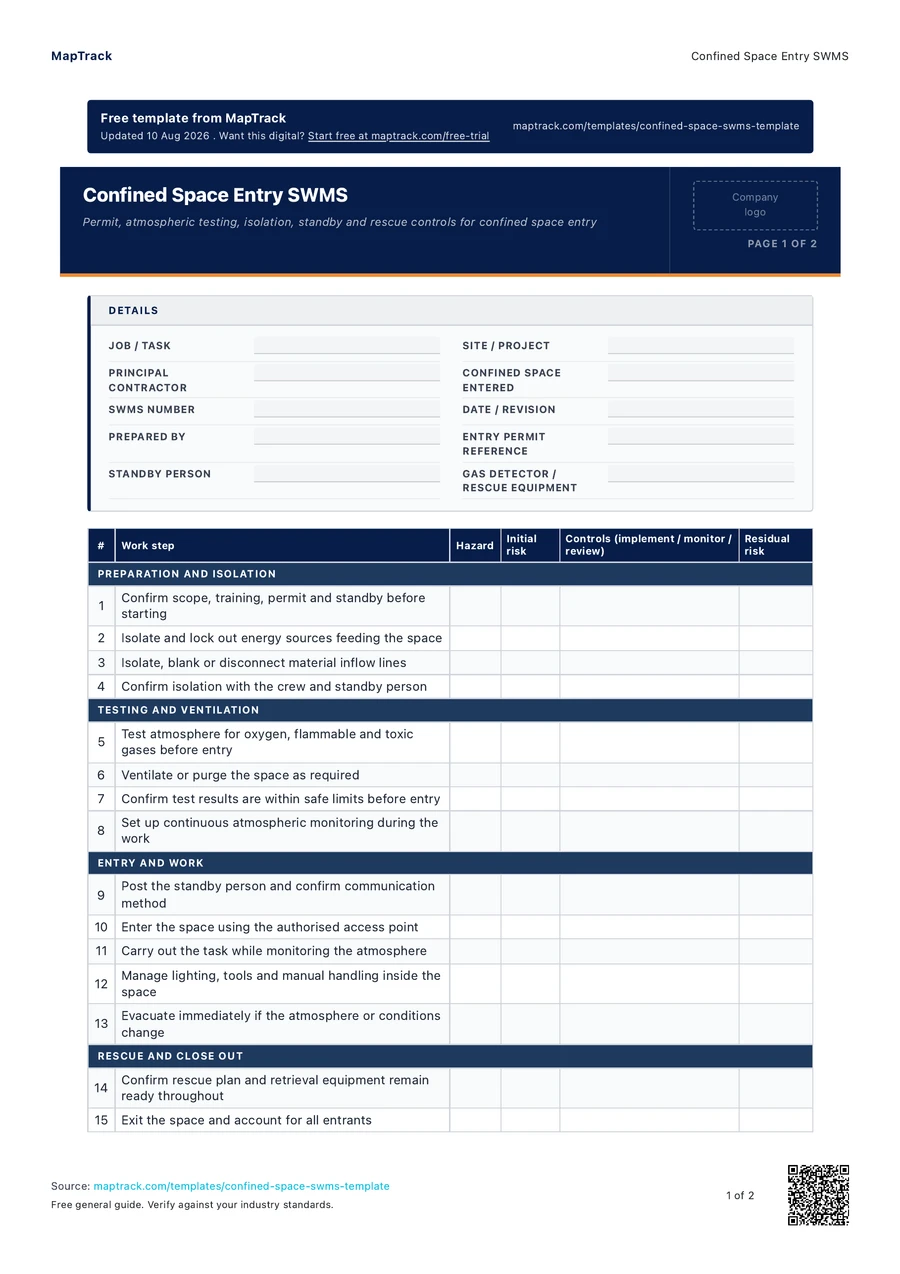
- Job / task
- Site / project
- Principal contractor
- Confined space entered
- SWMS number
- Date / revision
- Prepared by
- Entry permit reference
- Standby person
- Gas detector / rescue equipment
PREPARATION AND ISOLATION
TESTING AND VENTILATION
ENTRY AND WORK
RESCUE AND CLOSE OUT
Declaration & Sign-Off
I confirm that all items have been inspected/completed as indicated above. Any defects or concerns have been noted and reported.
Completed By
Printed name · Signature · Date
Reviewed / Approved By
Printed name · Signature · Date
The MapTrack confined space entry SWMS contains 17 checks across 4 sections.

Make this form your own
Add your fields and logo. Give your team a form they can use on site.
Free 30-day trial. No credit card. Work email needed.
Upload & use this form now for free



“MapTrack beat them all in every aspect.”
 Vincent Stone · HSEQ Advisor, Concept Tanks
After signup: upload this PDF, check the form MapTrack drafts, then save and publish it for your team.
General guidance only. Check the form against your equipment manual, site procedures and local requirements before using it.
Key takeaways
- The MapTrack confined space entry SWMS contains 17 checks across 4 sections. Sections covered: PREPARATION AND ISOLATION, TESTING AND VENTILATION, ENTRY AND WORK, RESCUE AND CLOSE OUT.
- Job description, site or project, principal contractor and the confined space entered
- SWMS number, date prepared and revision, with the person responsible for the SWMS
- Workers and roles, confined-space training, and the standby person nominated
What is a confined space entry SWMS?
A confined space entry Safe Work Method Statement (SWMS) is the high-risk construction work document that sets out how work inside a confined space, such as a tank, pit, silo, vessel or sewer, will be carried out safely. It records the job and site, the workers and their confined-space training, the plant and gas-testing equipment used, and a row for every work step showing the hazard, the risk rating, the controls and how each control is implemented, monitored and reviewed. For confined-space work it centres on the entry permit, atmospheric testing before and during entry, isolating energy and material inflows, a standby person outside, and a rescue plan that does not send the standby person in unprotected.
A confined space entry SWMS matters because confined spaces kill in ways that give no warning: an atmosphere can be short of oxygen or full of toxic or flammable gas, and would-be rescuers who rush in without protection are frequently among the dead. Work carried out in or near a confined space is named in the high-risk construction work categories of the model WHS Regulations (in Victoria, the Occupational Health and Safety Regulations 2017), and confined-space entry carries its own specific duties including a written entry permit. This template keeps the testing, isolation, standby and rescue controls explicit so a crew cannot enter on assumption, works alongside the entry permit, and gives you the dated, signed evidence a regulator or principal contractor expects.
Learn more about compliance and inspections in MapTrack.
Choose the format that fits your team
Download the PDF
Use the original printable form for a paper workflow. Check it against your equipment and site procedure before the job.
Keep completed copies in your own record system and arrange any follow-up through your normal process.
Download free PDFCustomise a form in MapTrack
Start a free trial, upload this PDF and MapTrack drafts the form. Adjust it to your workflow, then save and publish it for your team to use.
Sample answers on this page and completed PDF records aren't imported automatically.
Upload & use this form now for freeFree 30-day trial. No credit card. Work email needed.
Benefits of using this confined space entry SWMS
- Permit-driven: the SWMS works alongside a written entry permit, so no one enters until the atmosphere, isolation and standby are confirmed.
- Atmosphere tested: testing before and continuously during entry catches oxygen deficiency and toxic or flammable gas that has no smell or warning.
- Energy isolated: isolating and locking out energy and material inflows stops a pump, auger or valve starting while someone is inside.
- Standby in place: a dedicated standby person outside maintains contact and triggers the rescue, so a worker in trouble is never unnoticed.
- Rescue without a second victim: a planned rescue that does not rely on the standby entering unprotected stops the rescuer becoming the next casualty.
- Regulatory fit: work in or near a confined space is high-risk construction work with its own permit duties, and this template captures the hazard, control and review detail required.
- Crew sign-on: every worker signs on, so the whole crew shares the same understanding of the isolation, testing and rescue arrangements.
What to include in a confined space entry SWMS
- Job description, site or project, principal contractor and the confined space entered
- SWMS number, date prepared and revision, with the person responsible for the SWMS
- Workers and roles, confined-space training, and the standby person nominated
- Entry permit reference and the gas detector, ventilation and rescue equipment used
- Atmospheric test results before entry and the monitoring regime during entry
- Isolation of energy sources and material inflows: lock-out, tag-out and blanking
- Work steps in order, one row per step, covering isolation, testing, entry and exit
- Hazard, risk rating, controls and residual risk for each step
- Ventilation, communication method between standby and entrant, and access and egress
- Rescue plan and equipment, emergency arrangements, and worker sign-on before entry
How to use this confined space entry SWMS
Plan the entry and confirm training
Define the work, the confined space and the site, and confirm every worker holds current confined-space training and the standby person is nominated. Work in or near a confined space is named high-risk construction work and carries its own permit duties, so the SWMS and entry permit must be ready and understood before anyone approaches the space, not written up afterwards.
Isolate energy and material inflows
Isolate and lock out every energy source and material inflow that could harm an entrant, including pumps, augers, agitators, steam, gas and product lines, and blank or physically disconnect lines where a valve alone is not enough. A confined space that is fed by an unisolated line can fill, start or energise while a worker is inside, so isolation comes before any testing or entry.
Test the atmosphere and ventilate
Test the atmosphere with a calibrated gas detector for oxygen, flammable gas and the toxic gases expected for that space before entry, and ventilate as needed. Continue monitoring during the work, because conditions can change once the task disturbs sludge, residue or coatings, and an atmosphere that tested safe on entry can turn dangerous mid-task.
Set standby, rate hazards and plan rescue
Post a standby person outside who maintains communication with the entrant and controls the entry, score each work step and apply controls, and write a rescue plan that recovers a worker without the standby entering unprotected. Most confined-space deaths include a rescuer who rushed in, so the plan must use retrieval equipment and trained responders rather than instinct.
Sign on, monitor and review
Every worker reads and signs on to the SWMS and the permit is authorised before entry. Keep both at the entry point, stop work and evacuate if the atmosphere or conditions change, and review the SWMS after the job or any incident so the isolation, testing and rescue controls stay current for the next entry.
How often should you complete this form?
Prepare a confined space entry SWMS before the work starts and use it with a written entry permit for every entry. Reassess before each entry even into the same space, because the atmosphere and conditions inside can change between shifts and between tasks.
Stop work and evacuate the space if a control fails, if the atmosphere moves outside safe limits, or if communication with the standby is lost, then reassess before re-entry. Formally review the master SWMS after any incident or near miss, after a change to the space or the work method, or when a relevant standard or regulation changes.
Make this form your own
From your template to your team.
Upload this PDF and MapTrack drafts the form. Adjust it for your equipment and site, then save and publish the digital form for your team.
- 01
Start your free trial
Use your work email to create your MapTrack account.
- 02
Customise, save and publish
Adjust the template fields and branding for your site.
- 03
Complete it on the job
Record checks, add photos and export a branded PDF.
Keep working offline
Load the form before you lose reception. Complete it offline and sync when you're back online.
Scan the asset. Open its form.
Use an asset's QR code to find and complete the forms that belong to it.
Show what you found
Capture photos and attach files so the next person has the details they need.
Take a branded PDF with you
Download completed forms as PDF reports with your company logo.
Completed paper records aren't imported automatically.
Frequently asked questions
Practical answers about the form, record keeping and using MapTrack.
Yes. The model WHS Regulations require a written confined-space entry permit before a worker enters a confined space, in addition to managing the risks (in Victoria, the Occupational Health and Safety Regulations 2017). The permit records the space, the workers, the atmospheric test results, the isolations, the standby arrangements and the rescue plan, and it must be completed and authorised before entry. Work in or near a confined space is also named in the high-risk construction work categories, so a SWMS is required as well: the SWMS sets out the method and the permit authorises the specific entry.
Link to this answerMost confined-space fatalities are caused by the atmosphere: too little oxygen, too much of a toxic gas such as hydrogen sulphide or carbon monoxide, or a flammable atmosphere. These conditions often give no warning that a person can detect. Testing with a calibrated gas detector before entry confirms the space is safe to enter, and continuous monitoring during the work catches changes when the task disturbs residue or when ventilation shifts. Never rely on how a space looks or smells.
Link to this answerThe standby person stays outside the confined space for the whole entry, maintains continuous communication with the entrant, monitors conditions and controls who enters and leaves. If something goes wrong, the standby raises the alarm and initiates the rescue plan. Critically, the standby does not enter to attempt a rescue unless the plan specifically provides for a protected, equipped rescue, because an unprotected rescuer entering the same atmosphere is how a single casualty becomes several.
Link to this answerThe SWMS is the method statement that sets out how the confined-space work will be done, the hazards, and how the controls are implemented, monitored and reviewed, and it applies to the type of work. The entry permit is the authority for a specific entry at a specific time: it records the actual test results, isolations, standby and rescue arrangements for that entry and is signed off before workers go in. You need both, and they work together.
Link to this answerUse the SWMS with a fresh entry permit for every entry, and reassess before each entry even into the same space because internal conditions change. Stop work and evacuate if a control fails, the atmosphere moves outside safe limits, or communication is lost, then reassess before re-entry. Formally review the master SWMS after any incident or near miss, a change to the space or method, or a change in the relevant standard.
Link to this answerYes, it is completely free. It downloads as a ready-to-print PDF. You do not need a MapTrack account. If you want to move beyond paper, MapTrack tracks your gas detectors and rescue equipment, their calibration and inspection due dates, and the asset history behind each SWMS in one place. Start a free trial or book a demo to see how.
Link to this answerApplicable regulatory standards
This form is a starting point. Check the current requirements that apply to your equipment, work and location. The form alone does not establish compliance.
- Model Work Health and Safety Act (enacted in each state and territory; in Victoria, the Occupational Health and Safety Act 2004)
- Model Work Health and Safety Regulations, confined spaces and entry permit duties (Part 4.3, regs 66-77; in Victoria, the Occupational Health and Safety Regulations 2017)
- Safe Work Australia Model Code of Practice: Confined spaces
- AS 2865-2009 Confined spaces
- Model Codes of Practice (Safe Work Australia)
- Model WHS Regulations (Safe Work Australia)
- Model Work Health and Safety Act (Safe Work Australia)
MapTrack publishes this template. The linked authorities publish their own guidance; they haven't endorsed this form.
The numbers behind this confined space entry SWMS
Every figure below is sourced and dated, so you can quote it in a toolbox talk, a budget case or a board paper without having to chase the original report.
Cite this template
Writing about this topic? You’re welcome to quote this checklist. Here’s the wording to use so your readers can find the original.
The MapTrack confined space entry SWMS contains 17 checks across 4 sections.
- Short attribution
- MapTrack Confined Space Entry SWMS, https://www.maptrack.com/templates/confined-space-swms-template
- Reference list
- MapTrack. (2026). Confined Space Entry SWMS [Checklist template]. Retrieved from https://www.maptrack.com/templates/confined-space-swms-template
Free to reuse with credit under a Creative Commons Attribution 4.0 licence. If you’d rather link straight to it, the page is https://www.maptrack.com/templates/confined-space-swms-template.
Embed this free template on your website
Run an industry blog, trade association site, or training resource? Drop a preview of this free confined space entry SWMS straight into your page. The snippet is self-contained, needs no scripts, and links readers back to the full free template.
<div style="max-width:480px;font-family:system-ui,-apple-system,'Segoe UI',Roboto,sans-serif;border:1px solid #E5E7EB;border-radius:12px;padding:20px;background:#ffffff;">
  <p style="font-size:12px;font-weight:700;letter-spacing:0.05em;text-transform:uppercase;color:#071D49;margin:0;">Free template</p>
  <p style="font-size:18px;font-weight:700;color:#071D49;margin:6px 0 0;">Confined Space Entry SWMS</p>
  <ul style="margin:12px 0 0;padding-left:18px;color:#374151;font-size:14px;line-height:1.6;">
    <li style="margin:4px 0;">Job description, site or project, principal contractor and the confined space entered</li>
    <li style="margin:4px 0;">SWMS number, date prepared and revision, with the person responsible for the SWMS</li>
    <li style="margin:4px 0;">Workers and roles, confined-space training, and the standby person nominated</li>
    <li style="margin:4px 0;">Entry permit reference and the gas detector, ventilation and rescue equipment used</li>
    <li style="margin:4px 0;">Atmospheric test results before entry and the monitoring regime during entry</li>
    <li style="margin:4px 0;">Isolation of energy sources and material inflows: lock-out, tag-out and blanking</li>
  </ul>
  <p style="font-size:13px;color:#6B7280;margin:14px 0 0;padding-top:12px;border-top:1px solid #E5E7EB;">Free <a href="https://www.maptrack.com/templates/confined-space-swms-template" style="color:#071D49;font-weight:600;text-decoration:none;">Confined Space Entry SWMS</a> by MapTrack</p>
</div>Free to reuse, including commercially. This template is published under a Creative Commons Attribution 4.0 licence. Copy it, adapt it, put it on your own site or in your own docs. All we ask is that you credit MapTrack with a link back to this page. The snippet above already includes that credit, so if you use it as-is you’re covered.
About the author

Co-Founder & Commercial Director
Jarrod has spent over a decade in technology consulting and asset management, including roles at Accenture (mining and heavy industry) and CGI as an Asset Management Consultant. He co-founded MapTrack and built and scaled its original platform, then rebuilt it with Lachlan and Alex from thousands of customer conversations and 300+ user research sessions with field teams. His consulting background gives him deep insight into the operational and compliance challenges facing asset-intensive Australian businesses.
View LinkedIn profile →Ready for your next job?
Keep the PDF handy, or upload it to MapTrack and turn it into a digital form for your team.