
Free template · PDF
Free confined space rescue plan template
Free confined space rescue plan template (PDF-ready). Procedural response document aligned to AS 2865, OSHA 1910.146(k), NFPA 350 and NFPA 1006.
Loading PDF page...
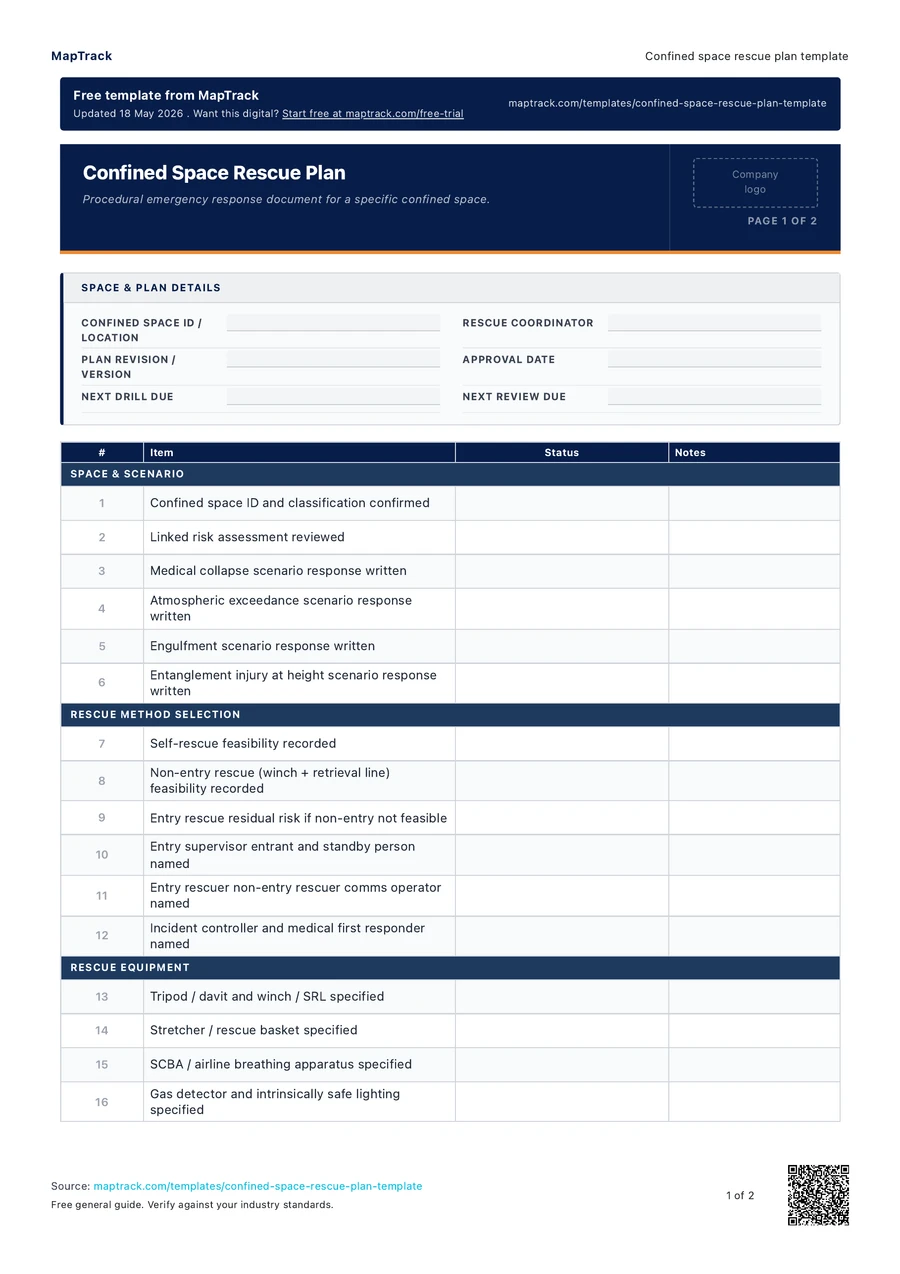

Read the form fields
24 checks · 4 sections · Sign-off
24 checks
The fields in the printable form, in a view that fits your screen.
- Confined space ID / location
- Rescue coordinator
- Plan revision / version
- Approval date
- Next drill due
- Next review due
Space & scenario
Rescue method selection
Rescue equipment
Drills & notification
Declaration & Sign-Off
I confirm that all items have been inspected/completed as indicated above. Any defects or concerns have been noted and reported.
Completed By
Printed name · Signature · Date
Reviewed / Approved By
Printed name · Signature · Date
The MapTrack confined space rescue plan template contains 24 checks across 4 sections.

Co-Founder & Commercial Director
Make this form your own
Add your fields and logo. Give your team a form they can use on site.
Free 30-day trial. No credit card. Work email needed.
Upload & use this form now for free



“MapTrack beat them all in every aspect.”
 Vincent Stone · HSEQ Advisor, Concept Tanks
After signup: upload this PDF, check the form MapTrack drafts, then save and publish it for your team.
General guidance only. Check the form against your equipment manual, site procedures and local requirements before using it.
Key takeaways
- The MapTrack confined space rescue plan template contains 24 checks across 4 sections. Sections covered: Space & scenario, Rescue method selection, Rescue equipment, Drills & notification.
- Plan ownership and scope: specific confined space ID classification typical occupancy entry method linked risk assessment and the rescue plan revision number owner and approval date.
- Scenario library: realistic rescue scenarios for this space including medical collapse atmospheric exceedance heat stress engulfment entanglement injury at height electrical contact and fire each with its own response branch.
- Rescue method decision: documented selection of self-rescue non-entry rescue (winch and retrieval line) or entry rescue with the reasoning recorded and the residual risk if entry rescue is unavoidable.
What is a confined space rescue plan template?
A confined space rescue plan is the procedural emergency-response document that describes how a casualty will be retrieved from a specific confined space, who performs each role, what equipment and communications are used, how the rescue is escalated and how the response is rehearsed. It is distinct from the rescue equipment checklist (which is a hardware inventory verifying tripod winch SCBA harness and detector are present and serviceable) because the rescue plan is the written response procedure: it captures the rescue scenarios anticipated, the rescue method selected (self-rescue, non-entry rescue, entry rescue), the step-by-step response sequence, the comms tree, the medical handover, the post-incident review and the drill cadence that keeps competency current.
The plan operates beneath the site-wide confined space management plan and against each per-space risk assessment. It is the document Australian PCBUs hold under WHS Regulations 2011 Chapter 4 Part 4.3, AS 2865-2009 (rescue clauses including Section 4.5 and Appendix C on rescue arrangements), OSHA 29 CFR 1910.146(k) (rescue and emergency services - response time training and drill requirements), NFPA 350 (Guide for Safe Confined Space Entry and Work, Chapter 9 on rescue), NFPA 1006 (Standard for Technical Rescuer Professional Qualifications, Chapter 7 on confined space rescue) and UK HSE L101 ACoP guidance on emergency arrangements. Major-project HSE managers, water utility teams, marine yards, tank-farm operators and mine site emergency response coordinators write a rescue plan for every space that is more complex than self-rescue capable, then attach it to the entry permit and rehearse it against realistic scenarios. Without a documented rescue plan the entry permit cannot lawfully be issued because the rescue arrangement element of AS 2865 clause 4.5 and OSHA 1910.146(d)(9) is not satisfied, and the most common cause of confined space fatalities (would-be rescuer death) becomes an unmitigated foreseeable risk.
Learn more about compliance and inspections in MapTrack.
Choose the format that fits your team
Download the PDF
Use the original printable form for a paper workflow. Check it against your equipment and site procedure before the job.
Keep completed copies in your own record system and arrange any follow-up through your normal process.
Download free PDFCustomise a form in MapTrack
Start a free trial, upload this PDF and MapTrack drafts the form. Adjust it to your workflow, then save and publish it for your team to use.
Sample answers on this page and completed PDF records aren't imported automatically.
Upload & use this form now for freeFree 30-day trial. No credit card. Work email needed.
Benefits of using this confined space rescue plan template
- Procedural clarity: a written response procedure step roles communications and handover gives every rescuer a clear path through the highest-stress event on site rather than relying on memory of a generic training course.
- Scenario coverage: documenting every realistic scenario (medical collapse atmospheric change engulfment entanglement injury at height) ensures the response is rehearsed for the worst foreseeable event not just the most likely one.
- Rescue method selection: scoring whether self-rescue non-entry rescue (winch and retrieval line) or entry rescue is feasible for the specific space prevents the catastrophic default to untrained entry rescue that drives most rescuer fatalities.
- Drill cadence: a written drill schedule and scenario rotation satisfies OSHA 1910.146(k)(2) practice exercise requirement and AS 2865 rescue competency expectations so the team remains current.
- Comms and medical handover: defined comms tree from standby person to entry supervisor to emergency services and medical pathway to clinical care addresses the gaps that turn recoverable casualties into fatalities.
- Regulator and insurer defence: a documented exercised rescue plan attached to every entry permit is the artefact regulators and insurers examine first after a confined space incident or near-miss.
What to include in a confined space rescue plan template
- Plan ownership and scope: specific confined space ID classification typical occupancy entry method linked risk assessment and the rescue plan revision number owner and approval date.
- Scenario library: realistic rescue scenarios for this space including medical collapse atmospheric exceedance heat stress engulfment entanglement injury at height electrical contact and fire each with its own response branch.
- Rescue method decision: documented selection of self-rescue non-entry rescue (winch and retrieval line) or entry rescue with the reasoning recorded and the residual risk if entry rescue is unavoidable.
- Roles and team composition: entry supervisor entrant standby person attendant entry rescuer non-entry rescuer comms operator medical first responder and incident controller with named individuals and competencies.
- Response sequence: step by step response procedure from alarm raised through retrieval medical assessment handover to ambulance and post-incident scene preservation expected times against each step.
- Equipment and PPE: rescue equipment specific to the scenario (tripod winch SRL stretcher rescue basket SCBA airline harness gas detector intrinsically safe lighting comms) linked to the rescue equipment checklist that verifies hardware presence.
- Communications: comms tree from entrant to standby person to entry supervisor to incident controller to emergency services radio channels backup hardwired comms hand signals and the language and accent considerations on multi-cultural sites.
- Drill program: annual drill cadence scenario rotation realistic scenario rules evaluation method documentation requirement under OSHA 1910.146(k)(2) and AS 2865 rescue competency.
- Post-incident actions: scene preservation regulator notification timeline incident report investigation root cause analysis corrective actions plan revision and re-training requirement.
- Sign-off and review: rescue coordinator signature site manager countersign valid from date next review due date and the trigger criteria for interim plan revision.
How to use this confined space rescue plan template
Confirm the space and the linked risk assessment
select the specific confined space ID review the per-space risk assessment confirm classification typical entry method occupancy duration and atmospheric profile then identify every realistic rescue scenario this space could foreseeably produce including medical collapse atmospheric exceedance engulfment entanglement injury at height electrical contact and fire.
Decide the rescue method against AS 2865 and OSHA 1910.146(k)
for each scenario decide whether self-rescue non-entry rescue (winch and retrieval line) or entry rescue is the chosen method document the reasoning if entry rescue is required (because the space configuration cannot support retrieval line) and record the residual risk and any compensating controls.
Assign roles competencies and the response sequence
name individuals to entry supervisor entrant standby person attendant entry rescuer non-entry rescuer comms operator medical first responder and incident controller record competencies against AS 2865 OSHA 1910.146(g) NFPA 1006 Chapter 7 expectations and write the step by step response procedure with expected times against each step.
Document equipment communications and medical handover
specify rescue equipment per scenario link to the rescue equipment checklist that verifies hardware presence write the comms tree from entrant to standby person to entry supervisor to incident controller to emergency services define radio channels backup hardwired comms hand signals and the medical handover procedure to first responders and ambulance.
Set the drill cadence post-incident actions and sign off
schedule the annual rescue drill (minimum per OSHA 1910.146(k)(2)) rotate scenarios document evaluation method define the post-incident actions (scene preservation regulator notification incident report root cause corrective actions and plan revision) then have the rescue coordinator and site manager sign the plan and attach it to every entry permit raised against this space.
How often should you complete this plan?
The confined space rescue plan must be reviewed and rehearsed on a fixed cadence plus event-driven triggers. OSHA 1910.146(k)(2) requires the rescue team to practise rescues at least once every 12 months by means of simulated rescue operations and to evaluate proficiency afterwards. AS 2865-2009 expects equivalent competence to be maintained through documented training and drill. NFPA 350 Chapter 9 and NFPA 1006 Chapter 7 set the rescuer qualification cadence. The plan itself must be reviewed annually as part of the WHS management system audit cycle and refreshed whenever the space configuration changes (modification new ventilation new contents change in occupancy), the rescue arrangement changes (new team new contractor new equipment), regulations or standards change (AS 2865 revision new ACoP), an incident or near-miss occurs in the same or a similar space or any change in the named individuals holding rescue roles. Realistic-scenario drills should rotate through the scenario library each year so the team is rehearsed on more than the most likely event. In MapTrack the rescue plan is attached to the confined space asset and the next drill date and next review date are scheduled automatically so neither lapses silently between major audits.
Make this form your own
From your template to your team.
Upload this PDF and MapTrack drafts the form. Adjust it for your equipment and site, then save and publish the digital form for your team.
- 01
Start your free trial
Use your work email to create your MapTrack account.
- 02
Customise, save and publish
Adjust the template fields and branding for your site.
- 03
Complete it on the job
Record checks, add photos and export a branded PDF.
Keep working offline
Load the form before you lose reception. Complete it offline and sync when you're back online.
Scan the asset. Open its form.
Use an asset's QR code to find and complete the forms that belong to it.
Show what you found
Capture photos and attach files so the next person has the details they need.
Take a branded PDF with you
Download completed forms as PDF reports with your company logo.
Completed paper records aren't imported automatically.
Frequently asked questions
Practical answers about the form, record keeping and using MapTrack.
Yes. WHS Regulations 2011 Chapter 4 Part 4.3 and AS 2865-2009 clause 4.5 require the PCBU to ensure rescue arrangements are in place before any entry. OSHA 29 CFR 1910.146(d)(9) imposes the same duty in the United States and 1910.146(k) sets out the specific rescue and emergency services requirements. UK Confined Spaces Regulations 1997 regulation 5 requires suitable and sufficient emergency arrangements. A written rescue plan is the artefact that demonstrates the arrangement exists and has been considered against the specific space and the foreseeable scenarios. An entry permit issued without a current rescue plan does not satisfy the rescue arrangement element of any of these frameworks.
Link to this answerThe rescue plan is the procedural document that describes how the rescue will be performed including scenarios method roles step-by-step response communications and drill cadence. The rescue equipment checklist is the hardware inventory that verifies the tripod winch SRL harness SCBA gas detector and comms equipment are present at the entry point serviceable and within calibration before entry begins. The plan answers how will we respond and who does what. The checklist answers is the gear ready. Both are required together because a plan with no equipment cannot be executed and equipment with no plan does not save a life.
Link to this answerAS 2865-2009 clause 4.5 and OSHA 1910.146(k) both expect the duty holder to consider three rescue methods in order of preference: self-rescue (entrant exits unaided when alarm sounds) non-entry rescue (entrant is retrieved using a winch and retrieval line attached to a body harness anchored to a tripod or davit arm) and entry rescue (a trained rescuer enters the space wearing breathing apparatus and retrieves the casualty). Non-entry rescue is the preferred method wherever the space configuration allows because it eliminates the risk to the rescuer. Entry rescue is reserved for spaces where retrieval line geometry is not feasible such as horizontal access spaces with internal obstructions.
Link to this answerOSHA 1910.146(k)(2) requires the rescue team to practise rescues at least once every 12 months by means of simulated rescue operations in which dummies manikins or actual persons are removed from the actual confined space or from representative spaces. AS 2865 expects equivalent competence through documented training and drill which is typically interpreted as annual scenario-based exercise. Best practice rotates scenarios across the scenario library so the team is rehearsed on the worst-foreseeable rescue not just the most likely one. Each drill is documented evaluated and any deficiencies feed back into the plan revision and team retraining.
Link to this answerSafe Work Australia and OSHA both report that a significant proportion of confined space fatalities involve untrained rescuers who enter the space to assist a casualty without breathing apparatus without an atmospheric retest and without a documented rescue plan. The atmosphere that incapacitated the entrant overcomes the rescuer in seconds. The rescue plan addresses this by forcing the duty holder to decide whether non-entry rescue is feasible before any entry and to ensure entry rescue is only performed by a trained competent rescuer wearing breathing apparatus following the documented response sequence. The plan is the single most effective control against rescuer fatality which is why the documented exercised plan is mandatory under every confined space framework.
Link to this answerApplicable regulatory standards
This form is a starting point. Check the current requirements that apply to your equipment, work and location. The form alone does not establish compliance.
- AS 2865-2009 (Confined spaces - rescue clauses Section 4.5 and Appendix C)
- OSHA 29 CFR 1910.146(k) (Rescue and emergency services)
- NFPA 350-2025 (Guide for Safe Confined Space Entry and Work Chapter 9)
- NFPA 1006-2025 (Technical Rescuer Professional Qualifications Chapter 7)
- UK Confined Spaces Regulations 1997 regulation 5
- UK HSE L101 Approved Code of Practice
- Model Codes of Practice (Safe Work Australia)
- OSHA 29 CFR Part 1910, Occupational Safety and Health Standards
MapTrack publishes this template. The linked authorities publish their own guidance; they haven't endorsed this form.
The numbers behind this confined space rescue plan template
Every figure below is sourced and dated, so you can quote it in a toolbox talk, a budget case or a board paper without having to chase the original report.
Cite this template
Writing about this topic? You’re welcome to quote this checklist. Here’s the wording to use so your readers can find the original.
The MapTrack confined space rescue plan template contains 24 checks across 4 sections.
- Short attribution
- MapTrack Confined space rescue plan template, https://www.maptrack.com/templates/confined-space-rescue-plan-template
- Reference list
- MapTrack. (2026). Confined space rescue plan template [Checklist template]. Retrieved from https://www.maptrack.com/templates/confined-space-rescue-plan-template
Free to reuse with credit under a Creative Commons Attribution 4.0 licence. If you’d rather link straight to it, the page is https://www.maptrack.com/templates/confined-space-rescue-plan-template.
Embed this free template on your website
Run an industry blog, trade association site, or training resource? Drop a preview of this free confined space rescue plan template straight into your page. The snippet is self-contained, needs no scripts, and links readers back to the full free template.
<div style="max-width:480px;font-family:system-ui,-apple-system,'Segoe UI',Roboto,sans-serif;border:1px solid #E5E7EB;border-radius:12px;padding:20px;background:#ffffff;">
  <p style="font-size:12px;font-weight:700;letter-spacing:0.05em;text-transform:uppercase;color:#071D49;margin:0;">Free template</p>
  <p style="font-size:18px;font-weight:700;color:#071D49;margin:6px 0 0;">Confined space rescue plan template</p>
  <ul style="margin:12px 0 0;padding-left:18px;color:#374151;font-size:14px;line-height:1.6;">
    <li style="margin:4px 0;">Plan ownership and scope: specific confined space ID classification typical occupancy entry method linked risk assessment and the rescue plan revision number owner and approval date.</li>
    <li style="margin:4px 0;">Scenario library: realistic rescue scenarios for this space including medical collapse atmospheric exceedance heat stress engulfment entanglement injury at height electrical contact and fire each with its own response branch.</li>
    <li style="margin:4px 0;">Rescue method decision: documented selection of self-rescue non-entry rescue (winch and retrieval line) or entry rescue with the reasoning recorded and the residual risk if entry rescue is unavoidable.</li>
    <li style="margin:4px 0;">Roles and team composition: entry supervisor entrant standby person attendant entry rescuer non-entry rescuer comms operator medical first responder and incident controller with named individuals and competencies.</li>
    <li style="margin:4px 0;">Response sequence: step by step response procedure from alarm raised through retrieval medical assessment handover to ambulance and post-incident scene preservation expected times against each step.</li>
    <li style="margin:4px 0;">Equipment and PPE: rescue equipment specific to the scenario (tripod winch SRL stretcher rescue basket SCBA airline harness gas detector intrinsically safe lighting comms) linked to the rescue equipment checklist that verifies hardware presence.</li>
  </ul>
  <p style="font-size:13px;color:#6B7280;margin:14px 0 0;padding-top:12px;border-top:1px solid #E5E7EB;">Free <a href="https://www.maptrack.com/templates/confined-space-rescue-plan-template" style="color:#071D49;font-weight:600;text-decoration:none;">Confined space rescue plan template</a> by MapTrack</p>
</div>Free to reuse, including commercially. This template is published under a Creative Commons Attribution 4.0 licence. Copy it, adapt it, put it on your own site or in your own docs. All we ask is that you credit MapTrack with a link back to this page. The snippet above already includes that credit, so if you use it as-is you’re covered.
About the author

Co-Founder & Commercial Director
Jarrod has spent over a decade in technology consulting and asset management, including roles at Accenture (mining and heavy industry) and CGI as an Asset Management Consultant. He co-founded MapTrack and built and scaled its original platform, then rebuilt it with Lachlan and Alex from thousands of customer conversations and 300+ user research sessions with field teams. His consulting background gives him deep insight into the operational and compliance challenges facing asset-intensive Australian businesses.
View LinkedIn profile →Ready for your next job?
Keep the PDF handy, or upload it to MapTrack and turn it into a digital form for your team.