
Free journey management plan template
Free journey management plan template (PDF-ready). Document route, vehicle, driver, hazards, communication schedule and rest stops. Download free.
Updated 3 May 2026
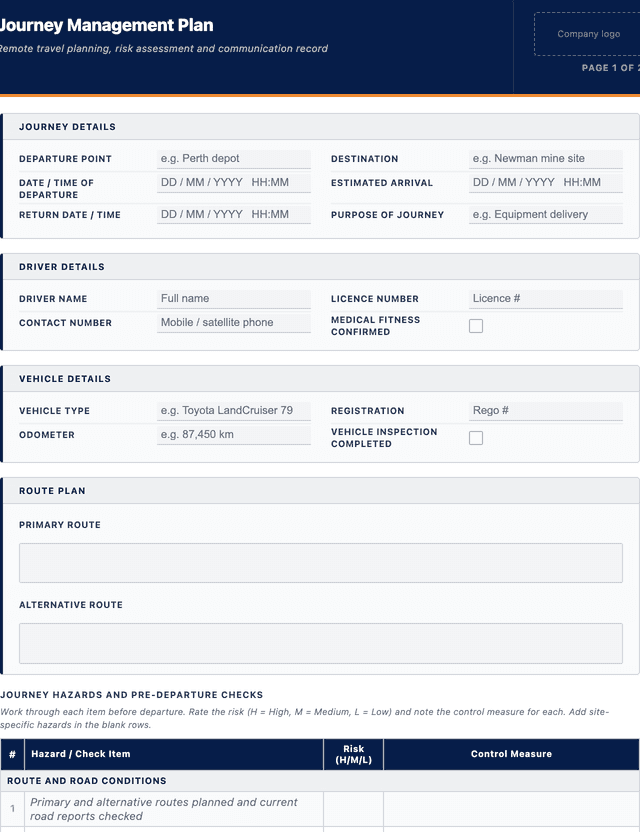
Journey Management Plan
Remote travel planning, risk assessment and communication record
Route and Road Conditions
Weather and Environment
Vehicle and Equipment
Driver and Fatigue
Communications and Emergency
Driver Sign-off
Print name
Signature
Date
Supervisor / Manager Approval
Print name
Signature
Date
How to use: download the PDF, print or complete digitally on any device.
- PDF format, ready to print or fill on screen
- Use as-is or customise to suit your operation
- Go digital in MapTrack for photos, reminders and audit trails
Two ways to use it
Use in MapTrack →Use it digitally instead
Unlimited usersThese same 24 checks, already built.




- Scan the asset’s QR tag with any phone
- Submitted forms can trigger alerts
- Photos on fails, audit-ready records
- Export responses, PDF reports with your logo
Free trial. No credit card needed.
Trusted by teams across Australia and New Zealand
We respect your privacy. Unsubscribe anytime.
These templates are free general guides provided as-is. They do not constitute legal, safety or compliance advice. You are responsible for ensuring any form meets your specific workplace obligations, industry standards and applicable regulations.
Don't just download it - use it live. Start a free workspace with this journey management plan template already built, so your crew can run it from a phone.

Co-Founder & Commercial Director
Key takeaways
- The MapTrack journey management plan template contains 24 checks across 5 sections. Sections covered: Route and Road Conditions, Weather and Environment, Vehicle and Equipment, Driver and Fatigue, Communications and Emergency.
- Plans a specific trip: route, stops, contact schedule, escalation trigger and emergency contacts, agreed before departure rather than reconstructed after.
- The escalation trigger is the plan. A missed check-in time that nobody acts on is the failure mode journey management exists to remove.
- Match the plan to the risk: remote routes, fatigue windows, weather and vehicle type decide the check-in frequency, not a fixed rule.
- The model WHS Act duty of care extends to work travel, and a journey plan is the usual evidence that the risk was managed.
Enter your email below to download this journey management plan template as a ready-to-use PDF.
Used by construction, mining and field service teams











What is a journey management plan template?
A journey management plan (JMP) is a structured document used to plan, risk-assess and communicate travel through remote or high-risk areas. It is standard practice across mining, oil and gas, utilities, pastoral and remote construction operations in Australia. The plan captures the route, vehicle condition, driver fitness, identified hazards, communication check-in schedule, planned rest stops and emergency contacts. Its purpose is simple: make sure someone knows where you are, when you should arrive and what to do if you do not check in. Journey management plans reduce the risk of fatigue-related incidents, improve emergency response times and provide a documented record of travel decisions for compliance and incident investigation.
Vehicle incidents on remote roads are a leading cause of workplace fatalities in Australian mining, pastoral and resources industries. Many of these incidents involve fatigue, poor road conditions, wildlife strikes or communication failures where help cannot be reached quickly. A journey management plan addresses each of these risks before the driver leaves, and the scheduled check-in system ensures that if something does go wrong, the alarm is raised as soon as a check-in is missed rather than hours or days later. Safe Work Australia's Guide for Managing the Risk of Fatigue at Work reinforces the importance of planning rest breaks and limiting driving hours, particularly for journeys that cross time zones or span overnight periods.
Learn more about compliance and inspections in MapTrack.
Benefits of using this journey management plan template
- Fatigue management: plan rest stops and driving hours before departure, reducing the risk of fatigue-related incidents on long remote journeys.
- Risk reduction: identify and document route hazards (wildlife, weather, road conditions, remote areas) and agree control measures before the journey starts.
- Emergency response: ensure someone knows your route, expected arrival time and how to raise an alarm if you miss a scheduled check-in.
- Communication: establish a clear check-in schedule with contact persons, methods (radio, phone, satellite) and confirmed times so no one is travelling unmonitored.
- Compliance: meet WHS obligations, site-specific travel policies and industry standards for remote travel across mining, oil and gas and construction operations.
- Accountability: create a signed record of the journey plan, driver fitness declaration and supervisor approval for audits, incident investigations and insurance purposes.
Benefits of digitising forms in MapTrack
When you move your checklists from paper to MapTrack, you get:
- Field users can easily scan a QR code to complete a form on mobile. Unlimited users.
- Email the right people when a form is submitted, with an automation you set up.
- File every completed form against the asset, location or person it covers.
- Download any completed form as a PDF, with failed answers listed at the top.
- Fill in forms offline; they upload when the device is back online.
- Build conditional logic (show or hide questions based on answers).
- Take pictures or attach photos. Not possible with a paper-based form.
- Electronic signatures.
- Edit forms later without reprinting.
- Set who can view, fill in or edit forms with user roles.
- Upload a paper form (PDF, Word, Excel or a photo) and MapTrack's AI builds a digital version for you to check.
- Email safety managers when a hazard report is submitted, with an automation you set up.
- Keep every hazard and incident report against the site it came from, with photos.
- Turn a hazard report into a corrective-action work order with its own review step.
Book a demo to see how MapTrack handles checklists.
Try MapTrack free for 30 days
Full access to every feature. No credit card required. Per-asset pricing so you scale as your fleet grows.
- No credit card required
- 30 days free trial
- Cancel anytime
1-2 days/week saved
“Bloody amazing! We used to spend 1-2 days a week tracking and managing our generators alone.”

Steve McAllister
Asset Coordinator, Saunders International
What to include in a journey management plan template
This journey management plan template covers 10 key areas:
- Journey details: departure point, destination, date and time of departure, estimated arrival, return date and time, purpose of journey.
- Vehicle details: vehicle type, registration, odometer reading, vehicle inspection completed (checkbox).
- Driver details: driver name, licence number, contact number, medical fitness confirmed (checkbox).
- Route plan: primary route description and alternative route if the primary is unavailable.
- Hazards: identified journey hazards with risk rating (high, medium, low) and control measures. Pre-filled rows for fatigue, wildlife, weather, road condition, remote area and breakdown.
- Communication schedule: check-in times, contact person, contact method (radio, phone, satellite) and confirmation checkbox.
- Rest stops: planned rest stop locations, times and durations.
- Emergency contacts: name, role and phone number for key emergency contacts.
- Check-in procedures: scheduled check-in protocol and what happens if a check-in is missed.
- Fatigue management: hours driving, rest breaks planned, last sleep duration and fitness to drive declaration.
How to use this journey management plan template
- Record journey and vehicle details before departure.: Fill in the departure point, destination, departure date and time, estimated arrival time, purpose of the journey and return details. Record the vehicle type, registration, odometer reading and confirm the vehicle pre-start inspection has been completed.
- Record driver details and confirm fitness to drive.: Enter the driver name, licence number and contact number. Complete the fitness to drive declaration including hours of sleep in the last 24 hours, hours since last rest period and any medication or health issues that could affect driving. Sign the declaration.
- Plan the route and identify an alternative if the primary route is unavailable.: Describe the primary route including road names, distances and key landmarks. Identify an alternative route in case of road closures, flooding or other hazards. Mark planned fuel stops on the route where applicable.
- Identify journey hazards and document control measures.: Work through the pre-filled hazard rows (fatigue, wildlife, weather, road condition, remote area, breakdown) and add any additional journey-specific hazards. Rate each hazard and record the control measures you will apply, for example adjusting departure time to avoid dawn and dusk wildlife activity.
- Establish the communication check-in schedule with your contact person.: Agree on check-in times, the contact method (mobile, UHF radio, satellite phone) and what action will be taken if a check-in is missed. Record the contact person name and phone number. Test the communication device before departure.
- Have the plan reviewed and approved by your supervisor before departure.: Present the completed plan to your supervisor or manager for review. The supervisor confirms the route, timing and controls are reasonable, signs the plan and retains a copy. Carry a copy of the signed plan in the vehicle throughout the journey.
In MapTrack, you can digitise safety inspections and compliance forms. Each submission is stored as a timestamped PDF against the asset record.
Get the free templateEnter your email above to download the full journey management plan template as a PDF.Back to download formHow often should you complete this checklist?
A journey management plan should be completed before every journey through remote or high-risk areas. This includes travel to and from remote mine sites, oil and gas facilities, pastoral properties, construction projects and utility assets in areas with limited mobile coverage. A new plan is required for each trip, even if the route is the same, because conditions such as weather, road state and driver fitness change between journeys. If the return journey is on a different day or conditions have changed, a separate plan should be completed for the return trip.
Safe Work Australia and state mining regulators recommend reviewing journey management procedures at least annually, or whenever routes, vehicles or driver fitness-for-work requirements change. Organisations with high-frequency journey activity should embed the plan into their pre-start process.
Frequently asked questions
Applicable regulatory standards
This template is a starting point. Check the current requirements that apply to your equipment, work and location. The template alone does not establish compliance.
- WHS Act 2011
- Safe Work Australia - Guide for Managing the Risk of Fatigue at Work
- WHS Regulations - Chapter 3 General risk and workplace management
Journey management plan template preview
The numbers behind this journey management plan template
Every figure below is sourced and dated, so you can quote it in a toolbox talk, a budget case or a board paper without having to chase the original report.
Embed this free template on your website
Run an industry blog, trade association site, or training resource? Drop a preview of this free journey management plan template straight into your page. The snippet is self-contained, needs no scripts, and links readers back to the full free template.
<div style="max-width:480px;font-family:system-ui,-apple-system,'Segoe UI',Roboto,sans-serif;border:1px solid #E5E7EB;border-radius:12px;padding:20px;background:#ffffff;">
  <p style="font-size:12px;font-weight:700;letter-spacing:0.05em;text-transform:uppercase;color:#071D49;margin:0;">Free template</p>
  <p style="font-size:18px;font-weight:700;color:#071D49;margin:6px 0 0;">Journey management plan template</p>
  <ul style="margin:12px 0 0;padding-left:18px;color:#374151;font-size:14px;line-height:1.6;">
    <li style="margin:4px 0;">Journey details: departure point, destination, date and time of departure, estimated arrival, return date and time, purpose of journey.</li>
    <li style="margin:4px 0;">Vehicle details: vehicle type, registration, odometer reading, vehicle inspection completed (checkbox).</li>
    <li style="margin:4px 0;">Driver details: driver name, licence number, contact number, medical fitness confirmed (checkbox).</li>
    <li style="margin:4px 0;">Route plan: primary route description and alternative route if the primary is unavailable.</li>
    <li style="margin:4px 0;">Hazards: identified journey hazards with risk rating (high, medium, low) and control measures. Pre-filled rows for fatigue, wildlife, weather, road condition, remote area and breakdown.</li>
    <li style="margin:4px 0;">Communication schedule: check-in times, contact person, contact method (radio, phone, satellite) and confirmation checkbox.</li>
  </ul>
  <p style="font-size:13px;color:#6B7280;margin:14px 0 0;padding-top:12px;border-top:1px solid #E5E7EB;">Free <a href="https://www.maptrack.com/templates/journey-management-plan" style="color:#071D49;font-weight:600;text-decoration:none;">Journey management plan template</a> by MapTrack</p>
</div>Free to reuse, including commercially. This template is published under a Creative Commons Attribution 4.0 licence. Copy it, adapt it, put it on your own site or in your own docs. All we ask is that you credit MapTrack with a link back to this page. The snippet above already includes that credit, so if you use it as-is you’re covered.
Cite this template
Writing about this topic? You’re welcome to quote this checklist. Here’s the wording to use so your readers can find the original.
The MapTrack journey management plan template contains 24 checks across 5 sections.
- Short attribution
- MapTrack Journey management plan template, https://www.maptrack.com/templates/journey-management-plan
- Reference list
- MapTrack. (2026). Journey management plan template [Checklist template]. Retrieved from https://www.maptrack.com/templates/journey-management-plan
Free to reuse with credit under a Creative Commons Attribution 4.0 licence. If you’d rather link straight to it, the page is https://www.maptrack.com/templates/journey-management-plan.
Need to digitise safety inspections and compliance forms?
Register every asset in MapTrack, attach digital forms, and get a complete history of every inspection, service and compliance record.
Compliance and inspections · All templates · Pricing · Book a demo