
Free template · PDF
Free grain silo inspection checklist
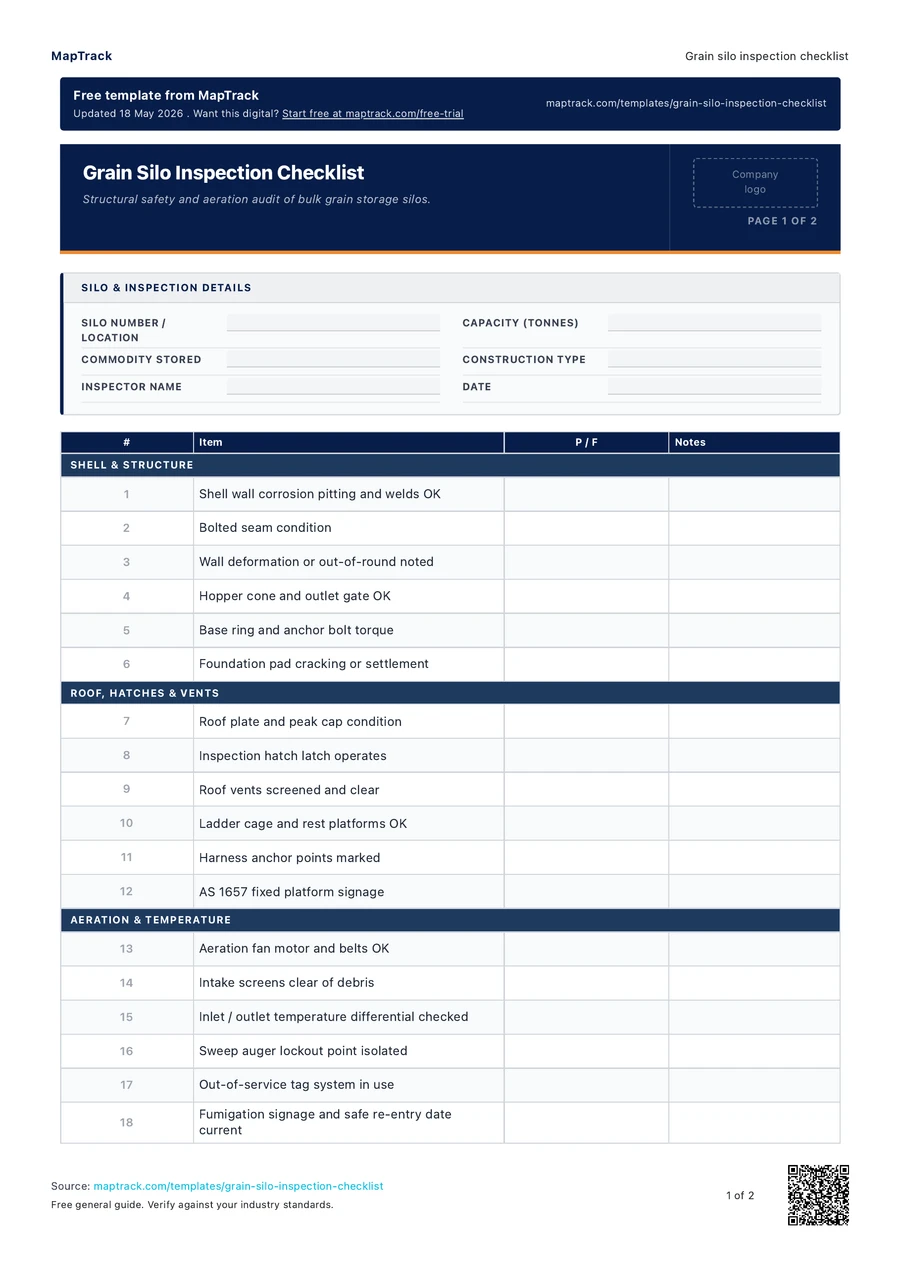
Free grain silo inspection checklist (PDF-ready). Engulfment dust explosion structural fatigue and aeration audit. AS 1747 and OSHA 1910.272 aligned.
Loading PDF page...

Read the form fields
24 checks · 4 sections · Sign-off
24 checks
The fields in the printable form, in a view that fits your screen.
- Silo number / location
- Capacity (tonnes)
- Commodity stored
- Construction type
- Inspector name
- Date
Shell & structure
Roof, hatches & vents
Aeration & temperature
Dust control & hazardous area
Declaration & Sign-Off
I confirm that all items have been inspected/completed as indicated above. Any defects or concerns have been noted and reported.
Completed By
Printed name · Signature · Date
Reviewed / Approved By
Printed name · Signature · Date
The MapTrack grain silo inspection checklist contains 24 checks across 4 sections.

Co-Founder & Commercial Director
Make this form your own
Add your fields and logo. Give your team a form they can use on site.
Free 30-day trial. No credit card. Work email needed.
Upload & use this form now for free



“MapTrack beat them all in every aspect.”
 Vincent Stone · HSEQ Advisor, Concept Tanks
After signup: upload this PDF, check the form MapTrack drafts, then save and publish it for your team.
General guidance only. Check the form against your equipment manual, site procedures and local requirements before using it.
Key takeaways
- The MapTrack grain silo inspection checklist contains 24 checks across 4 sections. Sections covered: Shell & structure, Roof, hatches & vents, Aeration & temperature, Dust control & hazardous area.
- Silo identification: silo number capacity (tonnes) commodity stored construction type (galvanised steel concrete or fabric) construction date last full inspection date and the operator or asset owner.
- Shell condition: visual inspection for corrosion pitting weld defects bolted seam condition staining (indicating moisture ingress) and any wall deformation or out-of-round.
- Hopper or cone and base: hopper plate condition outlet gate operation cone seam condition base ring and anchor bolt torque plus foundation pad cracking and settlement.
What is a grain silo inspection checklist?
A grain silo inspection checklist is a structured audit document used by farm owners, grain bulk handlers, agribusiness managers and rural infrastructure inspectors to verify the structural integrity, safety controls and operational readiness of a grain storage silo or bin. Grain silos carry a distinct hazard profile that separates them from other storage tanks and structures. The four primary risks are engulfment in flowing grain (which kills more than 70 percent of those drawn into a silo within minutes), dust explosion (grain dust is a Class II combustible dust with explosive concentrations as low as 50 grams per cubic metre), structural fatigue from cyclic pressure loading as the silo is filled and emptied and aeration or fumigation related hazards. The checklist covers the silo shell condition, hopper or cone, roof and vents, ladders and fall protection, aeration fans and ducts, fumigation system and signage, sweep auger or unloading equipment, electrical classification and confined space controls.
Unlike a storage tank inspection (which focuses on liquid containment, API 653 shell thickness, bunding and overfill prevention), a grain silo inspection covers very different failure modes. Grain shifts unpredictably as it flows, creating bridging cavities that collapse under the operator and engulf in seconds. Vertical and lateral grain pressure on the silo wall cycles every fill and unload, fatiguing welded seams and bolted joints over years. Grain dust accumulates on every horizontal surface and inside the head and boot of every elevator, building toward a primary explosion that can trigger a far larger secondary explosion through suspended dust clouds. The Australian standard AS 1747 (Silos for storage of bulk materials Safety) sets the safety requirements for silo design, signage and operation. AS 1170 series sets the structural loading standards. OSHA 1910.272 (Grain handling facilities) is the US Federal regulation that requires written housekeeping, hot work permits, lockout tagout, entry permits and emergency action plans specifically for grain handling. A documented inspection satisfies WHS Act 2011 plant duty obligations under Section 19, supports insurance and bank security audit obligations on farm and depot assets, and prevents the single category of agricultural workplace incident with the highest fatality rate per exposure hour.
Learn more about compliance and inspections in MapTrack.
Choose the format that fits your team
Download the PDF
Use the original printable form for a paper workflow. Check it against your equipment and site procedure before the job.
Keep completed copies in your own record system and arrange any follow-up through your normal process.
Download free PDFCustomise a form in MapTrack
Start a free trial, upload this PDF and MapTrack drafts the form. Adjust it to your workflow, then save and publish it for your team to use.
Sample answers on this page and completed PDF records aren't imported automatically.
Upload & use this form now for freeFree 30-day trial. No credit card. Work email needed.
Benefits of using this grain silo inspection checklist
- Engulfment prevention: structured audit of sweep auger lockout entry permit harness anchorages and signage targets the highest fatality category in grain handling so operators do not enter a flowing or bridged silo without controls in place.
- Dust explosion control: inspecting dust accumulation on horizontal surfaces inside elevator head and boot enclosures and confirming electrical classification housekeeping and hot work permit controls reduces the catastrophic primary and secondary dust explosion risk.
- Structural fatigue surveillance: cyclic fill and unload pressure on the silo wall fatigues welded seams and bolted joints across years and a documented inspection identifies cracking deformation and corrosion early enough to repair before structural failure.
- AS 1747 and AS 1170 alignment: silo design and inspection against AS 1747 safety requirements and AS 1170 structural loading provides the defensible compliance position Australian regulators insurers and bank securities expect on farm and depot assets.
- OSHA 1910.272 compliance: for US operators or Australian operators serving export grain customers documented inspection covers entry permit hot work lockout dust housekeeping and emergency action plan obligations under OSHA 1910.272 grain handling facilities.
- Aeration and fumigation safety: inspecting aeration fan ducts vent screens and fumigation signage prevents both gas exposure incidents and the moisture related crusting that contributes to silo bridging engulfment and unsaleable grain.
What to include in a grain silo inspection checklist
- Silo identification: silo number capacity (tonnes) commodity stored construction type (galvanised steel concrete or fabric) construction date last full inspection date and the operator or asset owner.
- Shell condition: visual inspection for corrosion pitting weld defects bolted seam condition staining (indicating moisture ingress) and any wall deformation or out-of-round.
- Hopper or cone and base: hopper plate condition outlet gate operation cone seam condition base ring and anchor bolt torque plus foundation pad cracking and settlement.
- Roof and ventilation: roof plate condition peak cap inspection hatch latch screened roof vents pressure and vacuum relief and any signs of moisture ingress around the eave.
- Ladders fall protection and access: ladder cage condition rest platforms anchor points for harness use and access hatches plus signage at the base of each ladder against AS 1657 fixed platforms.
- Aeration system: fan and motor condition belt and intake screen condition duct integrity inlet and outlet temperature differential and any blocked aeration floor.
- Sweep auger and unloading: sweep auger lockout point isolation procedure auger flighting condition guards in place and out-of-service tag system.
- Fumigation and dust: phosphine fumigation signage current empty container disposal vent purge schedule plus dust accumulation on every horizontal ledge and inside elevator head and boot.
- Electrical classification: hazardous area classification per AS/NZS 60079.10.2 dust explosion zone signage motor enclosure rating and earth continuity on conductive equipment.
- Confined space and entry controls: entry permit register harness lifeline and tripod equipment current gas test kit current and rescue plan and signage at every entry point.
How to use this grain silo inspection checklist
Confirm the silo is isolated and gather records
capture silo number capacity commodity construction type and last inspection date, isolate aeration fans sweep auger and any electrical equipment under lockout tagout and confirm fumigation has not been applied or the safe re-entry period has expired before approaching any access hatch or entry point.
Walk the external shell hopper and roof
inspect the silo wall at ground level for corrosion pitting bolted seam separation weld defects moisture staining and wall deformation, walk the base ring inspecting anchor bolts foundation pad cracking and settlement and use a long lens or drone where helpful to inspect the roof peak cap latch and screened vents.
Inspect ladders fall protection access and aeration
check the ladder cage condition rest platforms harness anchor points and signage against AS 1657, inspect the aeration fan motor belts intake screens duct integrity and verify inlet and outlet temperature differential is within the expected range for the commodity, season and grain moisture content.
Assess sweep auger fumigation dust and electrical classification
inspect the sweep auger lockout point and out-of-service tag system, confirm fumigation signage is current with the correct safe re-entry date, audit dust accumulation on every horizontal ledge inside the elevator head boot and on top of motors and check the electrical equipment matches the hazardous area classification per AS/NZS 60079.10.2.
Verify confined space controls document defects and sign off
confirm the entry permit register, harness lifeline tripod gas test kit are current and the rescue plan is on file, log every defect with location severity recommended action and responsible person, set a target date for remediation and have the inspector and asset owner sign the report and the next inspection due date.
How often should you complete this checklist?
Inspection cadence is tiered. A short visual walk-around (signage lockout point dust around the base ladder access integrity) should occur weekly during the active receival or storage period. A full structural and safety inspection should be completed every six months as a minimum for high-throughput silos at bulk handler depots and at least annually for on-farm storage. AS 1747 expects design integrity and operational safety to be maintained through documented inspections, and AS 1170 series structural loading expects fatigue cycles to be reviewed against design assumptions. OSHA 1910.272 expects written housekeeping and inspection programs for grain handling facilities. An out-of-cycle inspection is triggered by any structural anomaly (visible deformation, anchor bolt failure, weld crack), engulfment near-miss or fatality, fumigation incident, fire or dust explosion event, severe weather impact (hail, cyclone, wind) and any change of commodity that alters loading or moisture characteristics. MapTrack scheduling can run the weekly walk monthly housekeeping audit six monthly structural inspection and annual fumigation regime review as recurring tasks against every silo.
Make this form your own
From your template to your team.
Upload this PDF and MapTrack drafts the form. Adjust it for your equipment and site, then save and publish the digital form for your team.
- 01
Start your free trial
Use your work email to create your MapTrack account.
- 02
Customise, save and publish
Adjust the template fields and branding for your site.
- 03
Complete it on the job
Record checks, add photos and export a branded PDF.
Keep working offline
Load the form before you lose reception. Complete it offline and sync when you're back online.
Scan the asset. Open its form.
Use an asset's QR code to find and complete the forms that belong to it.
Show what you found
Capture photos and attach files so the next person has the details they need.
Take a branded PDF with you
Download completed forms as PDF reports with your company logo.
Completed paper records aren't imported automatically.
Frequently asked questions
Practical answers about the form, record keeping and using MapTrack.
A storage tank inspection (API 653 or AS 1940) focuses on liquid containment shell thickness floor condition bunding and overfill prevention for petroleum, chemical and water tanks. A grain silo inspection covers very different hazards: engulfment in flowing grain, dust explosion from grain dust accumulation, structural fatigue from cyclic fill and unload pressure on the silo wall and aeration or fumigation related risks. The structural failure mode (fatigue rather than corrosion-driven thinning) differs and the human risk category (engulfment fatality rather than spill or fire) differs. The standards differ as well: AS 1747 and AS 1170 for grain silos versus AS 1940 and API 653 for storage tanks.
Link to this answerAS 1747 (Silos for storage of bulk materials Safety) sets the Australian safety requirements for silo design signage and operation. AS 1170 series sets the structural design loading including fatigue cycles. AS 1657 (Fixed platforms walkways stairways and ladders) governs access. AS/NZS 60079.10.2 governs hazardous area classification for combustible dust. WHS Act 2011 Section 19 places the primary duty of care on the PCBU. OSHA 1910.272 (Grain handling facilities) is the US Federal regulation requiring written housekeeping hot work permits lockout tagout entry permits and emergency action plans specifically for grain. Operators exporting to the US under FSMA compliance also reference 21 CFR 117 food safety preventive controls.
Link to this answerGrain behaves as a fluid when it flows during unloading. An operator who enters a silo while grain is unloading can sink to the chest in seconds and be fully submerged in 60 seconds, with crushing pressure preventing chest expansion and rescue often arriving too late. Bridging cavities (where grain crusts over a hollow void) collapse without warning under an operator walking across the top. Grain handling fatality data shows engulfment is the largest cause of silo deaths, killing more than 70 percent of those drawn in. The inspection focuses on sweep auger lockout, harness anchors, entry permit controls and signage to prevent entry where engulfment is possible.
Link to this answerGrain dust is a Class II combustible dust with explosive concentrations as low as 50 grams per cubic metre. A primary dust explosion in a head house or elevator boot can suspend additional accumulated dust and trigger a far larger secondary explosion that has destroyed entire grain handling facilities. The inspection should verify housekeeping controls against AS/NZS 60079.10.2 and OSHA 1910.272: dust accumulation on horizontal ledges does not exceed 1/8 inch (3.2 mm) over more than 5 percent of any working area, all electrical equipment in dust-classified areas carries the correct enclosure rating, hot work permits are required for any welding or grinding inside the dust zone and an emergency action plan is in place.
Link to this answerA short visual walk-around should occur weekly during the active receival or storage period checking signage lockout dust around the base ladder access and integrity. A full structural and safety inspection should be completed every six months for high-throughput bulk handler silos and at least annually for on-farm storage under AS 1747. Aeration and fumigation system checks follow the commodity storage plan typically monthly during active aeration. An out-of-cycle inspection is mandatory after any structural anomaly engulfment near-miss fumigation incident dust explosion fire severe weather impact or change of commodity. Where the silo is also a confined space the entry permit must be active for every entry.
Link to this answerApplicable regulatory standards
This form is a starting point. Check the current requirements that apply to your equipment, work and location. The form alone does not establish compliance.
- WHS Act 2011 (Section 19)
- AS 1747-2003 (Silos for storage of bulk materials Safety)
- AS 1170 series (Structural design actions)
- AS 1657-2018 (Fixed platforms walkways stairways and ladders)
- AS/NZS 60079.10.2:2020 (Hazardous area classification combustible dust)
- OSHA 1910.272 (Grain handling facilities)
- Model Work Health and Safety Act (Safe Work Australia)
- OSHA 29 CFR Part 1910, Occupational Safety and Health Standards
MapTrack publishes this template. The linked authorities publish their own guidance; they haven't endorsed this form.
The numbers behind this grain silo inspection checklist
Every figure below is sourced and dated, so you can quote it in a toolbox talk, a budget case or a board paper without having to chase the original report.
Cite this template
Writing about this topic? You’re welcome to quote this checklist. Here’s the wording to use so your readers can find the original.
The MapTrack grain silo inspection checklist contains 24 checks across 4 sections.
- Short attribution
- MapTrack Grain silo inspection checklist, https://www.maptrack.com/templates/grain-silo-inspection-checklist
- Reference list
- MapTrack. (2026). Grain silo inspection checklist [Checklist template]. Retrieved from https://www.maptrack.com/templates/grain-silo-inspection-checklist
Free to reuse with credit under a Creative Commons Attribution 4.0 licence. If you’d rather link straight to it, the page is https://www.maptrack.com/templates/grain-silo-inspection-checklist.
Embed this free template on your website
Run an industry blog, trade association site, or training resource? Drop a preview of this free grain silo inspection checklist straight into your page. The snippet is self-contained, needs no scripts, and links readers back to the full free template.
<div style="max-width:480px;font-family:system-ui,-apple-system,'Segoe UI',Roboto,sans-serif;border:1px solid #E5E7EB;border-radius:12px;padding:20px;background:#ffffff;">
  <p style="font-size:12px;font-weight:700;letter-spacing:0.05em;text-transform:uppercase;color:#071D49;margin:0;">Free template</p>
  <p style="font-size:18px;font-weight:700;color:#071D49;margin:6px 0 0;">Grain silo inspection checklist</p>
  <ul style="margin:12px 0 0;padding-left:18px;color:#374151;font-size:14px;line-height:1.6;">
    <li style="margin:4px 0;">Silo identification: silo number capacity (tonnes) commodity stored construction type (galvanised steel concrete or fabric) construction date last full inspection date and the operator or asset owner.</li>
    <li style="margin:4px 0;">Shell condition: visual inspection for corrosion pitting weld defects bolted seam condition staining (indicating moisture ingress) and any wall deformation or out-of-round.</li>
    <li style="margin:4px 0;">Hopper or cone and base: hopper plate condition outlet gate operation cone seam condition base ring and anchor bolt torque plus foundation pad cracking and settlement.</li>
    <li style="margin:4px 0;">Roof and ventilation: roof plate condition peak cap inspection hatch latch screened roof vents pressure and vacuum relief and any signs of moisture ingress around the eave.</li>
    <li style="margin:4px 0;">Ladders fall protection and access: ladder cage condition rest platforms anchor points for harness use and access hatches plus signage at the base of each ladder against AS 1657 fixed platforms.</li>
    <li style="margin:4px 0;">Aeration system: fan and motor condition belt and intake screen condition duct integrity inlet and outlet temperature differential and any blocked aeration floor.</li>
  </ul>
  <p style="font-size:13px;color:#6B7280;margin:14px 0 0;padding-top:12px;border-top:1px solid #E5E7EB;">Free <a href="https://www.maptrack.com/templates/grain-silo-inspection-checklist" style="color:#071D49;font-weight:600;text-decoration:none;">Grain silo inspection checklist</a> by MapTrack</p>
</div>Free to reuse, including commercially. This template is published under a Creative Commons Attribution 4.0 licence. Copy it, adapt it, put it on your own site or in your own docs. All we ask is that you credit MapTrack with a link back to this page. The snippet above already includes that credit, so if you use it as-is you’re covered.
About the author

Co-Founder & Commercial Director
Jarrod has spent over a decade in technology consulting and asset management, including roles at Accenture (mining and heavy industry) and CGI as an Asset Management Consultant. He co-founded MapTrack and built and scaled its original platform, then rebuilt it with Lachlan and Alex from thousands of customer conversations and 300+ user research sessions with field teams. His consulting background gives him deep insight into the operational and compliance challenges facing asset-intensive Australian businesses.
View LinkedIn profile →Ready for your next job?
Keep the PDF handy, or upload it to MapTrack and turn it into a digital form for your team.