
Free template · PDF
Free quality control checklist
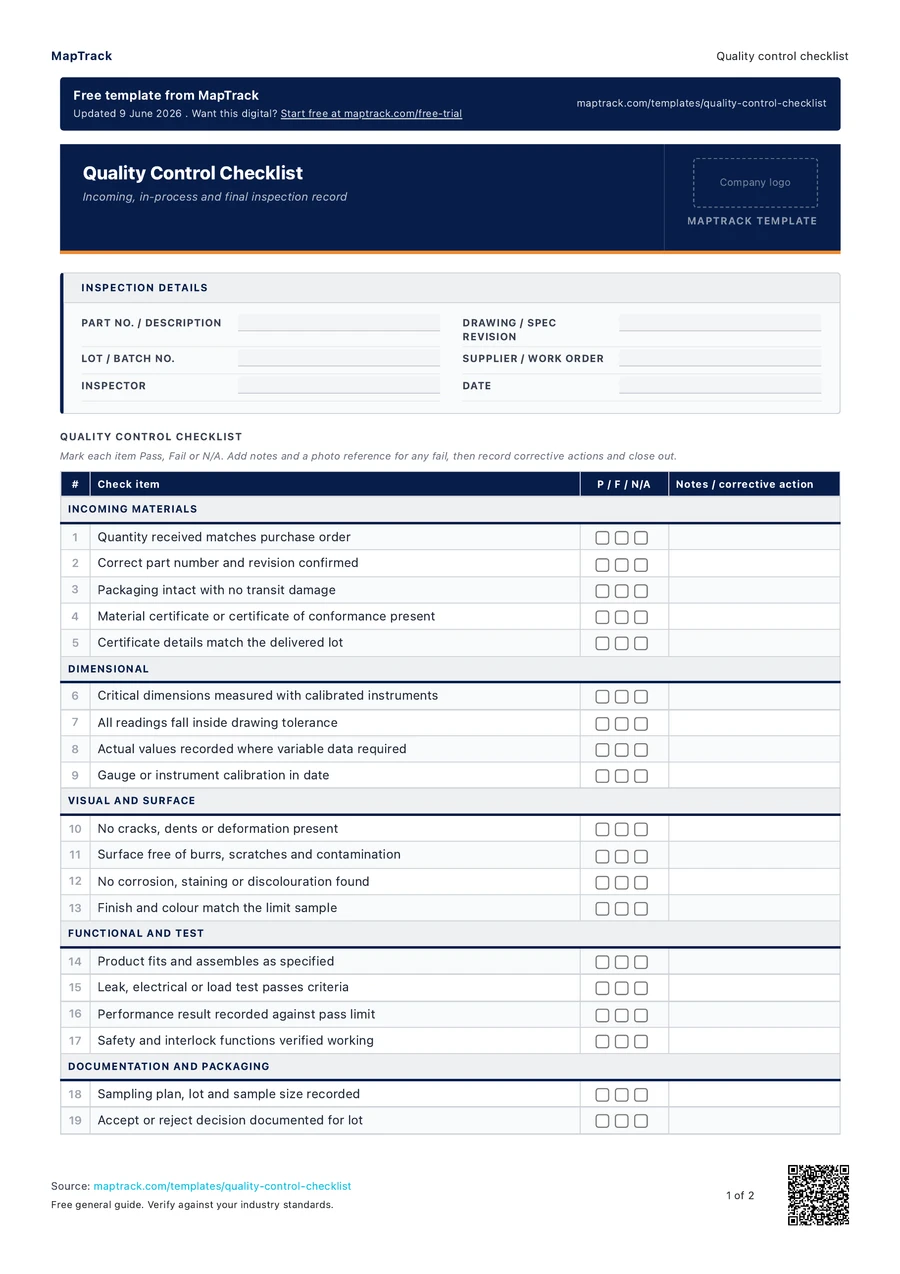
Free quality control checklist (PDF-ready). Incoming, in-process and final inspection: dimensional, visual, functional, traceability and sampling.
Loading PDF page...

Read the form fields
22 checks · 5 sections · Sign-off
22 checks
The fields in the printable form, in a view that fits your screen.
- Part no. / description
- Drawing / spec revision
- Lot / batch no.
- Supplier / work order
- Inspector
- Date
Incoming materials
Dimensional
Visual and surface
Functional and test
Documentation and packaging
Completed by
Signature · Print name · Role · Date
Reviewed / approved by
Signature · Print name · Role · Date
The MapTrack quality control checklist contains 22 checks across 5 sections.

Make this form your own
Add your fields and logo. Give your team a form they can use on site.
Free 30-day trial. No credit card. Work email needed.
Upload & use this form now for free



“MapTrack beat them all in every aspect.”
 Vincent Stone · HSEQ Advisor, Concept Tanks
After signup: upload this PDF, check the form MapTrack drafts, then save and publish it for your team.
General guidance only. Check the form against your equipment manual, site procedures and local requirements before using it.
Key takeaways
- The MapTrack quality control checklist contains 22 checks across 5 sections. Sections covered: Incoming materials, Dimensional, Visual and surface, Functional and test, Documentation and packaging.
- A quality control checklist verifies materials, in-process work and finished product against defined acceptance criteria.
- ISO 9001:2015 Clause 8.6 requires verification before release and a record of who authorised it.
- Cover dimensional, visual, functional, materials, labelling, traceability and sampling in one structured pass.
- Use AQL sampling such as ISO 2859-1 to size samples and set defensible accept or reject limits.
- Segregate and disposition nonconforming product, then sign off release with a retained record.
What is a quality control checklist?
A quality control checklist is a structured inspection record used to verify that materials, in-process work and finished product conform to specification before they move to the next stage or reach the customer. It groups the checks an inspector performs into clear pass or fail items across incoming goods, dimensional measurement, visual and surface condition, functional or performance testing, and documentation and packaging. Each item ties back to a defined acceptance criterion so two inspectors reach the same verdict on the same part, and so every release decision is supported by an objective record rather than a judgement call.
ISO 9001 clause 8.6 covers the release of products and services, and a quality control checklist is how a team controls release at the bench. It documents who inspected what, against which criteria, with what result, and who authorised the release, giving the traceability auditors look for. Used consistently across incoming, in-process and final inspection, the checklist turns scattered quality habits into a repeatable gate that catches defects early, before scrap, rework or escapes become expensive.
Learn more about compliance and inspections in MapTrack.
Choose the format that fits your team
Download the PDF
Use the original printable form for a paper workflow. Check it against your equipment and site procedure before the job.
Keep completed copies in your own record system and arrange any follow-up through your normal process.
Download free PDFCustomise a form in MapTrack
Start a free trial, upload this PDF and MapTrack drafts the form. Adjust it to your workflow, then save and publish it for your team to use.
Sample answers on this page and completed PDF records aren't imported automatically.
Upload & use this form now for freeFree 30-day trial. No credit card. Work email needed.
Benefits of using this quality control checklist
- Consistent acceptance: every inspector checks the same items against the same criteria, so release decisions stay repeatable across shifts and people.
- Defects caught early: incoming and in-process gates stop nonconforming material before value is added, reducing scrap, rework and customer escapes.
- Audit-ready evidence: completed checklists record who inspected, against what criteria and who authorised release, satisfying ISO 9001 verification needs.
- Faster onboarding: a clear pass or fail format lets new or relief inspectors perform reliable checks without years of accumulated bench knowledge.
- Sampling discipline: documented lot size, sample size and acceptance numbers keep AQL-based inspection consistent and statistically defensible.
- Traceable disposition: nonconforming product is segregated, identified and routed for a recorded decision rather than slipping back into normal flow.
What to include in a quality control checklist
- Header and references: part number, revision, supplier or work order, lot or batch number, quantity, inspector name, date, and the drawing, specification or standard inspected against.
- Incoming material checks: verify quantity received against the order, packaging condition, correct part and revision, and that material or certificate documents are present and match.
- Dimensional checks: measure critical and major characteristics against the drawing with calibrated instruments, record actual values where required, and confirm each reading is inside tolerance.
- Visual and surface checks: inspect for cracks, scratches, dents, burrs, corrosion, contamination, colour and finish defects against a defined acceptance standard or limit sample.
- Functional and performance test: confirm the product operates as specified through fit, assembly, leak, electrical, load or performance tests, and record results against the pass criteria.
- Materials and certificates: confirm the correct material grade, heat or lot traceability, and that mill certificates, test reports or certificates of conformance are valid and retained.
- Labelling and packaging: verify correct labels, markings, serial numbers, barcodes, handling and storage instructions, and that packaging protects the product for transport and storage.
- Sampling and acceptance criteria: record the sampling plan used (such as an ISO 2859-1 AQL plan), lot size, sample size, acceptance and rejection numbers, and the accept or reject decision.
- Disposition and sign-off: record the overall result, the disposition of any nonconforming items (accept, rework, repair, return, scrap or concession), and who authorised release.
How to use this quality control checklist
Set up the inspection and confirm the acceptance criteria before touching the product.
Pull the current drawing, specification and standard for the part, and confirm you have the correct revision. Identify which characteristics are critical, major and minor, and note the tolerance for each. Check that your measuring instruments are calibrated and in date, and record the lot or batch details on the checklist header so the result is fully traceable.
Inspect incoming materials and verify documentation against the order.
Confirm the quantity received matches the order, the part number and revision are correct, and packaging arrived undamaged. Check that material certificates, certificates of conformance and test reports are present, valid and match the delivered lot. Hold any delivery with missing paperwork or visible damage in a quarantine area until the discrepancy is resolved, rather than releasing it to production.
Perform dimensional, visual and functional checks against specification.
Measure each required characteristic with calibrated instruments and record actual readings where the checklist calls for variable data, confirming every value sits inside tolerance. Inspect surfaces for cracks, burrs, corrosion and finish defects against the defined limit sample. Run the specified functional or performance tests, such as fit, leak, electrical or load checks, and record measured results against the documented pass criteria.
Apply the sampling plan and record the acceptance decision.
For lot-by-lot inspection, use the agreed sampling plan, for example an ISO 2859-1 AQL plan, to determine the sample size and the acceptance and rejection numbers from the lot size and inspection level. Inspect the sampled units, count the nonconformities found, and compare the count to the acceptance number. Record the lot size, sample size, accept and reject limits, and the resulting accept or reject decision on the checklist.
Disposition nonconforming product and authorise release.
Segregate and clearly identify any nonconforming items so they cannot be used or shipped by mistake, in line with the control of nonconforming output requirement. Record the disposition decision, whether accept, rework, repair, return to supplier, scrap or use under concession, and the authority for it. Once all planned checks pass, the authorised person signs the checklist to release the product, and the completed record is retained as evidence.
How often should you complete this checklist?
Quality control inspection is driven by product flow, not the calendar. Incoming inspection happens on each delivery or lot received, in-process inspection happens at defined hold points or first-off and last-off a run, and final inspection happens before each lot is released to the customer or to stock. The depth of each check is set by risk, history and contract requirements, with critical characteristics inspected on every lot and lower-risk features sampled. For a new supplier, a new part or a process change, a first article or first piece inspection is performed before normal production sampling begins.
Sampling frequency and intensity should respond to demonstrated quality. AQL-based schemes such as ISO 2859-1 use switching rules that tighten inspection when a supplier or process deteriorates and allow reduced inspection when a strong record is established, which keeps inspection effort matched to actual risk. Review your inspection points, sampling plans and acceptance criteria at least annually, and whenever a recurring escape, customer complaint or audit finding shows the current checks are missing a defect. The checklist itself should be version controlled so changes to criteria are traceable.
Make this form your own
From your template to your team.
Upload this PDF and MapTrack drafts the form. Adjust it for your equipment and site, then save and publish the digital form for your team.
- 01
Start your free trial
Use your work email to create your MapTrack account.
- 02
Customise, save and publish
Adjust the template fields and branding for your site.
- 03
Complete it on the job
Record checks, add photos and export a branded PDF.
Keep working offline
Load the form before you lose reception. Complete it offline and sync when you're back online.
Scan the asset. Open its form.
Use an asset's QR code to find and complete the forms that belong to it.
Show what you found
Capture photos and attach files so the next person has the details they need.
Take a branded PDF with you
Download completed forms as PDF reports with your company logo.
Completed paper records aren't imported automatically.
Frequently asked questions
Practical answers about the form, record keeping and using MapTrack.
ISO 9001 Clause 8.6 covers the release of products and services. A quality control checklist is how teams carry this out at the bench. It defines the acceptance criteria, records the inspection results against them, and captures who authorised release. The completed checklist is the retained documented information that shows the criteria were met and provides traceability to the person who released the product.
Link to this answerISO 9001 Clause 8.7 covers control of nonconforming outputs, and the standard defines a nonconformity as the non-fulfilment of a requirement. In practice, identify and hold product that fails inspection so it cannot be used or shipped by mistake, decide how to deal with it (correction, segregation, containment, return, suspension, or release under concession where the customer allows it), and record the nonconformity, the decision, any concession and who made the call. A checklist disposition section captures exactly this evidence.
Link to this answerMany manufacturers use ISO 2859-1, which provides AQL-indexed sampling schemes for lot-by-lot inspection by attributes. You select an acceptance quality limit, an inspection level and the lot size, then read off the sample size and the acceptance and rejection numbers. Switching rules move you between normal, tightened and reduced inspection as quality changes. The right AQL depends on the risk of the characteristic, so safety-critical features get a tighter limit than cosmetic ones. Record the plan, lot size, sample size and accept or reject decision on the checklist for traceability.
Link to this answerA control plan is a planning document that maps every product and process characteristic to the control method, specification, measurement technique, sample size and reaction plan across the whole process. A quality control checklist is the inspection record an operator or inspector completes at a specific point, capturing the actual pass or fail result against those criteria. The control plan defines what should be controlled and how, while the checklist is the executed evidence that the control happened. They work together, and many teams derive their inspection checklists directly from the control plan.
Link to this answerYes. This quality control checklist is free to download and use, with no account required. It downloads as a PDF you can print or share with your inspectors. If you want to run these checks on a phone or tablet, capture photo evidence, apply sampling rules automatically and trend defects across suppliers and lots, MapTrack turns the checklist into live digital forms with full traceability. Start free or book a demo to see how.
Link to this answerApplicable regulatory standards
This form is a starting point. Check the current requirements that apply to your equipment, work and location. The form alone does not establish compliance.
- ISO 9001 Clause 8.6 (Release of products and services)
- ISO 9001 Clause 8.5.1 (Control of production and service provision)
- ISO 9001 Clause 8.7 (Control of nonconforming outputs)
- ISO 2859-1 (Sampling procedures for inspection by attributes, AQL-indexed lot-by-lot)
- AS9100 / AS9102 (Aerospace first article inspection, where applicable)
MapTrack publishes this template. The linked authorities publish their own guidance; they haven't endorsed this form.
The numbers behind this quality control checklist
Every figure below is sourced and dated, so you can quote it in a toolbox talk, a budget case or a board paper without having to chase the original report.
Cite this template
Writing about this topic? You’re welcome to quote this checklist. Here’s the wording to use so your readers can find the original.
The MapTrack quality control checklist contains 22 checks across 5 sections.
- Short attribution
- MapTrack Quality control checklist, https://www.maptrack.com/templates/quality-control-checklist
- Reference list
- MapTrack. (2026). Quality control checklist [Checklist template]. Retrieved from https://www.maptrack.com/templates/quality-control-checklist
Free to reuse with credit under a Creative Commons Attribution 4.0 licence. If you’d rather link straight to it, the page is https://www.maptrack.com/templates/quality-control-checklist.
Embed this free template on your website
Run an industry blog, trade association site, or training resource? Drop a preview of this free quality control checklist straight into your page. The snippet is self-contained, needs no scripts, and links readers back to the full free template.
<div style="max-width:480px;font-family:system-ui,-apple-system,'Segoe UI',Roboto,sans-serif;border:1px solid #E5E7EB;border-radius:12px;padding:20px;background:#ffffff;">
  <p style="font-size:12px;font-weight:700;letter-spacing:0.05em;text-transform:uppercase;color:#071D49;margin:0;">Free template</p>
  <p style="font-size:18px;font-weight:700;color:#071D49;margin:6px 0 0;">Quality control checklist</p>
  <ul style="margin:12px 0 0;padding-left:18px;color:#374151;font-size:14px;line-height:1.6;">
    <li style="margin:4px 0;">Header and references: part number, revision, supplier or work order, lot or batch number, quantity, inspector name, date, and the drawing, specification or standard inspected against.</li>
    <li style="margin:4px 0;">Incoming material checks: verify quantity received against the order, packaging condition, correct part and revision, and that material or certificate documents are present and match.</li>
    <li style="margin:4px 0;">Dimensional checks: measure critical and major characteristics against the drawing with calibrated instruments, record actual values where required, and confirm each reading is inside tolerance.</li>
    <li style="margin:4px 0;">Visual and surface checks: inspect for cracks, scratches, dents, burrs, corrosion, contamination, colour and finish defects against a defined acceptance standard or limit sample.</li>
    <li style="margin:4px 0;">Functional and performance test: confirm the product operates as specified through fit, assembly, leak, electrical, load or performance tests, and record results against the pass criteria.</li>
    <li style="margin:4px 0;">Materials and certificates: confirm the correct material grade, heat or lot traceability, and that mill certificates, test reports or certificates of conformance are valid and retained.</li>
  </ul>
  <p style="font-size:13px;color:#6B7280;margin:14px 0 0;padding-top:12px;border-top:1px solid #E5E7EB;">Free <a href="https://www.maptrack.com/templates/quality-control-checklist" style="color:#071D49;font-weight:600;text-decoration:none;">Quality control checklist</a> by MapTrack</p>
</div>Free to reuse, including commercially. This template is published under a Creative Commons Attribution 4.0 licence. Copy it, adapt it, put it on your own site or in your own docs. All we ask is that you credit MapTrack with a link back to this page. The snippet above already includes that credit, so if you use it as-is you’re covered.
About the author

Co-Founder & Commercial Director
Jarrod has spent over a decade in technology consulting and asset management, including roles at Accenture (mining and heavy industry) and CGI as an Asset Management Consultant. He co-founded MapTrack and built and scaled its original platform, then rebuilt it with Lachlan and Alex from thousands of customer conversations and 300+ user research sessions with field teams. His consulting background gives him deep insight into the operational and compliance challenges facing asset-intensive Australian businesses.
View LinkedIn profile →Ready for your next job?
Keep the PDF handy, or upload it to MapTrack and turn it into a digital form for your team.