
Free supplier audit checklist
Free supplier audit checklist (printable PDF). Assess QMS, process control, traceability and non-conformance to ISO 9001 and 19011. Download free.
Updated 28 Sept 2026
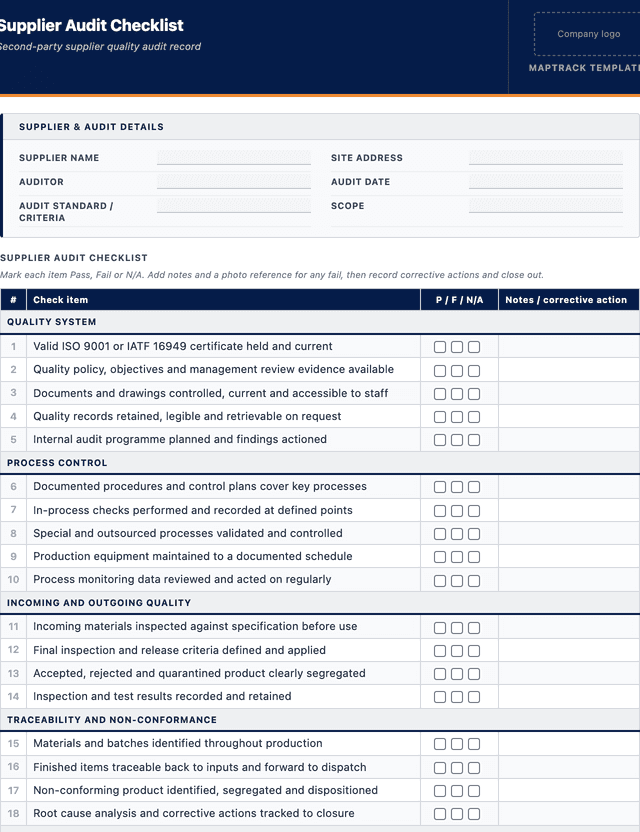
Supplier Audit Checklist
Second-party supplier quality audit record
Quality system
Process control
Incoming and outgoing quality
Traceability and non-conformance
Capability and sub-tier
How to use: download the PDF, print or complete digitally on any device.
- PDF format, ready to print or fill on screen
- Use as-is or customise to suit your operation
- Go digital in MapTrack for photos, reminders and audit trails
Download free PDF template
Use in MapTrack →


Trusted by teams across Australia and New Zealand
We respect your privacy. Unsubscribe anytime.
Or set it up in MapTrack
- Fill it in on a phone, attach photos to any check
- Automatic reports and audit trails
- Upload the PDF and MapTrack drafts the form for you
Free 30-day trial. No credit card. Personal email accepted.
Don't just download it - use it live. Start a free workspace, upload this supplier audit checklist and MapTrack drafts it as a form your crew can run from a phone.

Co-Founder & Commercial Director
Key takeaways
- The MapTrack supplier audit checklist contains 22 checks across 5 sections. Sections covered: Quality system, Process control, Incoming and outgoing quality, Traceability and non-conformance, Capability and sub-tier.
- A supplier audit checklist verifies that an external provider can consistently meet your quality and delivery requirements.
- ISO 9001 Clause 8.4 covers the control of externally provided processes, products and services.
- ISO 19011:2018 supplies the method: opening meeting, evidence collection, findings and closing meeting.
- Frame every line as a conform or non-conform check so findings are objective and comparable across suppliers.
- Each non-conform finding should drive a corrective action with an owner, a due date and verified closure.
Enter your email below to download this supplier audit checklist as a ready-to-use PDF.
Used by construction, mining and field service teams







What is a supplier audit checklist?
A supplier audit checklist is a structured assessment tool used to verify that an external provider, vendor or contractor can consistently supply products and services that meet your specified requirements. It guides an auditor through the supplier quality management system, document and record control, process control, incoming and outgoing inspection, traceability, non-conforming product handling, calibration, training, sub-tier supplier control and delivery performance. Each line is framed as a clear conform or non-conform check, so findings are objective, repeatable and easy to score across multiple suppliers and audit cycles.
Controlling externally provided processes, products and services is a core requirement of ISO 9001 Clause 8.4, whose sub-clauses cover the type and extent of control (8.4.2) and information for external providers (8.4.3). ISO 19011:2018 provides the auditing method behind the checklist, covering the opening meeting, evidence collection, findings and the closing meeting under a risk-based, evidence-based approach. In the automotive sector, IATF 16949:2016 extends these expectations through second-party audits and sub-tier requirements. A consistent checklist turns these standards into a practical, defensible record that supports approval decisions, corrective action and continuous improvement.
Learn more about compliance and inspections in MapTrack.
Benefits of using this supplier audit checklist
- Objective scoring: every line is a clear conform or non-conform check, so results stay consistent across suppliers and auditors.
- Risk reduction: verify quality systems, process control and traceability before defects reach your production line or customers.
- Standard alignment: map your supplier controls to ISO 9001:2015 Clause 8.4, ISO 19011:2018 method and IATF 16949 expectations.
- Approval evidence: build a defensible record that supports supplier approval, conditional approval or removal from the approved list.
- Corrective action trigger: each non-conform finding feeds a corrective action with a clear owner, due date and verification step.
- Continuous improvement: trend findings across audit cycles to focus development effort on the suppliers and processes that need it.
Benefits of digitising forms in MapTrack
When you move your checklists from paper to MapTrack, you get:
- Field users can easily scan a QR code to complete a form on mobile. Unlimited users.
- Email the right people when a form is submitted, with an automation you set up.
- File every completed form against the asset, location or person it covers.
- Download any completed form as a PDF, with failed answers listed at the top.
- Fill in forms offline; they upload when the device is back online.
- Build conditional logic (show or hide questions based on answers).
- Take pictures or attach photos. Not possible with a paper-based form.
- Electronic signatures.
- Edit forms later without reprinting.
- Set who can view, fill in or edit forms with user roles.
- Upload a paper form (PDF, Word, Excel or a photo) and MapTrack's AI builds a digital version for you to check.
- Assign audits and send reminder emails to the people doing them.
- Keep every audit, inspection and sign-off against the asset or site it covers.
- Track corrective actions as work orders from finding to close-out, with each change in the activity log.
Book a demo to see how MapTrack handles checklists.
Try MapTrack free for 30 days
Full access to every feature. No credit card required. Per-asset pricing so you scale as your fleet grows.
- No credit card required
- 30 days free trial
- Cancel anytime
1-2 days/week saved
“Bloody amazing! We used to spend 1-2 days a week tracking and managing our generators alone.”

Steve McAllister
Asset Coordinator, Saunders International
What to include in a supplier audit checklist
This supplier audit checklist covers 9 key areas:
- Supplier and audit details: supplier name, site address, contact, audit date, auditor, audit type and scope, and the standards used as audit criteria.
- Quality management system and certification: confirm a documented QMS, current ISO 9001 or IATF 16949 certificate, quality policy, objectives and management review records.
- Document and record control: check that procedures, work instructions, drawings and specifications are current, controlled and available, and that quality records are retained and retrievable.
- Process control and monitoring: review process documentation, control plans, in-process checks, statistical monitoring, equipment maintenance and control of any special or outsourced processes.
- Incoming and outgoing inspection: verify receiving inspection of raw materials, in-process and final inspection, release criteria, and segregation of accepted, rejected and quarantined product.
- Traceability and identification: confirm material and batch identification, lot traceability through production, and the ability to trace a finished item back to its inputs and forward to dispatch.
- Non-conforming product and corrective action: check identification, segregation and disposition of non-conforming product, root cause analysis, corrective action tracking and effectiveness review.
- Calibration, training and competency: confirm calibration of measuring equipment with traceability, plus training records, competency evidence and qualification of key operators and inspectors.
- Sub-tier management, capacity and delivery: review selection and monitoring of sub-tier suppliers, flow-down of requirements, production capacity, and on-time delivery and quality performance data.
How to use this supplier audit checklist
- Plan the audit and confirm scope, criteria and the supplier processes to be sampled.: Define the audit objectives, the standards and contract clauses that form the audit criteria, and the product lines or processes in scope. Send the checklist and agenda to the supplier in advance, and confirm the audit dates, site access and the records you will need to review on the day.
- Hold an opening meeting and confirm the plan with the supplier management team.: Following the ISO 19011:2018 method, open the audit by confirming the scope, criteria and timetable with the people who own the audited processes. Explain that findings are based on a sample of evidence, agree how non-conformances will be raised and reported, and confirm safety and confidentiality arrangements before you begin.
- Collect and verify evidence against each checklist item across the supplier site.: Gather objective evidence through interviews, direct observation of the process, and review of documents and records such as certificates, inspection results and calibration data. Mark each item conform or non-conform, record the evidence seen, and trace a sample of product forwards and backwards to test the traceability system end to end.
- Grade findings, classify non-conformities and agree corrective actions with owners.: Classify each non-conformity by severity, for example major or minor, and link it to the specific requirement that was not met. Distinguish genuine non-conformances from opportunities for improvement, then agree the corrective action, the responsible owner and a realistic due date for each finding raised during the audit.
- Close the audit, report results and verify corrective actions to closure.: Hold a closing meeting to present the findings and the overall result to supplier management so they are understood and acknowledged. Issue the written report with the agreed corrective actions, then track each action to completion, verify effectiveness with evidence, and update the supplier approval status and risk rating accordingly.
In MapTrack, you can automate compliance tracking and audit trails. Each submission is stored as a timestamped PDF against the asset record.
Get the free templateEnter your email above to download the full supplier audit checklist as a PDF.Back to download formHow often should you complete this checklist?
How often you audit a supplier should be driven by risk, not by a fixed calendar. ISO 9001 Clause 8.4.2 covers the type and extent of control over external providers, and a critical or single-source supplier warrants more frequent and deeper audits than a low-risk commodity vendor. A common pattern is an initial approval audit before first supply, then periodic surveillance audits, with annual audits for higher-risk suppliers and longer intervals for proven, low-risk ones.
Trigger an additional audit whenever the risk picture changes. New suppliers, a move to a new manufacturing site, recurring non-conformances, customer complaints, a significant process or ownership change, or a drop in delivery and quality performance all justify bringing an audit forward. In automotive supply chains, IATF 16949:2016 expects organisations to document the criteria that decide when, what type and how often second-party audits are needed. Record your audit frequency rationale so the chosen schedule is defensible during certification and customer audits.
Frequently asked questions
Applicable regulatory standards
This template is a starting point. Check the current requirements that apply to your equipment, work and location. The template alone does not establish compliance.
- ISO 9001 Clause 8.4 - Control of externally provided processes, products and services
- ISO 19011:2018 - Guidelines for auditing management systems
- IATF 16949:2016 - Automotive QMS, supplier management (Section 8.4)
Check the current source
Supplier audit checklist preview
The numbers behind this supplier audit checklist
Every figure below is sourced and dated, so you can quote it in a toolbox talk, a budget case or a board paper without having to chase the original report.
Embed this free template on your website
Run an industry blog, trade association site, or training resource? Drop a preview of this free supplier audit checklist straight into your page. The snippet is self-contained, needs no scripts, and links readers back to the full free template.
<div style="max-width:480px;font-family:system-ui,-apple-system,'Segoe UI',Roboto,sans-serif;border:1px solid #E5E7EB;border-radius:12px;padding:20px;background:#ffffff;">
  <p style="font-size:12px;font-weight:700;letter-spacing:0.05em;text-transform:uppercase;color:#071D49;margin:0;">Free template</p>
  <p style="font-size:18px;font-weight:700;color:#071D49;margin:6px 0 0;">Supplier audit checklist</p>
  <ul style="margin:12px 0 0;padding-left:18px;color:#374151;font-size:14px;line-height:1.6;">
    <li style="margin:4px 0;">Supplier and audit details: supplier name, site address, contact, audit date, auditor, audit type and scope, and the standards used as audit criteria.</li>
    <li style="margin:4px 0;">Quality management system and certification: confirm a documented QMS, current ISO 9001 or IATF 16949 certificate, quality policy, objectives and management review records.</li>
    <li style="margin:4px 0;">Document and record control: check that procedures, work instructions, drawings and specifications are current, controlled and available, and that quality records are retained and retrievable.</li>
    <li style="margin:4px 0;">Process control and monitoring: review process documentation, control plans, in-process checks, statistical monitoring, equipment maintenance and control of any special or outsourced processes.</li>
    <li style="margin:4px 0;">Incoming and outgoing inspection: verify receiving inspection of raw materials, in-process and final inspection, release criteria, and segregation of accepted, rejected and quarantined product.</li>
    <li style="margin:4px 0;">Traceability and identification: confirm material and batch identification, lot traceability through production, and the ability to trace a finished item back to its inputs and forward to dispatch.</li>
  </ul>
  <p style="font-size:13px;color:#6B7280;margin:14px 0 0;padding-top:12px;border-top:1px solid #E5E7EB;">Free <a href="https://www.maptrack.com/templates/supplier-audit-checklist" style="color:#071D49;font-weight:600;text-decoration:none;">Supplier audit checklist</a> by MapTrack</p>
</div>Free to reuse, including commercially. This template is published under a Creative Commons Attribution 4.0 licence. Copy it, adapt it, put it on your own site or in your own docs. All we ask is that you credit MapTrack with a link back to this page. The snippet above already includes that credit, so if you use it as-is you’re covered.
Cite this template
Writing about this topic? You’re welcome to quote this checklist. Here’s the wording to use so your readers can find the original.
The MapTrack supplier audit checklist contains 22 checks across 5 sections.
- Short attribution
- MapTrack Supplier audit checklist, https://www.maptrack.com/templates/supplier-audit-checklist
- Reference list
- MapTrack. (2026). Supplier audit checklist [Checklist template]. Retrieved from https://www.maptrack.com/templates/supplier-audit-checklist
Free to reuse with credit under a Creative Commons Attribution 4.0 licence. If you’d rather link straight to it, the page is https://www.maptrack.com/templates/supplier-audit-checklist.
Need to automate compliance tracking and audit trails?
Register every asset in MapTrack, attach digital forms, and get a complete history of every inspection, service and compliance record.
Compliance and inspections · All templates · Pricing · Book a demo