
Free template · PDF
Free control plan template
Free control plan template (PDF-ready). APQP control plan with characteristics, tolerances, sample size, control method and reaction plan. No sign-up.
Loading PDF page...
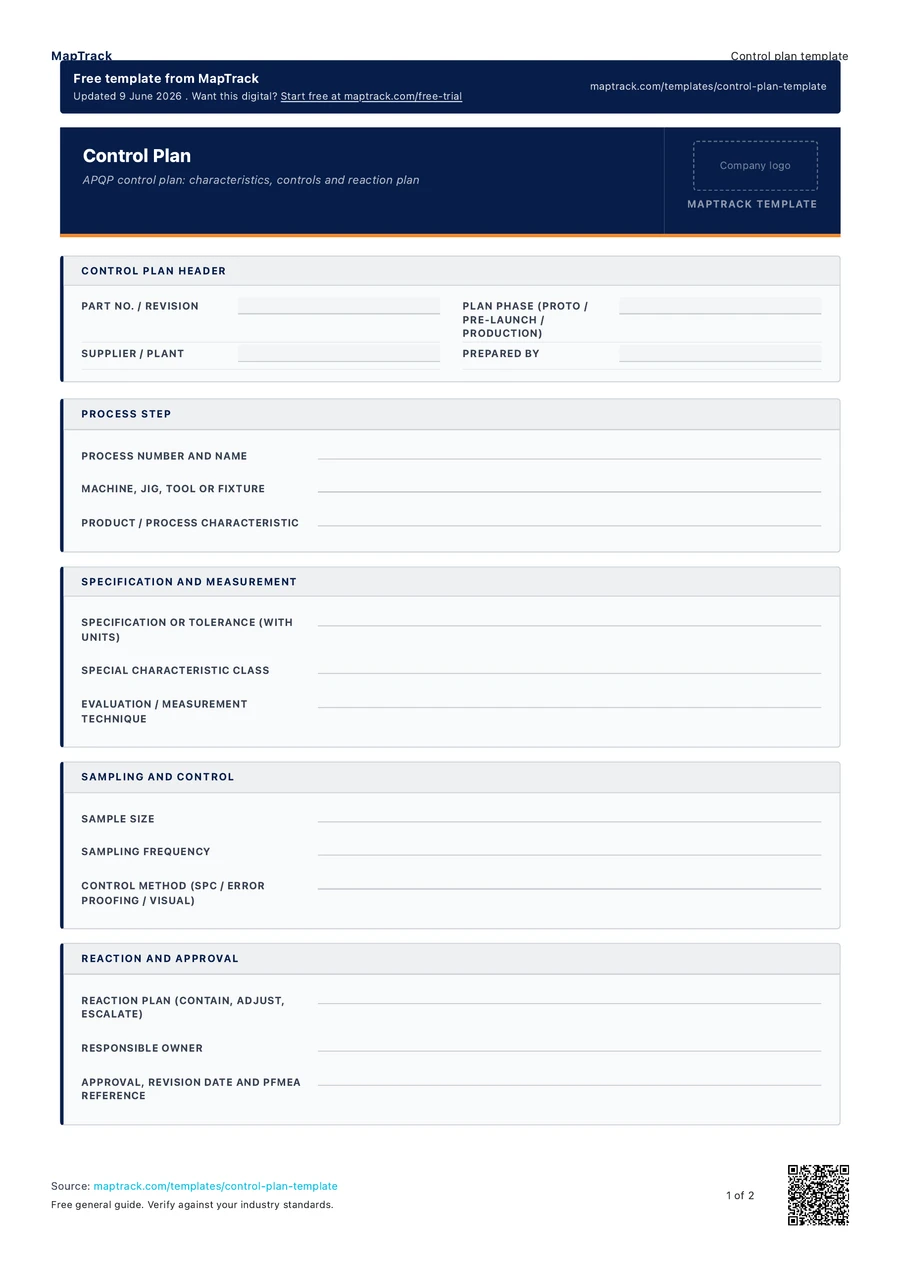

Read the form fields
APQP control plan: characteristics, controls and reaction plan
5 sections
The fields in the printable form, in a view that fits your screen.
Control Plan Header
- Part no. / revision
- Plan phase (proto / pre-launch / production)
- Supplier / plant
- Prepared by
Process step
- Process number and name
- Machine, jig, tool or fixture
- Product / process characteristic
Specification and measurement
- Specification or tolerance (with units)
- Special characteristic class
- Evaluation / measurement technique
Sampling and control
- Sample size
- Sampling frequency
- Control method (SPC / error proofing / visual)
Reaction and approval
- Reaction plan (contain, adjust, escalate)
- Responsible owner
- Approval, revision date and PFMEA reference
Completed by
Signature · Print name · Role · Date
Reviewed / approved by
Signature · Print name · Role · Date

Make this form your own
Add your fields and logo. Give your team a form they can use on site.
Free 30-day trial. No credit card. Work email needed.
Upload & use this form now for free



“MapTrack beat them all in every aspect.”
 Vincent Stone · HSEQ Advisor, Concept Tanks
After signup: upload this PDF, check the form MapTrack drafts, then save and publish it for your team.
General guidance only. Check the form against your equipment manual, site procedures and local requirements before using it.
Key takeaways
- A control plan lists each characteristic with its specification, measurement, sample size, frequency, control method and reaction plan.
- It flows from the process flow and PFMEA, so every assessed risk becomes a real, monitored control.
- Plans are issued by phase: prototype, then pre-launch, then production, with controls tuned as capability is proven.
- IATF 16949 clause 8.5.1.1 requires a multidisciplinary control plan, and PPAP lists it as a required element.
- The reaction plan defines containment, adjustment, disposition and escalation, so out of control results get a fast response.
What is a control plan template?
A control plan is a structured document that lists every product and process characteristic that must be controlled to deliver a conforming part, together with the specification or tolerance, the measurement technique, the sample size and frequency, the control method and the reaction plan to follow when a result falls out of control. It is one of the core quality planning tools used across automotive and regulated manufacturing, and it is written for the people who run the line, not just for the quality office.
The control plan flows directly from the process flow diagram and the PFMEA, so each failure mode and significant characteristic identified during risk analysis is carried forward into a real, monitored control. Plans are issued in three phases as a part matures from prototype, through pre-launch, to full production, with the depth of inspection usually highest early and then tuned as the process proves capable. A clear plan keeps controls consistent across shifts, operators and sites.
Learn more about compliance and inspections in MapTrack.
Choose the format that fits your team
Download the PDF
Use the original printable form for a paper workflow. Check it against your equipment and site procedure before the job.
Keep completed copies in your own record system and arrange any follow-up through your normal process.
Download free PDFCustomise a form in MapTrack
Start a free trial, upload this PDF and MapTrack drafts the form. Adjust it to your workflow, then save and publish it for your team to use.
Sample answers on this page and completed PDF records aren't imported automatically.
Upload & use this form now for freeFree 30-day trial. No credit card. Work email needed.
Benefits of using this control plan template
- Risk traceability: every characteristic and failure mode from the PFMEA is carried into a real, monitored control with an owner.
- Consistent inspection: operators across shifts and sites follow the same sample size, frequency and method, so results stay comparable.
- Faster reaction: a written reaction plan tells the line exactly what to contain, adjust and escalate when a reading goes out of control.
- Audit readiness: a complete plan shows IATF 16949 and PPAP reviewers that controls exist, are linked to risk and are actually being run.
- Smoother launches: prototype, pre-launch and production columns make the increase in control during ramp-up explicit and reviewable.
- Lower scrap and rework: detecting drift at the planned checkpoint stops nonconforming parts before they reach the next operation or the customer.
What to include in a control plan template
- Header block: part number, part name, revision level, supplier and plant, control plan number, phase (prototype, pre-launch or production) and the core team.
- Process number and process name or operation description, matched to the process flow diagram so each step is traceable.
- Machine, device, jig, tool or fixture used at that operation, so the control is tied to the equipment that produces the characteristic.
- Product characteristic and process characteristic for each step, with special or significant characteristics flagged using the customer classification symbol.
- Specification or tolerance for the characteristic, stated with units and limits exactly as the drawing or standard requires.
- Evaluation and measurement technique, including the gauge or method and a reference to the measurement system analysis where one applies.
- Sample size and sampling frequency, stating how many pieces are checked and how often, from every piece to a set interval.
- Control method, naming the SPC chart, error proofing, checklist, work instruction or visual standard used to hold the characteristic.
- Reaction plan, defining the containment, adjustment, disposition and escalation steps to take, and who acts, when a result is out of control.
How to use this control plan template
Gather the inputs and assemble the team
Pull together the drawings, process flow diagram, PFMEA, customer special characteristics and any lessons learned, then assemble the multidisciplinary team of quality, process, manufacturing and tooling so the plan reflects how the line actually runs.
List each process step and its characteristics
Walk the process flow in sequence and, for every operation, record the product and process characteristics that must be controlled, carrying across each significant characteristic and failure mode that the PFMEA identified so nothing assessed as a risk is left unmonitored.
Define specification, measurement and sampling
For each characteristic, capture the specification or tolerance with units, choose the evaluation and measurement technique with the right gauge, confirm the measurement system is capable, and set a sample size and frequency that matches the severity and the stability of the process.
Set the control method and the reaction plan
Decide how each characteristic is held, whether by SPC, error proofing, a checklist or a visual standard, and write a clear reaction plan stating the containment, adjustment, disposition and escalation steps plus the responsible owner for when a reading falls outside the limits.
Validate, approve and maintain by phase
Review the draft against the PFMEA for full coverage, obtain the required approvals, issue the correct prototype, pre-launch or production version, and then update the plan whenever the process, tooling, drawing or a corrective action changes so it stays a living document.
How often should you complete this plan?
A control plan is not a one-time document. Issue a prototype plan during product design, a pre-launch plan during process design and validation, and a production plan once the process is approved, with each phase typically adding tighter or more frequent checks as the part ramps up. After launch, the production plan stays live and is run continuously by operators at the sample frequencies it defines, while quality monitors the results for drift.
Review and revise the plan whenever a trigger occurs rather than only on a calendar. Common triggers are an engineering or drawing change, a process or tooling change, a new supplier or material, a recurring nonconformance, a corrective action that adds or changes a control, or a customer or audit request. Many organisations also run a periodic layered audit and an annual review to confirm the plan still matches the floor and that linked PFMEA risks remain covered.
Make this form your own
From your template to your team.
Upload this PDF and MapTrack drafts the form. Adjust it for your equipment and site, then save and publish the digital form for your team.
- 01
Start your free trial
Use your work email to create your MapTrack account.
- 02
Customise, save and publish
Adjust the template fields and branding for your site.
- 03
Complete it on the job
Record checks, add photos and export a branded PDF.
Keep working offline
Load the form before you lose reception. Complete it offline and sync when you're back online.
Scan the asset. Open its form.
Use an asset's QR code to find and complete the forms that belong to it.
Show what you found
Capture photos and attach files so the next person has the details they need.
Take a branded PDF with you
Download completed forms as PDF reports with your company logo.
Completed paper records aren't imported automatically.
Frequently asked questions
Practical answers about the form, record keeping and using MapTrack.
A PFMEA identifies what can go wrong at each process step, ranks the risk and recommends actions to reduce it. A control plan turns those conclusions into the day to day controls: the characteristic, specification, measurement, sample size, frequency, control method and reaction plan. The two are linked, so every significant characteristic and high risk failure mode in the PFMEA should appear as a real control in the plan. Auditors treat a risk that is in the PFMEA but missing from the control plan as a traceability gap, which is a common finding in IATF 16949 and PPAP reviews.
Link to this answerYes. IATF 16949 clause 8.5.1.1 requires the organisation to develop a control plan at the system, subsystem, component or material level for the manufacturing site, using a multidisciplinary approach. The plan must cover the controls used to manage the process and must exist for prototype where applicable, pre-launch and production. The clause also expects the plan to be reviewed and updated after changes such as engineering changes, process changes, nonconformances or measurement system findings, so it stays aligned with the PFMEA and the actual process on the floor.
Link to this answerA reaction plan is the documented set of actions to take when a characteristic is out of specification or out of statistical control. It tells the operator what to contain, how to adjust or stop the process, how to disposition the suspect parts and when to escalate, and it names who is responsible for each action. A strong reaction plan removes guesswork on the line, so a drifting reading triggers a fast, consistent response instead of nonconforming parts moving to the next operation. It is one of the most scrutinised columns in any control plan review.
Link to this answerThey are the same document at three maturity phases. The prototype plan supports early builds and focuses on dimensional, material and performance checks while the design settles. The pre-launch plan applies after the prototype and before full production, usually with extra inspection, more frequent sampling and added controls to contain risk during ramp up. The production plan is the steady state version used once the process is validated and approved through PPAP, with sampling tuned to the demonstrated capability. IATF 16949 expects pre-launch and production plans, and prototype when the customer requires it.
Link to this answerYes. This control plan template is free to download with no account, no sign-up and no payment. It downloads as a PDF: fill it in for your part and process, or adapt the columns to your customer format. MapTrack also lets you run control plans and inspections as live digital forms, so checks, results, reactions and approvals are captured against each asset and stay audit ready. Start free or book a demo to see how.
Link to this answerApplicable regulatory standards
This form is a starting point. Check the current requirements that apply to your equipment, work and location. The form alone does not establish compliance.
- IATF 16949:2016 clause 8.5.1.1 requires a control plan developed using a multidisciplinary approach, covering prototype, pre-launch and production phases.
- AIAG APQP and Control Plan reference manual defines the standard control plan columns and the prototype, pre-launch and production progression.
- ISO 9001 clause 8.5.1 (Control of production and service provision).
- PPAP (Production Part Approval Process, AIAG) lists the control plan as a required element, and the control plan must trace back to the PFMEA.
MapTrack publishes this template. The linked authorities publish their own guidance; they haven't endorsed this form.
The numbers behind this control plan template
Every figure below is sourced and dated, so you can quote it in a toolbox talk, a budget case or a board paper without having to chase the original report.
Cite this template
Writing about this topic? You’re welcome to quote this checklist. Here’s the wording to use so your readers can find the original.
- Short attribution
- MapTrack Control plan template, https://www.maptrack.com/templates/control-plan-template
- Reference list
- MapTrack. (2026). Control plan template [Checklist template]. Retrieved from https://www.maptrack.com/templates/control-plan-template
Free to reuse with credit under a Creative Commons Attribution 4.0 licence. If you’d rather link straight to it, the page is https://www.maptrack.com/templates/control-plan-template.
Embed this free template on your website
Run an industry blog, trade association site, or training resource? Drop a preview of this free control plan template straight into your page. The snippet is self-contained, needs no scripts, and links readers back to the full free template.
<div style="max-width:480px;font-family:system-ui,-apple-system,'Segoe UI',Roboto,sans-serif;border:1px solid #E5E7EB;border-radius:12px;padding:20px;background:#ffffff;">
  <p style="font-size:12px;font-weight:700;letter-spacing:0.05em;text-transform:uppercase;color:#071D49;margin:0;">Free template</p>
  <p style="font-size:18px;font-weight:700;color:#071D49;margin:6px 0 0;">Control plan template</p>
  <ul style="margin:12px 0 0;padding-left:18px;color:#374151;font-size:14px;line-height:1.6;">
    <li style="margin:4px 0;">Header block: part number, part name, revision level, supplier and plant, control plan number, phase (prototype, pre-launch or production) and the core team.</li>
    <li style="margin:4px 0;">Process number and process name or operation description, matched to the process flow diagram so each step is traceable.</li>
    <li style="margin:4px 0;">Machine, device, jig, tool or fixture used at that operation, so the control is tied to the equipment that produces the characteristic.</li>
    <li style="margin:4px 0;">Product characteristic and process characteristic for each step, with special or significant characteristics flagged using the customer classification symbol.</li>
    <li style="margin:4px 0;">Specification or tolerance for the characteristic, stated with units and limits exactly as the drawing or standard requires.</li>
    <li style="margin:4px 0;">Evaluation and measurement technique, including the gauge or method and a reference to the measurement system analysis where one applies.</li>
  </ul>
  <p style="font-size:13px;color:#6B7280;margin:14px 0 0;padding-top:12px;border-top:1px solid #E5E7EB;">Free <a href="https://www.maptrack.com/templates/control-plan-template" style="color:#071D49;font-weight:600;text-decoration:none;">Control plan template</a> by MapTrack</p>
</div>Free to reuse, including commercially. This template is published under a Creative Commons Attribution 4.0 licence. Copy it, adapt it, put it on your own site or in your own docs. All we ask is that you credit MapTrack with a link back to this page. The snippet above already includes that credit, so if you use it as-is you’re covered.
About the author

Co-Founder & Commercial Director
Jarrod has spent over a decade in technology consulting and asset management, including roles at Accenture (mining and heavy industry) and CGI as an Asset Management Consultant. He co-founded MapTrack and built and scaled its original platform, then rebuilt it with Lachlan and Alex from thousands of customer conversations and 300+ user research sessions with field teams. His consulting background gives him deep insight into the operational and compliance challenges facing asset-intensive Australian businesses.
View LinkedIn profile →Ready for your next job?
Keep the PDF handy, or upload it to MapTrack and turn it into a digital form for your team.