
Free HVAC refrigerant management log
Free HVAC refrigerant management log as PDF or Excel (XLSX). Track charge, recovery, leak checks and ARCTick licence compliance.
Updated 10 Aug 2026
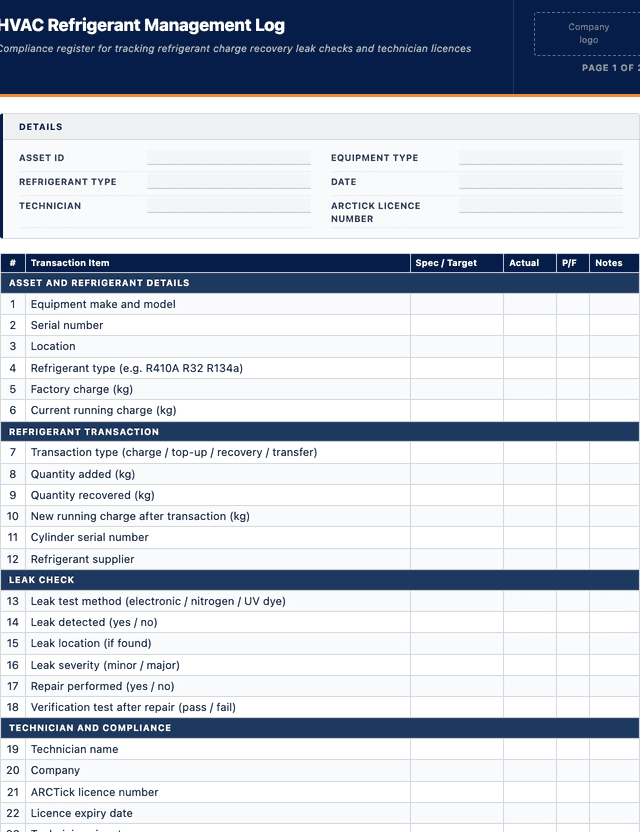
HVAC Refrigerant Management Log
Compliance register for tracking refrigerant charge recovery leak checks and technician licences
Asset and Refrigerant Details
Refrigerant Transaction
Leak Check
Technician and Compliance
How to use: download the PDF, print or complete digitally on any device.
- PDF format, ready to print or fill on screen
- Use as-is or customise to suit your operation
- Go digital in MapTrack for photos, reminders and audit trails
Download formats
- HVAC refrigerant management log PDF
PDF: Print-ready log for charge, recovery, leak checks and ARCTick licence details.
- HVAC refrigerant management log XLSX
XLSX: Editable Excel workbook with the same log columns, ready to total refrigerant quantities per period.
Two ways to use it
Use in MapTrack →Use it digitally instead
Unlimited usersThese same 23 checks, already built.




- Scan the asset’s QR tag with any phone
- Submitted forms can trigger alerts
- Photos on fails, audit-ready records
- Export responses, PDF reports with your logo
Free trial. No credit card needed.
Trusted by teams across Australia and New Zealand
We respect your privacy. Unsubscribe anytime.
These templates are free general guides provided as-is. They do not constitute legal, safety or compliance advice. You are responsible for ensuring any form meets your specific workplace obligations, industry standards and applicable regulations.
Don't just download it - use it live. Start a free workspace with this HVAC refrigerant management log already built, so your crew can run it from a phone.

Co-Founder & Commercial Director
Key takeaways
- The MapTrack HVAC refrigerant management log contains 23 checks across 4 sections. Sections covered: Asset and Refrigerant Details, Refrigerant Transaction, Leak Check, Technician and Compliance.
Enter your email below to download this HVAC refrigerant management log as a ready-to-use PDF.
Used by construction, mining and field service teams











What is an HVAC refrigerant management log?
An HVAC refrigerant management log is a compliance register used to record every refrigerant transaction across a building or portfolio of HVAC assets. MapTrack helps facility managers and HVAC contractors maintain digital refrigerant logs that link every charge, recovery and leak check to the specific asset serial number and technician licence details. The log tracks refrigerant type, quantity, cylinder serial numbers and running system charge for each piece of equipment, creating a complete chain of custody for all scheduled substances.
In Australia, the Ozone Protection and Synthetic Greenhouse Gas Management Act requires businesses to manage and report on scheduled substances including HFC and HCFC refrigerants. Internationally, the F-Gas Regulation (EU) 517/2014 and EPA Section 608 impose similar record-keeping obligations. A properly maintained refrigerant management log provides the evidence needed for compliance audits, environmental reporting and insurance reviews, and helps identify units with chronic leaks that are both costly and environmentally damaging.
Learn more about maintenance and work orders in MapTrack.
Benefits of using this HVAC refrigerant management log
- Regulatory compliance: a complete log demonstrates compliance with the Ozone Protection and Synthetic Greenhouse Gas Management Act
- Leak trend analysis: tracking refrigerant additions over time reveals units with chronic leaks that need repair rather than repeated top-up
- Licence verification: recording the ARCTick licence number of every technician who handles refrigerant ensures only licensed personnel perform the work
- Cost tracking: logging every refrigerant purchase and charge event provides visibility into refrigerant spending per asset and across the portfolio
- Audit readiness: a digital register with date-stamped entries is immediately available for auditors inspectors or insurers
- Environmental responsibility: accurate records support annual emissions reporting and demonstrate responsible management of scheduled substances
Benefits of digitising forms in MapTrack
When you digitise hvac log / registers in MapTrack, you get:
- Field users can easily scan a QR code to complete a form on mobile. Unlimited users.
- Email the right people when a form is submitted, with an automation you set up.
- File every completed form against the asset, location or person it covers.
- Download any completed form as a PDF, with failed answers listed at the top.
- Fill in forms offline; they upload when the device is back online.
- Build conditional logic (show or hide questions based on answers).
- Take pictures or attach photos. Not possible with a paper-based form.
- Electronic signatures.
- Edit forms later without reprinting.
- Set who can view, fill in or edit forms with user roles.
- Upload a paper form (PDF, Word, Excel or a photo) and MapTrack's AI builds a digital version for you to check.
- Log refrigerant charge weights and leak-check results against each unit.
- Schedule seasonal changeover inspections for each unit by date.
- Track filter, belt and coil replacement intervals per system.
Book a demo to see how MapTrack handles HVAC log / registers.
Try MapTrack free for 30 days
Full access to every feature. No credit card required. Per-asset pricing so you scale as your fleet grows.
- No credit card required
- 30 days free trial
- Cancel anytime
Less loss and downtime
“Doing monthly site audits in MapTrack has drastically reduced our equipment loss and downtime.”

Khalid El-Hussein
NSW Store Manager, Axis Services Group
What to include in an HVAC refrigerant management log
This HVAC refrigerant management log covers 8 key areas:
- Asset identification: record the asset ID equipment type location make model and serial number for every entry
- Refrigerant type: record the specific refrigerant used such as R410A R32 R134a R407C or R22 for each transaction
- Transaction type: specify whether the event is a charge top-up recovery or transfer and record the quantity in kilograms
- Running charge: record the total system charge after each transaction to maintain an accurate running balance
- Leak check details: document leak test method (electronic detector nitrogen pressure test UV dye) result and any leak location found
- Technician details: record the technician name company and ARCTick licence number for every refrigerant handling event
- Cylinder tracking: log the cylinder serial number and supplier for every refrigerant cylinder used
- Notes and corrective actions: record any repairs performed leak repair verification test results and recommended follow-up actions
How to use this HVAC refrigerant management log
- Create an entry for each asset: set up a log entry for every HVAC asset that contains refrigerant, recording the asset ID, equipment type, location, make, model, serial number and factory-specified refrigerant charge in kilograms
- Record every refrigerant transaction: each time refrigerant is added, removed or transferred, log the date, transaction type, quantity in kilograms, refrigerant type, cylinder serial number and the performing technician ARCTick licence number
- Update the running charge: after each transaction, calculate and record the new total system charge so the register always reflects the current refrigerant level and any discrepancy from the original factory charge is visible
- Document leak checks: record every leak test performed including the detection method used, whether a leak was found, and the specific location and estimated severity of any leak detected during the inspection
- Record repairs and verification: when a refrigerant leak is repaired, log the repair method and materials used, then record the results of the follow-up verification leak test to confirm the repair was successful
- Review the log quarterly: review the refrigerant management log each quarter to identify assets with recurring top-ups that indicate chronic leaks, and escalate those units for detailed repair investigation and remediation
- Archive and retain records: retain all refrigerant transaction records for a minimum of five years to satisfy the requirements of the Ozone Protection and Synthetic Greenhouse Gas Management Act and support future compliance audits
In MapTrack, you can track HVAC maintenance and service schedules. Each submission is stored as a timestamped PDF against the asset record.
Get the free templateEnter your email above to download the full HVAC refrigerant management log as a PDF.Back to download formHow often should you complete this log / register?
The refrigerant management log should be updated every time a refrigerant transaction occurs. This includes any charging top-up recovery or transfer event. In practice most commercial buildings will have refrigerant log entries at least quarterly when HVAC systems are serviced and refrigerant pressures are checked.
The Ozone Protection and Synthetic Greenhouse Gas Management Act requires records to be kept for all acquisition use and disposal of scheduled substances. Under the Australian WHS Act the PCBU also has a duty to maintain plant safely which includes managing refrigerant circuits.
Frequently asked questions
Applicable regulatory standards
This template is a starting point. Check the current requirements that apply to your equipment, work and location. The template alone does not establish compliance.
- Ozone Protection and Synthetic Greenhouse Gas Management Act 1989
- AS/NZS 3666.1 - Air-handling and water systems of buildings (microbial control)
- AS/NZS 1668.2 - Mechanical ventilation for acceptable indoor air quality
- PCBU duty of care (WHS Act 2011, Section 19)
Check the current source
HVAC refrigerant management log preview
The numbers behind this HVAC refrigerant management log
Every figure below is sourced and dated, so you can quote it in a toolbox talk, a budget case or a board paper without having to chase the original report.
Embed this free template on your website
Run an industry blog, trade association site, or training resource? Drop a preview of this free HVAC refrigerant management log straight into your page. The snippet is self-contained, needs no scripts, and links readers back to the full free template.
<div style="max-width:480px;font-family:system-ui,-apple-system,'Segoe UI',Roboto,sans-serif;border:1px solid #E5E7EB;border-radius:12px;padding:20px;background:#ffffff;">
  <p style="font-size:12px;font-weight:700;letter-spacing:0.05em;text-transform:uppercase;color:#071D49;margin:0;">Free template</p>
  <p style="font-size:18px;font-weight:700;color:#071D49;margin:6px 0 0;">HVAC refrigerant management log</p>
  <ul style="margin:12px 0 0;padding-left:18px;color:#374151;font-size:14px;line-height:1.6;">
    <li style="margin:4px 0;">Asset identification: record the asset ID equipment type location make model and serial number for every entry</li>
    <li style="margin:4px 0;">Refrigerant type: record the specific refrigerant used such as R410A R32 R134a R407C or R22 for each transaction</li>
    <li style="margin:4px 0;">Transaction type: specify whether the event is a charge top-up recovery or transfer and record the quantity in kilograms</li>
    <li style="margin:4px 0;">Running charge: record the total system charge after each transaction to maintain an accurate running balance</li>
    <li style="margin:4px 0;">Leak check details: document leak test method (electronic detector nitrogen pressure test UV dye) result and any leak location found</li>
    <li style="margin:4px 0;">Technician details: record the technician name company and ARCTick licence number for every refrigerant handling event</li>
  </ul>
  <p style="font-size:13px;color:#6B7280;margin:14px 0 0;padding-top:12px;border-top:1px solid #E5E7EB;">Free <a href="https://www.maptrack.com/templates/hvac-refrigerant-management-log" style="color:#071D49;font-weight:600;text-decoration:none;">HVAC refrigerant management log</a> by MapTrack</p>
</div>Free to reuse, including commercially. This template is published under a Creative Commons Attribution 4.0 licence. Copy it, adapt it, put it on your own site or in your own docs. All we ask is that you credit MapTrack with a link back to this page. The snippet above already includes that credit, so if you use it as-is you’re covered.
Cite this template
Writing about this topic? You’re welcome to quote this checklist. Here’s the wording to use so your readers can find the original.
The MapTrack HVAC refrigerant management log contains 23 checks across 4 sections.
- Short attribution
- MapTrack HVAC refrigerant management log, https://www.maptrack.com/templates/hvac-refrigerant-management-log
- Reference list
- MapTrack. (2026). HVAC refrigerant management log [Checklist template]. Retrieved from https://www.maptrack.com/templates/hvac-refrigerant-management-log
Free to reuse with credit under a Creative Commons Attribution 4.0 licence. If you’d rather link straight to it, the page is https://www.maptrack.com/templates/hvac-refrigerant-management-log.
Need to track HVAC maintenance and service schedules?
Register every HVAC in MapTrack, attach digital forms, and get a complete history of every inspection, service and compliance record.
Maintenance and work orders · All templates · Pricing · Book a demo