
Free exhaust fan inspection checklist
Free exhaust fan inspection checklist (PDF-ready). Covers motor, bearings, belts, guards, ductwork and airflow. Meets Australian WHS requirements.
Updated 2 May 2026
Exhaust Fan Inspection Checklist
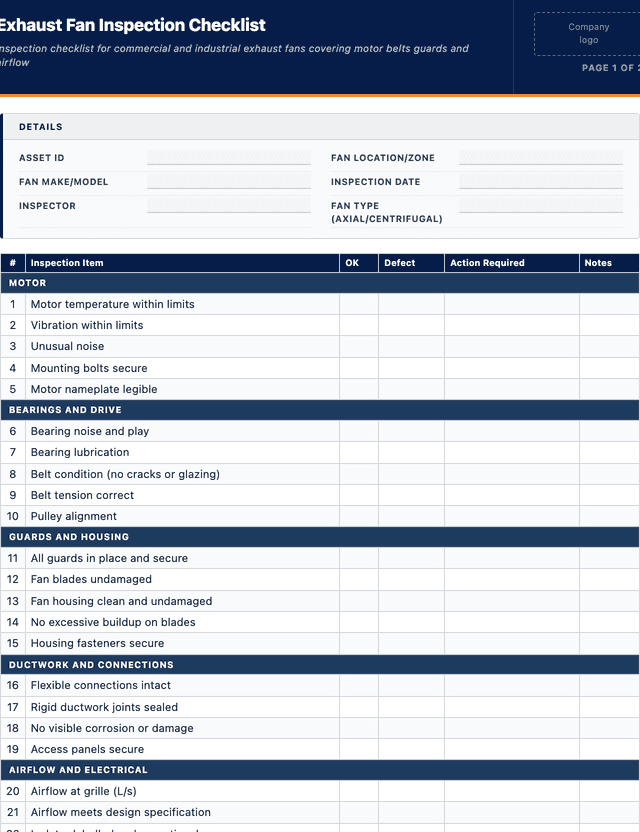
Inspection checklist for commercial and industrial exhaust fans covering motor belts guards and airflow
Motor
Bearings and Drive
Guards and Housing
Ductwork and Connections
Airflow and Electrical
How to use: download the PDF, print or complete digitally on any device.
- PDF format, ready to print or fill on screen
- Use as-is or customise to suit your operation
- Go digital in MapTrack for photos, reminders and audit trails
Download free PDF template
Use in MapTrack →



Trusted by teams across Australia and New Zealand
We respect your privacy. Unsubscribe anytime.
Or set it up in MapTrack
- Fill it in on a phone, attach photos to any check
- Automatic reports and audit trails
- The same checks as the PDF, ready to configure
Free 30-day trial. No credit card. Personal email accepted.
Don't just download it - use it live. Start a free workspace with this exhaust fan inspection checklist already built, so your crew can run it from a phone.

Co-Founder & Commercial Director
Key takeaways
- The MapTrack exhaust fan inspection checklist contains 24 checks across 5 sections. Sections covered: Motor, Bearings and Drive, Guards and Housing, Ductwork and Connections, Airflow and Electrical.
Enter your email below to download this exhaust fan inspection checklist as a ready-to-use PDF.
Used by construction, mining and field service teams











What is an exhaust fan inspection checklist?
An exhaust fan inspection checklist is a structured form used to verify that exhaust fans are operating safely and effectively. MapTrack users digitise this checklist to log inspections against each fan asset and trigger follow-up work orders automatically. The inspection covers motor condition, belt tension and alignment, bearings, guards, ductwork connections and measured airflow performance. Using a standardised checklist ensures every fan receives the same level of scrutiny regardless of its location or the technician performing the inspection.
Exhaust fans are critical safety assets in Australian commercial and industrial buildings. They remove heat, fumes, dust and airborne contaminants from kitchens, plant rooms, car parks, laboratories and manufacturing areas. A failed exhaust fan can create immediate health and safety risks including hazardous atmosphere buildup and non-compliance with the Building Code of Australia (NCC, BCA Volume 1, Part F4) essential safety measures requirements. AS/NZS 1668.2 sets minimum ventilation and extraction rates for occupied spaces, and AS 1851 requires routine service of fire protection systems including smoke exhaust fans. Regular documented inspections protect building occupants, demonstrate due diligence under the WHS Act, and provide the maintenance history needed for insurance and compliance audits. Without a systematic inspection programme, exhaust fan failures can go undetected for weeks, allowing hazardous atmospheres to develop in enclosed spaces and exposing building owners to enforcement action and liability.
Learn more about maintenance and work orders in MapTrack.
Benefits of using this exhaust fan inspection checklist
- Consistency: every fan receives the same inspection regardless of location or technician
- Compliance: documented inspections demonstrate the PCBU has met their WHS duty of care for ventilation systems
- Early fault detection: catching bearing wear belt glazing or motor overheating before failure prevents unplanned downtime
- Occupant safety: confirming exhaust airflow meets design specification protects building occupants from hazardous atmospheres
- Accountability: signed inspection records create a clear trail of who checked each fan and when
- Audit readiness: complete inspection history supports BCA compliance audits and insurer inspections
Benefits of digitising forms in MapTrack
When you digitise exhaust fan checklists in MapTrack, you get:
- Field users can easily scan a QR code to complete a form on mobile. Unlimited users.
- Email the right people when a form is submitted, with an automation you set up.
- File every completed form against the asset, location or person it covers.
- Download any completed form as a PDF, with failed answers listed at the top.
- Fill in forms offline; they upload when the device is back online.
- Build conditional logic (show or hide questions based on answers).
- Take pictures or attach photos. Not possible with a paper-based form.
- Electronic signatures.
- Edit forms later without reprinting.
- Set who can view, fill in or edit forms with user roles.
- Upload a paper form (PDF, Word, Excel or a photo) and MapTrack's AI builds a digital version for you to check.
- Log refrigerant charge weights and leak-check results against each unit.
- Schedule seasonal changeover inspections for each unit by date.
- Track filter, belt and coil replacement intervals per system.
Book a demo to see how MapTrack handles exhaust fan checklists.
Try MapTrack free for 30 days
Full access to every feature. No credit card required. Per-asset pricing so you scale as your fleet grows.
- No credit card required
- 30 days free trial
- Cancel anytime
Less loss and downtime
“Doing monthly site audits in MapTrack has drastically reduced our equipment loss and downtime.”

Khalid El-Hussein
NSW Store Manager, Axis Services Group
What to include in an exhaust fan inspection checklist
This exhaust fan inspection checklist covers 8 key areas:
- Motor condition: check for excessive heat vibration unusual noise and secure mounting bolts
- Bearings: listen for grinding or rumbling and check for excessive play or lubrication leaks
- Belt condition and tension: inspect belts for cracking glazing fraying and correct tension and alignment
- Guards and safety screens: confirm all guards are in place secure and undamaged
- Ductwork and connections: check flexible connections for tears and rigid ductwork for loose joints or corrosion
- Fan blades and housing: inspect for buildup damage imbalance and secure fasteners
- Airflow performance: measure airflow at grille or duct and compare to design specification
- Electrical connections: check isolator condition terminal tightness and earth continuity
How to use this exhaust fan inspection checklist
- Identify the fan: confirm the asset ID, location, area served and design airflow specification before starting the inspection so results can be compared accurately to the original design intent
- Isolate and lock out: follow site-specific lock-out tag-out procedures at the local isolator, confirm zero energy on all circuits and display isolation tags before any physical inspection of rotating parts
- Inspect motor and bearings: check motor surface temperature with an IR gun, listen for unusual vibration or noise, then check bearings for excessive play, rumbling sounds or lubrication leakage
- Check belts and drives: inspect belt condition for cracking, glazing or fraying, check tension against manufacturer specification, verify pulley alignment and note any wear patterns requiring belt replacement
- Inspect guards and housing: confirm all safety guards and screens are securely fastened and undamaged, then check fan blades and the housing interior for grease buildup, corrosion or physical damage
- Measure airflow: with the fan running at normal speed, measure airflow at the grille or duct connection point using a calibrated anemometer and compare the reading to the design specification for that exhaust zone
- Document and sign off: record all findings and measurements, note any defects requiring follow-up corrective action, sign the inspection form and schedule the next inspection date based on the site risk assessment
In MapTrack, you can track HVAC maintenance and service schedules. Each submission is stored as a timestamped PDF against the asset record.
Get the free templateEnter your email above to download the full exhaust fan inspection checklist as a PDF.Back to download formHow often should you complete this checklist?
Exhaust fan inspection frequency depends on the application and risk level. Kitchen exhaust fans typically require monthly inspection and cleaning due to grease buildup. General ventilation and car park exhaust fans are commonly inspected quarterly. Critical exhaust systems in laboratories or hazardous areas may require weekly or even daily checks.
Under the Australian WHS Act the PCBU must ensure plant including ventilation systems is maintained and inspected so it remains safe. AS 1668.2 sets minimum ventilation rates for occupied spaces and the Building Code of Australia requires ongoing compliance with essential safety measures including mechanical ventilation systems.
Frequently asked questions
Applicable regulatory standards
This template is a starting point. Check the current requirements that apply to your equipment, work and location. The template alone does not establish compliance.
- AS/NZS 1668.2 - Mechanical ventilation for acceptable indoor air quality
- National Construction Code (NCC) - BCA Volume 1 Part F4
- AS 1851 - Routine service of fire protection systems and equipment
- Safe Work Australia Code of Practice: Managing Risks of Plant in the Workplace
Exhaust fan inspection checklist preview
The numbers behind this exhaust fan inspection checklist
Every figure below is sourced and dated, so you can quote it in a toolbox talk, a budget case or a board paper without having to chase the original report.
Embed this free template on your website
Run an industry blog, trade association site, or training resource? Drop a preview of this free exhaust fan inspection checklist straight into your page. The snippet is self-contained, needs no scripts, and links readers back to the full free template.
<div style="max-width:480px;font-family:system-ui,-apple-system,'Segoe UI',Roboto,sans-serif;border:1px solid #E5E7EB;border-radius:12px;padding:20px;background:#ffffff;">
  <p style="font-size:12px;font-weight:700;letter-spacing:0.05em;text-transform:uppercase;color:#071D49;margin:0;">Free template</p>
  <p style="font-size:18px;font-weight:700;color:#071D49;margin:6px 0 0;">Exhaust fan inspection checklist</p>
  <ul style="margin:12px 0 0;padding-left:18px;color:#374151;font-size:14px;line-height:1.6;">
    <li style="margin:4px 0;">Motor condition: check for excessive heat vibration unusual noise and secure mounting bolts</li>
    <li style="margin:4px 0;">Bearings: listen for grinding or rumbling and check for excessive play or lubrication leaks</li>
    <li style="margin:4px 0;">Belt condition and tension: inspect belts for cracking glazing fraying and correct tension and alignment</li>
    <li style="margin:4px 0;">Guards and safety screens: confirm all guards are in place secure and undamaged</li>
    <li style="margin:4px 0;">Ductwork and connections: check flexible connections for tears and rigid ductwork for loose joints or corrosion</li>
    <li style="margin:4px 0;">Fan blades and housing: inspect for buildup damage imbalance and secure fasteners</li>
  </ul>
  <p style="font-size:13px;color:#6B7280;margin:14px 0 0;padding-top:12px;border-top:1px solid #E5E7EB;">Free <a href="https://www.maptrack.com/templates/exhaust-fan-inspection-checklist" style="color:#071D49;font-weight:600;text-decoration:none;">Exhaust fan inspection checklist</a> by MapTrack</p>
</div>Free to reuse, including commercially. This template is published under a Creative Commons Attribution 4.0 licence. Copy it, adapt it, put it on your own site or in your own docs. All we ask is that you credit MapTrack with a link back to this page. The snippet above already includes that credit, so if you use it as-is you’re covered.
Cite this template
Writing about this topic? You’re welcome to quote this checklist. Here’s the wording to use so your readers can find the original.
The MapTrack exhaust fan inspection checklist contains 24 checks across 5 sections.
- Short attribution
- MapTrack Exhaust fan inspection checklist, https://www.maptrack.com/templates/exhaust-fan-inspection-checklist
- Reference list
- MapTrack. (2026). Exhaust fan inspection checklist [Checklist template]. Retrieved from https://www.maptrack.com/templates/exhaust-fan-inspection-checklist
Free to reuse with credit under a Creative Commons Attribution 4.0 licence. If you’d rather link straight to it, the page is https://www.maptrack.com/templates/exhaust-fan-inspection-checklist.
Need to track HVAC maintenance and service schedules?
Register every exhaust fan in MapTrack, attach digital forms, and get a complete history of every inspection, service and compliance record.
Maintenance and work orders · All templates · Pricing · Book a demo