
Free hoist inspection checklist
Free hoist inspection checklist (PDF-ready). Covers chain or wire rope, hooks, brakes, limit switches, controls and load rating. Download free.
Updated 3 May 2026
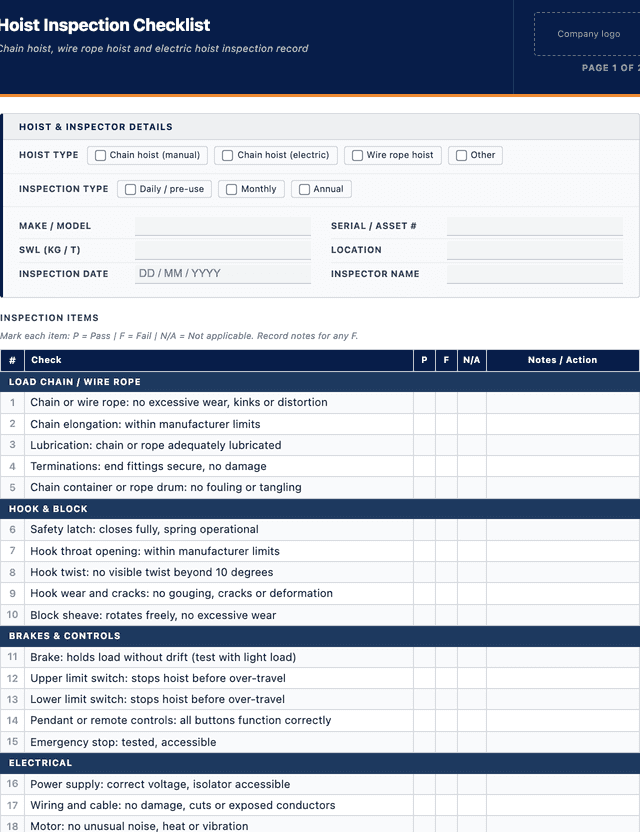
Hoist Inspection Checklist
Chain hoist, wire rope hoist and electric hoist inspection record
Load Chain / Wire Rope
Hook & Block
Brakes & Controls
Electrical
Structure & General
Inspector Sign-off
Signature
Print name
Date & time
Supervisor / Reviewer Acknowledgement
Signature
Print name
Date
How to use: download the PDF, print or complete digitally on any device.
- PDF format, ready to print or fill on screen
- Use as-is or customise to suit your operation
- Go digital in MapTrack for photos, reminders and audit trails
Two ways to use it
Use in MapTrack →Use it digitally instead
Unlimited usersThese same 24 checks, already built.




- Scan the asset’s QR tag with any phone
- Submitted forms can trigger alerts
- Photos on fails, audit-ready records
- Export responses, PDF reports with your logo
Free trial. No credit card needed.
Trusted by teams across Australia and New Zealand
We respect your privacy. Unsubscribe anytime.
These templates are free general guides provided as-is. They do not constitute legal, safety or compliance advice. You are responsible for ensuring any form meets your specific workplace obligations, industry standards and applicable regulations.
Don't just download it - use it live. Start a free workspace with this hoist inspection checklist already built, so your crew can run it from a phone.

Co-Founder & Commercial Director
Key takeaways
- The MapTrack hoist inspection checklist contains 24 checks across 5 sections. Sections covered: Load Chain / Wire Rope, Hook & Block, Brakes & Controls, Electrical, Structure & General.
Enter your email below to download this hoist inspection checklist as a ready-to-use PDF.
Used by construction, mining and field service teams











What is a hoist inspection checklist?
A hoist inspection checklist is a structured form used to inspect a chain hoist, wire rope hoist or electric hoist before it is used for lifting. It covers the load chain or wire rope, hook and block assembly, brakes and clutch, limit switches and controls, electrical components, and structural items including the frame, trolley and beam clamps. Hoists are used across construction, manufacturing, warehousing and maintenance operations. A thorough inspection helps confirm the hoist is safe, identifies chain wear, hook deformation or brake faults before they cause dropped loads, and provides documented evidence of compliance with Australian Standards (AS 1418 and AS 2550) and WHS regulations.
Hoist failures can result in dropped loads, serious injury or fatality, and significant property damage. Regular inspections are required under Australian WHS legislation and the relevant standards to ensure hoists remain safe for their rated capacity. The inspection follows a tiered approach: a visual check before each use or shift, a more detailed monthly inspection covering mechanical and electrical components, and an annual thorough examination by a competent person. Documented inspection records provide an audit trail for safety regulators, insurers and site safety audits, and demonstrate that the organisation is meeting its duty of care obligations for lifting equipment.
Learn more about compliance and inspections in MapTrack.
Benefits of using this hoist inspection checklist
- Load safety: verify chain or wire rope condition, hook integrity and brakes before lifting loads.
- Dropped load prevention: catch chain elongation, hook deformation and brake wear before they cause failures.
- Standards compliance: documented inspections meet AS 1418, AS 2550 and WHS obligations for lifting equipment.
- Reduced downtime: identify electrical faults, limit switch failures, lubrication needs and mechanical wear before they cause unplanned breakdowns and production delays.
- Worker confidence: operators can trust the hoist has been checked and cleared before each lifting task.
- Audit trail: maintain a verifiable history of inspections for each hoist, supporting safety audits, incident investigations and regulatory compliance reviews.
Benefits of digitising forms in MapTrack
When you digitise hoist checklists in MapTrack, you get:
- Field users can easily scan a QR code to complete a form on mobile. Unlimited users.
- Email the right people when a form is submitted, with an automation you set up.
- File every completed form against the asset, location or person it covers.
- Download any completed form as a PDF, with failed answers listed at the top.
- Fill in forms offline; they upload when the device is back online.
- Build conditional logic (show or hide questions based on answers).
- Take pictures or attach photos. Not possible with a paper-based form.
- Electronic signatures.
- Edit forms later without reprinting.
- Set who can view, fill in or edit forms with user roles.
- Upload a paper form (PDF, Word, Excel or a photo) and MapTrack's AI builds a digital version for you to check.
- Assign audits and send reminder emails to the people doing them.
- Keep every audit, inspection and sign-off against the asset or site it covers.
- Track corrective actions as work orders from finding to close-out, with each change in the activity log.
Book a demo to see how MapTrack handles hoist checklists.
Try MapTrack free for 30 days
Full access to every feature. No credit card required. Per-asset pricing so you scale as your fleet grows.
- No credit card required
- 30 days free trial
- Cancel anytime
1-2 days/week saved
“Bloody amazing! We used to spend 1-2 days a week tracking and managing our generators alone.”

Steve McAllister
Asset Coordinator, Saunders International
What to include in a hoist inspection checklist
This hoist inspection checklist covers 9 key areas:
- Hoist details: type (chain/wire rope/electric/manual), make/model, serial/asset number, SWL (safe working load).
- Inspector details: name, inspection date, inspection type (daily/monthly/annual).
- Load chain or wire rope: wear, elongation, kinks, lubrication, terminations.
- Hook and block: safety latch, throat opening, twist, wear, block sheave.
- Brakes and controls: brake holding test, upper and lower limit switches, pendant or remote controls, emergency stop.
- Electrical: power supply, wiring condition, motor, isolator.
- Structure: frame and housing, mounting bolts, trolley wheels, beam clamps, load rating plate.
- Defect register: item, description, action required.
- Sign-off: inspector and supervisor.
How to use this hoist inspection checklist
- Record hoist details including type, make/model, serial number and SWL.: Confirm the hoist identity against your plant register. Note the hoist type (chain, wire rope, electric or manual), rated safe working load and the inspection type being performed (daily, monthly or annual).
- Visually inspect the load chain or wire rope for wear, kinks, elongation and proper lubrication.: Run the chain or wire rope through its full travel and inspect each section. Check chain links for stretch, gouging or corrosion. For wire rope, count broken wires per lay length and check for kinking or bird-caging.
- Check the hook: safety latch closes fully, no throat opening beyond limits, no twist or cracks.: Measure the hook throat opening against the manufacturer specification. Check for twist exceeding 10 degrees from the plane of the hook body. Inspect for cracks, gouges or signs of overloading at the bend.
- Test the brakes with a light load. Confirm the hoist holds without drift.: Lift a light test load a short distance and hold for at least one minute. Observe for any drift or creep. If the brake slips or the load drops, the hoist must be taken out of service immediately.
- Test upper and lower limit switches, pendant or remote controls, and emergency stop.: Slowly raise and lower the hook to confirm both limit switches activate and stop the hoist at the correct positions. Test all pendant or remote control buttons for correct function and verify the emergency stop halts all movement.
- Check the structure: frame, mounting bolts, trolley wheels and beam clamps for damage or looseness.: Inspect the hoist housing, trolley wheels and beam clamps for cracks, wear or loose fixings. Confirm the load rating plate is legible and the mounting is secure with no excessive movement or vibration during operation.
- Record any defects and report per your site procedures. Tag out the hoist until safety defects are rectified.: Document each defect with a description, location and severity. Apply a tag-out or lock-out to the hoist if any safety-critical defect is found. Notify the site supervisor and arrange repair before the hoist is returned to service.
- Sign off and date the form.: The inspector and supervisor should both sign the completed checklist. File the record in the lifting equipment register and schedule the next inspection based on the applicable frequency under AS 1418.
In MapTrack, you can automate compliance tracking and audit trails. Each submission is stored as a timestamped PDF against the asset record.
Get the free templateEnter your email above to download the full hoist inspection checklist as a PDF.Back to download formHow often should you complete this checklist?
Complete a visual inspection before each use or at the start of each shift. Monthly inspections should cover deeper items such as chain or wire rope measurement, brake adjustment, limit switch function testing and electrical component checks. Annual thorough examinations should be performed by a competent person in accordance with AS 1418 and AS 2550, covering structural integrity, load testing and full component assessment. In MapTrack, you can schedule each inspection tier and track compliance across all your hoists and lifting equipment.
Frequently asked questions
Applicable regulatory standards
This template is a starting point. Check the current requirements that apply to your equipment, work and location. The template alone does not establish compliance.
- AS 1418
- AS 2550
- LOLER 1998
- WHS Regulations 2011, Chapter 5
Hoist inspection checklist preview
The numbers behind this hoist inspection checklist
Every figure below is sourced and dated, so you can quote it in a toolbox talk, a budget case or a board paper without having to chase the original report.
Embed this free template on your website
Run an industry blog, trade association site, or training resource? Drop a preview of this free hoist inspection checklist straight into your page. The snippet is self-contained, needs no scripts, and links readers back to the full free template.
<div style="max-width:480px;font-family:system-ui,-apple-system,'Segoe UI',Roboto,sans-serif;border:1px solid #E5E7EB;border-radius:12px;padding:20px;background:#ffffff;">
  <p style="font-size:12px;font-weight:700;letter-spacing:0.05em;text-transform:uppercase;color:#071D49;margin:0;">Free template</p>
  <p style="font-size:18px;font-weight:700;color:#071D49;margin:6px 0 0;">Hoist inspection checklist</p>
  <ul style="margin:12px 0 0;padding-left:18px;color:#374151;font-size:14px;line-height:1.6;">
    <li style="margin:4px 0;">Hoist details: type (chain/wire rope/electric/manual), make/model, serial/asset number, SWL (safe working load).</li>
    <li style="margin:4px 0;">Inspector details: name, inspection date, inspection type (daily/monthly/annual).</li>
    <li style="margin:4px 0;">Load chain or wire rope: wear, elongation, kinks, lubrication, terminations.</li>
    <li style="margin:4px 0;">Hook and block: safety latch, throat opening, twist, wear, block sheave.</li>
    <li style="margin:4px 0;">Brakes and controls: brake holding test, upper and lower limit switches, pendant or remote controls, emergency stop.</li>
    <li style="margin:4px 0;">Electrical: power supply, wiring condition, motor, isolator.</li>
  </ul>
  <p style="font-size:13px;color:#6B7280;margin:14px 0 0;padding-top:12px;border-top:1px solid #E5E7EB;">Free <a href="https://www.maptrack.com/templates/hoist-inspection-checklist" style="color:#071D49;font-weight:600;text-decoration:none;">Hoist inspection checklist</a> by MapTrack</p>
</div>Free to reuse, including commercially. This template is published under a Creative Commons Attribution 4.0 licence. Copy it, adapt it, put it on your own site or in your own docs. All we ask is that you credit MapTrack with a link back to this page. The snippet above already includes that credit, so if you use it as-is you’re covered.
Cite this template
Writing about this topic? You’re welcome to quote this checklist. Here’s the wording to use so your readers can find the original.
The MapTrack hoist inspection checklist contains 24 checks across 5 sections.
- Short attribution
- MapTrack Hoist inspection checklist, https://www.maptrack.com/templates/hoist-inspection-checklist
- Reference list
- MapTrack. (2026). Hoist inspection checklist [Checklist template]. Retrieved from https://www.maptrack.com/templates/hoist-inspection-checklist
Free to reuse with credit under a Creative Commons Attribution 4.0 licence. If you’d rather link straight to it, the page is https://www.maptrack.com/templates/hoist-inspection-checklist.
Need to automate compliance tracking and audit trails?
Register every hoist in MapTrack, attach digital forms, and get a complete history of every inspection, service and compliance record.
Compliance and inspections · All templates · Pricing · Book a demo