
Free facility condition assessment template
Free facility condition assessment template (PDF-ready). ASTM E2018 walk-through with FCI calculation and ISO 55000 capital planning input. Download free.
Updated 18 May 2026
Facility Condition Assessment
ASTM E2018 walk-through with FCI calculation and 10-year renewal forecast.
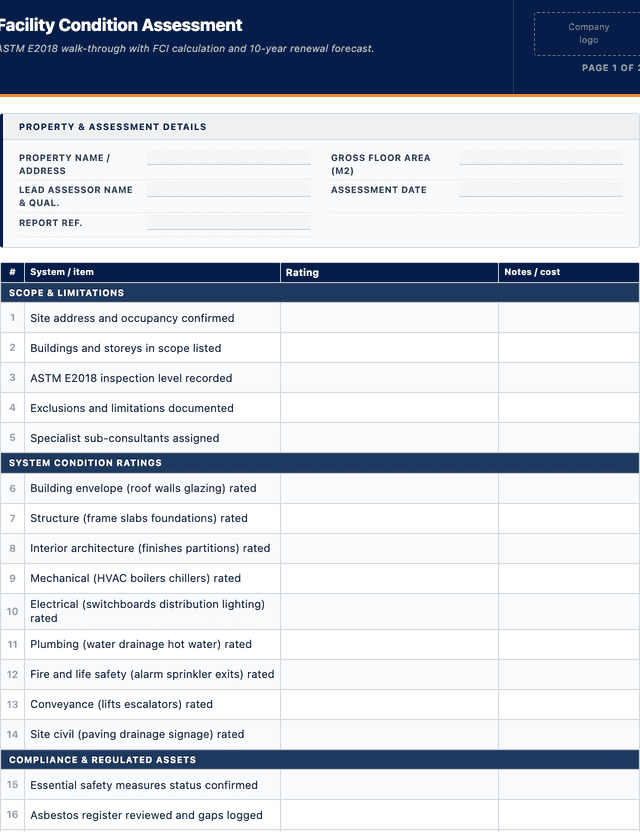
Scope & limitations
System condition ratings
Compliance & regulated assets
Deficiencies & cost forecast
How to use: download the PDF, print or complete digitally on any device.
- PDF format, ready to print or fill on screen
- Use as-is or customise to suit your operation
- Go digital in MapTrack for photos, reminders and audit trails
Two ways to use it
Use in MapTrack →Use it digitally instead
Unlimited usersThese same 25 checks, already built.




- Scan the asset’s QR tag with any phone
- Submitted forms can trigger alerts
- Photos on fails, audit-ready records
- Export responses, PDF reports with your logo
Free trial. No credit card needed.
Trusted by teams across Australia and New Zealand
We respect your privacy. Unsubscribe anytime.
These templates are free general guides provided as-is. They do not constitute legal, safety or compliance advice. You are responsible for ensuring any form meets your specific workplace obligations, industry standards and applicable regulations.
Don't just download it - use it live. Start a free workspace with this facility condition assessment template already built, so your crew can run it from a phone.

Co-Founder & Commercial Director
Key takeaways
- The MapTrack facility condition assessment template contains 25 checks across 4 sections. Sections covered: Scope & limitations, System condition ratings, Compliance & regulated assets, Deficiencies & cost forecast.
Enter your email below to download this facility condition assessment template as a ready-to-use PDF.
Used by construction, mining and field service teams











What is a facility condition assessment template?
A facility condition assessment (FCA) is a structured walk-through evaluation of a building or campus that documents the physical condition of every major building system, costs the deficiencies identified and produces a Facility Condition Index (FCI) that benchmarks the asset against a portfolio. The methodology is anchored by ASTM E2018 (Standard Guide for Property Condition Assessments), the ASHRAE FCI framework and the ISO 55000 family on asset management. Facilities directors, property managers and strategic asset managers commission an FCA as the upstream input for the capital renewal plan, the operating budget submission, the long range maintenance forecast and any portfolio transaction (acquisition, refinance, disposal).
The FCA is distinct from a building maintenance inspection (which catches recurring service tasks) and from an asset condition assessment form for a single piece of plant (which scores one item). The FCA covers every major system across the building envelope, structure, interior architecture, mechanical, electrical, plumbing, fire and life safety, conveyance, vertical transport, site civil and the regulated assets (essential safety measures, asbestos, lead-based paint). For each deficiency identified the assessor records the system, the observation, a cost estimate and a recommended year of work over a 10 to 20 year horizon. The cost of all deficiencies divided by the current replacement value (CRV) produces the FCI, which is the headline metric facilities directors take to the executive (typical thresholds: less than 0.05 good, 0.05 to 0.10 fair, 0.10 to 0.30 poor, greater than 0.30 critical). A defensible FCA gives property managers the evidence to justify capital requests, the data to write a 10 year renewal forecast, the documentation that satisfies ISO 55001 clause 6.2.2 strategic asset management planning, and the benchmark to compare buildings within a portfolio. Without it, capital decisions revert to politics, age and reactive failure.
Learn more about asset tracking in MapTrack.
Benefits of using this facility condition assessment template
- Capital planning justification: a costed deficiency register and an FCI score gives the facilities director defensible numbers to take to the CFO board or asset committee for the annual capital and operating budget.
- Portfolio benchmarking: an FCI calculated consistently across every building enables the property manager to rank assets fund capital where it has the greatest return and identify candidates for disposal or major upgrade.
- Strategic asset management compliance: a documented FCA satisfies ISO 55001 clause 6.2.2 strategic asset management plan input requirement and Public Works engineering practice for government and council portfolios.
- Transaction readiness: the assessment is the document property investors lenders insurers and tenants request first during acquisition due diligence refinance valuation or end-of-lease handover negotiations.
- Risk visibility: identifying deferred maintenance backlog and essential safety measure gaps early prevents reactive failure that typically costs 3 to 5 times the planned renewal price for the same scope of work.
- Lifecycle clarity: the 10 to 20 year renewal forecast turns building stewardship from a reactive cost centre into a planned program with phased budgets and traceable decisions over a defensible horizon.
Benefits of digitising forms in MapTrack
When you move your assessments from paper to MapTrack, you get:
- Field users can easily scan a QR code to complete a form on mobile. Unlimited users.
- Email the right people when a form is submitted, with an automation you set up.
- File every completed form against the asset, location or person it covers.
- Download any completed form as a PDF, with failed answers listed at the top.
- Fill in forms offline; they upload when the device is back online.
- Build conditional logic (show or hide questions based on answers).
- Take pictures or attach photos. Not possible with a paper-based form.
- Electronic signatures.
- Edit forms later without reprinting.
- Set who can view, fill in or edit forms with user roles.
- Upload a paper form (PDF, Word, Excel or a photo) and MapTrack's AI builds a digital version for you to check.
- Keep one asset register with each asset's location, condition and custody history.
- Schedule calibration and record certification and warranty expiry dates against each asset.
- See each asset's value over time in the Asset Depreciation report.
Book a demo to see how MapTrack handles assessments.
Try MapTrack free for 30 days
Full access to every feature. No credit card required. Per-asset pricing so you scale as your fleet grows.
- No credit card required
- 30 days free trial
- Cancel anytime
1-2 days/week saved
“Bloody amazing! We used to spend 1-2 days a week tracking and managing our generators alone.”

Steve McAllister
Asset Coordinator, Saunders International
What to include in a facility condition assessment template
This facility condition assessment template covers 10 key areas:
- Property identification: site name, address, building age, gross floor area, number of buildings and storeys, ownership status, occupancy and current use classification.
- Assessment scope: the ASTM E2018 level of inspection conducted (walk-through visual or invasive), the systems in scope and any exclusions agreed with the client up front.
- Assessor team: lead assessor name and qualifications (ASTM E2018 trained or chartered engineer surveyor) plus any specialist sub-consultants for asbestos, mechanical, electrical or structural review.
- System inventory: a row per major system (envelope, structure, interior architecture, mechanical, electrical, plumbing, fire and life safety, conveyance, site civil) with year of installation, expected useful life and current age.
- Condition rating: each system rated against a calibrated scale (typically 1 to 5 from excellent to critical) with a worded anchor description supported by representative photographs.
- Deficiency register: each deficiency identified by system, observation, criticality, recommended year of remediation, cost estimate and basis of estimate (RS Means published rate locally adjusted contractor quote).
- Essential safety measures and compliance: fire safety, asbestos, lead based paint, accessibility (DDA / ADA), energy compliance and any regulated assets flagged against current code.
- FCI calculation: total deficiency cost divided by current replacement value (CRV) with the FCI value, rating band and the comparable portfolio benchmark recorded.
- Renewal forecast: a 10 or 20 year capital renewal schedule with each major system replacement plotted in the year it falls due plus phased phasing options.
- Sign-off and limitations: lead assessor signature, property manager acknowledgement and the documented limitations (concealed conditions, destructive testing not conducted, seasonal weather constraints) consistent with ASTM E2018 reporting requirements.
How to use this facility condition assessment template
- Define the scope and assemble the assessor team: agree the ASTM E2018 level of inspection with the client, document the buildings and systems in scope and out of scope, assign the lead assessor and any specialist sub-consultants (mechanical, electrical, structural, asbestos) and confirm the inspection horizon, report deliverable and FCI methodology.
- Conduct the visual walk-through across every major system: walk the building envelope, structure, interior architecture, mechanical, electrical, plumbing, fire and life safety, conveyance and site civil capturing photographs, measurements and condition notes, use thermal imaging where helpful and review the building manual O and M files, essential safety measure records and recent capital projects.
- Score each system against the condition scale: assign a calibrated 1 to 5 condition rating to each major system, support each rating with a worded justification, representative photographs and any evidence reviewed and flag any essential safety measure gap or regulatory non-conformance for priority remediation.
- Build the costed deficiency register and 10 to 20 year renewal forecast: for every deficiency identified record system, observation, criticality, remediation year and cost estimate using RS Means or local contractor rates, aggregate into a phased renewal plan and identify capital versus operating spend separately.
- Calculate the FCI write the report and present findings: divide total deficiency cost by current replacement value to derive the FCI band, assemble the ASTM E2018 compliant report with executive summary, FCI score, deficiency register, renewal forecast and limitations and present the findings to the facilities director, property manager and capital planning committee.
In MapTrack, you can manage your full asset register digitally. Each submission is stored as a timestamped PDF against the asset record.
Get the free templateEnter your email above to download the full facility condition assessment template as a PDF.Back to download formHow often should you complete this assessment?
A full facility condition assessment is typically commissioned every 3 to 5 years for an operating portfolio, with interim desk-top updates between full assessments to keep the deficiency register and FCI current. ASTM E2018 does not mandate an interval, but ASHRAE strategic asset management guidance and ISO 55001 clause 9.1 monitoring expect the FCI to be tracked annually. An out-of-cycle assessment is triggered by major refurbishment, building addition, change of occupancy or use, significant incident (fire, flood, storm damage), portfolio transaction (acquisition, refinance, disposal) or material change in code (DDA, energy, fire, essential safety measures). In MapTrack the deficiency register is attached to each building and each major system asset so the FCI and the renewal forecast stay live between full assessments rather than going stale on a shared drive.
Frequently asked questions
Applicable regulatory standards
This template is a starting point. Check the current requirements that apply to your equipment, work and location. The template alone does not establish compliance.
- ASTM E2018-15 (Property Condition Assessments)
- ASHRAE FCI framework
- ISO 55001:2024 (clause 6.2.2 strategic asset management planning)
- ISO 55002:2018 (guidance)
- IPWEA Practice Note 12.1 (condition assessment)
Check the current source
Facility condition assessment template preview
The numbers behind this facility condition assessment template
Every figure below is sourced and dated, so you can quote it in a toolbox talk, a budget case or a board paper without having to chase the original report.
Embed this free template on your website
Run an industry blog, trade association site, or training resource? Drop a preview of this free facility condition assessment template straight into your page. The snippet is self-contained, needs no scripts, and links readers back to the full free template.
<div style="max-width:480px;font-family:system-ui,-apple-system,'Segoe UI',Roboto,sans-serif;border:1px solid #E5E7EB;border-radius:12px;padding:20px;background:#ffffff;">
  <p style="font-size:12px;font-weight:700;letter-spacing:0.05em;text-transform:uppercase;color:#071D49;margin:0;">Free template</p>
  <p style="font-size:18px;font-weight:700;color:#071D49;margin:6px 0 0;">Facility condition assessment template</p>
  <ul style="margin:12px 0 0;padding-left:18px;color:#374151;font-size:14px;line-height:1.6;">
    <li style="margin:4px 0;">Property identification: site name, address, building age, gross floor area, number of buildings and storeys, ownership status, occupancy and current use classification.</li>
    <li style="margin:4px 0;">Assessment scope: the ASTM E2018 level of inspection conducted (walk-through visual or invasive), the systems in scope and any exclusions agreed with the client up front.</li>
    <li style="margin:4px 0;">Assessor team: lead assessor name and qualifications (ASTM E2018 trained or chartered engineer surveyor) plus any specialist sub-consultants for asbestos, mechanical, electrical or structural review.</li>
    <li style="margin:4px 0;">System inventory: a row per major system (envelope, structure, interior architecture, mechanical, electrical, plumbing, fire and life safety, conveyance, site civil) with year of installation, expected useful life and current age.</li>
    <li style="margin:4px 0;">Condition rating: each system rated against a calibrated scale (typically 1 to 5 from excellent to critical) with a worded anchor description supported by representative photographs.</li>
    <li style="margin:4px 0;">Deficiency register: each deficiency identified by system, observation, criticality, recommended year of remediation, cost estimate and basis of estimate (RS Means published rate locally adjusted contractor quote).</li>
  </ul>
  <p style="font-size:13px;color:#6B7280;margin:14px 0 0;padding-top:12px;border-top:1px solid #E5E7EB;">Free <a href="https://www.maptrack.com/templates/facility-condition-assessment-template" style="color:#071D49;font-weight:600;text-decoration:none;">Facility condition assessment template</a> by MapTrack</p>
</div>Free to reuse, including commercially. This template is published under a Creative Commons Attribution 4.0 licence. Copy it, adapt it, put it on your own site or in your own docs. All we ask is that you credit MapTrack with a link back to this page. The snippet above already includes that credit, so if you use it as-is you’re covered.
Cite this template
Writing about this topic? You’re welcome to quote this checklist. Here’s the wording to use so your readers can find the original.
The MapTrack facility condition assessment template contains 25 checks across 4 sections.
- Short attribution
- MapTrack Facility condition assessment template, https://www.maptrack.com/templates/facility-condition-assessment-template
- Reference list
- MapTrack. (2026). Facility condition assessment template [Checklist template]. Retrieved from https://www.maptrack.com/templates/facility-condition-assessment-template
Free to reuse with credit under a Creative Commons Attribution 4.0 licence. If you’d rather link straight to it, the page is https://www.maptrack.com/templates/facility-condition-assessment-template.
Need to manage your full asset register digitally?
Register every asset in MapTrack, attach digital forms, and get a complete history of every inspection, service and compliance record.