
Free equipment replacement decision matrix template
Free equipment replacement decision matrix template (PDF-ready). Score keep, refurbish or replace by age, condition, cost, reliability and remaining life.
Updated 2 Oct 2026
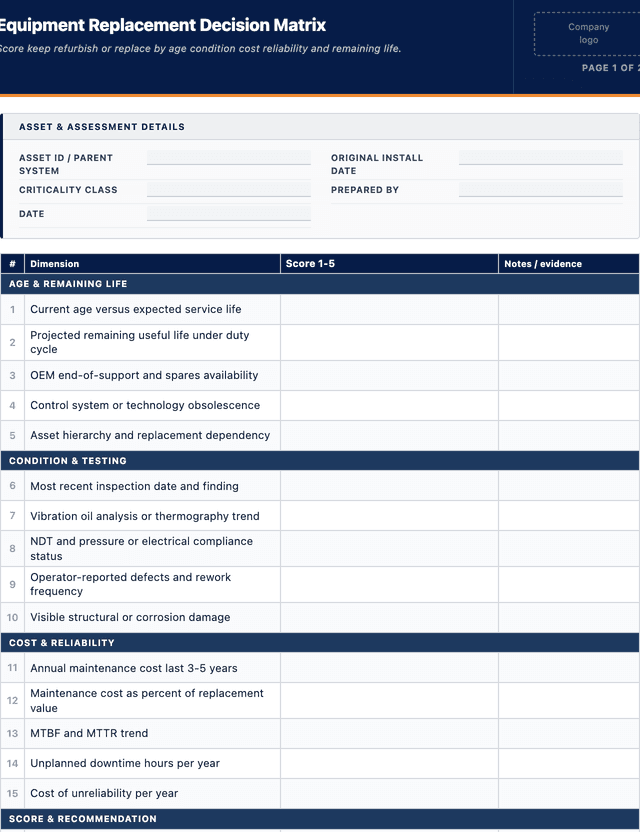
Equipment Replacement Decision Matrix
Score keep refurbish or replace by age condition cost reliability and remaining life.
Age & remaining life
Condition & testing
Cost & reliability
Score & recommendation
How to use: download the PDF, print or complete digitally on any device.
- PDF format, ready to print or fill on screen
- Use as-is or customise to suit your operation
- Go digital in MapTrack for photos, reminders and audit trails
Two ways to use it
Use in MapTrack →Use it digitally instead
Unlimited usersThese same 21 checks, already built.




- Scan the asset’s QR tag with any phone
- Submitted forms can trigger alerts
- Photos on fails, audit-ready records
- Export responses, PDF reports with your logo
Free trial. No credit card needed.
Trusted by teams across Australia and New Zealand
We respect your privacy. Unsubscribe anytime.
These templates are free general guides provided as-is. They do not constitute legal, safety or compliance advice. You are responsible for ensuring any form meets your specific workplace obligations, industry standards and applicable regulations.
Don't just download it - use it live. Start a free workspace with this equipment replacement decision matrix template already built, so your crew can run it from a phone.

Co-Founder & Commercial Director
Key takeaways
- The MapTrack equipment replacement decision matrix template contains 21 checks across 4 sections. Sections covered: Age & remaining life, Condition & testing, Cost & reliability, Score & recommendation.
Enter your email below to download this equipment replacement decision matrix template as a ready-to-use PDF.
Used by construction, mining and field service teams











What is an equipment replacement decision matrix template?
An equipment replacement decision matrix is a structured scoring framework used by asset managers, reliability engineers and capital planners to decide, on a defensible basis, whether each end-of-life asset should be kept (run-to-failure or status quo PM), refurbished or overhauled (life-extension capex), or replaced (full like-for-like or upgraded capital project). The matrix scores each candidate asset against five dimensions that together determine the economically rational decision: age relative to expected service life, current condition (from inspection, vibration or oil analysis, and operator reports), cumulative maintenance cost trend (the maintenance-cost-to-replacement-value ratio over the last three to five years), reliability and downtime exposure (MTBF, MTTR, cost of unreliability), and remaining useful life under the planned duty cycle. Each dimension is scored on a 1 to 5 scale, weighted according to its strategic importance, and rolled into an overall replacement priority score that maps directly to a keep / refurbish / replace recommendation.
This differs sharply from an asset criticality matrix (which scores business consequence of failure to drive maintenance strategy) and from a TCO calculator (which models whole-of-life economics of a new asset). The replacement decision matrix is the assessment that sits between them: it takes the existing assets criticality, the most recent condition data, the actual maintenance cost run-rate and the downtime exposure, and produces a year-by-year capital replacement schedule that finance can fund. SMRP defines the cost measure as Total Maintenance Cost as a Percent of Replacement Asset Value (metric 1.5 in its Best Practices metrics), and a ratio that keeps rising over two to three years while condition and reliability fall is the usual signal to test the replacement case. ISO 55001 requires the organisation to plan asset renewal as part of the strategic asset management plan, and the decision matrix is the evidence document that demonstrates structured, criteria-based replacement decisions rather than gut-feel capex requests. Without it, capex tends to flow to the loudest manager rather than the asset with the highest objective replacement priority, and refurbishment money often gets spent on assets that should have been replaced two years earlier.
Learn more about asset tracking in MapTrack.
Benefits of using this equipment replacement decision matrix template
- Defensible capital prioritisation: scoring every end-of-life candidate against the same criteria produces a ranked capital replacement schedule the CFO and board can compare across departments and sites.
- Avoidance of throwing good money after bad: tracking the maintenance-cost-to-replacement-value ratio surfaces assets where refurbishment investment is no longer economic, preventing the multi-year drip of repair spend on a doomed asset.
- Multi-year capital pipeline: the matrix output is a 3 to 5 year replacement pipeline that integrates with the strategic asset management plan, eliminating the annual scramble for emergency capex.
- Refurbish-versus-replace clarity: each candidate gets an explicit refurbish-vs-replace assessment, capturing the life extension a major overhaul will buy and the breakeven cost beyond which replacement is the better decision.
- Reliability data put to use: MTBF, MTTR and cost of unreliability data that often sit in CMMS reports without driving any action become primary inputs into the replacement decision and the business case.
- ISO 55001 audit evidence: the populated matrix is the structured asset-renewal evidence ISO 55001 auditors and insurance assessors expect to see, replacing anecdotal renewal arguments with documented scoring.
Benefits of digitising forms in MapTrack
When you move your assessments from paper to MapTrack, you get:
- Field users can easily scan a QR code to complete a form on mobile. Unlimited users.
- Email the right people when a form is submitted, with an automation you set up.
- File every completed form against the asset, location or person it covers.
- Download any completed form as a PDF, with failed answers listed at the top.
- Fill in forms offline; they upload when the device is back online.
- Build conditional logic (show or hide questions based on answers).
- Take pictures or attach photos. Not possible with a paper-based form.
- Electronic signatures.
- Edit forms later without reprinting.
- Set who can view, fill in or edit forms with user roles.
- Upload a paper form (PDF, Word, Excel or a photo) and MapTrack's AI builds a digital version for you to check.
- Keep one asset register with each asset's location, condition and custody history.
- Schedule calibration and record certification and warranty expiry dates against each asset.
- See each asset's value over time in the Asset Depreciation report.
Book a demo to see how MapTrack handles assessments.
Try MapTrack free for 30 days
Full access to every feature. No credit card required. Per-asset pricing so you scale as your fleet grows.
- No credit card required
- 30 days free trial
- Cancel anytime
1-2 days/week saved
“Bloody amazing! We used to spend 1-2 days a week tracking and managing our generators alone.”

Steve McAllister
Asset Coordinator, Saunders International
What to include in an equipment replacement decision matrix template
This equipment replacement decision matrix template covers 10 key areas:
- Asset identification and context: asset ID, parent system, current age, original install date, expected service life under planned duty cycle, criticality class and operating context (utilisation, environment, duty cycle).
- Age and remaining life scoring: actual age versus expected service life, projected remaining useful life from inspection and condition data, and obsolescence factors (OEM support availability, spares availability, control-system end-of-life).
- Condition assessment: latest condition score from inspection, vibration or oil analysis, thermography, NDT or operator reports, with the date of the most recent assessment and the trend over the last three to five years.
- Cumulative maintenance cost trend: annual planned and reactive maintenance cost for the last three to five years, expressed in absolute terms and as a percentage of current asset replacement value (SMRP metric 1.5).
- Reliability and downtime exposure: MTBF, MTTR, availability percentage, unplanned downtime hours per year, cost of unreliability per year and the trend in each metric over the assessment window.
- Refurbish-versus-replace business case: estimated refurbishment scope and cost, life extension that overhaul will buy, expected post-refurbish maintenance run-rate, and the comparison to like-for-like replacement net present cost.
- Safety, environmental and compliance triggers: any safety, environmental or regulatory factor that forces a replacement decision irrespective of economics (e.g. failed pressure-vessel inspection, refrigerant phase-out, electrical compliance non-conformance).
- Weighting and scoring methodology: documented weights for each dimension (typically condition 25 to 30 percent, age 15 to 20 percent, cost 20 to 25 percent, reliability 20 to 25 percent, remaining life 10 to 15 percent) and the recommendation thresholds.
- Recommendation and rationale: keep / refurbish / replace recommendation, planned year of action, indicative capital cost, indicative payback or business case headline and the assumptions used.
- Approval and version control: prepared by, reviewed by, approved by, asset owner sign-off, revision number, revision date and the change log referencing the underlying data sources.
How to use this equipment replacement decision matrix template
- Build the candidate list and pull the input data. Run the asset register filtered for assets in the last 25 percent of expected service life, plus any asset flagged by reliability KPIs (MTBF deteriorating, maintenance cost as a share of replacement value above the trigger the fleet has set, condition score amber or red). For each candidate, pull the historical maintenance cost trend, the latest condition assessment, the reliability KPIs and any regulatory or environmental triggers.
- Score each candidate across the five dimensions using documented scales. Apply the 1 to 5 scoring scales to age, condition, maintenance cost trend, reliability and remaining life. The scoring must be done by a multi-disciplinary panel (reliability engineer, maintenance manager, operations representative, finance partner) using the documented data inputs so the scores are evidence-based rather than opinion-driven, and so two independent panels would arrive at the same answer.
- Apply the weighting and produce the recommendation. Multiply each dimension score by its weight, sum to produce the overall replacement priority score, and map the score to the recommendation thresholds (keep, monitor, refurbish, replace). Flag any candidate where a regulatory or safety trigger forces replacement independent of the economic score, because those assets bypass the standard prioritisation.
- Build the refurbish-versus-replace case for short-list candidates. For every candidate scored at refurbish or replace, build a one-page business case comparing the refurbishment option (scope, cost, life extension, post-overhaul maintenance run-rate) against the replacement option (TCO of the new asset over the planned life). The refurbish case is preferred only when life extension is genuinely material (typically 5+ years) and the post-overhaul maintenance run-rate is credible.
- Sequence the multi-year capital plan and integrate with the strategic asset management plan. Sequence the recommended actions across a three to five year pipeline against capital budget envelopes, operational windows (planned shutdowns, seasonal demand low points) and dependency on other capital projects. The output is a multi-year replacement schedule signed off by operations and finance and integrated into the strategic asset management plan, with the matrix revised annually.
In MapTrack, you can manage your full asset register digitally. Each submission is stored as a timestamped PDF against the asset record.
Get the free templateEnter your email above to download the full equipment replacement decision matrix template as a PDF.Back to download formHow often should you complete this assessment?
The equipment replacement decision matrix is refreshed annually as part of the capital planning cycle, with the output feeding the strategic asset management plan and the multi-year capex budget. The full assessment cycle typically runs in parallel with the annual budget build (March to June for Australian organisations on a July to June fiscal year) so that approved replacements are funded in the new fiscal year. The matrix is also revised on event triggers between annual cycles: a major failure of any candidate asset, a step-change in reliability KPIs (MTBF dropping more than 25 percent, maintenance cost as a share of replacement value crossing the trigger the fleet has set), a regulatory change forcing accelerated replacement (refrigerant phase-out, emissions tightening, pressure-vessel non-conformance), a strategic change to capacity or production mix that alters duty cycle, or a major OEM end-of-support announcement. In MapTrack, the matrix scoring inputs (age, condition, maintenance cost run-rate, MTBF, MTTR, downtime cost) are auto-populated from the asset register and work order history, so the refresh is a review rather than a rebuild.
Frequently asked questions
Applicable regulatory standards
This template is a starting point. Check the current requirements that apply to your equipment, work and location. The template alone does not establish compliance.
- ISO 55001:2024 (Asset management - Asset management system - Requirements)
- ISO 55002:2018 (Asset management - Management systems - Guidelines for the application of ISO 55001)
- SMRP Best Practices metric 1.5, numbering as in the 5th edition (Total Maintenance Cost as a Percent of Replacement Asset Value)
- AS NZS 4536:1999 (Life cycle costing - An application guide)
Check the current source
Equipment replacement decision matrix template preview
The numbers behind this equipment replacement decision matrix template
Every figure below is sourced and dated, so you can quote it in a toolbox talk, a budget case or a board paper without having to chase the original report.
Embed this free template on your website
Run an industry blog, trade association site, or training resource? Drop a preview of this free equipment replacement decision matrix template straight into your page. The snippet is self-contained, needs no scripts, and links readers back to the full free template.
<div style="max-width:480px;font-family:system-ui,-apple-system,'Segoe UI',Roboto,sans-serif;border:1px solid #E5E7EB;border-radius:12px;padding:20px;background:#ffffff;">
  <p style="font-size:12px;font-weight:700;letter-spacing:0.05em;text-transform:uppercase;color:#071D49;margin:0;">Free template</p>
  <p style="font-size:18px;font-weight:700;color:#071D49;margin:6px 0 0;">Equipment replacement decision matrix template</p>
  <ul style="margin:12px 0 0;padding-left:18px;color:#374151;font-size:14px;line-height:1.6;">
    <li style="margin:4px 0;">Asset identification and context: asset ID, parent system, current age, original install date, expected service life under planned duty cycle, criticality class and operating context (utilisation, environment, duty cycle).</li>
    <li style="margin:4px 0;">Age and remaining life scoring: actual age versus expected service life, projected remaining useful life from inspection and condition data, and obsolescence factors (OEM support availability, spares availability, control-system end-of-life).</li>
    <li style="margin:4px 0;">Condition assessment: latest condition score from inspection, vibration or oil analysis, thermography, NDT or operator reports, with the date of the most recent assessment and the trend over the last three to five years.</li>
    <li style="margin:4px 0;">Cumulative maintenance cost trend: annual planned and reactive maintenance cost for the last three to five years, expressed in absolute terms and as a percentage of current asset replacement value (SMRP metric 1.5).</li>
    <li style="margin:4px 0;">Reliability and downtime exposure: MTBF, MTTR, availability percentage, unplanned downtime hours per year, cost of unreliability per year and the trend in each metric over the assessment window.</li>
    <li style="margin:4px 0;">Refurbish-versus-replace business case: estimated refurbishment scope and cost, life extension that overhaul will buy, expected post-refurbish maintenance run-rate, and the comparison to like-for-like replacement net present cost.</li>
  </ul>
  <p style="font-size:13px;color:#6B7280;margin:14px 0 0;padding-top:12px;border-top:1px solid #E5E7EB;">Free <a href="https://www.maptrack.com/templates/equipment-replacement-decision-matrix-template" style="color:#071D49;font-weight:600;text-decoration:none;">Equipment replacement decision matrix template</a> by MapTrack</p>
</div>Free to reuse, including commercially. This template is published under a Creative Commons Attribution 4.0 licence. Copy it, adapt it, put it on your own site or in your own docs. All we ask is that you credit MapTrack with a link back to this page. The snippet above already includes that credit, so if you use it as-is you’re covered.
Cite this template
Writing about this topic? You’re welcome to quote this checklist. Here’s the wording to use so your readers can find the original.
The MapTrack equipment replacement decision matrix template contains 21 checks across 4 sections.
- Short attribution
- MapTrack Equipment replacement decision matrix template, https://www.maptrack.com/templates/equipment-replacement-decision-matrix-template
- Reference list
- MapTrack. (2026). Equipment replacement decision matrix template [Checklist template]. Retrieved from https://www.maptrack.com/templates/equipment-replacement-decision-matrix-template
Free to reuse with credit under a Creative Commons Attribution 4.0 licence. If you’d rather link straight to it, the page is https://www.maptrack.com/templates/equipment-replacement-decision-matrix-template.
Need to manage your full asset register digitally?
Register every asset in MapTrack, attach digital forms, and get a complete history of every inspection, service and compliance record.