
Free cycle count inventory procedure template
Free cycle count inventory procedure template (PDF-ready). ABC stratified count plan, variance tolerance, root cause and SOX-aligned audit trail. Free.
Updated 28 Sept 2026
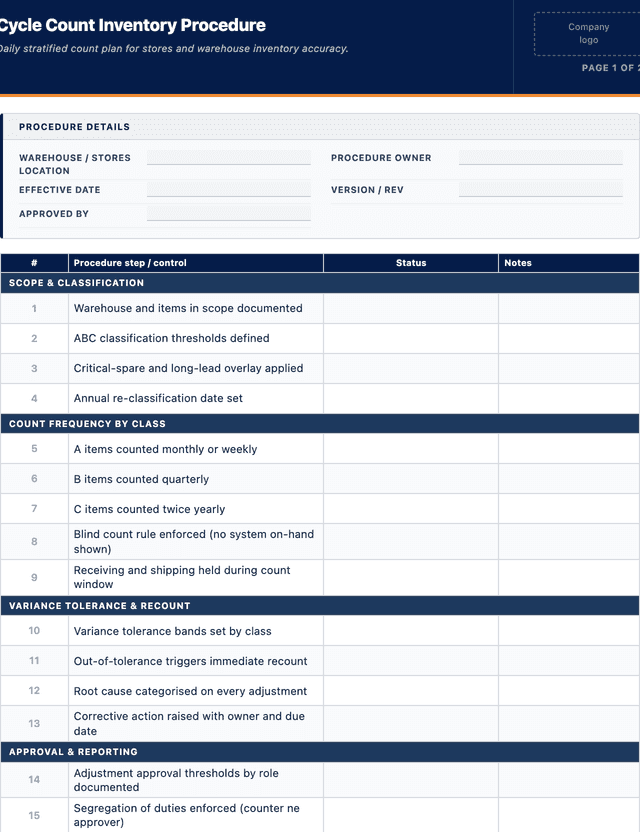
Cycle Count Inventory Procedure
Daily stratified count plan for stores and warehouse inventory accuracy.
Scope & classification
Count frequency by class
Variance tolerance & recount
Approval & reporting
How to use: download the PDF, print or complete digitally on any device.
- PDF format, ready to print or fill on screen
- Use as-is or customise to suit your operation
- Go digital in MapTrack for photos, reminders and audit trails
Download free PDF template
Use in MapTrack →



Trusted by teams across Australia and New Zealand
We respect your privacy. Unsubscribe anytime.
Or set it up in MapTrack
- Fill it in on a phone, attach photos to any check
- Automatic reports and audit trails
- The same checks as the PDF, ready to configure
Free 30-day trial. No credit card. Personal email accepted.
Don't just download it - use it live. Start a free workspace with this cycle count inventory procedure template already built, so your crew can run it from a phone.

Co-Founder & Commercial Director
Key takeaways
- The MapTrack cycle count inventory procedure template contains 17 checks across 4 sections. Sections covered: Scope & classification, Count frequency by class, Variance tolerance & recount, Approval & reporting.
Enter your email below to download this cycle count inventory procedure template as a ready-to-use PDF.
Used by construction, mining and field service teams











What is a cycle count inventory procedure template?
A cycle count inventory procedure is a written warehouse or stores process that replaces the traditional once-a-year wall-to-wall stocktake with a continuous stratified count of selected stock-keeping units (SKUs) every business day. Instead of shutting the warehouse for a weekend to count everything once the team counts a defined subset of inventory each day so that every SKU is physically verified at a frequency that matches its value and risk. The cycle count is the most widely adopted inventory-accuracy control in modern warehouse and maintenance stores operations used to detect shrinkage mis-pick errors mis-location supplier short-shipment and system data errors before they cause a stockout an emergency procurement or a financial misstatement. Most stratified count plans follow the ABC classification model documented in APICS CSCP and ASCM literature: A items (top 80 percent of dollar value typically 10 to 20 percent of SKUs) counted monthly or weekly B items counted quarterly and C items counted twice a year.
This procedure is different from an ad-hoc stocktake or a tool stocktake on a construction site. A cycle count is a scheduled repeatable warehouse process that runs every business day with a written variance tolerance (typically plus or minus two percent on count quantity for C items tightening to plus or minus 0.5 percent on A items) and a documented root cause investigation when variance exceeds the tolerance. The procedure is the foundational inventory accuracy control under ISO 55000:2024 inventory practices ISO 9001 clause 8.5.4 (preservation) and is the de facto evidence of inventory controls used in Sarbanes-Oxley (SOX) section 404 management assessments and IFRS or AASB 102 inventory audits. A typical mature operation runs at 98 to 99.5 percent location-level inventory accuracy on the strength of a daily ABC cycle count programme. Without it the only inventory truth event is the annual wall-to-wall by which time the operational pain has been absorbed for twelve months.
Learn more about asset tracking in MapTrack.
Benefits of using this cycle count inventory procedure template
- Inventory accuracy continuously verified: a daily count programme keeps location-level accuracy at 98 percent or better which removes the recurring stockouts and emergency runs that mask the true cost of poor stock data.
- Audit and SOX evidence ready: a documented procedure with stratified count plan variance tolerance root cause log and supervisor sign-off is the standard evidence requested under SOX 404 controls and ISO 9001 clause 8.5.4 in audit.
- Variance triage with discipline: counting every day surfaces a variance the day it occurs while the trail to the receipt pick or transaction that caused it is still warm and the root cause can actually be found.
- Lower wall-to-wall stocktake burden: organisations on a mature ABC cycle count programme typically reduce the annual physical stocktake to a verification sample only saving 80 to 90 percent of the operational disruption of a full count.
- Stockout and emergency procurement reduction: A items counted monthly or weekly catch supplier short-shipment mis-location and supplier-substitution errors weeks before the maintenance team realises a critical spare is missing.
- Continuous improvement loop: trend analysis of variance root causes (receipt error pick error system error theft mis-location) is the input that fires process improvements in receiving putaway pick and putback discipline across the stores.
Benefits of digitising forms in MapTrack
When you move your procedures from paper to MapTrack, you get:
- Field users can easily scan a QR code to complete a form on mobile. Unlimited users.
- Email the right people when a form is submitted, with an automation you set up.
- File every completed form against the asset, location or person it covers.
- Download any completed form as a PDF, with failed answers listed at the top.
- Fill in forms offline; they upload when the device is back online.
- Build conditional logic (show or hide questions based on answers).
- Take pictures or attach photos. Not possible with a paper-based form.
- Electronic signatures.
- Edit forms later without reprinting.
- Set who can view, fill in or edit forms with user roles.
- Upload a paper form (PDF, Word, Excel or a photo) and MapTrack's AI builds a digital version for you to check.
- Keep one asset register with each asset's location, condition and custody history.
- Schedule calibration and record certification and warranty expiry dates against each asset.
- See each asset's value over time in the Asset Depreciation report.
Book a demo to see how MapTrack handles procedures.
Try MapTrack free for 30 days
Full access to every feature. No credit card required. Per-asset pricing so you scale as your fleet grows.
- No credit card required
- 30 days free trial
- Cancel anytime
1-2 days/week saved
“Bloody amazing! We used to spend 1-2 days a week tracking and managing our generators alone.”

Steve McAllister
Asset Coordinator, Saunders International
What to include in a cycle count inventory procedure template
This cycle count inventory procedure template covers 10 key areas:
- Scope and stores in coverage: site warehouse or stores location business units served items in scope (raw work in progress finished goods MRO spares consumables kitting bins) and any items excluded with documented rationale.
- ABC stratification rules: dollar-value classification thresholds for A B and C items (typical Pareto split is 80 percent value or 20 percent SKUs to A 15 percent or 30 percent to B 5 percent or 50 percent to C) refresh frequency for the classification (annual) and any non-financial criticality overlays (critical spares long-lead items regulated stock).
- Count frequency by class: A items counted monthly or weekly B items quarterly C items twice a year (or other documented cadence aligned to operational risk and audit appetite) with documented annual count coverage of 100 percent of items in scope.
- Daily count schedule: number of count sheets issued per day blind versus open count rule (blind count is industry best practice and SOX-aligned) counter assignment count window timing within shift and exclusion of receiving and shipping movement during count.
- Variance tolerance bands: documented variance bands by class (typically plus or minus 0.5 percent on A items plus or minus 1 percent on B items plus or minus 2 percent on C items) with the rule that any variance above tolerance triggers an immediate recount before any adjustment is posted.
- Root cause investigation: a documented investigation step for every out-of-tolerance variance root cause categorisation (receipt error pick error putaway error system data error theft mis-location damage write-off pending) and the corrective action raised.
- Adjustment authority and posting rules: dollar-value approval thresholds for adjustments (supervisor up to a value stores manager up to a higher value finance director above that) segregation of duties between counter and approver and the journal posting rule.
- Performance metrics and reporting: inventory record accuracy (IRA) percentage variance dollar value root cause Pareto recount rate and the monthly scorecard issued to operations and finance.
- Roles and segregation of duties: counter supervisor or recount approver finance recipient (warehouse manager stores supervisor internal audit liaison) and the documented rule that the counter cannot also approve adjustments to the items they counted.
- Document retention and audit trail: count sheets variance reports root cause records and approval evidence retained for at least seven years to satisfy financial audit and SOX 404 documentation requirements.
How to use this cycle count inventory procedure template
- Define the scope ABC classification and count frequency: pull the SKU list for the warehouse or stores in scope run the dollar-value analysis classify each SKU into A B or C using the documented Pareto thresholds overlay critical-spare and long-lead flags and publish the count frequency for each class. The classification is refreshed annually or when the product mix changes materially. Document the rationale for any SKU excluded from the cycle count programme so the audit trail is complete.
- Issue the daily count schedule and run a blind count: each business day the stores supervisor issues count sheets covering a defined subset of SKUs (typical operation counts five to fifteen A items ten to twenty B items and twenty to forty C items per day depending on warehouse size). Counters receive the location and item description but not the on-hand quantity which is industry best practice and aligned to SOX segregation-of-duties. Receiving and shipping for the counted locations are held during the count window to prevent movement-during-count errors.
- Reconcile counts against the system on-hand and apply the variance tolerance: the counted quantity is entered into the WMS or ERP and compared with the system on-hand. Where the variance is within tolerance for the SKU class (plus or minus 0.5 to 2 percent depending on class) the system on-hand stands and the count is closed. Where the variance is outside tolerance the count is paused and an immediate recount is issued before any adjustment is posted. Recounts are completed by a second counter to remove counter error from the root cause.
- Investigate variance root cause and post the approved adjustment: for every out-of-tolerance variance confirmed by the recount the supervisor categorises the root cause (receipt error pick error putaway error system data error theft mis-location damage supplier substitution) and raises the corrective action. The adjustment is posted only after approval by the authorised role for the dollar value (supervisor up to a value stores manager above that finance director or controller for the highest band) with segregation of duties enforced so the counter cannot approve the adjustment to their own count.
- Track the monthly scorecard and feed continuous improvement: the stores supervisor or warehouse manager publishes a monthly cycle count scorecard with inventory record accuracy (IRA) percentage variance dollar value recount rate root cause Pareto and the top three corrective actions for the next period. The scorecard is issued to operations finance and internal audit. The trend in IRA and variance dollars over time is what proves to the audit committee the operations director and the maintenance manager that the programme is mature and that the annual wall-to-wall stocktake can be downgraded to a verification sample.
In MapTrack, you can manage your full asset register digitally. Each submission is stored as a timestamped PDF against the asset record.
Get the free templateEnter your email above to download the full cycle count inventory procedure template as a PDF.Back to download formHow often should you complete this procedure?
A cycle count programme runs every business day not on a monthly or quarterly cadence. Within the daily routine count frequency varies by stratification: A items (top 80 percent of dollar value typically 10 to 20 percent of SKUs) are counted monthly or weekly depending on programme maturity and audit appetite. B items are counted quarterly. C items are counted twice a year (or other documented cadence). Many operations adopt a 30/90/180 day cadence as a starting point and tighten the A-class frequency once accuracy stabilises above 98 percent. The full SKU set is counted at least once per year through the cumulative effect of the daily counts which is what allows the annual wall-to-wall stocktake to be reduced to a sample verification. The classification (which SKUs are A B and C) is reviewed annually and whenever the product mix changes materially. The procedure document is reviewed every two years against APICS CSCP and ASCM literature ISO 9001 and SOX 404 control updates with any change approved by operations internal audit and finance.
Frequently asked questions
Applicable regulatory standards
This template is a starting point. Check the current requirements that apply to your equipment, work and location. The template alone does not establish compliance.
- ISO 9001 (clause 8.5.4 Preservation)
- ISO 55000:2024 (Asset management overview principles)
- ISO 31000:2018 (Risk management Guidelines)
- Sarbanes-Oxley Act 2002 (section 404 Internal control over financial reporting)
- IFRS / AASB 102:2018 (Inventories)
- APICS CSCP and ASCM CPIM body of knowledge 2022
Cycle count inventory procedure template preview
The numbers behind this cycle count inventory procedure template
Every figure below is sourced and dated, so you can quote it in a toolbox talk, a budget case or a board paper without having to chase the original report.
Embed this free template on your website
Run an industry blog, trade association site, or training resource? Drop a preview of this free cycle count inventory procedure template straight into your page. The snippet is self-contained, needs no scripts, and links readers back to the full free template.
<div style="max-width:480px;font-family:system-ui,-apple-system,'Segoe UI',Roboto,sans-serif;border:1px solid #E5E7EB;border-radius:12px;padding:20px;background:#ffffff;">
  <p style="font-size:12px;font-weight:700;letter-spacing:0.05em;text-transform:uppercase;color:#071D49;margin:0;">Free template</p>
  <p style="font-size:18px;font-weight:700;color:#071D49;margin:6px 0 0;">Cycle count inventory procedure template</p>
  <ul style="margin:12px 0 0;padding-left:18px;color:#374151;font-size:14px;line-height:1.6;">
    <li style="margin:4px 0;">Scope and stores in coverage: site warehouse or stores location business units served items in scope (raw work in progress finished goods MRO spares consumables kitting bins) and any items excluded with documented rationale.</li>
    <li style="margin:4px 0;">ABC stratification rules: dollar-value classification thresholds for A B and C items (typical Pareto split is 80 percent value or 20 percent SKUs to A 15 percent or 30 percent to B 5 percent or 50 percent to C) refresh frequency for the classification (annual) and any non-financial criticality overlays (critical spares long-lead items regulated stock).</li>
    <li style="margin:4px 0;">Count frequency by class: A items counted monthly or weekly B items quarterly C items twice a year (or other documented cadence aligned to operational risk and audit appetite) with documented annual count coverage of 100 percent of items in scope.</li>
    <li style="margin:4px 0;">Daily count schedule: number of count sheets issued per day blind versus open count rule (blind count is industry best practice and SOX-aligned) counter assignment count window timing within shift and exclusion of receiving and shipping movement during count.</li>
    <li style="margin:4px 0;">Variance tolerance bands: documented variance bands by class (typically plus or minus 0.5 percent on A items plus or minus 1 percent on B items plus or minus 2 percent on C items) with the rule that any variance above tolerance triggers an immediate recount before any adjustment is posted.</li>
    <li style="margin:4px 0;">Root cause investigation: a documented investigation step for every out-of-tolerance variance root cause categorisation (receipt error pick error putaway error system data error theft mis-location damage write-off pending) and the corrective action raised.</li>
  </ul>
  <p style="font-size:13px;color:#6B7280;margin:14px 0 0;padding-top:12px;border-top:1px solid #E5E7EB;">Free <a href="https://www.maptrack.com/templates/cycle-count-inventory-procedure-template" style="color:#071D49;font-weight:600;text-decoration:none;">Cycle count inventory procedure template</a> by MapTrack</p>
</div>Free to reuse, including commercially. This template is published under a Creative Commons Attribution 4.0 licence. Copy it, adapt it, put it on your own site or in your own docs. All we ask is that you credit MapTrack with a link back to this page. The snippet above already includes that credit, so if you use it as-is you’re covered.
Cite this template
Writing about this topic? You’re welcome to quote this checklist. Here’s the wording to use so your readers can find the original.
The MapTrack cycle count inventory procedure template contains 17 checks across 4 sections.
- Short attribution
- MapTrack Cycle count inventory procedure template, https://www.maptrack.com/templates/cycle-count-inventory-procedure-template
- Reference list
- MapTrack. (2026). Cycle count inventory procedure template [Checklist template]. Retrieved from https://www.maptrack.com/templates/cycle-count-inventory-procedure-template
Free to reuse with credit under a Creative Commons Attribution 4.0 licence. If you’d rather link straight to it, the page is https://www.maptrack.com/templates/cycle-count-inventory-procedure-template.
Need to manage your full asset register digitally?
Register every asset in MapTrack, attach digital forms, and get a complete history of every inspection, service and compliance record.