
Free monthly site inspection checklist
Free monthly site inspection checklist (PDF-ready). Covers housekeeping, access and egress, electrical, fire safety, PPE and welfare. Download free.
Updated 3 May 2026
Monthly Site Inspection Checklist
Workplace health and safety compliance inspection record
Housekeeping
Access and Egress
Electrical Safety
Fire Safety
PPE and Signage
Welfare Facilities
Environmental
Plant and Equipment
How to use: download the PDF, print or complete digitally on any device.
- PDF format, ready to print or fill on screen
- Use as-is or customise to suit your operation
- Go digital in MapTrack for photos, reminders and audit trails
Download free PDF template
Use in MapTrack →



Trusted by teams across Australia and New Zealand
We respect your privacy. Unsubscribe anytime.
Or set it up in MapTrack
- Fill it in on a phone, attach photos to any check
- Automatic reports and audit trails
- The same checks as the PDF, ready to configure
Free 30-day trial. No credit card. Personal email accepted.
Don't just download it - use it live. Start a free workspace with this monthly site inspection checklist already built, so your crew can run it from a phone.

Co-Founder & Commercial Director
Key takeaways
- The MapTrack monthly site inspection checklist contains 32 checks across 8 sections. Sections covered: Housekeeping, Access and Egress, Electrical Safety, Fire Safety, PPE and Signage, Welfare Facilities, Environmental, Plant and Equipment.
Enter your email below to download this monthly site inspection checklist as a ready-to-use PDF.
Used by construction, mining and field service teams










What is a monthly site inspection checklist?
A monthly site inspection is a structured walkthrough of your workplace carried out on a regular schedule, typically once a month. The purpose is to identify hazards, verify that controls are in place, and confirm that the site complies with workplace health and safety (WHS) legislation and your organisation's own procedures. Monthly inspections apply to construction sites, manufacturing facilities, warehouses, offices, workshops and any other workplace where safety risks exist. They supplement daily pre-start checks and toolbox talks by looking at broader site conditions that may not be caught in routine day-to-day checks.
A consistent monthly inspection program builds a documented history of site conditions over time, making it possible to identify trends, measure improvement and demonstrate due diligence to regulators, auditors and insurers. The inspection also provides a regular opportunity for management to be visibly present on site, reinforcing the message that safety is a priority and giving workers confidence that hazards they report will be addressed. Under the WHS Act, the PCBU must monitor the workplace and review control measures to ensure they remain effective. A monthly site inspection directly supports that obligation by creating a recurring checkpoint that captures the state of housekeeping, fire safety, electrical compliance, emergency egress, PPE availability and welfare facilities across the entire site in a single documented walkthrough. WHS Regulations 2011 require PCBUs to maintain workplaces in a safe condition, and Safe Work Australia recommends scheduled inspections as a key part of ongoing hazard management. A monthly cadence ensures emerging issues are identified before they escalate into incidents.
Learn more about compliance and inspections in MapTrack.
Benefits of using this monthly site inspection checklist
- Compliance with WHS obligations: meet your duty of care under WHS legislation by demonstrating regular, documented workplace inspections.
- Hazard identification: catch emerging risks such as blocked exits, damaged electrical leads, missing signage or deteriorating housekeeping before they cause incidents.
- Accountability: assign corrective actions to responsible persons with due dates, creating a clear record of who is fixing what and by when.
- Trend tracking: compare inspection results month-on-month to spot recurring issues and measure whether corrective actions are effective over time.
- Audit readiness: maintain a documented inspection history that satisfies internal audits, client requirements and regulatory inquiries.
- Safety culture: regular visible inspections show workers that safety is taken seriously and encourage proactive hazard reporting across the team.
Benefits of digitising forms in MapTrack
When you move your checklists from paper to MapTrack, you get:
- Field users can easily scan a QR code to complete a form on mobile. Unlimited users.
- Email the right people when a form is submitted, with an automation you set up.
- File every completed form against the asset, location or person it covers.
- Download any completed form as a PDF, with failed answers listed at the top.
- Fill in forms offline; they upload when the device is back online.
- Build conditional logic (show or hide questions based on answers).
- Take pictures or attach photos. Not possible with a paper-based form.
- Electronic signatures.
- Edit forms later without reprinting.
- Set who can view, fill in or edit forms with user roles.
- Upload a paper form (PDF, Word, Excel or a photo) and MapTrack's AI builds a digital version for you to check.
- Email safety managers when a hazard report is submitted, with an automation you set up.
- Keep every hazard and incident report against the site it came from, with photos.
- Turn a hazard report into a corrective-action work order with its own review step.
Book a demo to see how MapTrack handles checklists.
Try MapTrack free for 30 days
Full access to every feature. No credit card required. Per-asset pricing so you scale as your fleet grows.
- No credit card required
- 30 days free trial
- Cancel anytime
1-2 days/week saved
“Bloody amazing! We used to spend 1-2 days a week tracking and managing our generators alone.”

Steve McAllister
Asset Coordinator, Saunders International
What to include in a monthly site inspection checklist
This monthly site inspection checklist covers 10 key areas:
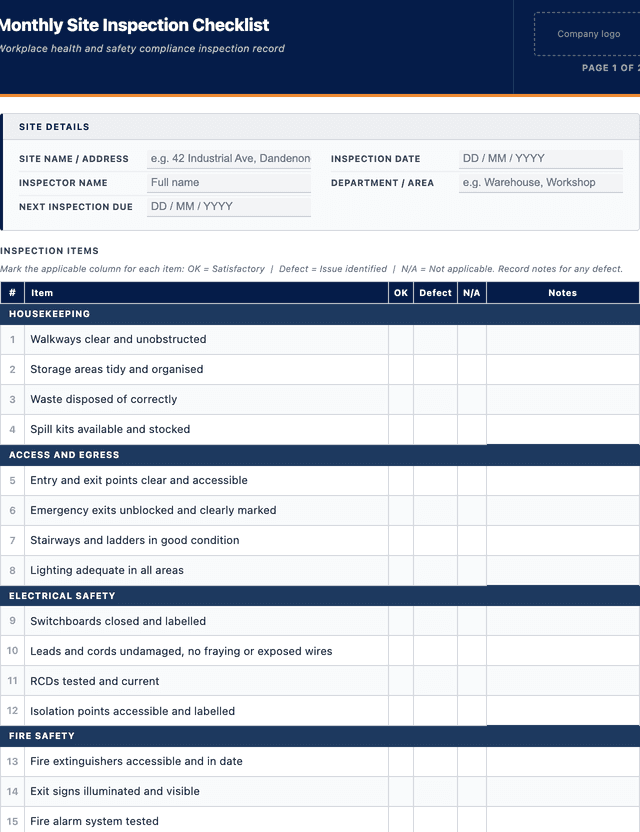
- Housekeeping: walkways clear and unobstructed, storage areas tidy, waste disposed of correctly, spill kits available and stocked.
- Access and egress: entry and exit points clear, emergency exits unblocked and marked, stairways and ladders in good condition, adequate lighting.
- Electrical safety: switchboards closed and labelled, leads and cords undamaged, RCDs tested and current, isolation points accessible.
- Fire safety: extinguishers accessible and in date, exit signs illuminated, alarm system tested, evacuation plan posted and current.
- PPE compliance: required PPE available and in serviceable condition, safety signage visible and correct, restricted areas clearly marked, safety data sheets accessible.
- Signage: hazard warnings displayed, mandatory PPE signs posted, speed limits and traffic management signs in place.
- Welfare facilities: amenities clean and functional, drinking water available, first aid kit stocked and accessible, shade or shelter provided where required.
- Environmental: dust control measures in place, noise management controls working, waste segregation followed, chemical storage compliant.
- Plant and equipment: guards in place and secured, pre-start checks completed, maintenance current and recorded, isolations secure.
- First aid: first aid officer on site, kit contents checked and replenished, emergency contacts displayed.
How to use this monthly site inspection checklist
- Complete the site details at the top of the checklist, including the site name, address, inspection date, inspector name and the department or area being inspected.: Record the site name, physical address, the date and time of the inspection, your full name and role, and the specific area or department you are inspecting. If the site is large, note which zone or building this inspection covers.
- Walk through the site systematically, following the checklist sections in order. Mark each item as OK, Defect or N/A. Add notes for any item marked as a defect.: Start at the site entry and work through each section: housekeeping, access and egress, electrical safety, fire safety, PPE compliance, signage, welfare facilities, environmental controls, plant and equipment, and first aid. Physically inspect each area rather than assessing from a distance.
- For each defect identified, record the corrective action required, the responsible person, and the due date in the corrective actions table.: Be specific about what needs to be done, who is responsible for doing it and when it must be completed. High-risk defects (blocked emergency exits, faulty RCDs, missing fire extinguishers) should have immediate due dates. Lower-risk items can be scheduled within the month.
- Assess the overall site condition and mark the appropriate outcome: Satisfactory, Requires Attention, or Unsatisfactory.: Base the overall assessment on the number and severity of defects found. A site with critical defects should be marked Unsatisfactory even if most items pass. An Unsatisfactory rating should trigger an escalation to site management for immediate attention.
- Add any general comments or observations in the comments section, noting anything that does not fit a specific checklist item.: Use this section to note positive observations (well-maintained areas, good housekeeping practices) as well as concerns that do not have a specific checklist item. Positive feedback reinforces good behaviour and balances the inspection findings.
- Sign and date the inspection. Have the site manager review and countersign to acknowledge the findings and commit to follow-up on corrective actions.: Your signature confirms the inspection was conducted honestly and thoroughly. The site manager countersignature acknowledges the findings and commits to ensuring corrective actions are completed by their due dates. File the completed inspection for audit records.
In MapTrack, you can digitise safety inspections and compliance forms. Each submission is stored as a timestamped PDF against the asset record.
Get the free templateEnter your email above to download the full monthly site inspection checklist as a PDF.Back to download formHow often should you complete this checklist?
Most organisations complete a formal site inspection monthly. On higher-risk sites such as construction, mining or manufacturing, weekly or fortnightly inspections may be required by your safety management plan. Some client contracts or principal contractor requirements specify a minimum inspection frequency. In addition to monthly inspections, daily pre-start checks, toolbox talks and hazard observations should be used to monitor conditions between formal inspections. When in doubt, inspect more frequently and adjust as your site risk profile changes. The WHS Act requires the PCBU to monitor the workplace to ensure health and safety is maintained. A documented monthly inspection program is one of the most practical ways to demonstrate this ongoing duty and to identify emerging risks before they cause incidents.
Frequently asked questions
Applicable regulatory standards
This template is a starting point. Check the current requirements that apply to your equipment, work and location. The template alone does not establish compliance.
- WHS Act 2011
- WHS Regulations - Chapter 3 General risk and workplace management
- Safe Work Australia - Code of Practice: How to Manage Work Health and Safety Risks
Monthly site inspection checklist preview
The numbers behind this monthly site inspection checklist
Every figure below is sourced and dated, so you can quote it in a toolbox talk, a budget case or a board paper without having to chase the original report.
Embed this free template on your website
Run an industry blog, trade association site, or training resource? Drop a preview of this free monthly site inspection checklist straight into your page. The snippet is self-contained, needs no scripts, and links readers back to the full free template.
<div style="max-width:480px;font-family:system-ui,-apple-system,'Segoe UI',Roboto,sans-serif;border:1px solid #E5E7EB;border-radius:12px;padding:20px;background:#ffffff;">
  <p style="font-size:12px;font-weight:700;letter-spacing:0.05em;text-transform:uppercase;color:#071D49;margin:0;">Free template</p>
  <p style="font-size:18px;font-weight:700;color:#071D49;margin:6px 0 0;">Monthly site inspection checklist</p>
  <ul style="margin:12px 0 0;padding-left:18px;color:#374151;font-size:14px;line-height:1.6;">
    <li style="margin:4px 0;">Housekeeping: walkways clear and unobstructed, storage areas tidy, waste disposed of correctly, spill kits available and stocked.</li>
    <li style="margin:4px 0;">Access and egress: entry and exit points clear, emergency exits unblocked and marked, stairways and ladders in good condition, adequate lighting.</li>
    <li style="margin:4px 0;">Electrical safety: switchboards closed and labelled, leads and cords undamaged, RCDs tested and current, isolation points accessible.</li>
    <li style="margin:4px 0;">Fire safety: extinguishers accessible and in date, exit signs illuminated, alarm system tested, evacuation plan posted and current.</li>
    <li style="margin:4px 0;">PPE compliance: required PPE available and in serviceable condition, safety signage visible and correct, restricted areas clearly marked, safety data sheets accessible.</li>
    <li style="margin:4px 0;">Signage: hazard warnings displayed, mandatory PPE signs posted, speed limits and traffic management signs in place.</li>
  </ul>
  <p style="font-size:13px;color:#6B7280;margin:14px 0 0;padding-top:12px;border-top:1px solid #E5E7EB;">Free <a href="https://www.maptrack.com/templates/monthly-site-inspection-checklist" style="color:#071D49;font-weight:600;text-decoration:none;">Monthly site inspection checklist</a> by MapTrack</p>
</div>Free to reuse, including commercially. This template is published under a Creative Commons Attribution 4.0 licence. Copy it, adapt it, put it on your own site or in your own docs. All we ask is that you credit MapTrack with a link back to this page. The snippet above already includes that credit, so if you use it as-is you’re covered.
Cite this template
Writing about this topic? You’re welcome to quote this checklist. Here’s the wording to use so your readers can find the original.
The MapTrack monthly site inspection checklist contains 32 checks across 8 sections.
- Short attribution
- MapTrack Monthly site inspection checklist, https://www.maptrack.com/templates/monthly-site-inspection-checklist
- Reference list
- MapTrack. (2026). Monthly site inspection checklist [Checklist template]. Retrieved from https://www.maptrack.com/templates/monthly-site-inspection-checklist
Free to reuse with credit under a Creative Commons Attribution 4.0 licence. If you’d rather link straight to it, the page is https://www.maptrack.com/templates/monthly-site-inspection-checklist.
Need to digitise safety inspections and compliance forms?
Register every asset in MapTrack, attach digital forms, and get a complete history of every inspection, service and compliance record.
Compliance and inspections · All templates · Pricing · Book a demo