
Free equipment inventory template
Free equipment inventory template (PDF and editable Excel). Log plant with make, model, serial, location, service dates and condition. Download free.
Updated 12 Aug 2026
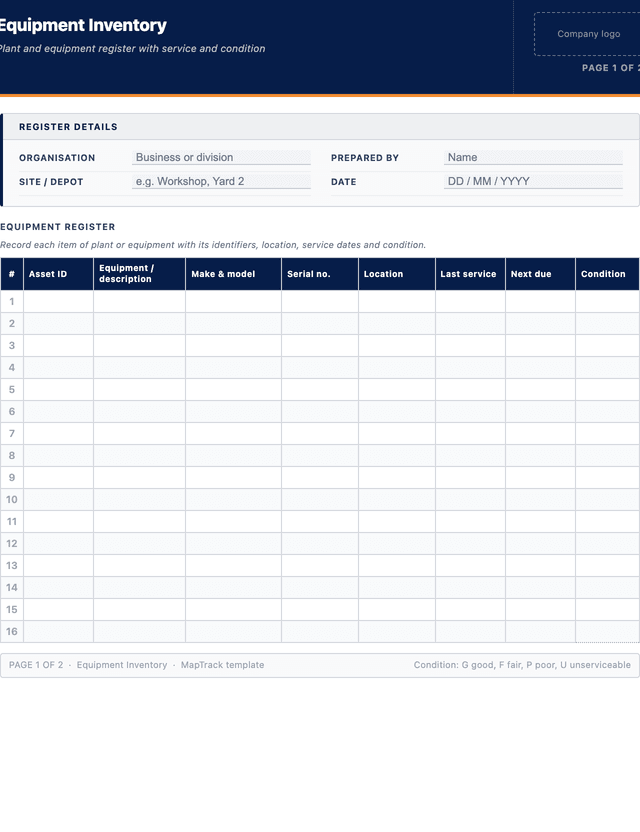
Equipment Inventory
Record each item of plant or equipment with its identifiers, location, service dates and condition.
| # | Asset ID | Equipment / description | Make & model | Serial no. | Location | Last service | Next due | Condition |
|---|---|---|---|---|---|---|---|---|
| e.g. | EXC-102 | Excavator - 8 tonne | CAT 308 | CAT30877412 | Depot A | 10/09/2026 | 10/09/2026 | G |
| 1 | ||||||||
| 2 | ||||||||
| 3 | ||||||||
| 4 | ||||||||
| 5 |
The PDF includes all 28 numbered rows, ready to print or fill on screen.
Completed by
Signature
Print name
Date
Reviewed by
Signature
Print name
Date
How to use: download the PDF, print or complete digitally on any device.
- PDF format, ready to print or fill on screen
- Use as-is or customise to suit your operation
- Go digital in MapTrack for photos, reminders and audit trails
Download formats
- Equipment inventory template PDF
PDF: Print-ready inventory: one row per machine with asset ID, make, model, serial number, location, last and next service, and condition.
- Equipment inventory template XLSX
XLSX: Editable Excel workbook with the same columns, ready to sort and filter by location, condition or next service due.
Two ways to use it
Use in MapTrack →Use it digitally instead
Unlimited usersUpload this PDF and MapTrack drafts the form for you.




- Scan the asset’s QR tag with any phone
- Submitted forms can trigger alerts
- Photos on fails, audit-ready records
- Export responses, PDF reports with your logo
Free trial. No credit card needed.
Trusted by teams across Australia and New Zealand
We respect your privacy. Unsubscribe anytime.
These templates are free general guides provided as-is. They do not constitute legal, safety or compliance advice. You are responsible for ensuring any form meets your specific workplace obligations, industry standards and applicable regulations.
Don't just download it - use it live. Start a free workspace, upload this equipment inventory template and MapTrack drafts it as a form your crew can run from a phone.

Co-Founder & Commercial Director
Key takeaways
- The MapTrack equipment inventory template has 8 columns and room for 28 entries. Columns: Asset ID, Equipment / description, Make & model, Serial no., Location, Last service, Next due, Condition.
- An equipment inventory lists each item of plant and equipment with its make, model, serial number, location, service dates and condition.
- Download it as a PDF, or as an editable Excel (XLSX) workbook you can sort and filter by location or service date.
- Recording the next service due date against each item turns the inventory into a simple preventive maintenance prompt.
- Serial numbers and asset IDs are what link an item of equipment to its warranty, service history and any theft report.
- For registrable plant, the inventory should also note registration and inspection status to support WHS compliance.
Enter your email below to download this equipment inventory template as a ready-to-use PDF.
Used by construction, mining and field service teams











What is an equipment inventory template?
An equipment inventory template is a register for recording every item of plant, machinery and powered equipment an organisation owns or hires, together with the detail needed to maintain and account for it. For each item it captures an asset ID, a description, the make and model, the serial number, the current location, the last and next service dates and the condition. It is the working list a maintenance team, workshop or site manager uses to know exactly what equipment exists, where it is and whether it is due for service.
Unlike a general asset inventory that covers all asset types, an equipment inventory focuses on plant and machinery, so it carries the maintenance and compliance detail that lighter assets do not need. Construction, mining, manufacturing, facilities and hire businesses rely on it to plan servicing, avoid running equipment past its service interval and prove that registrable plant has been inspected. In MapTrack, the equipment inventory is a live record: each machine has its own profile with a service schedule, meter readings and document history, and the next service due date triggers a reminder automatically rather than sitting unread in a spreadsheet.
Learn more about asset tracking in MapTrack.
Benefits of using this equipment inventory template
- Complete equipment list: every machine and powered tool recorded with the identifiers a maintenance team actually needs.
- Service visibility: last and next service dates against each item turn the register into a preventive maintenance prompt.
- Warranty and history: serial numbers link each item to its warranty, service records and any insurance or theft claim.
- Compliance support: registration and inspection status can be tracked alongside each item of registrable plant.
- Utilisation insight: location and status show idle equipment that could be redeployed instead of hired or bought.
- Audit and handover ready: a structured equipment register speeds up audits, site handovers and end-of-hire reconciliations.
- Less unplanned downtime: acting on next-service dates and meter readings catches due servicing before a machine fails on the job.
Benefits of digitising forms in MapTrack
When you move your asset registers from paper to MapTrack, you get:
- Field users can easily scan a QR code to complete a form on mobile. Unlimited users.
- Email the right people when a form is submitted, with an automation you set up.
- File every completed form against the asset, location or person it covers.
- Download any completed form as a PDF, with failed answers listed at the top.
- Fill in forms offline; they upload when the device is back online.
- Build conditional logic (show or hide questions based on answers).
- Take pictures or attach photos. Not possible with a paper-based form.
- Electronic signatures.
- Edit forms later without reprinting.
- Set who can view, fill in or edit forms with user roles.
- Upload a paper form (PDF, Word, Excel or a photo) and MapTrack's AI builds a digital version for you to check.
- Keep one asset register with each asset's location, condition and custody history.
- Schedule calibration and record certification and warranty expiry dates against each asset.
- See each asset's value over time in the Asset Depreciation report.
Book a demo to see how MapTrack handles asset registers.
Try MapTrack free for 30 days
Full access to every feature. No credit card required. Per-asset pricing so you scale as your fleet grows.
- No credit card required
- 30 days free trial
- Cancel anytime
1-2 days/week saved
“Bloody amazing! We used to spend 1-2 days a week tracking and managing our generators alone.”

Steve McAllister
Asset Coordinator, Saunders International
What to include in an equipment inventory template
This equipment inventory template covers 10 key areas:
- Register details: organisation, prepared by, site or depot, and the date.
- Asset ID: the internal tag or fleet number for each item of equipment.
- Equipment description: a clear name for the machine or powered tool.
- Make and model: manufacturer and model designation.
- Serial number: the manufacturer serial or VIN, used for warranty and theft reports.
- Location: the site, workshop, vehicle or store where the item is held.
- Service dates: the last service completed and the next service due.
- Condition: a rating such as good, fair, poor or unserviceable.
- Status: in use, available, on hire, in for repair or retired.
- Notes: hours or meter reading, registration or inspection status, and any defects.
How to use this equipment inventory template
- List every item of plant and equipment within the scope you are inventorying.: Decide whether the inventory covers a single site, a workshop or the whole fleet, then record each machine and powered tool. Include hired plant if you are responsible for it on site, and flag it so on-hire items are not confused with owned assets.
- Record the identifiers for each item: asset ID, make, model and serial number.: Capture the internal asset or fleet number along with the manufacturer make, model and serial number. These identifiers are what link the machine to its warranty, service history and any future insurance or theft report, so record them accurately from the data plate.
- Note the current location, holder and operating status of each machine.: Record where the equipment is right now, who is responsible for it and whether it is in use, available, on hire, in for repair or retired. Add the current hours or meter reading where the machine has one to support service planning.
- Capture the service position: last service done and next service due.: Record the date or meter reading of the last service and calculate the next service due from the manufacturer interval. This single step turns a static list into a forward maintenance prompt and highlights any machine that is already overdue.
- Rate condition and record registration or inspection status where it applies.: Assign a condition rating and, for registrable or inspectable plant such as cranes, pressure equipment or elevating work platforms, note the registration number and the date of the last and next statutory inspection so compliance gaps are visible.
- Reconcile, store the register and keep it current as equipment moves and is serviced.: Check the inventory against purchase and hire records, correct discrepancies, then save it as the baseline. Update it whenever equipment is bought, hired off, serviced, repaired or disposed of so the service and location data stays reliable.
In MapTrack, you can manage your full asset register digitally. Each submission is stored as a timestamped PDF against the asset record.
Get the free templateEnter your email above to download the full equipment inventory template as a PDF.Back to download formHow often should you complete this asset register?
Build the equipment inventory once, then keep it live. Review it in full at least annually and before audits, but update individual records continuously as equipment is bought, hired on or off, serviced, repaired or retired. Because the register drives servicing, the next service due date should be checked weekly or monthly against what is actually happening in the workshop. In MapTrack, each machine updates its own service schedule and meter readings automatically, so the inventory and the maintenance plan stay aligned without manual re-entry.
Frequently asked questions
Applicable regulatory standards
This template is a starting point. Check the current requirements that apply to your equipment, work and location. The template alone does not establish compliance.
- WHS Regulations 2011, Chapter 5 - Plant and Structures (duties to maintain and keep records for plant)
- ISO 55001 - Asset Management Systems (systematic management of physical assets)
- AS ISO 55001 - Asset management (Australian adoption of the asset management system standard)
Equipment inventory template preview
The numbers behind this equipment inventory template
Every figure below is sourced and dated, so you can quote it in a toolbox talk, a budget case or a board paper without having to chase the original report.
Embed this free template on your website
Run an industry blog, trade association site, or training resource? Drop a preview of this free equipment inventory template straight into your page. The snippet is self-contained, needs no scripts, and links readers back to the full free template.
<div style="max-width:480px;font-family:system-ui,-apple-system,'Segoe UI',Roboto,sans-serif;border:1px solid #E5E7EB;border-radius:12px;padding:20px;background:#ffffff;">
  <p style="font-size:12px;font-weight:700;letter-spacing:0.05em;text-transform:uppercase;color:#071D49;margin:0;">Free template</p>
  <p style="font-size:18px;font-weight:700;color:#071D49;margin:6px 0 0;">Equipment inventory template</p>
  <ul style="margin:12px 0 0;padding-left:18px;color:#374151;font-size:14px;line-height:1.6;">
    <li style="margin:4px 0;">Register details: organisation, prepared by, site or depot, and the date.</li>
    <li style="margin:4px 0;">Asset ID: the internal tag or fleet number for each item of equipment.</li>
    <li style="margin:4px 0;">Equipment description: a clear name for the machine or powered tool.</li>
    <li style="margin:4px 0;">Make and model: manufacturer and model designation.</li>
    <li style="margin:4px 0;">Serial number: the manufacturer serial or VIN, used for warranty and theft reports.</li>
    <li style="margin:4px 0;">Location: the site, workshop, vehicle or store where the item is held.</li>
  </ul>
  <p style="font-size:13px;color:#6B7280;margin:14px 0 0;padding-top:12px;border-top:1px solid #E5E7EB;">Free <a href="https://www.maptrack.com/templates/equipment-inventory-template" style="color:#071D49;font-weight:600;text-decoration:none;">Equipment inventory template</a> by MapTrack</p>
</div>Free to reuse, including commercially. This template is published under a Creative Commons Attribution 4.0 licence. Copy it, adapt it, put it on your own site or in your own docs. All we ask is that you credit MapTrack with a link back to this page. The snippet above already includes that credit, so if you use it as-is you’re covered.
Cite this template
Writing about this topic? You’re welcome to quote this checklist. Here’s the wording to use so your readers can find the original.
The MapTrack equipment inventory template has 8 columns and room for 28 entries.
- Short attribution
- MapTrack Equipment inventory template, https://www.maptrack.com/templates/equipment-inventory-template
- Reference list
- MapTrack. (2026). Equipment inventory template [Checklist template]. Retrieved from https://www.maptrack.com/templates/equipment-inventory-template
Free to reuse with credit under a Creative Commons Attribution 4.0 licence. If you’d rather link straight to it, the page is https://www.maptrack.com/templates/equipment-inventory-template.
Need to manage your full asset register digitally?
Register every asset in MapTrack, attach digital forms, and get a complete history of every inspection, service and compliance record.